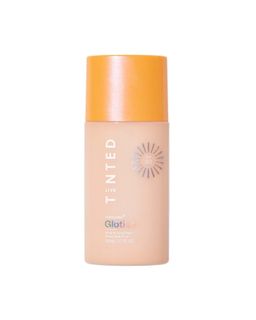
Live Tinted Hueguard Glotion Mineral Sunscreen Broad Spectrum SPF 50
Works for
4 of 4 advertised claims delivered
Sun protectionSPF 50 · 3 UV filtersBroad spectrum
This product offers a good level of protection against both UVB and UVA rays.
This sunscreen uses organic (so-called "chemical") sunscreen filters. Organic, or "chemical" filters usually provide reliable sun protection and rarely leave a white cast. Sunscreens with organic filters can sting eyes.
This product can be considered "reef safe" because it does not contain the UV filters (oxybenzone and octinoxate) that can be harmful to coral reefs when present in the water in high concentrations.
Evens skin toneNo ingredient credited for this claimStrong support
“targets uneven tone for added radiance”
This product offers broad spectrum sun protection. It means that it can prevent hyperpigmentation and help keep the skin tone even (sun damage is the main factor causing age spots, darkening of post-acne marks and other discolorations).
Anti-aging1 ingredient credited for this claimStrong support
“supports collagen”
This product can help prevent early signs of skin aging because it offers a good level of broad spectrum sun protection. Sun damage is the main cause of premature skin aging, and protecting your skin from the sun is the best anti-aging strategy.
Moisturizing9 ingredients credited for this claimGood support
“all-day hydration”
This product can help improve hydration of the skin with the two types of ingredients.
The first type is called “humectants”:
these ingredients help attract water.
When humectants are on the surface of the skin, they “pull in” the moisture from the outside environment, or from
within deeper layers of the skin. The following ingredients in this product do the job:
glycerin, butylene glycol.
This product also contains ingredients called “occlusives”. They help reduce the speed with which our skin loses moisture to the outside environment. These ingredients also help soften the upper layer of the skin, so it feels less tight and nicer to the touch. The following ingredients in this product do the job: caprylic/capric triglyceride, squalane.
Can it cause trouble?
Irritancy8 flagged ingredientsLow risk
ComedogenicClean of flagged comedogenic ingredientsNone flagged
User reviews
Be the first — your take helps the next person decide.
Ingredients
Filter by role to see what each ingredient is doing.
Zinc oxide14%
- Irritation risk
- Low
A broad spectrum sunblock (protects from both UVA and UVB rays). Is suitable for most sensitive skins. In small concentrations, can be used as a colorant
More about Zinc oxideButylene glycol~23–35%
- Irritation risk
- Low
Used to create a nice product texture and help delivery of other ingredients. Might be somewhat helpful in attracting water to the upper layer of the skin
More about Butylene glycolButyloctyl salicylate~5.8–8.7%
- Irritation risk
- Medium
A synthetic ester of salicylic acid that is used to help disperse pigments and boost effectiveness of sunscreen ingredients. It is able to absorb UV light (working as an organic, or chemical filter), but is not approved as a sunscreen ingredient on its own
More about Butyloctyl salicylateCaprylic/capric triglyceride~3.7–5.6%
- Irritation risk
- Medium
A good mix of fatty acids that forms a protective layer on the skin. Improves the shelf life of products. Derived from coconut and glycerin
More about Caprylic/capric triglycerideC12-15 alkyl benzoate~2.8–4.3%
- Irritation risk
- Low
Enhances the product texture and makes it more spreadable. Helps reduce water loss from the outer layer of skin. Extands the shelf life by preventing bacteria growth
More about C12-15 alkyl benzoateC13-15 alkane~2.1–3.1%
C15-19 alkane~1.7–2.6%
- Irritation risk
- Low
Helps soften the upper layer of the skin and create a nice product texture
More about C15-19 alkaneCitric acid~1.5–2.2%
- Irritation risk
- Medium
Can work as an exfoliant but is typically used to adjust the product pH
More about Citric acidClitoria ternatea flower extract~1.3–1.9%
- Irritation risk
- Low
Disteardimonium hectorite~1–1.6%
- Irritation risk
- Low
A type of clay that is used to thicken the product consistency
More about Disteardimonium hectoriteEpilobium fleischeri flower/leaf/stem extract~0.85–1.25%
- Irritation risk
- Low
Ethyl ferulate~0.5–1.15%
- Irritation risk
- Low
Ethylhexylglycerin~0.4–1%
Fragaria ananassa fruit extract~0.35–0.85%
- Irritation risk
- Low
Glycerin~0.35–0.85%
- Irritation risk
- Low
One of the best moisturizing ingredients. Naturally present in skin. It attracts water to the upper layer of the skin working as a humectant
More about GlycerinIron oxides~0.35–0.8%
- Irritation risk
- Low
An umbrella term for the following three colorants: CI 77491, CI 77492, CI 77499. They might be able to offer some protection against visible light, but the degree of the protection is not clear
More about Iron oxidesIsostearic acid~0.4–0.9%
- Irritation risk
- Low
Used to create a nice product texture
More about Isostearic acidLecithin~0.35–0.75%
- Irritation risk
- Low
Used mostly for creating emulsions - helping oil and water mix together. Helps soften the upper layer of the skin
More about LecithinMagnesium sulfate~0.2–0.75%
Mica~0.2–0.7%
- Irritation risk
- Low
Creates an illusion of smoother and more radiant skin tone. Adds shimmer to the skin by reflecting light
More about MicaOctyldodecanol~0.15–0.65%
- Irritation risk
- Low
An emollient that helps to soften the skin and create a pleasant product texture and stabilize the formulation
More about OctyldodecanolPolyglyceryl-3 polyricinoleate~0.15–0.6%
- Irritation risk
- Medium
Helps oil and water mix together
More about Polyglyceryl-3 polyricinoleatePolyglyceryl-4 diisostearate/polyhydroxystearate/sebacate~0.15–0.6%
- Irritation risk
- Medium
Helps water and oil mix together
More about Polyglyceryl-4 diisostearate/polyhydroxystearate/sebacatePolyhydroxystearic acid~0.15–0.55%
- Irritation risk
- Medium
Used to create a thicker product consistency and stabilize the formulation
More about Polyhydroxystearic acidPropanediol~0.15–0.55%
- Irritation risk
- Low
Acts as a solvent for other ingredients. Speeds up the absorption of other ingredients into the skin
More about PropanediolSilica~0.2–0.75%
Sodium benzoate~0.1–0.4%
Squalane~0.15–0.55%
- Irritation risk
- Low
An oil naturally present in skin. Works as an emollient to soften the skin and form a protective layer on its surface without a greasy feeling.
More about SqualaneTin oxide~0.15–0.65%
- Irritation risk
- Low
A colorant that can add a pearl-like appearance to the formulation
More about Tin oxideTitanium dioxide~0.15–0.55%
- Irritation risk
- Low
Works as a UV filter when used in high concentrations. It is photostable and is effective mostly against the UVB light, with some protection in the UVA range. In small concentrations, used for its ability to improve the color of cosmetic products. Is usually well tolerated by the skin
More about Titanium dioxideTocopherol~0.1–0.35%
- Irritation risk
- Low
Pure form of vitamin E. Can help moisturise and protect the skin from free radicals. Often used to help stabilise other ingredients or the formula itself
More about TocopherolVitis vinifera leaf extract~0.05–0.25%
- Irritation risk
- Medium
Water~0.05–0.2%
Zinc stearate~0.05–0.2%
- Irritation risk
- Low
Ingredient list view
Zinc oxide, Butylene glycol, Butyloctyl salicylate, Caprylic/capric triglyceride, C12-15 alkyl benzoate, C13-15 alkane, C15-19 alkane, Citric acid, Clitoria ternatea flower extract, Disteardimonium hectorite, Epilobium fleischeri flower/leaf/stem extract, Ethyl ferulate, Ethylhexylglycerin, Fragaria ananassa fruit extract, Glycerin, Iron oxides, Isostearic acid, Lecithin, Magnesium sulfate, Mica, Octyldodecanol, Polyglyceryl-3 polyricinoleate, Polyglyceryl-4 diisostearate/polyhydroxystearate/sebacate, Polyhydroxystearic acid, Propanediol, Silica, Sodium benzoate, Squalane, Tin oxide, Titanium dioxide, Tocopherol, Vitis vinifera leaf extract, Water, Zinc stearate
Compare prices
Retailers ranked by price — lowest first.

Sources cited in this review
Every concentration estimate and effectiveness label is anchored to one of these 11 studies and safety reviews.
- 1A review of inorganic UV filters zinc oxide and titanium dioxideonlinelibrary.wiley.com
- 2
- 3
- 4
- 5
- 6

Affiliate links · As an Amazon Associate, WIMJ earns from qualifying purchases.