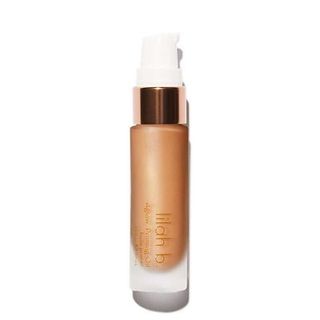
lilah b. Mini Aglow Golden Priming Oil
Works for
1 of 2 advertised claims delivered
MoisturizingSimmondsia chinensis seed oil, Caprylic/capric triglyceride + 9 moreGood evidence
“What it is: A nutrient-rich serum, moisturizer, and illuminating primer that can be worn alone for a golden glow or under makeup for longer wear.”
This product can help soften the skin and reduce its moisture loss with emollients and occlusives: caprylic/capric triglyceride, dimethicone.
Keep in mind that this product does not contain effective ingredients to attract water to the upper layer of the skin. This is why an additional product with humectants like glycerin or hyaluronic acid can be helpful (apply it before this product for the best results).
Evens skin toneCamellia sinensis leaf extractWeak evidence
“- Purple Tea Extract: Improves the look of skin tone.”
Effective ingredients missing or their concentration is too low
Anti-oxidationNot advertised by the brand · Tocopherol, Camellia sinensis leaf extract + 3 moreStrong evidence
This product contains antioxidants (tocopherol) that can help neutralize free radicals in skin. By doing so, they can lessen the damage the skin gets from the UV light (sun).
The following ingredients - camellia sinensis leaf extract also can have an antioxidant effect, but there is less evidence to confirm their effectiveness in skin.
Anti-agingNot advertised by the brand · Tocopherol, Camellia sinensis leaf extract + 1 moreModerate evidence
This product contains tocopherol. This ingredient help neutralize free radicals in skin. By doing so, they might be able to prevent early signs of aging (like fine lines and wrinkles), at least to some extent. These ingredients will not be able to "reverse" signs of aging.
Can it cause trouble?
Irritancy2 strong irritants: Rosa damascena flower water, Lavandula angustifolia oilMedium risk
ComedogenicClean of flagged comedogenic ingredientsNone flagged
User reviews
Be the first — your take helps the next person decide.
Ingredients
Filter by role to see what each ingredient is doing.
Prunus amygdalus dulcis oil~25–38%
- Irritation risk
- Low
An emollient that softens the skin
More about Prunus amygdalus dulcis oilRosa damascena flower water~7.8–11.7%
- Irritation risk
- High
Used to add a nice rose smell to the product. Might help attract water to the upper layer of the skin and have some anti-oxidant effect. Can be irritating
More about Rosa damascena flower waterMica~5–7.5%
- Irritation risk
- Low
Creates an illusion of smoother and more radiant skin tone. Adds shimmer to the skin by reflecting light
More about MicaPolyglyceryl-4 oleate~3.7–5.5%
- Irritation risk
- Medium
Helps oil and water mix together
More about Polyglyceryl-4 oleateTocopherol~2.6–3.9%
- Irritation risk
- Low
Pure form of vitamin E. Can help moisturise and protect the skin from free radicals. Often used to help stabilise other ingredients or the formula itself
More about TocopherolPentylene glycol~2.2–3.3%
- Irritation risk
- Medium
Used to preserve products, dissolve other ingredients and create a nice product texture
More about Pentylene glycolPolyglyceryl-6 oleate~1.7–2.5%
Polyhydroxystearic acid~1.4–2.1%
- Irritation risk
- Medium
Used to create a thicker product consistency and stabilize the formulation
More about Polyhydroxystearic acidQuaternium-90 bentonite~1.2–1.8%
- Irritation risk
- Low
Caprylic/capric triglyceride~1.1–1.6%
- Irritation risk
- Medium
A good mix of fatty acids that forms a protective layer on the skin. Improves the shelf life of products. Derived from coconut and glycerin
More about Caprylic/capric triglycerideCalophyllum inophyllum seed oil~0.9–1.35%
- Irritation risk
- Low
Simmondsia chinensis seed oil~0.6–1.35%
- Irritation risk
- Medium
Softens the upper layer of skin and helps restore the healthy skin barrier. Has shown to help calm down inflammation in skin. It is a stable oil, meaning that it retains its properties even when exposed to air.
More about Simmondsia chinensis seed oilSodium chloride~0.5–1.2%
- Irritation risk
- Low
Used to stabilize mixtures of oil and water, and create thicker, gel-like product textures
More about Sodium chlorideUndecane~0.5–1.15%
- Irritation risk
- Medium
Helps create a non-greasy finish on the skin
More about UndecaneWater~0.4–1%
Lavandula angustifolia oil~0.4–1%
- Irritation risk
- High
An essential oil. Potential allergen and can be irritating. It has some anti-bacterial properties
More about Lavandula angustifolia oilButylene glycol~0.4–0.95%
- Irritation risk
- Low
Used to create a nice product texture and help delivery of other ingredients. Might be somewhat helpful in attracting water to the upper layer of the skin
More about Butylene glycolTridecane~0.35–0.85%
Phenoxyethanol~0.35–0.85%
- Irritation risk
- Low
A preservative. It helps prevent bacterial growth in cosmetic products
More about PhenoxyethanolVitis vinifera fruit extract~0.3–0.75%
- Irritation risk
- Medium
A plant extract that helps attract water to the upper layer of the skin. It might be helpful in neutralizing free radicals in skin, but is less potent than the extract from the seeds
More about Vitis vinifera fruit extractDimethicone~0.35–0.85%
- Irritation risk
- Low
A silicone that helps to reduce water loss from the surface of the skin. Can temporarily "fill in" lines and wrinkles, absorb oil, and create a nice product finish
More about DimethiconeAluminum hydroxide~0.35–0.85%
- Irritation risk
- Low
Is used to add opaque (non-transparent) appearance to formulations. Can be used to coat other ingredients for even dispersion. This is a different ingredient compared to the ones used in antipersperants (aluminium chloride and aluminium chlorohydrate)
More about Aluminum hydroxideMaltodextrin~0.35–0.85%
- Irritation risk
- Low
Used to stabilize the product formulation and can help absorb oil
More about MaltodextrinCamellia sinensis leaf extract~0.15–0.65%
- Irritation risk
- Low
Can contain potent anti-oxidant compounds (abbreviated ECG, GCG, EGC, and EGCG) that might help protect the skin from free radicals. Can help calm down inflammation and has some anti-bacterial properties. Unfortunately, these antioxidants are unstable and lose their effectiveness very quickly in products. The concentration of the antioxidant compounds in the extract also tends to be low to be effective in topical formulation
More about Camellia sinensis leaf extractCamellia sinensis leaf powder~0.15–0.5%
- Irritation risk
- Low
Citric acid~0.1–0.5%
- Irritation risk
- Medium
Can work as an exfoliant but is typically used to adjust the product pH
More about Citric acidTocopherol~0.1–0.45%
- Irritation risk
- Low
Pure form of vitamin E. Can help moisturise and protect the skin from free radicals. Often used to help stabilise other ingredients or the formula itself
More about TocopherolIron oxides~0.1–0.35%
- Irritation risk
- Low
An umbrella term for the following three colorants: CI 77491, CI 77492, CI 77499. They might be able to offer some protection against visible light, but the degree of the protection is not clear
More about Iron oxidesTitanium dioxide~0.1–0.45%
- Irritation risk
- Low
Works as a UV filter when used in high concentrations. It is photostable and is effective mostly against the UVB light, with some protection in the UVA range. In small concentrations, used for its ability to improve the color of cosmetic products. Is usually well tolerated by the skin
More about Titanium dioxideIngredient list view
Prunus amygdalus dulcis oil, Rosa damascena flower water, Mica, Polyglyceryl-4 oleate, Tocopherol, Pentylene glycol, Polyglyceryl-6 oleate, Polyhydroxystearic acid, Quaternium-90 bentonite, Caprylic/capric triglyceride, Calophyllum inophyllum seed oil, Simmondsia chinensis seed oil, Sodium chloride, Undecane, Water, Lavandula angustifolia oil, Butylene glycol, Tridecane, Phenoxyethanol, Vitis vinifera fruit extract, Dimethicone, Aluminum hydroxide, Maltodextrin, Camellia sinensis leaf extract, Camellia sinensis leaf powder, Citric acid, Tocopherol, Iron oxides, Titanium dioxide
Compare prices
Retailers ranked by price — lowest first.

Sources cited in this review
Every concentration estimate and effectiveness label is anchored to one of these 8 studies and safety reviews.
- 1
- 2
- 3Vitamin E in dermatologyncbi.nlm.nih.gov
- 4Vitamin E and Skin Healthlpi.oregonstate.edu
- 5
- 6

Affiliate links · As an Amazon Associate, WIMJ earns from qualifying purchases.