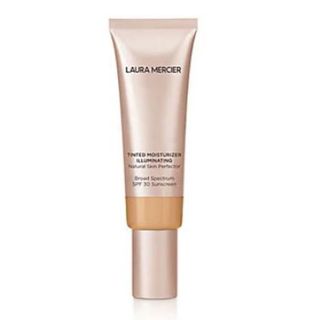
Laura Mercier Tinted Moisturizer Illuminating Natural Skin Perfector
Works for
1 of 2 advertised claims delivered
Moisturizing17 ingredients credited for this claimGood support
“Tinted Moisturizer Illuminating Natural Skin Perfector”
This product can help improve hydration of the skin with the two types of ingredients.
The first type is called “humectants”:
these ingredients help attract water.
When humectants are on the surface of the skin, they “pull in” the moisture from the outside environment, or from
within deeper layers of the skin. The following ingredients in this product do the job:
glycerin, saccharide isomerate.
This product also contains ingredients called “occlusives”. They help reduce the speed with which our skin loses moisture to the outside environment. These ingredients also help soften the upper layer of the skin, so it feels less tight and nicer to the touch. The following ingredients in this product do the job: dimethicone, phenyl trimethicone.
Evens skin tone2 ingredients credited for this claimLimited support
“Our luminous shades are formulated with a blend of finely milled pearls, to reveal more even-toned skin with lasting luminosity.”
This product contains ingredients (glycyrrhiza glabra root extract) that could help reduce hyperpigmentation (for example, post-acne marks or age spots) in theory, but there is not enough evidence that they actually work.
Can it cause trouble?
Irritancy1 strong irritant: Benzophenone-3Medium risk
Comedogenic2 ingredients rated 2 or more on the 0–5 pore-clogging scale2 flagged
User reviews
Be the first — your take helps the next person decide.
Ingredients
Filter by role to see what each ingredient is doing.
Butyl methoxydibenzoylmethane2.5%
- Irritation risk
- Medium
Avobenzone. An organic, or so-called "chemical" UV filter. Protects against both UVA and UVB rays. Needs to be combined with other filters in a formulation to be stable.
More about Butyl methoxydibenzoylmethaneEthylhexyl methoxycinnamate7.49%
- Irritation risk
- High
Octinoxate. When used in higher concentrations, works as a sunscreen protecting the skin from UVB rays. When used in lower concentration, helps to preserve the product formulation. Is shown to be harmful to coral reefs - consider avoiding bathing in coral reef areas when wearing a product with this ingredient. It can be irritating
More about Ethylhexyl methoxycinnamateOctocrylene2%
- Irritation risk
- Medium
A weak sunscreen that protects against the sun rays that cause sunburn (UVB) and is somewhat effective against the UVA rays. It is quite stable and can help stabilize other, more vulnerable, sunscreen ingredients like Avobenzone. It is an organic, or so called "chemical" sunscreen
More about OctocryleneBenzophenone-31%
- Irritation risk
- High
Same as oxybenzone. Protects in the UVB and short UVA range. In small concentrations, used to stabilize product formulation. Can be irritating. Is shown to be harmful to coral reefs - consider avoiding bathing in coral reef areas when wearing a product with this ingredient. It can penetrate the skin and get absorbed into bloodstream faster than other popular filters available in the US. The study that produced this finding did not address any potential health effects of the absorption
More about Benzophenone-3Water~45–55%
Butylene glycol~6–7.3%
- Irritation risk
- Low
Used to create a nice product texture and help delivery of other ingredients. Might be somewhat helpful in attracting water to the upper layer of the skin
More about Butylene glycolGlycerin~5.3–6.4%
- Irritation risk
- Low
One of the best moisturizing ingredients. Naturally present in skin. It attracts water to the upper layer of the skin working as a humectant
More about GlycerinMica~4.2–5.1%
- Irritation risk
- Low
Creates an illusion of smoother and more radiant skin tone. Adds shimmer to the skin by reflecting light
More about MicaDimethicone~3.5–4.2%
- Irritation risk
- Low
A silicone that helps to reduce water loss from the surface of the skin. Can temporarily "fill in" lines and wrinkles, absorb oil, and create a nice product finish
More about DimethiconePeg/ppg-14/7 dimethyl ether~2.4–3%
- Irritation risk
- Low
An emollient that helps soften the skin. It also forms a protective on its surface to reduce water loss
More about Peg/ppg-14/7 dimethyl etherHydrogenated polydecene~1.8–2.1%
- Irritation risk
- Low
Helps to soften the upper layer of the skin and create a nice product texture
More about Hydrogenated polydecenePeg-5 glyceryl stearate~1.4–1.8%
- Irritation risk
- Medium
Helps oil and water mix together
More about Peg-5 glyceryl stearateIsododecane~1.4–1.8%
- Irritation risk
- Low
An emollient that helps soften the skin and can decrease moisture loss. Helps create a nice product texture
More about IsododecaneTrehalose~1–1.2%
- Irritation risk
- Low
A sugar that attracts water to the upper layer of the skin
More about TrehalosePhenyl trimethicone~0.75–1.15%
- Irritation risk
- Low
A type of silicone that can decrease loss of moisture from the skin surface. It helps create a nice product texture
More about Phenyl trimethiconeButyrospermum parkii butter~0.7–1.05%
- Irritation risk
- Low
- Comedogenicity
- 3/5
A great moisturising ingredient that softens the skin and reduces water loss from its upper layer. It also can be helpful in protecting skin from free radicals
More about Butyrospermum parkii butterGlycyrrhiza glabra root extract~0.45–0.7%
- Irritation risk
- Medium
A plant extract that can help lighten the skin and calm down inflammation. Might be helpful in neutralizing free radicals
More about Glycyrrhiza glabra root extractAscophyllum nodosum extract~0.5–0.75%
- Irritation risk
- Low
Brown seaweed extract. Can help attract water to the upper layer of the skin and might have some antioxidant effect
More about Ascophyllum nodosum extractTocopherol~0.5–0.7%
- Irritation risk
- Low
Pure form of vitamin E. Can help moisturise and protect the skin from free radicals. Often used to help stabilise other ingredients or the formula itself
More about TocopherolAscorbyl glucoside~0.45–0.7%
- Irritation risk
- Medium
A vitamin C derivative that is more stable but less potent than pure form of vitamin C. Has a potential to boost collagen production, nutralise free radicals and reduce hyperpigmentation, but the required concentration is likely to be much higher than for the pure form of vitamin C, limiting the ingredient's effectiveness in products
More about Ascorbyl glucosideSaccharide isomerate~0.45–0.65%
- Irritation risk
- Low
Helps attract water to the upper layer of the skin
More about Saccharide isomerateIsostearic acid~0.5–0.75%
- Irritation risk
- Low
Used to create a nice product texture
More about Isostearic acidSilica~0.55–0.8%
Glyceryl stearate se~0.35–0.6%
- Irritation risk
- Low
- Comedogenicity
- 2/5
Used to stabilize the product formulations and works as an emollient
More about Glyceryl stearate sePolysilicone-11~0.45–0.7%
- Irritation risk
- Low
A silicone that forms a light film on the skin surface helping to bind water and temporarily absorb oils creating a matt and powdery feel
More about Polysilicone-11Behenyl alcohol~0.45–0.65%
- Irritation risk
- Low
Non-drying alcohol that helps water and oil mix together. Also serves as an emollient
More about Behenyl alcoholBehenic acid~0.45–0.65%
Stearic acid~0.45–0.7%
- Irritation risk
- Low
Helps oil and water mix together and works as an emollient
More about Stearic acidBatyl alcohol~0.35–0.65%
- Irritation risk
- Low
Non-drying alcohol. Used to stabilize other ingredients and is an emollient
More about Batyl alcoholHydroxypropyl methylcellulose stearoxy ether~0.3–0.5%
- Irritation risk
- Low
Helps create a thicker product formulation
More about Hydroxypropyl methylcellulose stearoxy etherPeg-30 phytosterol~0.3–0.6%
Sodium metaphosphate~0.3–0.6%
Carbomer~0.3–0.55%
- Irritation risk
- Low
Helps create a thicker or gel-like product texture. It is not a surfactant but can be used in gentle cleansing formulations
More about CarbomerPolyacrylate crosspolymer-6~0.3–0.55%
- Irritation risk
- Low
Potassium hydroxide~0.3–0.55%
Citric acid~0.3–0.55%
- Irritation risk
- Medium
Can work as an exfoliant but is typically used to adjust the product pH
More about Citric acidSodium citrate~0.3–0.55%
- Irritation risk
- Medium
Helps to control the skin's pH level. Maintains the skin's natural film of amino-lactic acids and oils. Helps to preserve products
More about Sodium citrateT-butyl alcohol~0.25–0.5%
- Irritation risk
- Medium
Used to dissolve other ingredients and to improve smell of products. It could be irritating
More about T-butyl alcoholDisodium edta~0.25–0.5%
Bht~0.25–0.45%
Phenoxyethanol~0.2–0.4%
- Irritation risk
- Low
A preservative. It helps prevent bacterial growth in cosmetic products
More about PhenoxyethanolPotassium sorbate~0.25–0.4%
Titanium dioxide~0.2–0.35%
- Irritation risk
- Low
Works as a UV filter when used in high concentrations. It is photostable and is effective mostly against the UVB light, with some protection in the UVA range. In small concentrations, used for its ability to improve the color of cosmetic products. Is usually well tolerated by the skin
More about Titanium dioxideCi 75470~0.15–0.3%
Iron oxides~0.2–0.35%
- Irritation risk
- Low
An umbrella term for the following three colorants: CI 77491, CI 77492, CI 77499. They might be able to offer some protection against visible light, but the degree of the protection is not clear
More about Iron oxidesIngredient list view
Butyl methoxydibenzoylmethane, Ethylhexyl methoxycinnamate, Octocrylene, Benzophenone-3, Water, Butylene glycol, Glycerin, Mica, Dimethicone, Peg/ppg-14/7 dimethyl ether, Hydrogenated polydecene, Peg-5 glyceryl stearate, Isododecane, Trehalose, Phenyl trimethicone, Butyrospermum parkii butter, Glycyrrhiza glabra root extract, Ascophyllum nodosum extract, Tocopherol, Ascorbyl glucoside, Saccharide isomerate, Isostearic acid, Silica, Glyceryl stearate se, Polysilicone-11, Behenyl alcohol, Behenic acid, Stearic acid, Batyl alcohol, Hydroxypropyl methylcellulose stearoxy ether, Peg-30 phytosterol, Sodium metaphosphate, Carbomer, Polyacrylate crosspolymer-6, Potassium hydroxide, Citric acid, Sodium citrate, T-butyl alcohol, Disodium edta, Bht, Phenoxyethanol, Potassium sorbate, Titanium dioxide, Ci 75470, Iron oxides
Compare prices
Retailers ranked by price — lowest first.
Affiliate links · prices updated regularly · As an Amazon Associate, WIMJ earns from qualifying purchases.
Sources cited in this review
Every concentration estimate and effectiveness label is anchored to one of these 13 studies and safety reviews.
- 1
- 2
- 3On Photostability of Oxybenzonecore.ac.uk
- 4
- 5
- 6Final Report on the Safety Assessment of Dimethicone Copolyoljournals.sagepub.com

Affiliate links · As an Amazon Associate, WIMJ earns from qualifying purchases.