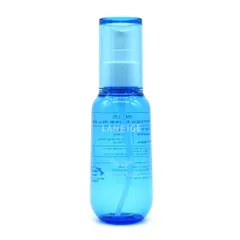
Works for:
based on ingredients and %- Moisturizing
Can it cause trouble?
- Irritation risk: medium
- Comedogenic risk ingredients: 0
Key actives
Product Summary
"LANEIGE - Water Bank Hydro Mist" could be helpful for: Moisturizing, but its actives are not the most effective or are not well-studied.
Ingredient callouts
- Humectants (saccharide isomerate 0.40% - 0.95% and glycerin 3.70% - 5.60%). These ingredients help attract water to the upper layer of the skin and improve the skin hydration.
Price
The product retails for 22.50A$ in Australia.
For a detailed price comparison: click here.
Works for
Moisturizing
What does the product description say?
Water Bank Hydro Mist
Source: From product name
This product contains good ingredients to attract water to the upper layer of the skin. These ingredients are called "humectants": glycerin, saccharide isomerate.
When humectants are on the surface of the skin, they “pull in” the moisture from the outside environment, or from within deeper layers of the skin. If the air is dry, humectants can speed up the moisture loss from the skin. This is why it is a good idea to use another product on top of this one to help "seal in" the moisture (look for ingredients like dimethicone, squalane, oils and butters).
Helps attract water to the upper layer of the skin
One of the best moisturizing ingredients. Naturally present in skin. It attracts water to the upper layer of the skin working as a humectant
Helps attract water to the upper layer of the skin and soften it
Used to create a nice product texture and help delivery of other ingredients. Might be somewhat helpful in attracting water to the upper layer of the skin
Helps soften the upper layer of the skin
Pure form of vitamin E. Can help moisturise and protect the skin from free radicals. Often used to help stabilise other ingredients or the formula itself
Used mostly for creating emulsions - helping oil and water mix together. Helps soften the upper layer of the skin
Might be helpful in neutralizing free radicals in skin but solid research is lacking. Helps attract water to the upper layer of the skin
How honest is this product?
| Promise | Can it deliver? |
|---|---|
| Moisturizing |
Total Promises Fulfilled score: 75/100.
We receive a small commission for purchases made through these links at no cost for you. Thank you for your support! Learn more
Affiliate link · supports WIMJ at no cost to you
Potential irritants
Comedogenic ingredients
No comedogenic ingredients detected
User reviews (0)
Averages from community submissions.
No reviews yet for this product.
Be the first to share your experience!
Tried this product?
Help capture what the ingredient list can't—texture, finish, pilling, scent, and more. Answer what you can, skip the rest.
Takes ~30 seconds.
Reviews are shown in aggregate. No personal details.
Key Actives
One of the best moisturizing ingredients. Naturally present in skin. It attracts water to the upper layer of the skin working as a humectant
Helps attract water to the upper layer of the skin
Helps soften the upper layer of the skin
Potential irritants
An aromatic blend of unspecified and possibly irritating ingredients
Used as a fragrance. Might have anti-oxidant properties
Helps create a thicker product consistency. Might be irritating
A plant extract that might have some antioxidant properties, but mostly used in cosmetics for its color
Can work as an exfoliant but is typically used to adjust the product pH
Helps to control the skin's pH level. Maintains the skin's natural film of amino-lactic acids and oils. Helps to preserve products
Might be helpful in neutralizing free radicals in skin but solid research is lacking. Helps attract water to the upper layer of the skin
A vitamin C derivative that is more stable but less potent than pure form of vitamin C. Has a potential to boost collagen production, nutralise free radicals and reduce hyperpigmentation, but the required concentration is likely to be much higher than for the pure form of vitamin C, limiting the ingredient's effectiveness in products
Comedogenic ingredients
We couldn't find any comedogenic ingredients in this product
All ingredients
Used to create a nice product texture and help delivery of other ingredients. Might be somewhat helpful in attracting water to the upper layer of the skin
One of the best moisturizing ingredients. Naturally present in skin. It attracts water to the upper layer of the skin working as a humectant
Dissolves other ingredients. It does not have additional skin benefits compared to plain water
Dissolves other ingredients. It does not have additional skin benefits compared to plain water
Helps attract water to the upper layer of the skin and soften it
An aromatic blend of unspecified and possibly irritating ingredients
Helps create a thicker product consistency. Might be irritating
A preservative. It helps prevent bacterial growth in cosmetic products
A plant extract that might have some antioxidant properties, but mostly used in cosmetics for its color
Can work as an exfoliant but is typically used to adjust the product pH
Helps to control the skin's pH level. Maintains the skin's natural film of amino-lactic acids and oils. Helps to preserve products
Used mostly for creating emulsions - helping oil and water mix together. Helps soften the upper layer of the skin
Might be helpful in neutralizing free radicals in skin but solid research is lacking. Helps attract water to the upper layer of the skin
Used as a fragrance. Might have anti-oxidant properties
Pure form of vitamin E. Can help moisturise and protect the skin from free radicals. Often used to help stabilise other ingredients or the formula itself
A vitamin C derivative that is more stable but less potent than pure form of vitamin C. Has a potential to boost collagen production, nutralise free radicals and reduce hyperpigmentation, but the required concentration is likely to be much higher than for the pure form of vitamin C, limiting the ingredient's effectiveness in products
Ingredient list view
Water, Butylene glycol, Glycerin, Sea water, Maris aqua, Sea water, 1,2-hexanediol, Methyl gluceth-20, Peg-60 hydrogenated castor oil, Octyldodeceth-16, Ethylhexylglycerin, Saccharide isomerate, Disodium edta, Parfum, Chenopodium quinoa seed extract, Magnesium sulfate, Calcium chloride, Phenoxyethanol, Beta vulgaris root extract, Beta vulgaris, Manganese sulfate, Citric acid, Sodium citrate, Zinc sulfate, Lecithin, Brassica oleracea acephala leaf extract, Nasturtium officinale extract, Tocopherol, Lepidium sativum sprout extract, Ascorbyl glucoside
- Glycerol and the skin: holistic approach to its origin and functions
- The influence of alkane chain length on the skin irritation potential of 1,2-alkanediols
- Safety Assessment of Magnesium Sulfate as Used in Cosmetics
- Safety Assessment of Zinc Salts as Used in Cosmetics
- Nasturtium officinale R. Br. effectively reduces the skin inflammation induced by croton oil via glucocorticoid receptor-dependent and NF-κB pathways without causing toxicological effects in mice