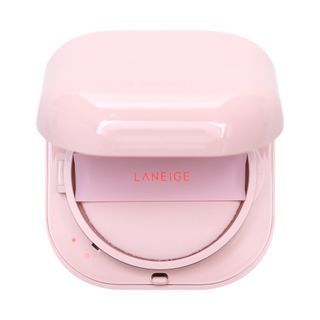
LANEIGE Neo Cushion Glow - 7 Colors
Works for
0 of 1 advertised claim delivered
Sun protectionSPF 50 · 3 UV filters · Partial spectrumWeak protection
This product does not offer good protection against UVA rays.
Anti-agingNot advertised by the brand · 4 ingredients credited for this claimStrong support
This product can help reduce and prevent fine lines and wrinkles, improve skin elasticity and firmness because it contains adenosine.
Keep in mind that it typically takes at least 6 weeks to notice any results because the changes that are needed to improve fine lines and elasticity happen in the deeper layers of the skin. No topical anti-aging product can “erase” wrinkles or fully reverse signs of aging.
MoisturizingNot advertised by the brand · 13 ingredients credited for this claimGood support
This product can help improve hydration of the skin with the two types of ingredients.
The first type is called “humectants”:
these ingredients help attract water.
When humectants are on the surface of the skin, they “pull in” the moisture from the outside environment, or from
within deeper layers of the skin. The following ingredients in this product do the job:
glycerin, caprylyl glycol.
This product also contains ingredients called “occlusives”. They help reduce the speed with which our skin loses moisture to the outside environment. These ingredients also help soften the upper layer of the skin, so it feels less tight and nicer to the touch. The following ingredients in this product do the job: ethylhexyl hydroxystearate, peg-10 dimethicone.
Can it cause trouble?
Irritancy5 strong irritants: Citronellol, Geraniol + 3 more — patch-test recommendedHigh risk
ComedogenicClean of flagged comedogenic ingredientsNone flagged


User reviews
Be the first — your take helps the next person decide.
Ingredients
Filter by role to see what each ingredient is doing.
Water~40–60%
Cyclopentasiloxane~5.2–7.9%
- Irritation risk
- Low
A silicone that helps improve the product texture and spreadability. Can absorb oil creating a short-term mattifying effect on the skin
More about CyclopentasiloxaneTitanium dioxide~4.7–7.1%
- Irritation risk
- Low
Works as a UV filter when used in high concentrations. It is photostable and is effective mostly against the UVB light, with some protection in the UVA range. In small concentrations, used for its ability to improve the color of cosmetic products. Is usually well tolerated by the skin
More about Titanium dioxideCi 77891~3.6–5.5%
- Irritation risk
- Low
Phenyl trimethicone~2.9–4.3%
- Irritation risk
- Low
A type of silicone that can decrease loss of moisture from the skin surface. It helps create a nice product texture
More about Phenyl trimethiconeHomosalate~2.8–4.2%
- Irritation risk
- Medium
A weak sunscreen that offers some protection against the sun rays that cause sunburn (UVB), but does not offer meaningful protection against protect against the most aging sun rays (UVA). It loses its effectiveness quickly when exposed to sunlight. It is an organic, or so called "chemical" sunscreen. When used in low concentrations, helps to stabilize the product formulation
More about HomosalateGlycerin~2.1–3.2%
- Irritation risk
- Low
One of the best moisturizing ingredients. Naturally present in skin. It attracts water to the upper layer of the skin working as a humectant
More about GlycerinEthylhexyl methoxycinnamate~2.2–3.3%
- Irritation risk
- High
Octinoxate. When used in higher concentrations, works as a sunscreen protecting the skin from UVB rays. When used in lower concentration, helps to preserve the product formulation. Is shown to be harmful to coral reefs - consider avoiding bathing in coral reef areas when wearing a product with this ingredient. It can be irritating
More about Ethylhexyl methoxycinnamatePeg-10 dimethicone~1.7–2.5%
- Irritation risk
- Low
A silicone that works to soften the upper layer of the skin and reduce its water loss
More about Peg-10 dimethiconeCyclohexasiloxane~1.2–1.8%
- Irritation risk
- Low
A silicone that serves as an emollient. Helps create a nice non-greasy feels
More about CyclohexasiloxaneBoron nitride~1–1.5%
- Irritation risk
- Low
Helps to absord oil and evenly disperse other ingredients (for example, pigment) in product formulation
More about Boron nitrideTrimethylsiloxysilicate~0.9–1.3%
- Irritation risk
- Low
A type of silicone that helps create a nice product consistency and support the delivery of other ingredients
More about TrimethylsiloxysilicateNiacinamide~0.85–1.25%
- Irritation risk
- Low
Is proven to be effective in reducing blemishes, evening out skin tone and helping to improve lines and wrinkles. It helps the skin to repair sun damage, calm down inflammation and keep maintain good levels of moisture. The concentration of about 2% is effective for supporting the skin barrier and evening out the skin tone. Concentration of 4-6% is better for helping with acne and balancing the sebum production
More about NiacinamidePropanediol~0.85–1.25%
- Irritation risk
- Low
Acts as a solvent for other ingredients. Speeds up the absorption of other ingredients into the skin
More about Propanediol1,2-hexanediol~0.55–1.3%
Acrylates/dimethicone copolymer~0.55–1.3%
- Irritation risk
- Medium
Used to stabilize product formulation, help create an even product layer over skin (for example, in sunscreen), evenly disperse pigements and create a nice product consistency
More about Acrylates/dimethicone copolymerDisteardimonium hectorite~0.55–1.3%
- Irritation risk
- Low
A type of clay that is used to thicken the product consistency
More about Disteardimonium hectoriteSodium chloride~0.55–1.3%
- Irritation risk
- Low
Used to stabilize mixtures of oil and water, and create thicker, gel-like product textures
More about Sodium chlorideAlumina~0.55–1.35%
- Irritation risk
- Low
The same compound that is used safely in dental implants and bone cements. In cosmetics, it is used to improve the consistency of products
More about AluminaGlyceryl stearate citrate~0.5–1.15%
- Irritation risk
- Low
Helps oil and water mix together while softening the upper layer of the skin
More about Glyceryl stearate citratePolysorbate 80~0.5–1.15%
Disodium stearoyl glutamate~0.5–1.1%
- Irritation risk
- Medium
Helps oil and water mix together and workd as a cleanser
More about Disodium stearoyl glutamateAluminum hydroxide~0.45–1.1%
- Irritation risk
- Low
Is used to add opaque (non-transparent) appearance to formulations. Can be used to coat other ingredients for even dispersion. This is a different ingredient compared to the ones used in antipersperants (aluminium chloride and aluminium chlorohydrate)
More about Aluminum hydroxideDimethicone/peg-10/15 crosspolymer~0.45–1.05%
Caprylyl glycol~0.45–1.1%
- Irritation risk
- Medium
Helps preserve products and creates a nice product texture
More about Caprylyl glycolHydrogenated lecithin~0.5–1.1%
- Irritation risk
- Low
Helps to retain moisture by creating a protective barrier on the skin. Rich in fatty acids. Improves product texture and helps with the penetration of other ingredients.
More about Hydrogenated lecithinEthylhexyl hydroxystearate~0.5–1.15%
- Irritation risk
- Low
Helps soften the upper layer of the skin and reduce water loss from it
More about Ethylhexyl hydroxystearateSimethicone~0.45–1.1%
- Irritation risk
- Low
A type of silicone that helps to create nice product texture and is used as an anti-foaming agent
More about SimethiconeGlyceryl caprylate~0.5–1.2%
- Irritation risk
- Low
An emollient that can also help water and oil mix together, as well as prevent bacteria growth in products
More about Glyceryl caprylateEthylhexylglycerin~0.45–1.1%
Disodium edta~0.5–1%
Adenosine~0.45–1%
- Irritation risk
- Low
Might help improve cell turnover and reduce inflammation in skin. One study shows that the ingredients might be able to help reduce dynamic wrinkles (for example, in the corners of the eyes or on the forehead)
More about AdenosineTriethoxycaprylylsilane~0.45–1.1%
- Irritation risk
- Low
A type of silicone that helps oil and water mix well together. Helps to disperse other ingredients, e.g. pigments, evenly in a formulation
More about TriethoxycaprylylsilaneCitronellol~0.45–1.05%
Geraniol~0.45–1.05%
Limonene~0.45–1.05%
- Irritation risk
- High
A common frangrance that can easily irritate skin, especially if exposed to air, light or heat
More about LimoneneDipropylene glycol~0.45–1.05%
- Irritation risk
- Low
Helps to dissolve other ingredients in a formulation. Slows down the rate of product drying
More about Dipropylene glycolBht~0.45–1%
Hydroxycitronellal~0.45–1.05%
- Irritation risk
- High
A fragrance. A likely allergen and can be irritating
More about HydroxycitronellalThymol trimethoxycinnamate~0.5–1.1%
- Irritation risk
- Low
Sodium citrate~0.45–1.05%
- Irritation risk
- Medium
Helps to control the skin's pH level. Maintains the skin's natural film of amino-lactic acids and oils. Helps to preserve products
More about Sodium citrateTocopherol~0.45–1.1%
- Irritation risk
- Low
Pure form of vitamin E. Can help moisturise and protect the skin from free radicals. Often used to help stabilise other ingredients or the formula itself
More about TocopherolSodium benzoate~0.25–0.5%
Potassium sorbate~0.3–0.6%
Diamond powder~0.55–1.25%
- Irritation risk
- Low
Does not have known skin benefits. Might help create an optical illusion of smoother skin
More about Diamond powderXanthan gum~0.45–1.1%
- Irritation risk
- Low
Used to create a thicker product consistency
More about Xanthan gumParfum~0.45–1.05%
- Irritation risk
- High
An aromatic blend of unspecified and possibly irritating ingredients
More about ParfumCi 77499~0.45–1.05%
Iron oxides~0.4–1%
- Irritation risk
- Low
An umbrella term for the following three colorants: CI 77491, CI 77492, CI 77499. They might be able to offer some protection against visible light, but the degree of the protection is not clear
More about Iron oxidesCi 77491~0.45–1.05%
- Irritation risk
- Low
A red colorant made of iron oxide. Typically is not irritating
More about Ci 77491Ci 77492~0.45–1.05%
Parfum~0.4–0.95%
- Irritation risk
- High
An aromatic blend of unspecified and possibly irritating ingredients
More about ParfumIron oxides~0.35–0.8%
- Irritation risk
- Low
An umbrella term for the following three colorants: CI 77491, CI 77492, CI 77499. They might be able to offer some protection against visible light, but the degree of the protection is not clear
More about Iron oxidesCi 77499~0.35–0.85%
Polymethyl methacrylate~0.4–0.95%
- Irritation risk
- Low
Is used to enhance product texture and can help to optically mask skin imperfections
More about Polymethyl methacrylateLactic acid~0.35–0.8%
- Irritation risk
- Medium
An exfoliating and moisturizing alpha-hydroxy acid (AHA). Typically causes less irritation than other AHAs, for example, glycolic acid. At high concentrations (about 15%), lactic acid can help reduce lines and wrinkles. Recent studies show that lactic acid can support the "good" bacteria living on skin's surface (healthy skin microbiome)
More about Lactic acidLauryl peg-10 tris(trimethylsiloxy)silylethyl dimethicone~0.35–0.8%
- Irritation risk
- Low
Polymethyl methacrylate~0.35–0.85%
- Irritation risk
- Low
Is used to enhance product texture and can help to optically mask skin imperfections
More about Polymethyl methacrylateCi 77163~0.3–0.75%
Titanium dioxide~0.4–0.9%
- Irritation risk
- Low
Works as a UV filter when used in high concentrations. It is photostable and is effective mostly against the UVB light, with some protection in the UVA range. In small concentrations, used for its ability to improve the color of cosmetic products. Is usually well tolerated by the skin
More about Titanium dioxideLactic acid~0.2–0.7%
- Irritation risk
- Medium
An exfoliating and moisturizing alpha-hydroxy acid (AHA). Typically causes less irritation than other AHAs, for example, glycolic acid. At high concentrations (about 15%), lactic acid can help reduce lines and wrinkles. Recent studies show that lactic acid can support the "good" bacteria living on skin's surface (healthy skin microbiome)
More about Lactic acidCi 77163~0.15–0.65%
Lauryl peg-10 tris(trimethylsiloxy)silylethyl dimethicone~0.15–0.6%
- Irritation risk
- Low
Titanium dioxide~0.2–0.8%
- Irritation risk
- Low
Works as a UV filter when used in high concentrations. It is photostable and is effective mostly against the UVB light, with some protection in the UVA range. In small concentrations, used for its ability to improve the color of cosmetic products. Is usually well tolerated by the skin
More about Titanium dioxideCi 77491~0.15–0.55%
- Irritation risk
- Low
A red colorant made of iron oxide. Typically is not irritating
More about Ci 77491Iron oxides~0.05–0.2%
- Irritation risk
- Low
An umbrella term for the following three colorants: CI 77491, CI 77492, CI 77499. They might be able to offer some protection against visible light, but the degree of the protection is not clear
More about Iron oxidesCi 77492~0.05–0.2%
Ingredient list view
Water, Cyclopentasiloxane, Titanium dioxide, Ci 77891, Phenyl trimethicone, Homosalate, Glycerin, Ethylhexyl methoxycinnamate, Peg-10 dimethicone, Cyclohexasiloxane, Boron nitride, Trimethylsiloxysilicate, Niacinamide, Propanediol, 1,2-hexanediol, Acrylates/dimethicone copolymer, Disteardimonium hectorite, Sodium chloride, Alumina, Glyceryl stearate citrate, Polysorbate 80, Disodium stearoyl glutamate, Aluminum hydroxide, Dimethicone/peg-10/15 crosspolymer, Caprylyl glycol, Hydrogenated lecithin, Ethylhexyl hydroxystearate, Simethicone, Glyceryl caprylate, Ethylhexylglycerin, Disodium edta, Adenosine, Triethoxycaprylylsilane, Citronellol, Geraniol, Limonene, Dipropylene glycol, Bht, Hydroxycitronellal, Thymol trimethoxycinnamate, Sodium citrate, Tocopherol, Sodium benzoate, Potassium sorbate, Diamond powder, Xanthan gum, Parfum, Ci 77499, Iron oxides, Ci 77491, Ci 77492, Parfum, Iron oxides, Ci 77499, Polymethyl methacrylate, Lactic acid, Lauryl peg-10 tris(trimethylsiloxy)silylethyl dimethicone, Polymethyl methacrylate, Ci 77163, Titanium dioxide, Lactic acid, Ci 77163, Lauryl peg-10 tris(trimethylsiloxy)silylethyl dimethicone, Titanium dioxide, Ci 77491, Iron oxides, Ci 77492
Compare prices
Retailers ranked by price — lowest first.

Affiliate links · prices updated regularly
Worth comparing, line by line.
Match % combines shared ingredients, the first five ingredients, shared actives and hero ingredients, irritancy (lower counts in the alternative's favour), texture and body area. Only products in the same routine step are compared.
| LANEIGENeo Cushion Glow - 7 ColorsYOUR PRODUCT | MISSHARadiance Perfect Fit Cushion - 4 Colors | Peach CHoney Glow Cover Cushion - 3 Colors | IOPEMen Air Cushion - 2 Colors | |
|---|---|---|---|---|
| Match | — | 85% | 84% | 82% |
| Price | $15.73 | $16.11 | $14.62−$1.11 | $20.48+$4.75 |
| Shared key ingredients | — | 8 of 12 | 7 of 12 | 9 of 12 |
| Key difference | — | Ceramide Np | Dimethicone | Chitosan |
| Irritancy | High | Medium | Medium | Medium |
| SPF | SPF 50 | SPF 50 | SPF 50 | SPF 50 |
| Drying alcohol | — | — | — | Contains drying alcohol |
| View product | Shop | Shop | Shop |


Product summary
We do not recommend "LANEIGE - Neo Cushion Glow - 7 Colors" because it does not provide good UVA protection. UVA sun rays don't burn the skin, but they still lead to photoaging and hyperpigmentation.
This moisturizer should also be hydrating enough to use without an additional moisturizer during the day. This product prevents early signs of aging by protecting against sun damage (all broad spectrum sunscreens do that).
Sunscreen filters
This is a "mixed" sunscreen in the sense that it uses both mineral and organic (so-called "chemical") sun filters. The organic filters in the product are: octinoxate and homosalate. As for the mineral filters, this sunscreen uses titanium dioxide.
Irritation risk
This moisturizer contains a bunch of common irritants, including ingredients that do not provide any known benefit for the skin. It might not be the best choice if your skin is sensitive. We assess the overall irritancy of this moisturizer to be high. For a detailed overview of all potential irritants: click here
You can see the detailed formula review with the breakdown of all actives in the product and the full ingredient list with estimated concentrations in the tables below.
Price
The product retails for 15.73$ in the United States.
For a detailed price comparison: click here.
Sources cited in this review
Every concentration estimate and effectiveness label is anchored to one of these 14 studies and safety reviews.
- 1
- 2
- 3Safety Assessment of Boron Nitride as Used in Cosmetics cir-safety.org
- 4
- 5
- 6

Affiliate links · As an Amazon Associate, WIMJ earns from qualifying purchases.