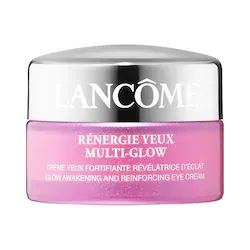
Lancôme Rénergie Yeux Multi-Glow Glow-Awakening and Reinforcing Eye Cream
Works for
3 of 3 advertised claims delivered
Anti-aging4 ingredients credited for this claimStrong support
“Infused with schizandra red berry and linseed extracts, Lancôme's formula reinforces the skin moisture barrier function and helps to smooth the appearance of fine lines and crepiness, while reviving the look of eye contour over time and leaving the skin feeling firmer.”
This product can help reduce and prevent fine lines and wrinkles, improve skin elasticity and firmness because it contains adenosine.
Keep in mind that it typically takes at least 6 weeks to notice any results because the changes that are needed to improve fine lines and elasticity happen in the deeper layers of the skin. No topical anti-aging product can “erase” wrinkles or fully reverse signs of aging.
Evens skin tone1 ingredient credited for this claimModerate support
“Reduces redness and evens skin tone.”
The following ingredient (ingredients) in this product might be helpful, but there is no evidence to confirm that it actually works: capryloyl salicylic acid.
Moisturizing23 ingredients credited for this claimGood support
“Infused with schizandra red berry and linseed extracts, Lancôme's formula reinforces the skin moisture barrier function and helps to smooth the appearance of fine lines and crepiness, while reviving the look of eye contour over time and leaving the skin feeling firmer.”
This product can help improve hydration of the skin with the two types of ingredients.
The first type is called “humectants”:
these ingredients help attract water.
When humectants are on the surface of the skin, they “pull in” the moisture from the outside environment, or from
within deeper layers of the skin. The following ingredients in this product do the job:
glycerin, butylene glycol.
This product also contains ingredients called “occlusives”. They help reduce the speed with which our skin loses moisture to the outside environment. These ingredients also help soften the upper layer of the skin, so it feels less tight and nicer to the touch. The following ingredients in this product do the job: beeswax, butyrospermum parkii butter.
ExfoliationNot advertised by the brand · 1 ingredient credited for this claimStrong support
This product can help exfoliate the skin. In other words, it helps break down the bonds between dead cells on the surface of the skin and speed up the skin turnover. Skin often appears softer and brighter after exfoliation, but overdoing it can result in disrupted skin barrier. The following ingredient is doing the exfoliating job in this product: capryloyl salicylic acid.
Can it cause trouble?
Irritancy5 strong irritants: Alcohol denat., Limonene + 3 more — patch-test recommendedHigh risk
Comedogenic4 ingredients rated 2 or more on the 0–5 pore-clogging scale4 flagged


User reviews
Be the first — your take helps the next person decide.
Ingredients
Filter by role to see what each ingredient is doing.
Water~45–55%
Glycerin~4.6–5.6%
- Irritation risk
- Low
One of the best moisturizing ingredients. Naturally present in skin. It attracts water to the upper layer of the skin working as a humectant
More about GlycerinCyclohexasiloxane~3.9–4.8%
- Irritation risk
- Low
A silicone that serves as an emollient. Helps create a nice non-greasy feels
More about CyclohexasiloxaneButylene glycol~2.8–3.5%
- Irritation risk
- Low
Used to create a nice product texture and help delivery of other ingredients. Might be somewhat helpful in attracting water to the upper layer of the skin
More about Butylene glycolAlcohol denat.~2.2–2.7%
- Irritation risk
- High
Produces temporary toning effect. Can help dissolve other ingredients or preserve products
More about Alcohol denat.Butyrospermum parkii butter~1.9–2.3%
- Irritation risk
- Low
- Comedogenicity
- 3/5
A great moisturising ingredient that softens the skin and reduces water loss from its upper layer. It also can be helpful in protecting skin from free radicals
More about Butyrospermum parkii butterStearic acid~1.6–2%
- Irritation risk
- Low
Helps oil and water mix together and works as an emollient
More about Stearic acidStearyl alcohol~1.4–1.7%
- Irritation risk
- Low
An emollient that helps soften the skin
More about Stearyl alcoholCetyl alcohol~1.2–1.4%
- Irritation risk
- Low
A non-drying alcohol that works to soften the skin and stabilize product formulations helping oil and water mix together
More about Cetyl alcoholPalmitic acid~0.75–1.15%
- Irritation risk
- Low
An emollient that is naturally present in skin and helps soften it
More about Palmitic acidPeg-100 stearate~0.6–0.9%
- Irritation risk
- Low
Helps oil and water mix togehter and creates a nice product texture
More about Peg-100 stearateGlyceryl stearate~0.45–0.65%
- Irritation risk
- Low
An emollient that softens the skin and forms a protective layer on its surface. Helps water and oil mix together
More about Glyceryl stearateCera alba~0.35–0.6%
- Irritation risk
- Medium
Forms a protective barrier that holds water and keeps dry skin hydrated. Keeps an emulsion from separating into its oil and liquid components, and increases the thickness of a product. Can be an allergen
More about Cera albaBeeswax~0.25–0.45%
- Irritation risk
- Low
Forms a protective barrier that holds water and keeps dry skin hydrated. Keeps an emulsion from separating into its oil and liquid components, and increases the thickness of a product. Can be an allergen
More about BeeswaxSodium stearoyl glutamate~0.2–0.4%
- Irritation risk
- Medium
Helps oil and water mix together
More about Sodium stearoyl glutamateOctyldodecanol~0.2–0.4%
- Irritation risk
- Low
An emollient that helps to soften the skin and create a pleasant product texture and stabilize the formulation
More about OctyldodecanolCi 77891~0.25–0.45%
- Irritation risk
- Low
Titanium dioxide~0.3–0.55%
- Irritation risk
- Low
Works as a UV filter when used in high concentrations. It is photostable and is effective mostly against the UVB light, with some protection in the UVA range. In small concentrations, used for its ability to improve the color of cosmetic products. Is usually well tolerated by the skin
More about Titanium dioxideCi 77491~0.2–0.4%
- Irritation risk
- Low
A red colorant made of iron oxide. Typically is not irritating
More about Ci 77491Iron oxides~0.2–0.4%
- Irritation risk
- Low
An umbrella term for the following three colorants: CI 77491, CI 77492, CI 77499. They might be able to offer some protection against visible light, but the degree of the protection is not clear
More about Iron oxidesCi 77163~0.15–0.3%
Ci 75120~0.15–0.3%
Zea mays oil~0.1–0.2%
- Irritation risk
- Low
- Comedogenicity
- 3/5
A good moisturizing plant oil. Due to the high linoleic acid content, it helps soften the upper layer of the skin, reduce water loss and support skin barrier function
More about Zea mays oilGuanosine~0.1–0.2%
- Irritation risk
- Low
Cyathea medullaris leaf extract~0.1–0.2%
- Irritation risk
- Low
Tocopheryl acetate~0.15–0.25%
- Irritation risk
- Medium
A more stable but less bio-available form of vitamin E compared to Tocopherol. Might help moisturize and protect the skin from free radicals, but mostly used in low concentrations to stabilize other ingredients.
More about Tocopheryl acetateEscin~0.1–0.2%
- Irritation risk
- High
A compound obtained from horse chestnut. It is claimed that this chemical can improve circulation, but there is no evidence available that it works in skin
More about EscinMica~0.15–0.3%
- Irritation risk
- Low
Creates an illusion of smoother and more radiant skin tone. Adds shimmer to the skin by reflecting light
More about MicaTocopherol~0.15–0.25%
- Irritation risk
- Low
Pure form of vitamin E. Can help moisturise and protect the skin from free radicals. Often used to help stabilise other ingredients or the formula itself
More about TocopherolAscorbyl palmitate~0.1–0.2%
- Irritation risk
- Medium
Being a lipid soluble form of vitamin C, it is more stable and can penetrate the skin better than L-Ascorbic acid. It is effective in protecting the skin from free radicals, as well as evening the skin tone, but is less effective in stimulating collagen production compared to L-Ascorbic acid.
More about Ascorbyl palmitateHydroxypropyl tetrahydropyrantriol~0.1–0.2%
- Irritation risk
- High
A sugar-derived compound that helps to attract water to the upper layer of the skin and might be able to stimulate synthesis of skin's own moisturizing factors, but solid research is lacking. It could be irritating
More about Hydroxypropyl tetrahydropyrantriolHydrolyzed linseed extract~0.1–0.2%
- Irritation risk
- Low
Helps soften the upper layer of the skin
More about Hydrolyzed linseed extractSodium benzoate~0.15–0.25%
Sodium levulinate~0.15–0.25%
Phenoxyethanol~0.15–0.3%
- Irritation risk
- Low
A preservative. It helps prevent bacterial growth in cosmetic products
More about PhenoxyethanolAdenosine~0.15–0.25%
- Irritation risk
- Low
Might help improve cell turnover and reduce inflammation in skin. One study shows that the ingredients might be able to help reduce dynamic wrinkles (for example, in the corners of the eyes or on the forehead)
More about AdenosinePeg-20 stearate~0.15–0.3%
Schizandra sphenanthera fruit extract~0.15–0.25%
- Irritation risk
- Low
Trisodium ethylenediamine disuccinate~0.15–0.25%
- Irritation risk
- Medium
Used to improve stability of the formulation
More about Trisodium ethylenediamine disuccinatePolysorbate 80~0.15–0.3%
Maltodextrin~0.15–0.25%
- Irritation risk
- Low
Used to stabilize the product formulation and can help absorb oil
More about MaltodextrinChlorhexidine digluconate~0.15–0.3%
Helianthus annuus seed oil~0.15–0.3%
- Irritation risk
- Low
A great emollient due to its high linoleic acid content. One of the most effective plant oils in helping skin hydration and repairing skin barrier function
More about Helianthus annuus seed oilLimonene~0.1–0.2%
- Irritation risk
- High
A common frangrance that can easily irritate skin, especially if exposed to air, light or heat
More about LimoneneSynthetic fluorphlogopite~0.15–0.3%
- Irritation risk
- Low
A mineral that is used as an optical filter (makes the skin looks nicer through light reflection) and to improve the texture of cosmetic products
More about Synthetic fluorphlogopitePanthenol~0.15–0.25%
- Irritation risk
- Low
Helps attract water to the upper layer of the skin and can help improve skin barrier function
More about PanthenolPentaerythrityl tetra-di-t-butyl hydroxyhydrocinnamate~0.15–0.3%
- Irritation risk
- Low
Used to increase stability of product formulations
More about Pentaerythrityl tetra-di-t-butyl hydroxyhydrocinnamateTin oxide~0.25–0.45%
- Irritation risk
- Low
A colorant that can add a pearl-like appearance to the formulation
More about Tin oxideBenzyl alcohol~0.1–0.2%
- Irritation risk
- High
A preservative. Can be used to mask unpleasant smell. Can be irritating
More about Benzyl alcoholXanthan gum~0.15–0.25%
- Irritation risk
- Low
Used to create a thicker product consistency
More about Xanthan gumCinnamic acid~0.1–0.2%
- Irritation risk
- High
Propylene glycol~0.15–0.25%
- Irritation risk
- High
Helps oil and water mix together and can enhance the penetration of other ingredients into the skin. It can be irritating
More about Propylene glycolIsohexadecane~0.2–0.4%
- Irritation risk
- Low
Improves the texture of the product and helps soften the skin. Helps oil and water mix together and can be used as a cleansing agent
More about IsohexadecaneCapryloyl salicylic acid~0.15–0.25%
- Irritation risk
- High
Acrylamide/sodium acryloyldimethyltaurate copolymer~0.15–0.25%
- Irritation risk
- Low
Helps water and oil mix together and create gel-like textures
More about Acrylamide/sodium acryloyldimethyltaurate copolymerMyristic acid~0.15–0.3%
- Irritation risk
- Medium
- Comedogenicity
- 3/5
Helps oil and water mix together. Could be comedogenic
More about Myristic acidSorbitan oleate~0.15–0.3%
- Irritation risk
- Medium
- Comedogenicity
- 2/5
Helps oil and water mix together
More about Sorbitan oleateGeraniol~0.15–0.25%
Passiflora edulis seed oil~0.2–0.4%
- Irritation risk
- High
A good emollient helping to soften the skin. Might have some anti-oxidant properties. Adds a fragrance to the product
More about Passiflora edulis seed oilCitric acid~0.15–0.25%
- Irritation risk
- Medium
Can work as an exfoliant but is typically used to adjust the product pH
More about Citric acidPrunus armeniaca kernel oil~0.2–0.35%
- Irritation risk
- Medium
An emollient that helps soften the skin
More about Prunus armeniaca kernel oilLevulinic acid~0.15–0.25%
Oryza sativa bran oil~0.2–0.35%
- Irritation risk
- Low
Helps soften the upper layer of the skin and might have some anti-oxidant properties
More about Oryza sativa bran oilGlyceryl caprylate~0.15–0.25%
- Irritation risk
- Low
An emollient that can also help water and oil mix together, as well as prevent bacteria growth in products
More about Glyceryl caprylateParfum~0.05–0.15%
- Irritation risk
- High
An aromatic blend of unspecified and possibly irritating ingredients
More about ParfumIngredient list view
Water, Glycerin, Cyclohexasiloxane, Butylene glycol, Alcohol denat., Butyrospermum parkii butter, Stearic acid, Stearyl alcohol, Cetyl alcohol, Palmitic acid, Peg-100 stearate, Glyceryl stearate, Cera alba, Beeswax, Sodium stearoyl glutamate, Octyldodecanol, Ci 77891, Titanium dioxide, Ci 77491, Iron oxides, Ci 77163, Ci 75120, Zea mays oil, Guanosine, Cyathea medullaris leaf extract, Tocopheryl acetate, Escin, Mica, Tocopherol, Ascorbyl palmitate, Hydroxypropyl tetrahydropyrantriol, Hydrolyzed linseed extract, Sodium benzoate, Sodium levulinate, Phenoxyethanol, Adenosine, Peg-20 stearate, Schizandra sphenanthera fruit extract, Trisodium ethylenediamine disuccinate, Polysorbate 80, Maltodextrin, Chlorhexidine digluconate, Helianthus annuus seed oil, Limonene, Synthetic fluorphlogopite, Panthenol, Pentaerythrityl tetra-di-t-butyl hydroxyhydrocinnamate, Tin oxide, Benzyl alcohol, Xanthan gum, Cinnamic acid, Propylene glycol, Isohexadecane, Capryloyl salicylic acid, Acrylamide/sodium acryloyldimethyltaurate copolymer, Myristic acid, Sorbitan oleate, Geraniol, Passiflora edulis seed oil, Citric acid, Prunus armeniaca kernel oil, Levulinic acid, Oryza sativa bran oil, Glyceryl caprylate, Parfum
Compare prices
Retailers ranked by price — lowest first.
Worth comparing, line by line.
Match % combines shared ingredients, the first five ingredients, shared actives and hero ingredients, irritancy (lower counts in the alternative's favour), texture and body area. Only products in the same routine step are compared.
| LancômeRénergie Yeux Multi-Glow Glow-Awakening and Reinforcing Eye CreamYOUR PRODUCT | BIOTHERMBLUE THERAPY REVITALIZE MOISTURIZING DAY CREAM | DECLEORPeony Eye Cream Absolute | SCINICSnail Matrix Eye Cream | |
|---|---|---|---|---|
| Match | — | 56% | 54% | 51% |
| Price | $75.00 | $99.00+$24.00 | $64.18−$10.82 | $12.20−$62.80 |
| Shared key ingredients | — | 12 of 15 | 7 of 15 | 6 of 15 |
| Key difference | — | Calcium Pca | Palmitoyl Tetrapeptide-7 | Oligopeptide-1 |
| Irritancy | High | Medium | Medium | Medium |
| Drying alcohol | Contains drying alcohol | — | Contains drying alcohol | — |
| View product | Shop | Shop | Shop |


Sources cited in this review
Every concentration estimate and effectiveness label is anchored to one of these 23 studies and safety reviews.
- 1
- 2
- 3Content of fatty acids in corn (Zea mays L.) oil from Ecuadorresearchgate.net
- 4Vitamin E in dermatologyncbi.nlm.nih.gov
- 5Vitamin E and Skin Healthlpi.oregonstate.edu
- 6

Affiliate links · As an Amazon Associate, WIMJ earns from qualifying purchases.