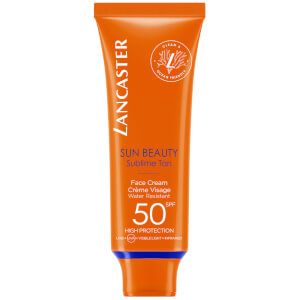
Lancaster Sun Beauty Face Cream SPF50
Works for
3 of 3 advertised claims delivered
Sun protectionSPF 50 · 5 UV filtersBroad spectrum
This product offers a good level of protection against both UVB and UVA rays.
This sunscreen uses organic (so-called "chemical") sunscreen filters. Organic, or "chemical" filters usually provide reliable sun protection and rarely leave a white cast. Sunscreens with organic filters can sting eyes.
This product can be considered "reef safe" because it does not contain the UV filters (oxybenzone and octinoxate) that can be harmful to coral reefs when present in the water in high concentrations.
Evens skin tone3 ingredients credited for this claimStrong support
“Non-greasy or sticky, this is also cast-free so every skin tone and type can enjoy a velvety-smooth finish.”
This product offers broad spectrum sun protection. It means that it can prevent hyperpigmentation and help keep the skin tone even (sun damage is the main factor causing age spots, darkening of post-acne marks and other discolorations).
Anti-aging5 ingredients credited for this claimStrong support
“Lightweight and quick-absorbing, this lusciously formulated cream also features the brand's breakthrough Tan Activator Complex (T. A. C. ) combining orange, coffee and antioxidant-rich buriti oil to encourage a faster, deeper tan, whilst promoting firmness and elasticity.”
This product can help prevent early signs of skin aging because it offers a good level of broad spectrum sun protection. Sun damage is the main cause of premature skin aging, and protecting your skin from the sun is the best anti-aging strategy.
Anti-oxidationNot advertised by the brand · 7 ingredients credited for this claimStrong support
This product contains antioxidants (dimethylmethoxy chromanol) that can help neutralize free radicals in skin. By doing so, they can lessen the damage the skin gets from the UV light (sun).
MoisturizingNot advertised by the brand · 14 ingredients credited for this claimGood support
This product can help improve hydration of the skin with the two types of ingredients.
The first type is called “humectants”:
these ingredients help attract water.
When humectants are on the surface of the skin, they “pull in” the moisture from the outside environment, or from
within deeper layers of the skin. The following ingredients in this product do the job:
glycerin, glycine.
This product also contains ingredients called “occlusives”. They help reduce the speed with which our skin loses moisture to the outside environment. These ingredients also help soften the upper layer of the skin, so it feels less tight and nicer to the touch. The following ingredients in this product do the job: dimethicone, cetearyl alcohol.
Can it cause trouble?
Irritancy12 strong irritants: Alpha-isomethyl ionone, Benzyl benzoate + 10 more — patch-test recommendedHigh risk
Comedogenic1 ingredient rated 2 or more on the 0–5 pore-clogging scale1 flagged

User reviews
Be the first — your take helps the next person decide.
Ingredients
Filter by role to see what each ingredient is doing.
Water~45–55%
Octocrylene~5.1–6.2%
- Irritation risk
- Medium
A weak sunscreen that protects against the sun rays that cause sunburn (UVB) and is somewhat effective against the UVA rays. It is quite stable and can help stabilize other, more vulnerable, sunscreen ingredients like Avobenzone. It is an organic, or so called "chemical" sunscreen
More about OctocryleneDicaprylyl carbonate~4.1–5%
- Irritation risk
- Low
Helps products spread more easily and works as an emollient to soften skin
More about Dicaprylyl carbonateGlycerin~3–3.6%
- Irritation risk
- Low
One of the best moisturizing ingredients. Naturally present in skin. It attracts water to the upper layer of the skin working as a humectant
More about GlycerinButyl methoxydibenzoylmethane~3–3.7%
- Irritation risk
- Medium
Avobenzone. An organic, or so-called "chemical" UV filter. Protects against both UVA and UVB rays. Needs to be combined with other filters in a formulation to be stable.
More about Butyl methoxydibenzoylmethaneEthylhexyl salicylate~2.5–3%
- Irritation risk
- Low
Octisalate. A UV filter. It offers some protection against the sun rays that cause sunburn (UVB), but does not protect against the most aging sun rays (UVA). It loses its effectiveness quickly when exposed to sunlight. It is an organic, or so called "chemical" sunscreen
More about Ethylhexyl salicylateDimethicone~1.6–2%
- Irritation risk
- Low
A silicone that helps to reduce water loss from the surface of the skin. Can temporarily "fill in" lines and wrinkles, absorb oil, and create a nice product finish
More about DimethiconeCyclopentasiloxane~1.4–1.7%
- Irritation risk
- Low
A silicone that helps improve the product texture and spreadability. Can absorb oil creating a short-term mattifying effect on the skin
More about CyclopentasiloxaneC20-22 alkyl phosphate~1.1–1.4%
C20-22 alcohols~0.8–1.15%
- Irritation risk
- Low
Methylene bis-benzotriazolyl tetramethylbutylphenol~0.95–1.2%
- Irritation risk
- Medium
Tinosorb M. A UV filter. Is effective against both UVA and UVB rays. It also provides some protection against visible light. It is photostable and can also be used to improve photostability of other sunscreen ingredients. Its physical properties help to create lightweight sunscreen formulations. It can leave a slight white cast. Unfortunately, it is not approved by the FDA (US) yet
More about Methylene bis-benzotriazolyl tetramethylbutylphenolAcrylates/c12-22 alkyl methacrylate copolymer~0.55–0.85%
- Irritation risk
- Low
Alcohol~0.45–0.7%
- Irritation risk
- High
Can be drying and contribute to skin irritation. Used in formulars to dissolve other ingredients, create a thinner product consistency or for its antibacterial properties
More about AlcoholAlpha-isomethyl ionone~0.35–0.6%
- Irritation risk
- High
A fragrance. Potential allergen and can be irritating
More about Alpha-isomethyl iononeAngelica archangelica root extract~0.3–0.55%
- Irritation risk
- Low
Ascorbic acid~0.3–0.6%
- Irritation risk
- High
The most well-researched antioxidant that works in skin. Helps neutralize free radicals supporting collagen production, helping to even out the skin tone and preventing early signs of aging
More about Ascorbic acidAscorbyl palmitate~0.3–0.55%
- Irritation risk
- Medium
Being a lipid soluble form of vitamin C, it is more stable and can penetrate the skin better than L-Ascorbic acid. It is effective in protecting the skin from free radicals, as well as evening the skin tone, but is less effective in stimulating collagen production compared to L-Ascorbic acid.
More about Ascorbyl palmitateBenzyl benzoate~0.25–0.5%
- Irritation risk
- High
Fragrance with sweet balsamic smell. Help to preserve products and dissolve other ingredients. Could trigger allergic reactions and be irritating
More about Benzyl benzoateC30-45 alkyl cetearyl dimethicone crosspolymer~0.35–0.6%
- Irritation risk
- Low
Helps to create a nice silky product texture
More about C30-45 alkyl cetearyl dimethicone crosspolymerCaffeine~0.25–0.5%
- Irritation risk
- Medium
Might be helpful in neutralizing free radicals. Can have a dehydration effect that might somewhat decrease the look of puffy eyes
More about CaffeineCalcium sodium phosphosilicate~0.3–0.5%
- Irritation risk
- Low
Camellia sinensis leaf extract~0.25–0.45%
- Irritation risk
- Low
Can contain potent anti-oxidant compounds (abbreviated ECG, GCG, EGC, and EGCG) that might help protect the skin from free radicals. Can help calm down inflammation and has some anti-bacterial properties. Unfortunately, these antioxidants are unstable and lose their effectiveness very quickly in products. The concentration of the antioxidant compounds in the extract also tends to be low to be effective in topical formulation
More about Camellia sinensis leaf extractCaprylyl glycol~0.25–0.45%
- Irritation risk
- Medium
Helps preserve products and creates a nice product texture
More about Caprylyl glycolCetearyl alcohol~0.25–0.45%
- Irritation risk
- Low
- Comedogenicity
- 2/5
A non-drying alcohol. Works as an emollient. Helps water and oil mix together and creates a nice product texture
More about Cetearyl alcoholCinnamal~0.2–0.35%
- Irritation risk
- High
Cinnamyl alcohol~0.2–0.35%
- Irritation risk
- High
Citric acid~0.2–0.35%
- Irritation risk
- Medium
Can work as an exfoliant but is typically used to adjust the product pH
More about Citric acidCitronellol~0.2–0.35%
Citrus aurantium amara peel extract~0.2–0.35%
- Irritation risk
- High
Coffea arabica seed extract~0.2–0.35%
- Irritation risk
- Low
Might be helpful in neutralizing free radicals in skin
More about Coffea arabica seed extractDecyl glucoside~0.25–0.5%
- Irritation risk
- High
Helps oil and water mix together. Can be irritating
More about Decyl glucosideDimethicone crosspolymer~0.2–0.4%
- Irritation risk
- Low
Used to create a thicker product texture. Helps soften the upper layer of the skin and might be able to prevent moisture loss from its surface
More about Dimethicone crosspolymerDimethylmethoxy chromanol~0.2–0.35%
- Irritation risk
- Low
Can help neutralize free radicals in skin
More about Dimethylmethoxy chromanolDisodium edta~0.2–0.35%
Farnesol~0.2–0.35%
Geraniol~0.2–0.35%
Glycine~0.2–0.4%
- Irritation risk
- Low
Helps to attract water to the upper layer of the skin and can help restore the skin barrier function
More about GlycineHydrolyzed citrus aurantium dulcis fruit extract~0.25–0.4%
- Irritation risk
- High
Hydroxycitronellal~0.2–0.4%
- Irritation risk
- High
A fragrance. A likely allergen and can be irritating
More about HydroxycitronellalHydroxyethylcellulose~0.25–0.45%
- Irritation risk
- Low
Used to thicken product formulations and create gel-like textures
More about HydroxyethylcelluloseLecithin~0.25–0.5%
- Irritation risk
- Low
Used mostly for creating emulsions - helping oil and water mix together. Helps soften the upper layer of the skin
More about LecithinLinalool~0.2–0.4%
Magnesium aluminum silicate~0.25–0.45%
- Irritation risk
- Low
Might be helpful in restoring skin barrier function and, when combined with zinc carbonate and malonic acid, reducing fine lines and wrinkles by stimulating elastin production. Also helps stabilize the product formulation
More about Magnesium aluminum silicateMaltodextrin~0.25–0.45%
- Irritation risk
- Low
Used to stabilize the product formulation and can help absorb oil
More about MaltodextrinMauritia flexuosa fruit oil~0.2–0.4%
- Irritation risk
- Medium
Helps soften the upper layer of the skin
More about Mauritia flexuosa fruit oilMica~0.25–0.5%
- Irritation risk
- Low
Creates an illusion of smoother and more radiant skin tone. Adds shimmer to the skin by reflecting light
More about MicaPeg-8~0.25–0.45%
- Irritation risk
- Medium
Used to create a nice product consistency
More about Peg-8Pentylene glycol~0.25–0.5%
- Irritation risk
- Medium
Used to preserve products, dissolve other ingredients and create a nice product texture
More about Pentylene glycolPongamia pinnata seed extract~0.2–0.4%
- Irritation risk
- Low
Propylene glycol~0.2–0.4%
- Irritation risk
- High
Helps oil and water mix together and can enhance the penetration of other ingredients into the skin. It can be irritating
More about Propylene glycolSclerotium gum~0.2–0.4%
- Irritation risk
- Low
Used to create gel-like formulas and stabilize emulsions
More about Sclerotium gumSodium hydroxide~0.2–0.4%
Sodium lactate methylsilanol~0.2–0.4%
- Irritation risk
- Low
Sodium polyacrylate~0.25–0.45%
- Irritation risk
- Low
Used to create a gel-like product texture, as well as to stabilize emulsions
More about Sodium polyacrylateSynthetic fluorphlogopite~0.25–0.45%
- Irritation risk
- Low
A mineral that is used as an optical filter (makes the skin looks nicer through light reflection) and to improve the texture of cosmetic products
More about Synthetic fluorphlogopiteTin oxide~0.3–0.6%
- Irritation risk
- Low
A colorant that can add a pearl-like appearance to the formulation
More about Tin oxideTocopherol~0.2–0.4%
- Irritation risk
- Low
Pure form of vitamin E. Can help moisturise and protect the skin from free radicals. Often used to help stabilise other ingredients or the formula itself
More about TocopherolXanthan gum~0.2–0.4%
- Irritation risk
- Low
Used to create a thicker product consistency
More about Xanthan gumChlorphenesin~0.16–0.32%
Phenoxyethanol~0.2–0.4%
- Irritation risk
- Low
A preservative. It helps prevent bacterial growth in cosmetic products
More about PhenoxyethanolSalicylic acid~0.2–0.35%
- Irritation risk
- High
Used for skin exfoliation. It has an anti-inflammatory and anti-bacterial effect, helps to unclog pores, prevent blemishes and speed up healing of the existing ones. Sometimes referred to as a BHA (beta-hydroxy acid)
More about Salicylic acidSorbic acid~0.15–0.3%
Parfum~0.15–0.25%
- Irritation risk
- High
An aromatic blend of unspecified and possibly irritating ingredients
More about ParfumCi 14700~0.15–0.25%
Ci 19140~0.15–0.25%
Titanium dioxide~0.1–0.2%
- Irritation risk
- Low
Works as a UV filter when used in high concentrations. It is photostable and is effective mostly against the UVB light, with some protection in the UVA range. In small concentrations, used for its ability to improve the color of cosmetic products. Is usually well tolerated by the skin
More about Titanium dioxideCi 77891~0.1–0.15%
- Irritation risk
- Low
Ingredient list view
Water, Octocrylene, Dicaprylyl carbonate, Glycerin, Butyl methoxydibenzoylmethane, Ethylhexyl salicylate, Dimethicone, Cyclopentasiloxane, C20-22 alkyl phosphate, C20-22 alcohols, Methylene bis-benzotriazolyl tetramethylbutylphenol, Acrylates/c12-22 alkyl methacrylate copolymer, Alcohol, Alpha-isomethyl ionone, Angelica archangelica root extract, Ascorbic acid, Ascorbyl palmitate, Benzyl benzoate, C30-45 alkyl cetearyl dimethicone crosspolymer, Caffeine, Calcium sodium phosphosilicate, Camellia sinensis leaf extract, Caprylyl glycol, Cetearyl alcohol, Cinnamal, Cinnamyl alcohol, Citric acid, Citronellol, Citrus aurantium amara peel extract, Coffea arabica seed extract, Decyl glucoside, Dimethicone crosspolymer, Dimethylmethoxy chromanol, Disodium edta, Farnesol, Geraniol, Glycine, Hydrolyzed citrus aurantium dulcis fruit extract, Hydroxycitronellal, Hydroxyethylcellulose, Lecithin, Linalool, Magnesium aluminum silicate, Maltodextrin, Mauritia flexuosa fruit oil, Mica, Peg-8, Pentylene glycol, Pongamia pinnata seed extract, Propylene glycol, Sclerotium gum, Sodium hydroxide, Sodium lactate methylsilanol, Sodium polyacrylate, Synthetic fluorphlogopite, Tin oxide, Tocopherol, Xanthan gum, Chlorphenesin, Phenoxyethanol, Salicylic acid, Sorbic acid, Parfum, Unknown, Ci 14700, Unknown, Ci 19140, Titanium dioxide, Ci 77891
Compare prices
Retailers ranked by price — lowest first.

Affiliate links · prices updated regularly
Worth comparing, line by line.
Match % combines shared ingredients, the first five ingredients, shared actives and hero ingredients, irritancy (lower counts in the alternative's favour), texture and body area. Only products in the same routine step are compared.
| LancasterSun Beauty Face Cream SPF50YOUR PRODUCT | La Roche-PosayEffaclar Duo+ SPF 30 | SVRSEBIACLEAR Crème SPF50 | Skin79Water Wrapping Moist Cool Sun Stick SPF50+ PA++++ | |
|---|---|---|---|---|
| Match | — | 84% | 81% | 80% |
| Price | $26.44 | $20.09−$6.35 | — | — |
| Shared key ingredients | — | 5 of 14 | 4 of 14 | 2 of 14 |
| Key difference | — | Niacinamide | Niacinamide | Uvinul A Plus |
| Irritancy | High | Medium | Medium | Medium |
| SPF | SPF 50 | SPF 30 | SPF 50 | SPF 50 |
| Drying alcohol | Contains drying alcohol | Contains drying alcohol | — | — |
| View product | Shop | Shop | Shop |


Product summary
We believe that "Lancaster - Sun Beauty Face Cream SPF50" can provide reliable sun protection based on the ingredients listed. We love that it can protect from both UVA and UVB rays (not all sunscreens with SPF ratings give UVA protection. UVA rays do not cause sunburn, but still damage our skin and lead to early aging).
As a plus, this sunscreen uses some of the new generation UV filters (Tinosorb M). These filters are more stable and more gentle on the skin.
Because it includes good moisturizing ingredients, it can also work as a hydrating day cream. Like all broad-spectrum sunscreens, this product helps prevent early signs of aging.
Sunscreen filters
This is a "mixed" sunscreen in the sense that it uses both mineral and organic (so-called "chemical") sun filters. The organic filters in the product are: avobenzone, octisalate, tinosorb m and octocrylene. As for the mineral filters, this sunscreen uses titanium dioxide.
Irritation risk
There are quite a few common irritants in this product, including ingredients without particular skin benefits. We would not recommend it for sensitive skin. We assess the overall irritancy of this moisturizer to be high. For a detailed overview of all potential irritants: click here
You can see the detailed formula review with the breakdown of all actives in the product and the full ingredient list with estimated concentrations in the tables below.
Price
The product retails for 34.50$ in the United States, for 25.00£ in the United Kingdom and for 43.80CA$ in Canada.
For a detailed price comparison: click here.
Sources cited in this review
Every concentration estimate and effectiveness label is anchored to one of these 22 studies and safety reviews.
- 1
- 2
- 3Final Report on the Safety Assessment of Dimethicone Copolyoljournals.sagepub.com
- 4
- 5
- 6

Affiliate links · As an Amazon Associate, WIMJ earns from qualifying purchases.