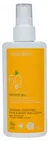
Laboratoire du Haut-Ségala Organic Sun Lotion SPF50
Works for
Sun protectionSPF 50 · 1 UV filter · Partial spectrumWeak protectionLow filter dose
This product does not offer good protection against UVA rays.
This product can be considered "reef safe" because it does not contain the UV filters (oxybenzone and octinoxate) that can be harmful to coral reefs when present in the water in high concentrations.
MoisturizingSide benefit the brand mentions · Caprylic/capric triglyceride, Glycerin + 9 moreWorks
“It is enriched with organic Aloe vera and organic Jojoba and Tamanu essential oils known for their moisturizing and anti-free radical properties.98.5% of the total is of natural origin.”
This product can help improve hydration of the skin with the two types of ingredients.
The first type is called “humectants”:
these ingredients help attract water.
When humectants are on the surface of the skin, they “pull in” the moisture from the outside environment, or from
within deeper layers of the skin. The following ingredients in this product do the job:
glycerin.
This product also contains ingredients called “occlusives”. They help reduce the speed with which our skin loses moisture to the outside environment. These ingredients also help soften the upper layer of the skin, so it feels less tight and nicer to the touch. The following ingredients in this product do the job: caprylic/capric triglyceride, simmondsia chinensis seed oil.
Can it cause trouble?
Irritancy5 strong irritants: Parfum, Sodium anisate + 3 more — patch-test recommendedHigh risk
Comedogenic2 ingredients rated 2 or more on the 0–5 pore-clogging scale2 flagged
User reviews
Be the first — your take helps the next person decide.
Ingredients
Filter by role to see what each ingredient is doing.
Dicaprylyl carbonate~22–33%
- Irritation risk
- Low
Helps products spread more easily and works as an emollient to soften skin
More about Dicaprylyl carbonateCaprylic/capric triglyceride~5.5–8.2%
- Irritation risk
- Medium
A good mix of fatty acids that forms a protective layer on the skin. Improves the shelf life of products. Derived from coconut and glycerin
More about Caprylic/capric triglycerideWater~4.7–7%
Titanium dioxide~4.2–6.2%
- Irritation risk
- Low
Works as a UV filter when used in high concentrations. It is photostable and is effective mostly against the UVB light, with some protection in the UVA range. In small concentrations, used for its ability to improve the color of cosmetic products. Is usually well tolerated by the skin
More about Titanium dioxideGlycerin~3–4.4%
- Irritation risk
- Low
One of the best moisturizing ingredients. Naturally present in skin. It attracts water to the upper layer of the skin working as a humectant
More about GlycerinCoconut alkanes~2.4–3.6%
- Irritation risk
- Medium
- Comedogenicity
- 2/5
An emollient that helps soften the skin
More about Coconut alkanesSimmondsia chinensis seed oil~2–2.9%
- Irritation risk
- Medium
Softens the upper layer of skin and helps restore the healthy skin barrier. Has shown to help calm down inflammation in skin. It is a stable oil, meaning that it retains its properties even when exposed to air.
More about Simmondsia chinensis seed oilPolyglyceryl-3 diisostearate~1.3–2%
- Irritation risk
- Medium
- Comedogenicity
- 3/5
Helps oil and water mix together
More about Polyglyceryl-3 diisostearatePolyglyceryl-2 dipolyhydroxystearate~1.2–1.8%
- Irritation risk
- Low
Helps to soften the upper layer of the skin
More about Polyglyceryl-2 dipolyhydroxystearatePolyhydroxystearic acid~0.95–1.45%
- Irritation risk
- Medium
Used to create a thicker product consistency and stabilize the formulation
More about Polyhydroxystearic acidMagnesium sulfate~0.8–1.2%
Sodium chloride~0.5–1.2%
- Irritation risk
- Low
Used to stabilize mixtures of oil and water, and create thicker, gel-like product textures
More about Sodium chlorideCalophyllum inophyllum seed oil~0.5–1.15%
- Irritation risk
- Low
Parfum~0.4–0.95%
- Irritation risk
- High
An aromatic blend of unspecified and possibly irritating ingredients
More about ParfumAluminum hydroxide~0.45–1.1%
- Irritation risk
- Low
Is used to add opaque (non-transparent) appearance to formulations. Can be used to coat other ingredients for even dispersion. This is a different ingredient compared to the ones used in antipersperants (aluminium chloride and aluminium chlorohydrate)
More about Aluminum hydroxideStearic acid~0.5–1.15%
- Irritation risk
- Low
Helps oil and water mix together and works as an emollient
More about Stearic acidCoco-caprylate/caprate~0.4–0.95%
- Irritation risk
- Low
Helps to soften the upper layer of the skin without creating a greasy texture
More about Coco-caprylate/caprateGlyceryl caprylate~0.35–0.85%
- Irritation risk
- Low
An emollient that can also help water and oil mix together, as well as prevent bacteria growth in products
More about Glyceryl caprylateAloe barbadensis leaf juice powder~0.15–0.65%
- Irritation risk
- Medium
Traditionally used to treat sunburns, dermatitis and inflammation, but evidence for its effectiveness is lacking. The extract can contain humectants that help attract water into the skin
More about Aloe barbadensis leaf juice powderSodium levulinate~0.15–0.65%
Alumina~0.35–0.8%
- Irritation risk
- Low
The same compound that is used safely in dental implants and bone cements. In cosmetics, it is used to improve the consistency of products
More about AluminaSodium anisate~0.1–0.5%
Citric acid~0.1–0.35%
- Irritation risk
- Medium
Can work as an exfoliant but is typically used to adjust the product pH
More about Citric acidTocopherol~0.1–0.35%
- Irritation risk
- Low
Pure form of vitamin E. Can help moisturise and protect the skin from free radicals. Often used to help stabilise other ingredients or the formula itself
More about TocopherolLinalool~0.05–0.25%
Limonene~0.05–0.2%
- Irritation risk
- High
A common frangrance that can easily irritate skin, especially if exposed to air, light or heat
More about LimoneneBenzyl benzoate~0.05–0.2%
- Irritation risk
- High
Fragrance with sweet balsamic smell. Help to preserve products and dissolve other ingredients. Could trigger allergic reactions and be irritating
More about Benzyl benzoateIngredient list view
Dicaprylyl carbonate, Caprylic/capric triglyceride, Water, Titanium dioxide, Glycerin, Coconut alkanes, Simmondsia chinensis seed oil, Polyglyceryl-3 diisostearate, Polyglyceryl-2 dipolyhydroxystearate, Polyhydroxystearic acid, Magnesium sulfate, Sodium chloride, Calophyllum inophyllum seed oil, Parfum, Aluminum hydroxide, Stearic acid, Coco-caprylate/caprate, Glyceryl caprylate, Aloe barbadensis leaf juice powder, Sodium levulinate, Alumina, Sodium anisate, Citric acid, Tocopherol, Linalool, Limonene, Benzyl benzoate
Compare prices
Retailers ranked by price — lowest first.
Affiliate links · As an Amazon Associate, WIMJ earns from qualifying purchases.
Worth comparing, line by line.
Match % combines shared ingredients, the first five ingredients, shared actives and hero ingredients, irritancy (lower counts in the alternative's favour), texture and body area. Only products in the same routine step are compared.
| Laboratoire du Haut-SégalaOrganic Sun Lotion SPF50YOUR PRODUCT | AlphanovaBaby Organic SPF50+ Sunscreen Lotion | Laboratoires de BiarritzOrganic Alga Maris Face Sunscreen SPF30 | ObagiPhysical Defense Broad Spectrum SPF 40 | |
|---|---|---|---|---|
| Match | — | 46% | 37% | 36% |
| Price | — | $16.00 | $22.21 | $69.00 |
| Shared key ingredients | — | 5 of 5 | 4 of 5 | 4 of 5 |
| Key difference | — | — | Sunflower Seed Oil | Dimethicone |
| Irritancy | High | Medium | Medium | Low |
| SPF | SPF 50 | SPF 50 | SPF 30 | SPF 40 |
| Drying alcohol | — | — | — | — |
| View product | Shop | Shop | Shop |


More alternatives: Alphanova Sun Tinted SPF50+ SunscreenToofruit So Solaire My Sunscreen Milk High Protection SPF50 Organic
Product summary
"Laboratoire du Haut-Ségala - Organic Sun Lotion SPF50" does not provide enough UVA protection. UVA rays do not cause sunburn, but still damage the skin, leading to early signs of aging and pigmentation issues.
This moisturizer should also be hydrating enough to use without an additional moisturizer during the day.
Sunscreen filters
This moisturizer is a mineral sunscreen. It uses titanium dioxide for sun protection. Titanium dioxide almost never irritates the skin or stings eyes, but it can leave a white cast.
Irritation risk
There are quite a few common irritants in this product, including ingredients without particular skin benefits. We would not recommend it for sensitive skin. We assess the overall irritancy of this moisturizer to be high. For a detailed overview of all potential irritants: click here
You can see the detailed formula review with the breakdown of all actives in the product and the full ingredient list with estimated concentrations in the tables below.
Sources cited in this review
Every concentration estimate and effectiveness label is anchored to one of these 6 studies and safety reviews.
- 1
- 2Safety Assessment of Magnesium Sulfate as Used in Cosmeticsncbi.nlm.nih.gov
- 3
- 4Safety Assessment of Alkyl Esters as Used in Cosmeticscir-safety.org
- 5Vitamin E in dermatologyncbi.nlm.nih.gov
- 6Vitamin E and Skin Healthlpi.oregonstate.edu

Affiliate links · As an Amazon Associate, WIMJ earns from qualifying purchases.