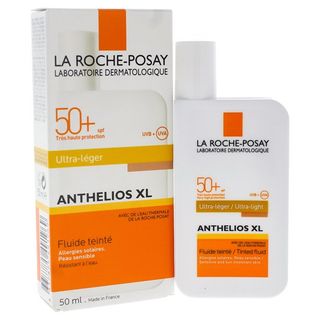
La Roche-Posay Anthelios XL Ultra Light Tinted Fluid SPF 50
Works for
1 of 1 advertised claim delivered
Sun protectionSPF 50 · 7 UV filtersBroad spectrum
This product offers a good level of protection against both UVB and UVA rays.
This sunscreen uses organic (so-called "chemical") sunscreen filters. Organic, or "chemical" filters usually provide reliable sun protection and rarely leave a white cast. Sunscreens with organic filters can sting eyes.
This product can be considered "reef safe" because it does not contain the UV filters (oxybenzone and octinoxate) that can be harmful to coral reefs when present in the water in high concentrations.
Evens skin toneNot advertised by the brand · No ingredient credited for this claimStrong support
This product offers broad spectrum sun protection. It means that it can prevent hyperpigmentation and help keep the skin tone even (sun damage is the main factor causing age spots, darkening of post-acne marks and other discolorations).
Anti-agingNot advertised by the brand · 1 ingredient credited for this claimStrong support
This product can help prevent early signs of skin aging because it offers a good level of broad spectrum sun protection. Sun damage is the main cause of premature skin aging, and protecting your skin from the sun is the best anti-aging strategy.
MoisturizingNot advertised by the brand · 12 ingredients credited for this claimGood support
This product can help improve hydration of the skin with the two types of ingredients.
The first type is called “humectants”:
these ingredients help attract water.
When humectants are on the surface of the skin, they “pull in” the moisture from the outside environment, or from
within deeper layers of the skin. The following ingredients in this product do the job:
glycerin, propylene glycol.
This product also contains ingredients called “occlusives”. They help reduce the speed with which our skin loses moisture to the outside environment. These ingredients also help soften the upper layer of the skin, so it feels less tight and nicer to the touch. The following ingredients in this product do the job: isocetyl stearate, isododecane.
Can it cause trouble?
Irritancy1 strong irritant: ParfumMedium risk
ComedogenicClean of flagged comedogenic ingredientsNone flagged
User reviews
Ingredients
Filter by role to see what each ingredient is doing.
Water~45–55%
Isododecane~6.7–8.2%
- Irritation risk
- Low
An emollient that helps soften the skin and can decrease moisture loss. Helps create a nice product texture
More about IsododecaneIsononyl isononanoate~4.2–5.1%
- Irritation risk
- Low
Forms a protective film on the surface of the skin to prevent moisture loss. Gives a velvety feel to products while reducing tackiness
More about Isononyl isononanoateAlcohol denat.~3.1–3.8%
- Irritation risk
- High
Produces temporary toning effect. Can help dissolve other ingredients or preserve products
More about Alcohol denat.Cyclohexasiloxane~2.4–3%
- Irritation risk
- Low
A silicone that serves as an emollient. Helps create a nice non-greasy feels
More about CyclohexasiloxaneOctocrylene~2.5–3.1%
- Irritation risk
- Medium
A weak sunscreen that protects against the sun rays that cause sunburn (UVB) and is somewhat effective against the UVA rays. It is quite stable and can help stabilize other, more vulnerable, sunscreen ingredients like Avobenzone. It is an organic, or so called "chemical" sunscreen
More about OctocryleneDicaprylyl carbonate~1.7–2.1%
- Irritation risk
- Low
Helps products spread more easily and works as an emollient to soften skin
More about Dicaprylyl carbonateTitanium dioxide~2–2.4%
- Irritation risk
- Low
Works as a UV filter when used in high concentrations. It is photostable and is effective mostly against the UVB light, with some protection in the UVA range. In small concentrations, used for its ability to improve the color of cosmetic products. Is usually well tolerated by the skin
More about Titanium dioxideIsocetyl stearate~1.2–1.5%
- Irritation risk
- Low
An emollient that helps soften the skin
More about Isocetyl stearateGlycerin~1–1.2%
- Irritation risk
- Low
One of the best moisturizing ingredients. Naturally present in skin. It attracts water to the upper layer of the skin working as a humectant
More about GlycerinButyl methoxydibenzoylmethane~1.1–1.4%
- Irritation risk
- Medium
Avobenzone. An organic, or so-called "chemical" UV filter. Protects against both UVA and UVB rays. Needs to be combined with other filters in a formulation to be stable.
More about Butyl methoxydibenzoylmethanePeg-30 dipolyhydroxystearate~0.6–0.85%
- Irritation risk
- Medium
Helps oil and water mix together
More about Peg-30 dipolyhydroxystearatePolymethylsilsesquioxane~0.55–0.85%
- Irritation risk
- Low
A silicone that improves product texture and helps dissolve other ingredients. Can form a non-greasy film on the skin to prevent moisture loss
More about PolymethylsilsesquioxaneBis-ethylhexyloxyphenol methoxyphenyl triazine~0.65–1%
- Irritation risk
- Medium
Tinosorb S. One of the most effective broad spectrum sunscreen ingredients. Protects from both UVA and UVB rays. It is photostable. Unfortunately, not approved by FDA (US) yet.
More about Bis-ethylhexyloxyphenol methoxyphenyl triazinePropylene glycol~0.4–0.6%
- Irritation risk
- High
Helps oil and water mix together and can enhance the penetration of other ingredients into the skin. It can be irritating
More about Propylene glycolSilica~0.6–0.95%
Cassia alata leaf extract~0.4–0.6%
- Irritation risk
- Medium
Might have some anti-oxidant properties. Can be used as a fragrance. Can be irritating
More about Cassia alata leaf extractIron oxides~0.35–0.6%
- Irritation risk
- Low
An umbrella term for the following three colorants: CI 77491, CI 77492, CI 77499. They might be able to offer some protection against visible light, but the degree of the protection is not clear
More about Iron oxidesCi 77891~0.3–0.55%
- Irritation risk
- Low
Titanium dioxide~0.45–0.65%
- Irritation risk
- Low
Works as a UV filter when used in high concentrations. It is photostable and is effective mostly against the UVB light, with some protection in the UVA range. In small concentrations, used for its ability to improve the color of cosmetic products. Is usually well tolerated by the skin
More about Titanium dioxideDisodium edta~0.25–0.5%
Disteardimonium hectorite~0.25–0.5%
- Irritation risk
- Low
A type of clay that is used to thicken the product consistency
More about Disteardimonium hectoriteDodecene~0.25–0.45%
- Irritation risk
- Low
Drometrizole trisiloxane~0.45–0.65%
- Irritation risk
- Medium
Mexoryl XL. A UV filter. Effective in the UVB and UVA range. It is stable. Unfortunately, not approved in the US yet
More about Drometrizole trisiloxaneEthylhexyl triazone~0.45–0.65%
- Irritation risk
- Medium
Uvinul T. A UV filter. Effective against UVB rays. It is photostable. Can increase water resistance properties of the sunscreen. Unfortunately, not approved by the FDA (US) yet
More about Ethylhexyl triazoneIsopropyl lauroyl sarcosinate~0.25–0.5%
- Irritation risk
- Medium
Helps soften the upper layer of the skin and create a nice product consistency
More about Isopropyl lauroyl sarcosinateIsostearyl alcohol~0.25–0.45%
- Irritation risk
- Low
Helps soften the upper layer of the skin
More about Isostearyl alcoholLauryl peg/ppg-18/18 methicone~0.25–0.4%
- Irritation risk
- Medium
Helps oil and water mix together. It might be irritating for some people
More about Lauryl peg/ppg-18/18 methiconeMaltodextrin~0.2–0.4%
- Irritation risk
- Low
Used to stabilize the product formulation and can help absorb oil
More about MaltodextrinPhenoxyethanol~0.2–0.35%
- Irritation risk
- Low
A preservative. It helps prevent bacterial growth in cosmetic products
More about PhenoxyethanolPoloxamer 407~0.2–0.4%
Poly c10-30 alkyl acrylate~0.15–0.3%
- Irritation risk
- Low
Propylene carbonate~0.2–0.35%
- Irritation risk
- Low
Is used to dissolve other ingredients and create nice product texture
More about Propylene carbonateTerephthalylidene dicamphor sulfonic acid~0.25–0.5%
- Irritation risk
- Medium
Ecamsule, Mexoryl SX. A UV filter. Is effective mostly against the UVA rays. It is legally marketed in the US with the FDA approval since 2006, even though the ingredient is not on the official FDA list of the approved sunscreen active ingredients. It is photostable
More about Terephthalylidene dicamphor sulfonic acidTocopherol~0.1–0.2%
- Irritation risk
- Low
Pure form of vitamin E. Can help moisturise and protect the skin from free radicals. Often used to help stabilise other ingredients or the formula itself
More about TocopherolTriethanolamine~0.1–0.15%
- Irritation risk
- Medium
Used to adjust pH of the product and can help improve the product's smell
More about TriethanolamineParfum~0.05–0.1%
- Irritation risk
- High
An aromatic blend of unspecified and possibly irritating ingredients
More about ParfumIngredient list view
Water, Isododecane, Isononyl isononanoate, Alcohol denat., Cyclohexasiloxane, Octocrylene, Dicaprylyl carbonate, Titanium dioxide, Isocetyl stearate, Glycerin, Butyl methoxydibenzoylmethane, Peg-30 dipolyhydroxystearate, Polymethylsilsesquioxane, Bis-ethylhexyloxyphenol methoxyphenyl triazine, Propylene glycol, Silica, Cassia alata leaf extract, Iron oxides, Ci 77891, Titanium dioxide, Disodium edta, Disteardimonium hectorite, Dodecene, Drometrizole trisiloxane, Ethylhexyl triazone, Isopropyl lauroyl sarcosinate, Isostearyl alcohol, Lauryl peg/ppg-18/18 methicone, Maltodextrin, Phenoxyethanol, Poloxamer 407, Poly c10-30 alkyl acrylate, Propylene carbonate, Terephthalylidene dicamphor sulfonic acid, Tocopherol, Triethanolamine, Parfum
Compare prices
Retailers ranked by price — lowest first.

Affiliate links · prices updated regularly
Product summary
We assess that "La Roche-Posay - Anthelios XL Ultra Light Tinted Fluid SPF 50" can provide reliable sun protection based on the ingredient list. We love that it can protect from both UVA and UVB rays (not all sunscreens with SPF ratings give UVA protection. UVA rays do not cause sunburn, but still damage our skin and lead to early aging).
Because it includes good moisturizing ingredients, it can also work as a hydrating day cream. Like all broad-spectrum sunscreens, this product has an anti-aging benefit.
Sunscreen filters
This is a "mixed" sunscreen in the sense that it uses both mineral and organic (so-called "chemical") sun filters. Here are the organic filters this product uses: tinosorb s, avobenzone, mexoryl xl, uvinul t, octocrylene and terephthalylidene dicamphor sulfonic acid. As for the mineral filters, this sunscreen uses titanium dioxide.
Irritation risk
This formulation includes some common irritants, including ingredients that do not provide a benefit for the skin. We assess the overall irritancy of this moisturizer to be medium. For a detailed overview of all potential irritants: click here
You can see the detailed formula review with the breakdown of all actives in the product and the full ingredient list with estimated concentrations in the tables below.
What our users say
Based on 4 reviews 100% recommend this product- When it comes to using this sunscreen under makeup, the majority of the reviewers (1 %) find that it pills under makeup.
- When it comes to comedogenicity, two out of three reviewers didn't notice clogged pores after using this sunscreen, but the third reviewer found that it clogged pores.
- As for the white cast, the majority of the reviewers (1 %) find that it leaves a noticeable white cast.
- As for using this sunscreen in the eye area, the vast majority of the reviewers (100%) find that it stings eyes.
Price
The product retails for 28.06$ in the United States.
For a detailed price comparison: click here.
Sources cited in this review
Every concentration estimate and effectiveness label is anchored to one of these 7 studies and safety reviews.
- 1
- 2Surfactants and experimental irritant contact dermatitisncbi.nlm.nih.gov
- 3Propylene Glycolpubmed.ncbi.nlm.nih.gov
- 4Skin-sensitizing and irritant properties of propylene glycolonlinelibrary.wiley.com
- 5
- 6Vitamin E in dermatologyncbi.nlm.nih.gov

Affiliate links · As an Amazon Associate, WIMJ earns from qualifying purchases.