Works for
Anti-blemishAloe barbadensis leaf juice, Rosmarinus officinalis leaf extractNot delivered
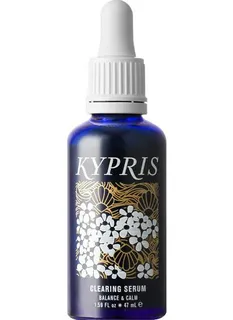
“Kypris Clearing Serum helps to balance oily skin and reduce the appearance of blemishes old and new.”
Effective ingredients missing or their concentration is too low.
Anti-oxidationNot advertised by the brand · Ferulic acid, Superoxide dismutase + 5 moreWorks well
This product contains antioxidants (ferulic acid, superoxide dismutase) that can help neutralize free radicals in skin. By doing so, they can lessen the damage the skin gets from the UV light (sun).
MoisturizingNot advertised by the brand · Panthenol, Glycerin + 15 moreWorks well
This product can help improve hydration of the skin with the two types of ingredients.
The first type is called “humectants”:
these ingredients help attract water.
When humectants are on the surface of the skin, they “pull in” the moisture from the outside environment, or from
within deeper layers of the skin. The following ingredients in this product do the job:
ahnfeltia concinna extract, anhydroxylitol.
This product also contains ingredients called “occlusives”. They help reduce the speed with which our skin loses moisture to the outside environment. These ingredients also help soften the upper layer of the skin, so it feels less tight and nicer to the touch. The following ingredients in this product do the job: helianthus annuus seed oil, camellia oleifera seed oil.
The following ingredients in this product are especially good for supporting the skin barrier and helping with the hydration level: panthenol
Anti-agingNot advertised by the brand · Ferulic acid, Dipalmitoyl hydroxyproline + 3 moreMay help
This product contains ferulic acid. This ingredient might be able to help reduce and prevent fine lines and wrinkles, improve skin elasticity and firmness, but there is not enough evidence that it actually works.
Evens skin toneNot advertised by the brand · Ferulic acidMay help
The following ingredient (ingredients) in this product might be helpful, but there is no evidence to confirm that it actually works: ferulic acid.
Can it cause trouble?
Irritancy4 strong irritants: Rosa centifolia flower extract, Rosa damascena flower extract + 2 more — patch-test recommendedHigh risk
ComedogenicClean of flagged comedogenic ingredientsNone flagged


User reviews
Be the first — your take helps the next person decide.
Ingredients
Filter by role to see what each ingredient is doing.
Water~45–55%
Glycerin~4.9–6%
- Irritation risk
- Low
One of the best moisturizing ingredients. Naturally present in skin. It attracts water to the upper layer of the skin working as a humectant
More about GlycerinHelianthus annuus seed oil~4.2–5.1%
- Irritation risk
- Low
A great emollient due to its high linoleic acid content. One of the most effective plant oils in helping skin hydration and repairing skin barrier function
More about Helianthus annuus seed oilCamellia oleifera seed oil~3.1–3.8%
- Irritation risk
- Medium
An emollient that does not leave a greasy finish
More about Camellia oleifera seed oilLeuconostoc/radish root ferment filtrate~2.3–2.8%
- Irritation risk
- Medium
A preservative that comes from radishes fermented by a bacteria. New research suggests that the preservation properties in the ingredient come from an ammonium salt that is not present naturally in radish root but used in its cultivation. Is problematic because the exact amount of the preservative agents is difficult to determine
More about Leuconostoc/radish root ferment filtrateXylitylglucoside~1.9–2.3%
- Irritation risk
- Low
Helps attract water to the upper layer of the skin and repair the skin barrier function
More about XylitylglucosideBetaine~1.6–1.9%
- Irritation risk
- Low
Helps attract water to the upper layer of the skin and improves the product texture
More about BetaineDipalmitoyl hydroxyproline~1.4–1.7%
- Irritation risk
- Low
Is claimed to stimulate collagen and elastin production, as well as work as an anti-oxidant. There is however not enough evidence for its effectiveness
More about Dipalmitoyl hydroxyprolinePanthenol~1.2–1.5%
- Irritation risk
- Low
Helps attract water to the upper layer of the skin and can help improve skin barrier function
More about PanthenolAhnfeltia concinna extract~0.95–1.15%
- Irritation risk
- Low
An algae extract that helps attract water to the upper layer of the skin. Also used to create a thicker product texture
More about Ahnfeltia concinna extractAloe barbadensis leaf juice~0.7–1.05%
- Irritation risk
- Medium
Traditionally used to treat sunburns, dermatitis and inflammation, but evidence for its effectiveness is lacking. The extract can contain humectants that help attract water into the skin
More about Aloe barbadensis leaf juiceAnhydroxylitol~0.6–0.85%
- Irritation risk
- Low
Helps attract water to the upper layer of the skin and repair the skin barrir function
More about AnhydroxylitolCalophyllum inophyllum seed oil~0.55–0.85%
- Irritation risk
- Low
Symphytum officinale leaf extract~0.45–0.7%
- Irritation risk
- High
A plant extract that has an anti-bacterial effect
More about Symphytum officinale leaf extractTocopherol~0.45–0.7%
- Irritation risk
- Low
Pure form of vitamin E. Can help moisturise and protect the skin from free radicals. Often used to help stabilise other ingredients or the formula itself
More about TocopherolUrtica dioica extract~0.4–0.6%
- Irritation risk
- Low
Waltheria indica leaf extract~0.4–0.6%
- Irritation risk
- Low
Citric acid~0.35–0.65%
- Irritation risk
- Medium
Can work as an exfoliant but is typically used to adjust the product pH
More about Citric acidDextrin~0.35–0.6%
- Irritation risk
- Low
A sugar that is used to stabilize the product formulation. Can help attract water to the upper layer of the skin
More about DextrinFerulic acid~0.3–0.55%
- Irritation risk
- Low
A potent anti-oxidant that has been shown to be effective in neutralizing free radicals in skin. There seem to have a synergetic effect of ferulic acid, vitamin E and C, meaning that when the ingredients are used together, they enhance each other's ability protect the skin against free radicals. Ferulic acid also helps to stabilize other ingredients - including vitamins C and E. It can help to even out the skin tone. Ferulic acid is approved for use as a sunscreen ingredient in Japan in concentrations up to 10%
More about Ferulic acidLecithin~0.3–0.6%
- Irritation risk
- Low
Used mostly for creating emulsions - helping oil and water mix together. Helps soften the upper layer of the skin
More about LecithinMannitol~0.25–0.5%
- Irritation risk
- Low
Helps to attract water to the upper layer of the skin
More about MannitolPhospholipids~0.25–0.5%
- Irritation risk
- Low
Emollients that are naturaly present in skin. In addition, they help water and oil mix together in the product
More about PhospholipidsPrunus cerasus flower extract~0.25–0.45%
- Irritation risk
- Low
Rosa centifolia flower extract~0.25–0.4%
- Irritation risk
- High
Contains essential oil. Can be irritating
More about Rosa centifolia flower extractRosa damascena flower extract~0.2–0.4%
Rosmarinus officinalis leaf extract~0.2–0.35%
- Irritation risk
- High
Can be helpful in reducing inflammation in skin, including inflamed acne. It can be irritating
More about Rosmarinus officinalis leaf extractSuperoxide dismutase~0.25–0.4%
- Irritation risk
- Low
An antioxidant enzyme that is naturally present in skin. It can help support skin barrier function and reduce inflammation in skin. It is used in topical medications for inflammatory skin conditions including atopic dermatitis (eczema) and psoriasis. There are three types of natural Superoxide Dismutase in human skin. The compound used in topical treatments and cosmetics are mimics of typically one of these natural variants
More about Superoxide dismutaseAscorbyl palmitate~0.2–0.35%
- Irritation risk
- Medium
Being a lipid soluble form of vitamin C, it is more stable and can penetrate the skin better than L-Ascorbic acid. It is effective in protecting the skin from free radicals, as well as evening the skin tone, but is less effective in stimulating collagen production compared to L-Ascorbic acid.
More about Ascorbyl palmitateSodium citrate~0.2–0.35%
- Irritation risk
- Medium
Helps to control the skin's pH level. Maintains the skin's natural film of amino-lactic acids and oils. Helps to preserve products
More about Sodium citrateSodium gluconate~0.15–0.3%
Sodium hyaluronate~0.15–0.3%
- Irritation risk
- Low
One of the best moisturizing ingredients. Attracts water into the upper layer of the skin
More about Sodium hyaluronateSodium levulinate~0.15–0.25%
Xanthan gum~0.1–0.2%
- Irritation risk
- Low
Used to create a thicker product consistency
More about Xanthan gumXylitol~0.1–0.15%
- Irritation risk
- Low
Helps attract water to the upper layer of the skin and repair the skin barrier function
More about XylitolSodium anisate~0.1–0.15%
Ingredient list view
Water, Glycerin, Helianthus annuus seed oil, Camellia oleifera seed oil, Leuconostoc/radish root ferment filtrate, Xylitylglucoside, Betaine, Dipalmitoyl hydroxyproline, Panthenol, Ahnfeltia concinna extract, Aloe barbadensis leaf juice, Anhydroxylitol, Calophyllum inophyllum seed oil, Symphytum officinale leaf extract, Tocopherol, Urtica dioica extract, Waltheria indica leaf extract, Citric acid, Dextrin, Ferulic acid, Lecithin, Mannitol, Phospholipids, Prunus cerasus flower extract, Rosa centifolia flower extract, Rosa damascena flower extract, Rosmarinus officinalis leaf extract, Superoxide dismutase, Ascorbyl palmitate, Sodium citrate, Sodium gluconate, Sodium hyaluronate, Sodium levulinate, Xanthan gum, Xylitol, Sodium anisate
Compare prices
Retailers ranked by price — lowest first.


Worth comparing, line by line.
Match % combines shared ingredients, the first five ingredients, shared actives and hero ingredients, irritancy (lower counts in the alternative's favour), texture and body area. Only products in the same routine step are compared.
| KyprisClearing Blemish SerumYOUR PRODUCT | Pure & CareSerum Oil-Cocktail Night Repair- 1 pcs | innisfreeVitamin C Green Tea Enzyme Brightening Serum | HanskinSeven Layer Ceramide Serum | |
|---|---|---|---|---|
| Match | — | 54% | 52% | 51% |
| Price | $90.00 | — | $31.22−$58.78 | $14.00−$76.00 |
| Shared key ingredients | — | 7 of 14 | 6 of 14 | 6 of 14 |
| Key difference | — | Oligopeptide-5 | Madecassoside | Ceramide Ap |
| Irritancy | High | Medium | Medium | Medium |
| Drying alcohol | — | — | — | — |
| View product | Shop | Shop | Shop |


More alternatives: Balea Serum Aqua FeuchtigkeitMEDIHEAL Baobab Soothing Moisture Serum
Product summary
"Kypris - Clearing Blemish Serum" is effective for: Anti-inflammatory and Moisturizing
This product could be helpful for: Anti-aging, but its actives are not the most effective or are not well-studied.
Ingredient callouts
- Ceramides (ceramide np 0.40% - 0.65%). Ceramides are a type of lipids that our skin produces itself. They are a building block of the skin's barrier. Ceramides used in skincare are synthetic or extracted from plants. They work well for softening the skin surface and "patch holes" in the skin's barrier.
- Actives derived from an extract of the Centella Asiatica plant (also known as Gotu Kola) - asiaticoside 0.70% - 1.05% The Centella Asiatica Actives, even in low concentration, can help reduce inflammation in skin, strengthen the skin barrier and reduce photodamage. They can also help to decrease scarring.
- Humectants (zinc pca 3.80% - 4.70%, sarcosine 2.10% - 2.50% and glycerin 4.90% - 6.00%). These ingredients help attract water to the upper layer of the skin and improve the skin hydration.
About the brand
According to Cruelty-Free Kitty "Kypris" is cruelty free and so is its parent company.
Price
The product retails from 62.45$ up to 90.00$ in the United States, for 100.50CA$ in Canada and for 52.00£ in the United Kingdom.
For a detailed price comparison: click here.
Sources cited in this review
Every concentration estimate and effectiveness label is anchored to one of these 26 studies and safety reviews.
- 1
- 2
- 3
- 4Effect of topically applied lipids on surfactant-irritated skinonlinelibrary.wiley.com
- 5
- 6Skin moisturizing effects of panthenol-based formulationspdfs.semanticscholar.org

Affiliate links · As an Amazon Associate, WIMJ earns from qualifying purchases.