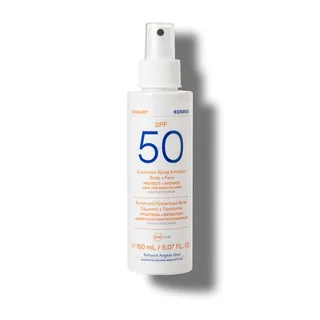
KORRES Yoghurt Sunscreen Spray Emulsion Body + Face SPF 50
Works for
Sun protectionSPF 50 · 6 UV filtersBroad spectrum
This product offers a good level of protection against both UVB and UVA rays.
This sunscreen uses organic (so-called "chemical") sunscreen filters. Organic, or "chemical" filters usually provide reliable sun protection and rarely leave a white cast. Sunscreens with organic filters can sting eyes.
This product can be considered "reef safe" because it does not contain the UV filters (oxybenzone and octinoxate) that can be harmful to coral reefs when present in the water in high concentrations.
Evens skin toneSide benefit · Lactic acidWorks well
This product offers broad spectrum sun protection. It means that it can prevent hyperpigmentation and help keep the skin tone even (sun damage is the main factor causing age spots, darkening of post-acne marks and other discolorations).
Anti-agingSide benefit · Lactic acidWorks well
This product can help prevent early signs of skin aging because it offers a good level of broad spectrum sun protection. Sun damage is the main cause of premature skin aging, and protecting your skin from the sun is the best anti-aging strategy.
Can it cause trouble?
Irritancy2 strong irritants: Zingiber officinale root extract, ParfumMedium risk
ComedogenicClean of flagged comedogenic ingredientsNone flagged
User reviews
Be the first — your take helps the next person decide.
Ingredients
Filter by role to see what each ingredient is doing.
Water~45–55%
Homosalate~6–7.3%
- Irritation risk
- Medium
A weak sunscreen that offers some protection against the sun rays that cause sunburn (UVB), but does not offer meaningful protection against protect against the most aging sun rays (UVA). It loses its effectiveness quickly when exposed to sunlight. It is an organic, or so called "chemical" sunscreen. When used in low concentrations, helps to stabilize the product formulation
More about HomosalateDiethylamino hydroxybenzoyl hexyl benzoate~4.5–5.5%
- Irritation risk
- Medium
Uvinul A Plus. A new generation broad spectrum sunscreen that offers an effective protection especially in the UVA range. It is stable in formulations. Unfortunately, is not approved by the FDA (US) yet
More about Diethylamino hydroxybenzoyl hexyl benzoateDibutyl adipate~3.2–3.9%
- Irritation risk
- Low
Helps soften the upper layer of the skin and create a nice product consistency
More about Dibutyl adipateEthylhexyl salicylate~3.2–3.9%
- Irritation risk
- Low
Octisalate. A UV filter. It offers some protection against the sun rays that cause sunburn (UVB), but does not protect against the most aging sun rays (UVA). It loses its effectiveness quickly when exposed to sunlight. It is an organic, or so called "chemical" sunscreen
More about Ethylhexyl salicylateBis-ethylhexyloxyphenol methoxyphenyl triazine~2.5–3.1%
- Irritation risk
- Medium
Tinosorb S. One of the most effective broad spectrum sunscreen ingredients. Protects from both UVA and UVB rays. It is photostable. Approved by the US FDA in 2026 (listed as bemotrizinol on US labels).
More about Bis-ethylhexyloxyphenol methoxyphenyl triazineDiethylhexyl butamido triazone~2.2–2.6%
- Irritation risk
- Medium
Uvasorb HEB. A UV filter. Is effective against UVB and UVA II rays (but not UVA I). It is photostable. Unfortunately, is not approved by FDA (US) yet
More about Diethylhexyl butamido triazoneTriheptanoin~1.4–1.7%
- Irritation risk
- Low
A synthetic triglyceride. Helps soften the upper layer of the skin
More about TriheptanoinEthylhexyl triazone~1.7–2.1%
- Irritation risk
- Medium
Uvinul T. A UV filter. Effective against UVB rays. It is photostable. Can increase water resistance properties of the sunscreen. Unfortunately, not approved by the FDA (US) yet
More about Ethylhexyl triazoneIsoamyl laurate~1–1.2%
- Irritation risk
- Medium
Helps stabilize emulsions and create a nice product texture
More about Isoamyl lauratePropanediol~0.7–1.05%
- Irritation risk
- Low
Acts as a solvent for other ingredients. Speeds up the absorption of other ingredients into the skin
More about PropanediolAlcohol denat.~0.6–0.85%
- Irritation risk
- High
Produces temporary toning effect. Can help dissolve other ingredients or preserve products
More about Alcohol denat.Trilaureth-4 phosphate~0.55–0.8%
- Irritation risk
- Medium
Helps oil and water mix together
More about Trilaureth-4 phosphatePolymethyl methacrylate~0.5–0.75%
- Irritation risk
- Low
Is used to enhance product texture and can help to optically mask skin imperfections
More about Polymethyl methacrylateSilica~0.65–0.95%
Polyamide-3~0.45–0.7%
- Irritation risk
- Low
Ammonium acryloyldimethyltaurate/beheneth-25 methacrylate crosspolymer~0.45–0.65%
- Irritation risk
- Medium
Used to stabilize product formulations
More about Ammonium acryloyldimethyltaurate/beheneth-25 methacrylate crosspolymerAmmonium acryloyldimethyltaurate/vp copolymer~0.35–0.65%
- Irritation risk
- Low
Increases thickness of a product. Texture enhancer for oil-in-water emulsions
More about Ammonium acryloyldimethyltaurate/vp copolymerBisabolol~0.3–0.5%
- Irritation risk
- Low
An active component of chamomile plant that historically has been used to calm down irritated skin. A recent study shows that bisabolol indeed can have some anti-inflammatory effect on skin, even though conclusive data is lacking. Bisabolol has a sweet floral scent and can be added to products for its aromatic properties
More about BisabololGlyceryl stearate~0.35–0.65%
- Irritation risk
- Low
An emollient that softens the skin and forms a protective layer on its surface. Helps water and oil mix together
More about Glyceryl stearateHydroxyacetophenone~0.3–0.5%
Lactic acid~0.25–0.45%
- Irritation risk
- Medium
An exfoliating and moisturizing alpha-hydroxy acid (AHA). Typically causes less irritation than other AHAs, for example, glycolic acid. At high concentrations (about 15%), lactic acid can help reduce lines and wrinkles. Recent studies show that lactic acid can support the "good" bacteria living on skin's surface (healthy skin microbiome)
More about Lactic acidPanthenol~0.25–0.45%
- Irritation risk
- Low
Helps attract water to the upper layer of the skin and can help improve skin barrier function
More about PanthenolPeg-100 stearate~0.3–0.6%
- Irritation risk
- Low
Helps oil and water mix togehter and creates a nice product texture
More about Peg-100 stearatePentaerythrityl tetra-di-t-butyl hydroxyhydrocinnamate~0.25–0.5%
- Irritation risk
- Low
Used to increase stability of product formulations
More about Pentaerythrityl tetra-di-t-butyl hydroxyhydrocinnamateSodium carboxymethyl beta-glucan~0.65–0.95%
- Irritation risk
- Low
Helps thicken the product formulation and create a gel-like texture
More about Sodium carboxymethyl beta-glucanSorbitan stearate~0.25–0.45%
Tetrasodium glutamate diacetate~0.2–0.4%
- Irritation risk
- Low
Helps stabilize the product formulation
More about Tetrasodium glutamate diacetateTocopheryl acetate~0.25–0.4%
- Irritation risk
- Medium
A more stable but less bio-available form of vitamin E compared to Tocopherol. Might help moisturize and protect the skin from free radicals, but mostly used in low concentrations to stabilize other ingredients.
More about Tocopheryl acetateXanthan gum~0.2–0.4%
- Irritation risk
- Low
Used to create a thicker product consistency
More about Xanthan gumYogurt powder~0.2–0.35%
- Irritation risk
- Low
Zingiber officinale root extract~0.1–0.2%
- Irritation risk
- High
A plant extract that can contain an irritating essential oil. Might have some anti-oxidant effect, but evidence is lacking
More about Zingiber officinale root extractBenzoic acid~0.15–0.3%
Dehydroacetic acid~0.1–0.2%
Phenoxyethanol~0.1–0.2%
- Irritation risk
- Low
A preservative. It helps prevent bacterial growth in cosmetic products
More about PhenoxyethanolParfum~0.05–0.1%
- Irritation risk
- High
An aromatic blend of unspecified and possibly irritating ingredients
More about ParfumIngredient list view
Water, Homosalate, Diethylamino hydroxybenzoyl hexyl benzoate, Dibutyl adipate, Ethylhexyl salicylate, Bis-ethylhexyloxyphenol methoxyphenyl triazine, Diethylhexyl butamido triazone, Triheptanoin, Ethylhexyl triazone, Isoamyl laurate, Propanediol, Alcohol denat., Trilaureth-4 phosphate, Polymethyl methacrylate, Silica, Polyamide-3, Ammonium acryloyldimethyltaurate/beheneth-25 methacrylate crosspolymer, Ammonium acryloyldimethyltaurate/vp copolymer, Bisabolol, Glyceryl stearate, Hydroxyacetophenone, Lactic acid, Panthenol, Peg-100 stearate, Pentaerythrityl tetra-di-t-butyl hydroxyhydrocinnamate, Sodium carboxymethyl beta-glucan, Sorbitan stearate, Tetrasodium glutamate diacetate, Tocopheryl acetate, Xanthan gum, Yogurt powder, Zingiber officinale root extract, Benzoic acid, Dehydroacetic acid, Phenoxyethanol, Parfum
Compare prices
Retailers ranked by price — lowest first.
Worth comparing, line by line.
Match % combines shared ingredients, the first five ingredients, shared actives and hero ingredients, irritancy (lower counts in the alternative's favour), texture and body area. Only products in the same routine step are compared.
| KORRESYoghurt Sunscreen Spray Emulsion Body + Face SPF 50YOUR PRODUCT | Alpha-HDaily Essential Moisturiser SPF50+ With Hydrosella | ISDINFotoprotector Gel Cream Pediatrics LSF 50 | skincode-SwissSun Protection Face Lotion SPF 50+ | |
|---|---|---|---|---|
| Match | — | 49% | 47% | 47% |
| Price | — | $49.67 | — | $47.31 |
| Shared key ingredients | — | 4 of 9 | 4 of 9 | 5 of 9 |
| Key difference | — | Erythritol | Avobenzone | Glycerin |
| Irritancy | Medium | Low | Low | Low |
| SPF | SPF 50 | SPF 50 | SPF 50 | SPF 50 |
| Drying alcohol | Contains drying alcohol | Contains drying alcohol | — | Contains drying alcohol |
| View product | Shop | Shop | Shop |


More alternatives: EUBOS Cool & Calm - Redness Relieving CC Cream SPF 50BABOR Doctor Babor Protect Cellular: Mattifying Protector SPF30
Product summary
Based on the ingredients included, we believe that "KORRES - Yoghurt Sunscreen Spray Emulsion Body + Face SPF 50" can offer reliable sun protection. It can protect from both UVA and UVB rays. This is great news because not all sunscreens with SPF ratings give UVA protection. (UVA rays do not cause sunburn, but still damage our skin and lead to early aging).
Like all broad-spectrum sunscreens, this product helps prevent early signs of aging.
Sunscreen filters
This is a so-called "chemical" sunscreen. It means that it uses organic UV filters. They typically offer good sun protection and rarely leave a white cast, but they can be irritating for some people with sensitive skin. These are the sun protection ingredients in this sunscreen: tinosorb s 2.50% - 3.10%, uvinul a plus 4.50% - 5.50%, uvasorb heb 2.20% - 2.60%, octisalate 3.20% - 3.90%, uvinul t 1.70% - 2.10% and homosalate 6.00% - 7.30%.
Irritation risk
This formulation includes some common irritants, including ingredients that do not provide a benefit for the skin. We assess the overall irritancy of this moisturizer to be medium. For a detailed overview of all potential irritants: click here
You can see the detailed formula review with the breakdown of all actives in the product and the full ingredient list with estimated concentrations in the tables below.
About the brand
According to Cruelty-Free Kitty "KORRES" is cruelty free, but its parent company is not.
Price
The product retails for 33.00€ in Greece.
For a detailed price comparison: click here.
Sources cited in this review
Every concentration estimate and effectiveness label is anchored to one of these 10 studies and safety reviews.
- 1
- 2
- 3
- 4Epidermal and dermal effects of topical lactic acidncbi.nlm.nih.gov
- 5Dual Effects of Alpha-Hydroxy Acids on the Skinpdfs.semanticscholar.org
- 6Skin moisturizing effects of panthenol-based formulationspdfs.semanticscholar.org

Affiliate links · As an Amazon Associate, WIMJ earns from qualifying purchases.