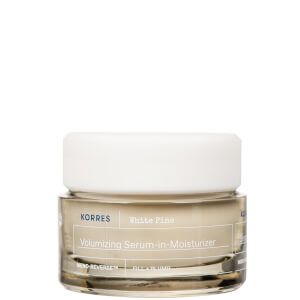
KORRES White Pine Meno-Reverse Serum-in-Moisturiser
Works for
1 of 2 advertised claims delivered
Moisturizing19 ingredients credited for this claimGood support
“replenishing hydration”
This product can help improve hydration of the skin with the two types of ingredients.
The first type is called “humectants”:
these ingredients help attract water.
When humectants are on the surface of the skin, they “pull in” the moisture from the outside environment, or from
within deeper layers of the skin. The following ingredients in this product do the job:
glycerin, sodium hyaluronate.
This product also contains ingredients called “occlusives”. They help reduce the speed with which our skin loses moisture to the outside environment. These ingredients also help soften the upper layer of the skin, so it feels less tight and nicer to the touch. The following ingredients in this product do the job: caprylic/capric triglyceride, helianthus annuus seed oil.
Anti-aging4 ingredients credited for this claimWeak support
“plump and firm the appearance of dry, sagging skin”
Effective ingredients missing or their concentration is too low.
Evens skin toneNot advertised by the brand · 3 ingredients credited for this claimModerate support
The following ingredient (ingredients) in this product might be helpful, but there is no evidence to confirm that it actually works: pancratium maritimum extract.
Can it cause trouble?
Irritancy7 strong irritants: Passiflora incarnata seed oil, Alpha-isomethyl ionone + 5 more — patch-test recommendedHigh risk
Comedogenic1 ingredient rated 2 or more on the 0–5 pore-clogging scale1 flagged


User reviews
Be the first — your take helps the next person decide.
Ingredients
Filter by role to see what each ingredient is doing.
Water~45–55%
Glycerin~4.4–5.4%
- Irritation risk
- Low
One of the best moisturizing ingredients. Naturally present in skin. It attracts water to the upper layer of the skin working as a humectant
More about GlycerinPolyglyceryl-6 distearate~3.6–4.5%
- Irritation risk
- Medium
Helps oil and water mix together while softening the upper layer of the skin
More about Polyglyceryl-6 distearateIsoamyl laurate~3.1–3.7%
- Irritation risk
- Medium
Helps stabilize emulsions and create a nice product texture
More about Isoamyl lauratePropanediol~2.2–2.7%
- Irritation risk
- Low
Acts as a solvent for other ingredients. Speeds up the absorption of other ingredients into the skin
More about PropanediolCaprylic/capric triglyceride~1.9–2.3%
- Irritation risk
- Medium
A good mix of fatty acids that forms a protective layer on the skin. Improves the shelf life of products. Derived from coconut and glycerin
More about Caprylic/capric triglyceridePentaerythrityl distearate~1.6–1.9%
Cetyl palmitate~1.4–1.7%
- Irritation risk
- Low
An emollient that helps soften the skin and is used to improve product texture and stability
More about Cetyl palmitateOlea europaea oil unsaponifiables~1.1–1.4%
- Irritation risk
- Low
Help soften the upper layer of the skin
More about Olea europaea oil unsaponifiablesPassiflora incarnata seed oil~0.9–1.1%
- Irritation risk
- High
A plant oil that can help soften the upper layer of the skin. Contains essential oil that can be irritating
More about Passiflora incarnata seed oilCetyl alcohol~0.75–1.1%
- Irritation risk
- Low
A non-drying alcohol that works to soften the skin and stabilize product formulations helping oil and water mix together
More about Cetyl alcoholJojoba esters~0.6–0.85%
- Irritation risk
- Medium
An emollient made of jojoba oil. Helps soften the skin and support its barrier function
More about Jojoba estersMicrocrystalline cellulose~0.6–0.9%
Butyrospermum parkii butter~0.5–0.75%
- Irritation risk
- Low
- Comedogenicity
- 3/5
A great moisturising ingredient that softens the skin and reduces water loss from its upper layer. It also can be helpful in protecting skin from free radicals
More about Butyrospermum parkii butterPrunus armeniaca kernel oil~0.45–0.65%
- Irritation risk
- Medium
An emollient that helps soften the skin
More about Prunus armeniaca kernel oilSimmondsia chinensis seed oil~0.45–0.7%
- Irritation risk
- Medium
Softens the upper layer of skin and helps restore the healthy skin barrier. Has shown to help calm down inflammation in skin. It is a stable oil, meaning that it retains its properties even when exposed to air.
More about Simmondsia chinensis seed oilSqualane~0.45–0.65%
- Irritation risk
- Low
An oil naturally present in skin. Works as an emollient to soften the skin and form a protective layer on its surface without a greasy feeling.
More about SqualaneAscorbyl palmitate~0.3–0.55%
- Irritation risk
- Medium
Being a lipid soluble form of vitamin C, it is more stable and can penetrate the skin better than L-Ascorbic acid. It is effective in protecting the skin from free radicals, as well as evening the skin tone, but is less effective in stimulating collagen production compared to L-Ascorbic acid.
More about Ascorbyl palmitateAvena strigosa seed extract~0.3–0.5%
- Irritation risk
- Low
Cellulose gum~0.3–0.55%
- Irritation risk
- Low
Used to create thicker product consistency and stabilize emulsions
More about Cellulose gumCitric acid~0.25–0.45%
- Irritation risk
- Medium
Can work as an exfoliant but is typically used to adjust the product pH
More about Citric acidCynara scolymus leaf extract~0.25–0.45%
- Irritation risk
- High
A plant extract that might have some anti-oxidant properties. It might be irritating
More about Cynara scolymus leaf extractDimethyl isosorbide~0.25–0.45%
- Irritation risk
- Low
Used to dissolve other ingredients in a product and can enhance their ability to penetrate the skin
More about Dimethyl isosorbideEthylhexylglycerin~0.25–0.45%
Helianthus annuus seed oil~0.25–0.45%
- Irritation risk
- Low
A great emollient due to its high linoleic acid content. One of the most effective plant oils in helping skin hydration and repairing skin barrier function
More about Helianthus annuus seed oilHydroxyethyl acrylate/sodium acryloyldimethyl taurate copolymer~0.25–0.45%
- Irritation risk
- Medium
A gelling agent that thickens the product consistency and leaves the skin with a velvety finish
More about Hydroxyethyl acrylate/sodium acryloyldimethyl taurate copolymerLactic acid~0.2–0.4%
- Irritation risk
- Medium
An exfoliating and moisturizing alpha-hydroxy acid (AHA). Typically causes less irritation than other AHAs, for example, glycolic acid. At high concentrations (about 15%), lactic acid can help reduce lines and wrinkles. Recent studies show that lactic acid can support the "good" bacteria living on skin's surface (healthy skin microbiome)
More about Lactic acidLecithin~0.25–0.5%
- Irritation risk
- Low
Used mostly for creating emulsions - helping oil and water mix together. Helps soften the upper layer of the skin
More about LecithinLonicera caprifolium flower extract~0.2–0.35%
- Irritation risk
- High
A plant extract that might help neutralize free radicals in skin. Can contain volalite oils and be irritating
More about Lonicera caprifolium flower extractLonicera japonica flower extract~0.2–0.4%
- Irritation risk
- High
A plant extract that might help neutralize free radicals in skin. Can contain volalite oils and be irritating
More about Lonicera japonica flower extractOlea europaea fruit oil~0.25–0.45%
- Irritation risk
- Medium
An emollient that helps soften the skin but is not effective for restoring its barrier function. Might be helpful to calm down inflammation
More about Olea europaea fruit oilOlea europaea leaf cell extract~0.25–0.45%
- Irritation risk
- Low
Olea europaea leaf extract~0.2–0.35%
- Irritation risk
- Medium
A plant extract that might have some anti-oxidant and anti-inflammatory properties but evidence for effectiveness in skin is missing
More about Olea europaea leaf extractPancratium maritimum extract~0.25–0.45%
- Irritation risk
- High
A plant extract that might help neutralize free radicals in skin. It might help reduce hyperpigmentation
More about Pancratium maritimum extractPhenethyl alcohol~0.25–0.45%
Pinus heldreichii bark extract~0.25–0.45%
- Irritation risk
- Low
Polyglyceryl-3 beeswax~0.25–0.45%
- Irritation risk
- Medium
Helps water and oil mix together. Could be an allergen (beeswax)
More about Polyglyceryl-3 beeswaxSesamum indicum seed extract~0.2–0.35%
- Irritation risk
- Low
Plant oil that due to its high content of linoleic acid can help support skin's barrier function improving its hydration
More about Sesamum indicum seed extractSodium carboxymethyl beta-glucan~0.6–0.95%
- Irritation risk
- Low
Helps thicken the product formulation and create a gel-like texture
More about Sodium carboxymethyl beta-glucanSodium hyaluronate~0.2–0.4%
- Irritation risk
- Low
One of the best moisturizing ingredients. Attracts water into the upper layer of the skin
More about Sodium hyaluronateSodium stearoyl glutamate~0.3–0.5%
- Irritation risk
- Medium
Helps oil and water mix together
More about Sodium stearoyl glutamateSpilanthes acmella flower extract~0.2–0.4%
- Irritation risk
- High
Plant extract that might hep calm down inflammation in skin
More about Spilanthes acmella flower extractTetrasodium glutamate diacetate~0.2–0.4%
- Irritation risk
- Low
Helps stabilize the product formulation
More about Tetrasodium glutamate diacetateTocopherol~0.25–0.45%
- Irritation risk
- Low
Pure form of vitamin E. Can help moisturise and protect the skin from free radicals. Often used to help stabilise other ingredients or the formula itself
More about TocopherolTocopheryl acetate~0.25–0.45%
- Irritation risk
- Medium
A more stable but less bio-available form of vitamin E compared to Tocopherol. Might help moisturize and protect the skin from free radicals, but mostly used in low concentrations to stabilize other ingredients.
More about Tocopheryl acetateXanthan gum~0.25–0.45%
- Irritation risk
- Low
Used to create a thicker product consistency
More about Xanthan gumBenzyl alcohol~0.2–0.35%
- Irritation risk
- High
A preservative. Can be used to mask unpleasant smell. Can be irritating
More about Benzyl alcoholPhenoxyethanol~0.25–0.4%
- Irritation risk
- Low
A preservative. It helps prevent bacterial growth in cosmetic products
More about PhenoxyethanolPotassium sorbate~0.2–0.4%
Salicylic acid~0.2–0.35%
- Irritation risk
- High
Used for skin exfoliation. It has an anti-inflammatory and anti-bacterial effect, helps to unclog pores, prevent blemishes and speed up healing of the existing ones. Sometimes referred to as a BHA (beta-hydroxy acid)
More about Salicylic acidSodium benzoate~0.2–0.35%
Sorbic acid~0.15–0.3%
Alpha-isomethyl ionone~0.15–0.25%
- Irritation risk
- High
A fragrance. Potential allergen and can be irritating
More about Alpha-isomethyl iononeBenzyl salicylate~0.1–0.2%
Citronellol~0.1–0.2%
Coumarin~0.1–0.2%
Hexyl cinnamal~0.1–0.2%
Linalool~0.05–0.1%
Ingredient list view
Water, Glycerin, Polyglyceryl-6 distearate, Isoamyl laurate, Propanediol, Caprylic/capric triglyceride, Unknown, Pentaerythrityl distearate, Cetyl palmitate, Olea europaea oil unsaponifiables, Passiflora incarnata seed oil, Cetyl alcohol, Jojoba esters, Microcrystalline cellulose, Butyrospermum parkii butter, Prunus armeniaca kernel oil, Simmondsia chinensis seed oil, Squalane, Ascorbyl palmitate, Avena strigosa seed extract, Cellulose gum, Citric acid, Cynara scolymus leaf extract, Dimethyl isosorbide, Ethylhexylglycerin, Helianthus annuus seed oil, Hydroxyethyl acrylate/sodium acryloyldimethyl taurate copolymer, Lactic acid, Lecithin, Lonicera caprifolium flower extract, Lonicera japonica flower extract, Olea europaea fruit oil, Olea europaea leaf cell extract, Olea europaea leaf extract, Pancratium maritimum extract, Phenethyl alcohol, Pinus heldreichii bark extract, Polyglyceryl-3 beeswax, Sesamum indicum seed extract, Sodium carboxymethyl beta-glucan, Sodium hyaluronate, Sodium stearoyl glutamate, Spilanthes acmella flower extract, Tetrasodium glutamate diacetate, Tocopherol, Tocopheryl acetate, Xanthan gum, Benzyl alcohol, Phenoxyethanol, Potassium sorbate, Salicylic acid, Sodium benzoate, Sorbic acid, Alpha-isomethyl ionone, Benzyl salicylate, Citronellol, Coumarin, Hexyl cinnamal, Linalool, Unknown
Compare prices
Retailers ranked by price — lowest first.

.png)
Worth comparing, line by line.
Match % combines shared ingredients, the first five ingredients, shared actives and hero ingredients, irritancy (lower counts in the alternative's favour), texture and body area. Only products in the same routine step are compared.
| KORRESWhite Pine Meno-Reverse Serum-in-MoisturiserYOUR PRODUCT | BeautycounterCountermatch Recovery Sleeping Cream | Paula's choiceRedness Relief Moisturizer for Normal to Oily Skin | Medipharma CosmeticsHaut in Balance Pigment/Age Spot Reducing Treatment Cream | |
|---|---|---|---|---|
| Match | — | 87% | 87% | 87% |
| Price | $39.66 | $62.00+$22.34 | $12.00−$27.66 | $27.50−$12.16 |
| Shared key ingredients | — | 8 of 14 | 5 of 14 | 6 of 14 |
| Key difference | — | Betaine | Linoleic Acid | Lactic Acid |
| Irritancy | High | Low | Medium | Medium |
| Drying alcohol | — | — | — | Contains drying alcohol |
| View product | Shop | Shop | Shop |


Sources cited in this review
Every concentration estimate and effectiveness label is anchored to one of these 26 studies and safety reviews.
- 1
- 2
- 3
- 4
- 5
- 6Effect of topically applied lipids on surfactant-irritated skinonlinelibrary.wiley.com

Affiliate links · As an Amazon Associate, WIMJ earns from qualifying purchases.