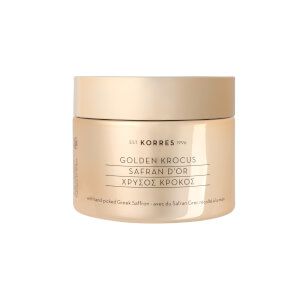
KORRES Golden Krocus Hydra-Filler Plumping Cream
Works for
2 of 3 advertised claims delivered
Moisturizing13 ingredients credited for this claimStrong support
“Plumping the skin with moisture”
This product can help improve hydration of the skin with the two types of ingredients.
The first type is called “humectants”:
these ingredients help attract water.
When humectants are on the surface of the skin, they “pull in” the moisture from the outside environment, or from
within deeper layers of the skin. The following ingredients in this product do the job:
glycerin, hydrolyzed collagen.
This product also contains ingredients called “occlusives”. They help reduce the speed with which our skin loses moisture to the outside environment. These ingredients also help soften the upper layer of the skin, so it feels less tight and nicer to the touch. The following ingredients in this product do the job: hydrolyzed collagen, caprylyl glycol.
The following ingredients in this product are especially good for supporting the skin barrier and helping with the hydration level: urea
Anti-aging2 ingredients credited for this claimModerate support
“anti-ageing power”
This product contains serine. This ingredient might be able to help reduce and prevent fine lines and wrinkles, improve skin elasticity and firmness, but there is not enough evidence that it actually works.
Evens skin tone1 ingredient credited for this claimWeak support
“recharge your radiance”
Effective ingredients missing or their concentration is too low
Can it cause trouble?
Irritancy6 strong irritants: Alpha-isomethyl ionone, Benzyl salicylate + 4 more — patch-test recommendedHigh risk
Comedogenic1 ingredient rated 2 or more on the 0–5 pore-clogging scale1 flagged


User reviews
Be the first — your take helps the next person decide.
Ingredients
Filter by role to see what each ingredient is doing.
Water~45–55%
Polyglyceryl-3 stearate~3.7–4.6%
- Irritation risk
- Low
Helps oil and water mix together
More about Polyglyceryl-3 stearatePropanediol~3.8–4.7%
- Irritation risk
- Low
Acts as a solvent for other ingredients. Speeds up the absorption of other ingredients into the skin
More about PropanediolSodium acrylates copolymer~2.9–3.5%
- Irritation risk
- Medium
Used to create a thicker product consistency
More about Sodium acrylates copolymerGlycerin~2.4–2.9%
- Irritation risk
- Low
One of the best moisturizing ingredients. Naturally present in skin. It attracts water to the upper layer of the skin working as a humectant
More about GlycerinAlgin~1.9–2.3%
- Irritation risk
- Low
- Comedogenicity
- 3/5
Used to thicken product formulation. Can help attract water to the upper layer of the skin
More about AlginCaprylyl glycol~1.6–2%
- Irritation risk
- Medium
Helps preserve products and creates a nice product texture
More about Caprylyl glycolCopper lysinate/prolinate~1.4–1.7%
- Irritation risk
- Low
Crocus sativus stigma extract~1.1–1.4%
- Irritation risk
- Low
Disodium phosphate~0.95–1.15%
- Irritation risk
- Low
Helps adjust the product pH and stabilize the formulation
More about Disodium phosphateEthylhexylglycerin~0.7–1%
Glyceryl polyacrylate~0.65–0.95%
- Irritation risk
- Low
Helps to create a nice product texture and spread the product more easily on the skin
More about Glyceryl polyacrylateHydrolyzed collagen~0.55–0.85%
- Irritation risk
- Low
A typically plant-derived compound that is supposed mimic human collagen. Cannot penetrate the skin barrier so is not particularly useful in skincare products beyond attracting water to the upper layer of the skin
More about Hydrolyzed collagenHydrolyzed sodium hyaluronate~0.5–0.75%
- Irritation risk
- Low
Attracts water into the upper layer of the skin
More about Hydrolyzed sodium hyaluronateLactic acid~0.45–0.7%
- Irritation risk
- Medium
An exfoliating and moisturizing alpha-hydroxy acid (AHA). Typically causes less irritation than other AHAs, for example, glycolic acid. At high concentrations (about 15%), lactic acid can help reduce lines and wrinkles. Recent studies show that lactic acid can support the "good" bacteria living on skin's surface (healthy skin microbiome)
More about Lactic acidLecithin~0.5–0.75%
- Irritation risk
- Low
Used mostly for creating emulsions - helping oil and water mix together. Helps soften the upper layer of the skin
More about LecithinLonicera caprifolium flower extract~0.4–0.65%
- Irritation risk
- High
A plant extract that might help neutralize free radicals in skin. Can contain volalite oils and be irritating
More about Lonicera caprifolium flower extractLonicera japonica flower extract~0.4–0.6%
- Irritation risk
- High
A plant extract that might help neutralize free radicals in skin. Can contain volalite oils and be irritating
More about Lonicera japonica flower extractMethylglucoside phosphate~0.35–0.65%
- Irritation risk
- Low
Mica~0.45–0.65%
- Irritation risk
- Low
Creates an illusion of smoother and more radiant skin tone. Adds shimmer to the skin by reflecting light
More about MicaPentylene glycol~0.4–0.65%
- Irritation risk
- Medium
Used to preserve products, dissolve other ingredients and create a nice product texture
More about Pentylene glycolPolyacrylate crosspolymer-6~0.35–0.6%
- Irritation risk
- Low
Potassium phosphate~0.3–0.6%
Pullulan~0.35–0.6%
- Irritation risk
- High
Creates a thin drying film on the skin resulting in a short-term tightening effect
More about PullulanSerine~0.3–0.55%
- Irritation risk
- Low
An amino-acid that helps to attract water to the upper layer of the skin. In combination with other amino-acids, might help to reduce fine lines and wrinkles
More about SerineSodium carboxymethyl beta-glucan~0.7–1.05%
- Irritation risk
- Low
Helps thicken the product formulation and create a gel-like texture
More about Sodium carboxymethyl beta-glucanSodium hyaluronate~0.3–0.55%
- Irritation risk
- Low
One of the best moisturizing ingredients. Attracts water into the upper layer of the skin
More about Sodium hyaluronateSpilanthes acmella flower extract~0.3–0.55%
- Irritation risk
- High
Plant extract that might hep calm down inflammation in skin
More about Spilanthes acmella flower extractTamarindus indica seed gum~0.3–0.55%
- Irritation risk
- Medium
Helps to attract water to the upper layer of the skin and create a nice product finish on the skin
More about Tamarindus indica seed gumTrehalose~0.3–0.55%
- Irritation risk
- Low
A sugar that attracts water to the upper layer of the skin
More about TrehaloseTroxerutin~0.3–0.5%
- Irritation risk
- Low
Urea~0.25–0.5%
- Irritation risk
- Low
Naturally present in skin (urea makes up about 7% of natural moisturizing factors in skin). Attracts water to the upper layer of the skin. Also has a positive effect on the skin barrier beyond the humectant action. Can enhance penetration of other ingredients. Is an exfoliating ingredient when used in high concentrations
More about UreaXanthan gum~0.3–0.5%
- Irritation risk
- Low
Used to create a thicker product consistency
More about Xanthan gumBenzyl alcohol~0.2–0.35%
- Irritation risk
- High
A preservative. Can be used to mask unpleasant smell. Can be irritating
More about Benzyl alcoholPhenoxyethanol~0.2–0.4%
- Irritation risk
- Low
A preservative. It helps prevent bacterial growth in cosmetic products
More about PhenoxyethanolAlpha-isomethyl ionone~0.15–0.3%
- Irritation risk
- High
A fragrance. Potential allergen and can be irritating
More about Alpha-isomethyl iononeBenzyl salicylate~0.15–0.25%
Cinnamyl alcohol~0.1–0.2%
- Irritation risk
- High
Hydroxycitronellal~0.1–0.15%
- Irritation risk
- High
A fragrance. A likely allergen and can be irritating
More about HydroxycitronellalLimonene~0.1–0.15%
- Irritation risk
- High
A common frangrance that can easily irritate skin, especially if exposed to air, light or heat
More about LimoneneLinalool~0.05–0.1%
Ingredient list view
Water, Unknown, Polyglyceryl-3 stearate, Propanediol, Unknown, Unknown, Sodium acrylates copolymer, Glycerin, Algin, Caprylyl glycol, Copper lysinate/prolinate, Crocus sativus stigma extract, Disodium phosphate, Ethylhexylglycerin, Glyceryl polyacrylate, Hydrolyzed collagen, Hydrolyzed sodium hyaluronate, Lactic acid, Lecithin, Lonicera caprifolium flower extract, Lonicera japonica flower extract, Methylglucoside phosphate, Mica, Pentylene glycol, Polyacrylate crosspolymer-6, Potassium phosphate, Pullulan, Serine, Sodium carboxymethyl beta-glucan, Sodium hyaluronate, Spilanthes acmella flower extract, Tamarindus indica seed gum, Trehalose, Troxerutin, Urea, Xanthan gum, Unknown, Benzyl alcohol, Phenoxyethanol, Alpha-isomethyl ionone, Benzyl salicylate, Cinnamyl alcohol, Hydroxycitronellal, Limonene, Linalool, Unknown
Compare prices
Retailers ranked by price — lowest first.
Affiliate links · prices updated regularly · As an Amazon Associate, WIMJ earns from qualifying purchases.
Worth comparing, line by line.
Match % combines shared ingredients, the first five ingredients, shared actives and hero ingredients, irritancy (lower counts in the alternative's favour), texture and body area. Only products in the same routine step are compared.
| KORRESGolden Krocus Hydra-Filler Plumping CreamYOUR PRODUCT | Elizabeth GrantHydra Cell Active Ultimate Hydration Face Cream | IsdinceuticsHyaluronic Moisture Normal to Dry Skin | GUERLAINOrchide Impriale - The Light Cream | |
|---|---|---|---|---|
| Match | — | 55% | 54% | 54% |
| Price | $53.99 | $15.00−$38.99 | — | $780.00+$726.01 |
| Shared key ingredients | — | 6 of 10 | 6 of 10 | 6 of 10 |
| Key difference | — | Panthenol | Panthenol | Adenosine |
| Irritancy | High | Medium | Medium | Medium |
| Drying alcohol | — | — | — | Contains drying alcohol |
| View product | Shop | Shop | Shop |

Product summary
Based on the ingredient list, "KORRES - Golden Krocus Hydra-Filler Plumping Cream" can work well for skin moisturization. This moisturizer uses a good combo of humectants and emollients. These both types of ingredients are essentials for improving the skin hydration and keeping the skin barrier healthy. Humectants in this product (urea, glycerin, hydrolyzed collagen, sodium hyaluronate and trehalose) help to increase the water content in the upper layer of the skin. (These ingredients do so by "capturing" water molecules from the outside air or from within the deeper layers of the skin). Emollients in this formulation (hydrolyzed collagen, caprylic/capric triglyceride, acacia decurrens/jojoba/sunflower seed wax polyglyceryl-3 esters, caprylyl glycol and pentylene glycol) help to reduce the moisture loss from the skin. They also soften the skin surface and relieve the feeling of dryness and tightness.
This product contains ingredients that could be beneficial, but their concentrations are too low in this formulation: titanium dioxide, lecithin and lactic acidIrritation risk
This moisturizer contains a bunch of common irritants, including ingredients that do not provide any known benefit for the skin. It might not be the best choice if your skin is sensitive. We assess the overall irritancy of this moisturizer to be high. For a detailed overview of all potential irritants: click here
You can see the detailed formula review with the breakdown of all actives in the product and the full ingredient list with estimated concentrations in the tables below.
About the brand
According to Cruelty-Free Kitty "KORRES" is cruelty free, but its parent company is not.
Price
The product retails for 79.80€ in Greece, for 76.00CA$ in Canada, from 60.00$ up to 76.00$ in the United States and from 49.16£ up to 60.00£ in the United Kingdom.
For a detailed price comparison: click here.
Sources cited in this review
Every concentration estimate and effectiveness label is anchored to one of these 12 studies and safety reviews.
- 1
- 2
- 3Epidermal and dermal effects of topical lactic acidncbi.nlm.nih.gov
- 4Dual Effects of Alpha-Hydroxy Acids on the Skinpdfs.semanticscholar.org
- 5
- 6

Affiliate links · As an Amazon Associate, WIMJ earns from qualifying purchases.