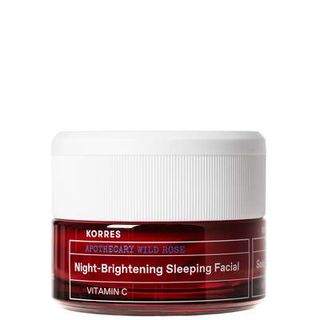
KORRES Face Care Apothecary Wild Rose Night-Brightening Sleeping Facial
Works for
1 of 3 advertised claims delivered
Moisturizing25 ingredients credited for this claimGood support
“Containing a complex array of vitamins, minerals, fatty acids and antioxidants, it delivers ultra moisture and a radiant plumpness to the skin. . Vitamin C. Helps to reduce the appearance of dark spots, even out skin tone, and enhance skin radiance. . Rosehip Oil.”
This product can help improve hydration of the skin with the two types of ingredients.
The first type is called “humectants”:
these ingredients help attract water.
When humectants are on the surface of the skin, they “pull in” the moisture from the outside environment, or from
within deeper layers of the skin. The following ingredients in this product do the job:
galactoarabinan, glycerin.
This product also contains ingredients called “occlusives”. They help reduce the speed with which our skin loses moisture to the outside environment. These ingredients also help soften the upper layer of the skin, so it feels less tight and nicer to the touch. The following ingredients in this product do the job: beeswax, cera alba.
Anti-aging5 ingredients credited for this claimLimited support
“Rich in vitamin A and packed with small molecules that penetrate into the skin, it's known to reduce the appearance of dark spots and wrinkles.”
This product does not contain ingredients that are able to reduce fine lines and wrinkles or help with skin elasticity, but it can improve the look of the skin temporarily through moisturization. Well-moisturized skin might also be able to repair the sun damage better.
This ingredient imperata cylindrica root extract might be able to help neutralize free radicals in skin and help it fight off some of the sun damage.
Evens skin tone3 ingredients credited for this claimLimited support
“Containing a complex array of vitamins, minerals, fatty acids and antioxidants, it delivers ultra moisture and a radiant plumpness to the skin. . Vitamin C. Helps to reduce the appearance of dark spots, even out skin tone, and enhance skin radiance. . Rosehip Oil.”
This product contains ingredients (tetrahydrodiferuloylmethane) that could help reduce hyperpigmentation (for example, post-acne marks or age spots) in theory, but there is not enough evidence that they actually work.
Anti-oxidationNot advertised by the brand · 8 ingredients credited for this claimModerate support
This product contains antioxidants (imperata cylindrica root extract, tetrahydrodiferuloylmethane) that might be able to help neutralize free radicals in skin to lessen the damage it gets from the UV light (sun). There is not enough evidence to confirm their effectiveness in skin though.
Can it cause trouble?
Irritancy4 strong irritants: Alcohol denat., Parfum + 2 more — patch-test recommendedHigh risk
Comedogenic2 ingredients rated 2 or more on the 0–5 pore-clogging scale2 flagged
User reviews
Be the first — your take helps the next person decide.
Ingredients
Filter by role to see what each ingredient is doing.
Water~45–55%
Glycerin~5.5–6.8%
- Irritation risk
- Low
One of the best moisturizing ingredients. Naturally present in skin. It attracts water to the upper layer of the skin working as a humectant
More about GlycerinGlyceryl stearate citrate~3.7–4.5%
- Irritation risk
- Low
Helps oil and water mix together while softening the upper layer of the skin
More about Glyceryl stearate citrateDicaprylyl carbonate~3.1–3.8%
- Irritation risk
- Low
Helps products spread more easily and works as an emollient to soften skin
More about Dicaprylyl carbonateTriheptanoin~2.3–2.8%
- Irritation risk
- Low
A synthetic triglyceride. Helps soften the upper layer of the skin
More about TriheptanoinAlcohol denat.~1.9–2.3%
- Irritation risk
- High
Produces temporary toning effect. Can help dissolve other ingredients or preserve products
More about Alcohol denat.Behenyl alcohol~1.7–2.1%
- Irritation risk
- Low
Non-drying alcohol that helps water and oil mix together. Also serves as an emollient
More about Behenyl alcoholGlyceryl stearate~1.5–1.8%
- Irritation risk
- Low
An emollient that softens the skin and forms a protective layer on its surface. Helps water and oil mix together
More about Glyceryl stearateAloe barbadensis leaf juice~1.2–1.5%
- Irritation risk
- Medium
Traditionally used to treat sunburns, dermatitis and inflammation, but evidence for its effectiveness is lacking. The extract can contain humectants that help attract water into the skin
More about Aloe barbadensis leaf juiceIsodecyl neopentanoate~1–1.2%
- Irritation risk
- Low
An emollient that helps soften the skin. It also forms a protective on its surface to reduce water loss.
More about Isodecyl neopentanoateSimmondsia chinensis seed oil~0.7–1.05%
- Irritation risk
- Medium
Softens the upper layer of skin and helps restore the healthy skin barrier. Has shown to help calm down inflammation in skin. It is a stable oil, meaning that it retains its properties even when exposed to air.
More about Simmondsia chinensis seed oilCera alba~0.7–1.05%
- Irritation risk
- Medium
Forms a protective barrier that holds water and keeps dry skin hydrated. Keeps an emulsion from separating into its oil and liquid components, and increases the thickness of a product. Can be an allergen
More about Cera albaBeeswax~0.55–0.8%
- Irritation risk
- Low
Forms a protective barrier that holds water and keeps dry skin hydrated. Keeps an emulsion from separating into its oil and liquid components, and increases the thickness of a product. Can be an allergen
More about BeeswaxLecithin~0.45–0.7%
- Irritation risk
- Low
Used mostly for creating emulsions - helping oil and water mix together. Helps soften the upper layer of the skin
More about LecithinImperata cylindrica root extract~0.35–0.65%
- Irritation risk
- Medium
A plat extract that might help neutralize free radicals in skin and attract water to its upper layer
More about Imperata cylindrica root extractAcacia decurrens/jojoba/sunflower seed wax polyglyceryl-3 esters~0.4–0.6%
- Irritation risk
- Medium
Helps soften the upper layer of the skin and create a nice product texture
More about Acacia decurrens/jojoba/sunflower seed wax polyglyceryl-3 estersRosa canina fruit oil~0.4–0.6%
- Irritation risk
- Medium
A great emollient. Contains vitamin E (tocopherol) which may give it some anti-oxidant properties. Can contain volatile compounds and can be irritating
More about Rosa canina fruit oilAcrylates/c10-30 alkyl acrylate crosspolymer~0.3–0.6%
- Irritation risk
- Medium
Maintains the texture of skincare products. Allows the product to spread evenly. Helps oil and water mix together
More about Acrylates/c10-30 alkyl acrylate crosspolymerAscorbyl tetraisopalmitate~0.3–0.55%
- Irritation risk
- Medium
A vitamin C derivative. Studies show that is might be effective in reducing hyperpigmentation, but there are no studies confirming that it is effectively converted into the bioavailable form of Vitamin C in skin. It is not clear how this derivative compares in effectiveness to the topical application of bioavailable form of vitamin C (L-ascorbic acid)
More about Ascorbyl tetraisopalmitateCaprylyl glycol~0.3–0.5%
- Irritation risk
- Medium
Helps preserve products and creates a nice product texture
More about Caprylyl glycolCarbomer~0.25–0.45%
- Irritation risk
- Low
Helps create a thicker or gel-like product texture. It is not a surfactant but can be used in gentle cleansing formulations
More about CarbomerCetearyl alcohol~0.3–0.5%
- Irritation risk
- Low
- Comedogenicity
- 2/5
A non-drying alcohol. Works as an emollient. Helps water and oil mix together and creates a nice product texture
More about Cetearyl alcoholCitric acid~0.2–0.4%
- Irritation risk
- Medium
Can work as an exfoliant but is typically used to adjust the product pH
More about Citric acidDistarch phosphate~0.2–0.4%
- Irritation risk
- Low
Galactoarabinan~0.25–0.45%
- Irritation risk
- Medium
Helps attract water to the upper layer of the skin
More about GalactoarabinanGlycine soja oil~0.25–0.4%
- Irritation risk
- Medium
- Comedogenicity
- 2/5
A good emollient that helps soften the skin and helps repair its barrier function. It can clog pores if used in high concentrations.
More about Glycine soja oilGlycine soja sterols~0.25–0.45%
- Irritation risk
- Low
An emollient that helps soften the skin
More about Glycine soja sterolsHelianthus annuus seed oil~0.25–0.45%
- Irritation risk
- Low
A great emollient due to its high linoleic acid content. One of the most effective plant oils in helping skin hydration and repairing skin barrier function
More about Helianthus annuus seed oilHydrolyzed sodium hyaluronate~0.25–0.4%
- Irritation risk
- Low
Attracts water into the upper layer of the skin
More about Hydrolyzed sodium hyaluronateHydroxyethyl acrylate/sodium acryloyldimethyl taurate copolymer~0.25–0.45%
- Irritation risk
- Medium
A gelling agent that thickens the product consistency and leaves the skin with a velvety finish
More about Hydroxyethyl acrylate/sodium acryloyldimethyl taurate copolymerLactic acid~0.2–0.4%
- Irritation risk
- Medium
An exfoliating and moisturizing alpha-hydroxy acid (AHA). Typically causes less irritation than other AHAs, for example, glycolic acid. At high concentrations (about 15%), lactic acid can help reduce lines and wrinkles. Recent studies show that lactic acid can support the "good" bacteria living on skin's surface (healthy skin microbiome)
More about Lactic acidParfum~0.2–0.4%
- Irritation risk
- High
An aromatic blend of unspecified and possibly irritating ingredients
More about ParfumPhenoxyethanol~0.25–0.45%
- Irritation risk
- Low
A preservative. It helps prevent bacterial growth in cosmetic products
More about PhenoxyethanolRosa canina fruit extract~0.2–0.4%
- Irritation risk
- Medium
A plant extract that might have some anti-oxidant properties, but evidence is lacking
More about Rosa canina fruit extractRosmarinus officinalis leaf extract~0.2–0.35%
- Irritation risk
- High
Can be helpful in reducing inflammation in skin, including inflamed acne. It can be irritating
More about Rosmarinus officinalis leaf extractRosmarinus officinalis extract~0.2–0.35%
- Irritation risk
- High
Sodium benzoate~0.15–0.3%
Sodium gluceptate~0.15–0.3%
- Irritation risk
- Low
Sodium hydroxide~0.15–0.3%
Tetrahydrodiferuloylmethane~0.15–0.3%
- Irritation risk
- High
An anti-oxidant derived from curcumin (naturally present in tumeric). Is a part of the tetrahydrocurcuminoids complex (THC). The complex might be helpful in neutralizing free radicals in skin and possibly help even out the skin tone. Can be irritating
More about TetrahydrodiferuloylmethaneTocopherol~0.15–0.3%
- Irritation risk
- Low
Pure form of vitamin E. Can help moisturise and protect the skin from free radicals. Often used to help stabilise other ingredients or the formula itself
More about TocopherolTocopheryl acetate~0.1–0.2%
- Irritation risk
- Medium
A more stable but less bio-available form of vitamin E compared to Tocopherol. Might help moisturize and protect the skin from free radicals, but mostly used in low concentrations to stabilize other ingredients.
More about Tocopheryl acetateXanthan gum~0.1–0.2%
- Irritation risk
- Low
Used to create a thicker product consistency
More about Xanthan gumIngredient list view
Water, Glycerin, Glyceryl stearate citrate, Dicaprylyl carbonate, Triheptanoin, Alcohol denat., Behenyl alcohol, Glyceryl stearate, Aloe barbadensis leaf juice, Isodecyl neopentanoate, Simmondsia chinensis seed oil, Cera alba, Beeswax, Lecithin, Imperata cylindrica root extract, Acacia decurrens/jojoba/sunflower seed wax polyglyceryl-3 esters, Rosa canina fruit oil, Acrylates/c10-30 alkyl acrylate crosspolymer, Ascorbyl tetraisopalmitate, Caprylyl glycol, Carbomer, Cetearyl alcohol, Citric acid, Distarch phosphate, Galactoarabinan, Glycine soja oil, Glycine soja sterols, Helianthus annuus seed oil, Hydrolyzed sodium hyaluronate, Hydroxyethyl acrylate/sodium acryloyldimethyl taurate copolymer, Lactic acid, Parfum, Phenoxyethanol, Rosa canina fruit extract, Rosmarinus officinalis leaf extract, Rosmarinus officinalis extract, Sodium benzoate, Sodium gluceptate, Sodium hydroxide, Tetrahydrodiferuloylmethane, Tocopherol, Tocopheryl acetate, Xanthan gum
Compare prices
Retailers ranked by price — lowest first.
Affiliate links · prices updated regularly · As an Amazon Associate, WIMJ earns from qualifying purchases.
Sources cited in this review
Every concentration estimate and effectiveness label is anchored to one of these 21 studies and safety reviews.
- 1
- 2
- 3Allergic contact dermatitis from grassespubmed.ncbi.nlm.nih.gov
- 4
- 5
- 6

Affiliate links · As an Amazon Associate, WIMJ earns from qualifying purchases.