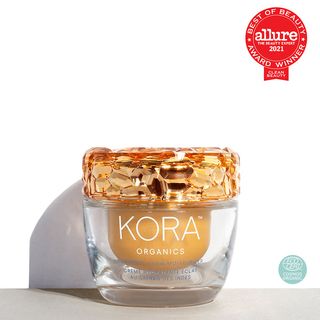
KORA Organics Turmeric Glow Moisturizer Jar with Pod:
Works for
2 of 3 advertised claims delivered
Anti-aging5 ingredients credited for this claimModerate support
“Made with a proprietary liposome technology containing active botanical blend of Turmeric, Noni, and Licorice extract that deliver visibly soften fine lines and wrinkles .”
This product contains superoxide dismutase. This ingredient help neutralize free radicals in skin. By doing so, they might be able to prevent early signs of aging (like fine lines and wrinkles), at least to some extent. These ingredients will not be able to "reverse" signs of aging.
Moisturizing29 ingredients credited for this claimGood support
“Turmeric Glow Moisturizer Jar with Pod”
This product can help improve hydration of the skin with the two types of ingredients.
The first type is called “humectants”:
these ingredients help attract water.
When humectants are on the surface of the skin, they “pull in” the moisture from the outside environment, or from
within deeper layers of the skin. The following ingredients in this product do the job:
cylindrotheca fusiformis extract, faex.
This product also contains ingredients called “occlusives”. They help reduce the speed with which our skin loses moisture to the outside environment. These ingredients also help soften the upper layer of the skin, so it feels less tight and nicer to the touch. The following ingredients in this product do the job: helianthus annuus seed oil, astrocaryum murumuru seed butter.
Evens skin tone3 ingredients credited for this claimLimited support
“The powerful blend of Turmeric and Noni Fruit Extract visibly brightens skin while minimizing the appearance of hyperpigmentation and fine lines and wrinkles.”
This product contains ingredients (glycyrrhiza glabra root extract) that could help reduce hyperpigmentation (for example, post-acne marks or age spots) in theory, but there is not enough evidence that they actually work.
Anti-oxidationNot advertised by the brand · 12 ingredients credited for this claimStrong support
This product contains antioxidants (superoxide dismutase) that can help neutralize free radicals in skin. By doing so, they can lessen the damage the skin gets from the UV light (sun).
Can it cause trouble?
Irritancy11 strong irritants: Balanites roxburghii seed oil, Calendula officinalis flower extract + 9 more — patch-test recommendedHigh risk
Comedogenic5 ingredients rated 2 or more on the 0–5 pore-clogging scale5 flagged
User reviews
Be the first — your take helps the next person decide.
Ingredients
Filter by role to see what each ingredient is doing.
Aloe barbadensis leaf juice~23–34%
- Irritation risk
- Medium
Traditionally used to treat sunburns, dermatitis and inflammation, but evidence for its effectiveness is lacking. The extract can contain humectants that help attract water into the skin
More about Aloe barbadensis leaf juiceGlycerin~3.4–5.1%
- Irritation risk
- Low
One of the best moisturizing ingredients. Naturally present in skin. It attracts water to the upper layer of the skin working as a humectant
More about GlycerinCoconut alkanes~4.3–6.4%
- Irritation risk
- Medium
- Comedogenicity
- 2/5
An emollient that helps soften the skin
More about Coconut alkanesCetearyl alcohol~3–4.4%
- Irritation risk
- Low
- Comedogenicity
- 2/5
A non-drying alcohol. Works as an emollient. Helps water and oil mix together and creates a nice product texture
More about Cetearyl alcoholPersea gratissima oil~2.6–4%
- Irritation risk
- Medium
An emollient that helps soften the skin and could be helpful in repairing its barrier function
More about Persea gratissima oilRosa canina seed oil~1.9–2.8%
- Irritation risk
- Medium
A plant oil that helps soften the upper layer of the skin. It might have anti-oxidant properties. Might help reduce inflammation in skin and help against blemishes
More about Rosa canina seed oilBalanites roxburghii seed oil~1.2–1.9%
- Irritation risk
- High
An emollient. Could be irritating
More about Balanites roxburghii seed oilWater~1–1.6%
Lactobacillus ferment~0.9–1.35%
- Irritation risk
- Low
A fermentation product created by bacteria Lactobacillus. The fermented product has anti-bacterial properties and might be helpful in calming down inflammation, but studies are lacking. Helps attract water to the upper layer of the skin. Can be used as a preservative
More about Lactobacillus fermentCetearyl olivate~0.6–1.35%
Helianthus annuus seed oil~0.55–1.25%
- Irritation risk
- Low
A great emollient due to its high linoleic acid content. One of the most effective plant oils in helping skin hydration and repairing skin barrier function
More about Helianthus annuus seed oilSorbitan olivate~0.4–0.95%
Butyrospermum parkii butter~0.4–1%
- Irritation risk
- Low
- Comedogenicity
- 3/5
A great moisturising ingredient that softens the skin and reduces water loss from its upper layer. It also can be helpful in protecting skin from free radicals
More about Butyrospermum parkii butterHippophae rhamnoides fruit oil~0.3–0.75%
- Irritation risk
- High
A plant oil that might somewhat help to neutralize free radicals. It could be irritating
More about Hippophae rhamnoides fruit oilPassiflora edulis seed oil~0.35–0.85%
- Irritation risk
- High
A good emollient helping to soften the skin. Might have some anti-oxidant properties. Adds a fragrance to the product
More about Passiflora edulis seed oilCaprylic/capric triglyceride~0.35–0.85%
- Irritation risk
- Medium
A good mix of fatty acids that forms a protective layer on the skin. Improves the shelf life of products. Derived from coconut and glycerin
More about Caprylic/capric triglycerideOryza sativa extract~0.3–0.75%
- Irritation risk
- Low
A grain extract that helps to create a thicker product consistency. It might have some anti-oxidant properties and help attract water to the upper layer of the skin
More about Oryza sativa extractLactobacillus~0.15–0.7%
- Irritation risk
- Low
A non-living ingredient made by fermentation with the bacteria Lactobacillus. It can help attract water to the upper layer of the skin and might help reduce inflammation
More about LactobacillusAscorbyl glucoside~0.3–0.7%
- Irritation risk
- Medium
A vitamin C derivative that is more stable but less potent than pure form of vitamin C. Has a potential to boost collagen production, nutralise free radicals and reduce hyperpigmentation, but the required concentration is likely to be much higher than for the pure form of vitamin C, limiting the ingredient's effectiveness in products
More about Ascorbyl glucosideCoco-caprylate/caprate~0.2–0.7%
- Irritation risk
- Low
Helps to soften the upper layer of the skin without creating a greasy texture
More about Coco-caprylate/caprateLactobacillus/arundinaria gigantea leaf ferment filtrate~0.15–0.55%
- Irritation risk
- Low
Fermented bamboo. Is used to create a nice product texture. Might have some antioxidant effect
More about Lactobacillus/arundinaria gigantea leaf ferment filtrateAstrocaryum murumuru seed butter~0.15–0.65%
- Irritation risk
- Medium
Helps soften the upper layer of the skin. Could be comedogenic due to the myrisic acid content
More about Astrocaryum murumuru seed butterGossypium herbaceum seed oil~0.1–0.5%
- Irritation risk
- Low
- Comedogenicity
- 3/5
Cottonseed oil. It is used as an emollient and occlusive in products. It is rich palmitic, oleic acid, and linoleic fatty acids.
More about Gossypium herbaceum seed oilSaccharomyces lysate extract~0.1–0.45%
- Irritation risk
- Low
Helps attract water to the upper layer of the skin. Can have some anti-inflammatory effect
More about Saccharomyces lysate extractBidens pilosa extract~0.1–0.45%
- Irritation risk
- Low
Calendula officinalis flower extract~0.1–0.45%
- Irritation risk
- High
A plant extract that has some anti-oxidant and anti-bacterial properties. Can be irritating
More about Calendula officinalis flower extractCocos nucifera fruit extract~0.15–0.65%
- Irritation risk
- Low
- Comedogenicity
- 3/5
An emollient. Found to be as effective as a moisturizer for dry skin as mineral oil. Could be comedogenic
More about Cocos nucifera fruit extractPotassium sorbate~0.15–0.5%
Lavandula angustifolia oil~0.1–0.45%
- Irritation risk
- High
An essential oil. Potential allergen and can be irritating. It has some anti-bacterial properties
More about Lavandula angustifolia oilLinum usitatissimum seed oil~0.1–0.45%
Lactic acid~0.1–0.45%
- Irritation risk
- Medium
An exfoliating and moisturizing alpha-hydroxy acid (AHA). Typically causes less irritation than other AHAs, for example, glycolic acid. At high concentrations (about 15%), lactic acid can help reduce lines and wrinkles. Recent studies show that lactic acid can support the "good" bacteria living on skin's surface (healthy skin microbiome)
More about Lactic acidPhospholipids~0.15–0.5%
- Irritation risk
- Low
Emollients that are naturaly present in skin. In addition, they help water and oil mix together in the product
More about PhospholipidsCitrus limon peel oil~0.1–0.45%
Hydrolyzed sodium hyaluronate~0.1–0.5%
- Irritation risk
- Low
Attracts water into the upper layer of the skin
More about Hydrolyzed sodium hyaluronateMentha piperita oil~0.1–0.4%
Sclerotium gum~0.1–0.5%
- Irritation risk
- Low
Used to create gel-like formulas and stabilize emulsions
More about Sclerotium gumPotassium hydroxide~0.15–0.5%
Curcuma longa root extract~0.1–0.45%
- Irritation risk
- High
A plant extract that can contain an active compound curcumin, that may have some anti-inflammatory properties when applied to the skin, but solid research is lacking and the typical concentration used in skincare products is too low. Can be an irritant
More about Curcuma longa root extractGlycyrrhiza glabra root extract~0.15–0.55%
- Irritation risk
- Medium
A plant extract that can help lighten the skin and calm down inflammation. Might be helpful in neutralizing free radicals
More about Glycyrrhiza glabra root extractMorinda citrifolia fruit extract~0.1–0.5%
- Irritation risk
- Low
Yeast~0.1–0.5%
- Irritation risk
- Low
Faex~0.1–0.45%
- Irritation risk
- Low
Yeast extract. Helps to attract water to the upper layer of the skin
More about FaexSodium phytate~0.1–0.45%
Cylindrotheca fusiformis extract~0.15–0.65%
- Irritation risk
- Low
Helps skin moisturization by attracting water to the upper layer of the skin. Might have some anti-oxidant properties but research confirming effectiveness in skin is lacking
More about Cylindrotheca fusiformis extractLeuconostoc/radish root ferment filtrate~0.1–0.45%
- Irritation risk
- Medium
A preservative that comes from radishes fermented by a bacteria. New research suggests that the preservation properties in the ingredient come from an ammonium salt that is not present naturally in radish root but used in its cultivation. Is problematic because the exact amount of the preservative agents is difficult to determine
More about Leuconostoc/radish root ferment filtrateCananga odorata flower oil~0.15–0.55%
Juniperus virginiana wood oil~0.15–0.55%
- Irritation risk
- Low
Leuconostoc ferment filtrate~0.15–0.6%
Tocopherol~0.15–0.6%
- Irritation risk
- Low
Pure form of vitamin E. Can help moisturise and protect the skin from free radicals. Often used to help stabilise other ingredients or the formula itself
More about TocopherolBisabolol~0.15–0.55%
- Irritation risk
- Low
An active component of chamomile plant that historically has been used to calm down irritated skin. A recent study shows that bisabolol indeed can have some anti-inflammatory effect on skin, even though conclusive data is lacking. Bisabolol has a sweet floral scent and can be added to products for its aromatic properties
More about BisabololSoybean peroxidase~0.15–0.6%
- Irritation risk
- Low
Superoxide dismutase~0.15–0.55%
- Irritation risk
- Low
An antioxidant enzyme that is naturally present in skin. It can help support skin barrier function and reduce inflammation in skin. It is used in topical medications for inflammatory skin conditions including atopic dermatitis (eczema) and psoriasis. There are three types of natural Superoxide Dismutase in human skin. The compound used in topical treatments and cosmetics are mimics of typically one of these natural variants
More about Superoxide dismutaseAlcohol~0.1–0.4%
- Irritation risk
- High
Can be drying and contribute to skin irritation. Used in formulars to dissolve other ingredients, create a thinner product consistency or for its antibacterial properties
More about AlcoholCitral~0.1–0.4%
Geraniol~0.1–0.35%
Limonene~0.1–0.3%
- Irritation risk
- High
A common frangrance that can easily irritate skin, especially if exposed to air, light or heat
More about LimoneneLinalool~0.1–0.3%
Ingredient list view
Aloe barbadensis leaf juice, Glycerin, Coconut alkanes, Cetearyl alcohol, Persea gratissima oil, Rosa canina seed oil, Balanites roxburghii seed oil, Water, Lactobacillus ferment, Cetearyl olivate, Helianthus annuus seed oil, Sorbitan olivate, Butyrospermum parkii butter, Hippophae rhamnoides fruit oil, Passiflora edulis seed oil, Caprylic/capric triglyceride, Oryza sativa extract, Lactobacillus, Ascorbyl glucoside, Coco-caprylate/caprate, Lactobacillus/arundinaria gigantea leaf ferment filtrate, Astrocaryum murumuru seed butter, Gossypium herbaceum seed oil, Saccharomyces lysate extract, Bidens pilosa extract, Calendula officinalis flower extract, Cocos nucifera fruit extract, Potassium sorbate, Lavandula angustifolia oil, Linum usitatissimum seed oil, Lactic acid, Phospholipids, Citrus limon peel oil, Hydrolyzed sodium hyaluronate, Mentha piperita oil, Sclerotium gum, Potassium hydroxide, Curcuma longa root extract, Glycyrrhiza glabra root extract, Morinda citrifolia fruit extract, Yeast, Faex, Unknown, Sodium phytate, Cylindrotheca fusiformis extract, Leuconostoc/radish root ferment filtrate, Cananga odorata flower oil, Juniperus virginiana wood oil, Leuconostoc ferment filtrate, Tocopherol, Bisabolol, Soybean peroxidase, Superoxide dismutase, Alcohol, Citral, Geraniol, Limonene, Linalool
Compare prices
Retailers ranked by price — lowest first.

Affiliate links · prices updated regularly
Sources cited in this review
Every concentration estimate and effectiveness label is anchored to one of these 36 studies and safety reviews.
- 1
- 2Nutrient composition of rose (Rosa canina L.) seed and oilsncbi.nlm.nih.gov
- 3
- 4
- 5
- 6

Affiliate links · As an Amazon Associate, WIMJ earns from qualifying purchases.