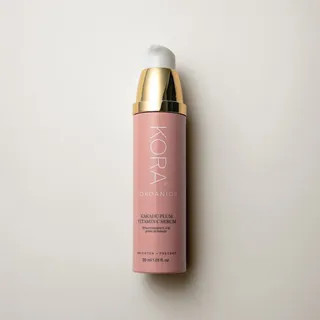
KORA Organics Kakadu Plum Vitamin C Serum

KORA Organics Kakadu Plum Vitamin C Serum

Efficacy75/100IrritancyHigh

Works for

Moisturizing
Glycerin, Lactobacillus ferment + 8 more
Works
What the product description says
“Smooths and hydrates for brighter, younger-looking skin”
Source: Kora Organics

This product can help improve hydration of the skin with the two types of ingredients.

The first type is called “humectants”:
these ingredients help attract water. When humectants are on the surface of the skin, they “pull in” the moisture from the outside environment, or from within deeper layers of the skin. The following ingredients in this product do the job: glycerin, lactobacillus ferment.

This product also contains ingredients called “occlusives”. They help reduce the speed with which our skin loses moisture to the outside environment. These ingredients also help soften the upper layer of the skin, so it feels less tight and nicer to the touch. The following ingredients in this product do the job: caprylic/capric triglyceride, cocos nucifera fruit extract.

GlycerinKey active· HumectantEffect: HighOne of the best moisturizing ingredients. Naturally present in skin. It attracts water to the upper layer of the skin working as a humectant~5–7.5%
Lactobacillus fermentKey active· HumectantEffect: HighA fermentation product created by bacteria Lactobacillus. The fermented product has anti-bacterial properties and might be helpful in calming down inflammation, but studies are lacking. Helps attract water to the upper layer of the skin. Can be used as a preservative~3.8–5.7%
LactobacillusKey activeEffect: HighA non-living ingredient made by fermentation with the bacteria Lactobacillus. It can help attract water to the upper layer of the skin and might help reduce inflammation~1–1.5%
Cocos nucifera fruit extractKey active· EmollientEffect: HighAn emollient. Found to be as effective as a moisturizer for dry skin as mineral oil. Could be comedogenic~0.5–1.15%
Caprylic/capric triglycerideKey active· Emollient, OcclusiveEffect: HighA good mix of fatty acids that forms a protective layer on the skin. Improves the shelf life of products. Derived from coconut and glycerin~0.5–1.15%
Hydrolyzed sodium hyaluronateKey activeEffect: HighAttracts water into the upper layer of the skin~0.4–0.9%
Aloe barbadensis leaf juice· HumectantEffect: LowTraditionally used to treat sunburns, dermatitis and inflammation, but evidence for its effectiveness is lacking. The extract can contain humectants that help attract water into the skin~23–34%
Dicaprylyl carbonate· EmollientEffect: LowHelps products spread more easily and works as an emollient to soften skin~1.3–1.9%
LysolecithinEffect: LowLecithin derivative. It helps oil and water mix together and can enhance penetration of other ingredients. It helps soften the upper layer of the skin~0.55–1.3%
TocopherolEffect: Low, below effective dosePure form of vitamin E. Can help moisturise and protect the skin from free radicals. Often used to help stabilise other ingredients or the formula itself~0.35–0.8%
Anti-aging
Ascorbyl glucoside, Aloe barbadensis leaf juice + 2 more
May help
What the product description says
“...and Hyaluronic Acid to smooth the appearance of fine lines, improve skin tone and radiance, and protect from the visible effects of environmental damage.”
Source: Kora Organics

This product contains ascorbyl glucoside. There is some human evidence that this ingredient helps reduce and prevent fine lines and wrinkles and improve skin elasticity and firmness, though it is smaller or less consistent than the evidence for the best anti-aging ingredients.

Ascorbyl glucosideKey activeEffect: MediumA vitamin C derivative that is more stable but less potent than pure form of vitamin C. Has a potential to boost collagen production, nutralise free radicals and reduce hyperpigmentation, but the required concentration is likely to be much higher than for the pure form of vitamin C, limiting the ingredient's effectiveness in products~5.4–8.1%
Aloe barbadensis leaf juiceEffect: LowTraditionally used to treat sunburns, dermatitis and inflammation, but evidence for its effectiveness is lacking. The extract can contain humectants that help attract water into the skin~23–34%
Sodium salicylateEffect: LowThe salt of salicylic acid. Helps exfoliate the upper layer of the skin. Can also work to preserve cosmetic products~0.25–0.5%
TocopherolEffect: Low, below effective dosePure form of vitamin E. Can help moisturise and protect the skin from free radicals. Often used to help stabilise other ingredients or the formula itself~0.35–0.8%
Evens skin tone
Ascorbyl glucoside
May help
What the product description says
“Improves overall skin tone and texture”
Source: Kora Organics

The following ingredient (ingredients) in this product might be helpful, but there is no evidence to confirm that it actually works: ascorbyl glucoside.

Ascorbyl glucosideKey activeEffect: MediumA vitamin C derivative that is more stable but less potent than pure form of vitamin C. Has a potential to boost collagen production, nutralise free radicals and reduce hyperpigmentation, but the required concentration is likely to be much higher than for the pure form of vitamin C, limiting the ingredient's effectiveness in products~5.4–8.1%
Anti-oxidation
Side benefit · Ascorbyl glucoside, Lactobacillus ferment + 4 more
May help

This product contains antioxidants (ascorbyl glucoside) that can help neutralize free radicals in skin to lessen the damage it gets from the UV light (sun). There is some human evidence for this effect in skin, though it is smaller or less consistent than the evidence for the best antioxidants.

Ascorbyl glucosideKey activeEffect: MediumA vitamin C derivative that is more stable but less potent than pure form of vitamin C. Has a potential to boost collagen production, nutralise free radicals and reduce hyperpigmentation, but the required concentration is likely to be much higher than for the pure form of vitamin C, limiting the ingredient's effectiveness in products~5.4–8.1%
Lactobacillus fermentEffect: LowA fermentation product created by bacteria Lactobacillus. The fermented product has anti-bacterial properties and might be helpful in calming down inflammation, but studies are lacking. Helps attract water to the upper layer of the skin. Can be used as a preservative~3.8–5.7%
Capsicum annuum fruit extractEffect: LowPepper extract. Might be able to help neutralize free radicals~1.4–2%
Terminalia ferdinandiana fruit extractEffect: LowA plant extract that might have some anti-oxidant effect in skin, but evidence is lacking~0.35–0.85%
Salvia sclarea extractEffect: LowUsed as a fragrance. Can be irritating~0.3–0.7%
TocopherolUnder-dosedPure form of vitamin E. Can help moisturise and protect the skin from free radicals. Often used to help stabilise other ingredients or the formula itself~0.35–0.8%

Can it cause trouble?

Irritancy
7 strong irritants: Citrus limon peel extract, Salvia sclarea extract + 5 more — patch-test recommended
High risk
We flagged 18 ingredients with irritancy potential. Severity depends on your sensitivity threshold; the table lists the worst offenders first.
IngredientFunctionIrritationEst. amount
Citrus limon peel extractA very irritating fragrant ingredientHigh~0.85–1.25%est.
PullulanCreates a thin drying film on the skin resulting in a short-term tightening effectHigh~0.45–1.1%est.
Salvia sclarea extractUsed as a fragrance. Can be irritatingHigh~0.3–0.7%est.
Citrus aurantium dulcis peel extractUsed as a fragranceHigh~0.3–0.75%est.
AlcoholCan be drying and contribute to skin irritation. Used in formulars to dissolve other ingredients, create a thinner product consistency or for its antibacterial propertiesHigh~0.35–0.8%est.
CitralA fragrance with a lemon scent. A likely irritantHigh~0.3–0.75%est.
LimoneneA common frangrance that can easily irritate skin, especially if exposed to air, light or heatHigh~0.3–0.75%est.
LinaloolA fragrance. Can be irritatingHigh~0.3–0.75%est.
Aloe barbadensis leaf juiceTraditionally used to treat sunburns, dermatitis and inflammation, but evidence for its effectiveness is lacking. The extract can contain humectants that help attract water into the skinMedium~23–34%est.
Ascorbyl glucosideA vitamin C derivative that is more stable but less potent than pure form of vitamin C. Has a potential to boost collagen production, nutralise free radicals and reduce hyperpigmentation, but the required concentration is likely to be much higher than for the pure form of vitamin C, limiting the ingredient's effectiveness in productsMedium~5.4–8.1%est.
Potassium hydroxideUsed to adjust the pH level of productsMedium~2.2–3.2%est.
Capsicum annuum fruit extractPepper extract. Might be able to help neutralize free radicalsMedium~1.4–2%est.
Potassium sorbateA preservativeMedium~0.3–0.6%est.
Caprylic/capric triglycerideA good mix of fatty acids that forms a protective layer on the skin. Improves the shelf life of products. Derived from coconut and glycerinMedium~0.5–1.15%est.
Terminalia ferdinandiana fruit extractA plant extract that might have some anti-oxidant effect in skin, but evidence is lackingMedium~0.35–0.85%est.
Leuconostoc/radish root ferment filtrateA preservative that comes from radishes fermented by a bacteria. New research suggests that the preservation properties in the ingredient come from an ammonium salt that is not present naturally in radish root but used in its cultivation. Is problematic because the exact amount of the preservative agents is difficult to determineMedium~0.35–0.8%est.
Citric acidCan work as an exfoliant but is typically used to adjust the product pHMedium~0.35–0.8%est.
Sodium salicylateThe salt of salicylic acid. Helps exfoliate the upper layer of the skin. Can also work to preserve cosmetic productsMedium~0.25–0.5%est.
Comedogenic
1 ingredient rated 2 or more on the 0–5 pore-clogging scale
1 flagged
These ingredients have a comedogenic rating of 2 or more on a 0–5 scale; the table shows each one's rating. In leave-on products they can clog pores in acne-prone skin.
IngredientFunctionRatingEst. amount
Cocos nucifera fruit extractAn emollient. Found to be as effective as a moisturizer for dry skin as mineral oil. Could be comedogenic3/5~0.5–1.15%est.
Did this help you decide?

User reviews

Would you recommend?
No community reviews yet.

Be the first — your take helps the next person decide.

Ingredients

Filter by role to see what each ingredient is doing.

Aloe barbadensis leaf juice~23–34%
Irritant · medium
Irritation risk
Medium
Works for
MoisturizingAntibacterialAnti-inflammatoryReduces rednessReduces irritationAnti-blemishAnti-aging

Traditionally used to treat sunburns, dermatitis and inflammation, but evidence for its effectiveness is lacking. The extract can contain humectants that help attract water into the skin

More about Aloe barbadensis leaf juice
Ascorbyl glucoside~5.4–8.1%
Key activeIrritant · medium
Irritation risk
Medium
Works for
Evens skin toneAnti-agingAnti-oxidation

A vitamin C derivative that is more stable but less potent than pure form of vitamin C. Has a potential to boost collagen production, nutralise free radicals and reduce hyperpigmentation, but the required concentration is likely to be much higher than for the pure form of vitamin C, limiting the ingredient's effectiveness in products

More about Ascorbyl glucoside
Glycerin~5–7.5%
Key active
Irritation risk
Low
Works for
Moisturizing

One of the best moisturizing ingredients. Naturally present in skin. It attracts water to the upper layer of the skin working as a humectant

More about Glycerin
Lactobacillus ferment~3.8–5.7%
Key active
Irritation risk
Low
Works for
MoisturizingAnti-oxidationAnti-inflammatoryReduces irritation

A fermentation product created by bacteria Lactobacillus. The fermented product has anti-bacterial properties and might be helpful in calming down inflammation, but studies are lacking. Helps attract water to the upper layer of the skin. Can be used as a preservative

More about Lactobacillus ferment
Water~3–4.4%
Formula
Irritation risk
Low

Plain old water

More about Water
Potassium hydroxide~2.2–3.2%
Irritant · medium
Irritation risk
Medium

Used to adjust the pH level of products

More about Potassium hydroxide
Lactobacillus/acerola cherry ferment~1.7–2.5%
Formula
Capsicum annuum fruit extract~1.4–2%
Irritant · medium
Irritation risk
Medium
Works for
Anti-oxidation

Pepper extract. Might be able to help neutralize free radicals

More about Capsicum annuum fruit extract
Dicaprylyl carbonate~1.3–1.9%
Formula
Irritation risk
Low
Works for
Moisturizing

Helps products spread more easily and works as an emollient to soften skin

More about Dicaprylyl carbonate
Lactobacillus~1–1.5%
Key active
Irritation risk
Low
Works for
Moisturizing

A non-living ingredient made by fermentation with the bacteria Lactobacillus. It can help attract water to the upper layer of the skin and might help reduce inflammation

More about Lactobacillus
Citrus limon peel extract~0.85–1.25%
Irritant · high
Irritation risk
High

A very irritating fragrant ingredient

More about Citrus limon peel extract
Lysolecithin~0.55–1.3%
Formula
Irritation risk
Low
Works for
CleansingMoisturizing

Lecithin derivative. It helps oil and water mix together and can enhance penetration of other ingredients. It helps soften the upper layer of the skin

More about Lysolecithin
Sclerotium gum~0.5–1.15%
Formula
Irritation risk
Low

Used to create gel-like formulas and stabilize emulsions

More about Sclerotium gum
Potassium sorbate~0.3–0.6%
Irritant · medium
Irritation risk
Medium

A preservative

More about Potassium sorbate
Xanthan gum~0.45–1.05%
Formula
Irritation risk
Low
Works for
Cleansing

Used to create a thicker product consistency

More about Xanthan gum
Pullulan~0.45–1.1%
Irritant · high
Irritation risk
High
Works for
Mattifying

Creates a thin drying film on the skin resulting in a short-term tightening effect

More about Pullulan
Cocos nucifera fruit extract~0.5–1.15%
Key activeComedogenic 3/5
Irritation risk
Low
Comedogenicity
3/5
Works for
Moisturizing

An emollient. Found to be as effective as a moisturizer for dry skin as mineral oil. Could be comedogenic

More about Cocos nucifera fruit extract
Caprylic/capric triglyceride~0.5–1.15%
Key activeIrritant · medium
Irritation risk
Medium
Works for
Moisturizing

A good mix of fatty acids that forms a protective layer on the skin. Improves the shelf life of products. Derived from coconut and glycerin

More about Caprylic/capric triglyceride
Hydrolyzed sodium hyaluronate~0.4–0.9%
Key active
Irritation risk
Low
Works for
Moisturizing

Attracts water into the upper layer of the skin

More about Hydrolyzed sodium hyaluronate
Morinda citrifolia fruit extract~0.35–0.85%
Formula
Terminalia ferdinandiana fruit extract~0.35–0.85%
Irritant · medium
Irritation risk
Medium
Works for
Anti-oxidation

A plant extract that might have some anti-oxidant effect in skin, but evidence is lacking

More about Terminalia ferdinandiana fruit extract
Sodium phytate~0.35–0.85%
Formula
Irritation risk
Low

Used to stabilize product formulations

More about Sodium phytate
Silica~0.45–1%
Formula
Irritation risk
Low

Used to absorb oil and can temporarily mattify skin

More about Silica
Salvia sclarea extract~0.3–0.7%
Irritant · high
Irritation risk
High
Works for
Anti-oxidation

Used as a fragrance. Can be irritating

More about Salvia sclarea extract
Leuconostoc/radish root ferment filtrate~0.35–0.8%
Irritant · medium
Irritation risk
Medium

A preservative that comes from radishes fermented by a bacteria. New research suggests that the preservation properties in the ingredient come from an ammonium salt that is not present naturally in radish root but used in its cultivation. Is problematic because the exact amount of the preservative agents is difficult to determine

More about Leuconostoc/radish root ferment filtrate
Sodium benzoate~0.25–0.5%
Formula
Irritation risk
Low

A preservative

More about Sodium benzoate
Citric acid~0.35–0.8%
Irritant · medium
Irritation risk
Medium

Can work as an exfoliant but is typically used to adjust the product pH

More about Citric acid
Sodium salicylate~0.25–0.5%
Irritant · medium
Irritation risk
Medium
Works for
Anti-aging

The salt of salicylic acid. Helps exfoliate the upper layer of the skin. Can also work to preserve cosmetic products

More about Sodium salicylate
Citrus aurantium dulcis peel extract~0.3–0.75%
Irritant · high
Irritation risk
High

Used as a fragrance

More about Citrus aurantium dulcis peel extract
Alcohol~0.35–0.8%
Irritant · high
Irritation risk
High
Works for
Antibacterial

Can be drying and contribute to skin irritation. Used in formulars to dissolve other ingredients, create a thinner product consistency or for its antibacterial properties

More about Alcohol
Tocopherol~0.35–0.8%
Under-dosed
Irritation risk
Low
Works for
Anti-oxidationMoisturizingAnti-inflammatoryAnti-aging

Pure form of vitamin E. Can help moisturise and protect the skin from free radicals. Often used to help stabilise other ingredients or the formula itself

More about Tocopherol
Citral~0.3–0.75%
Irritant · high
Irritation risk
High

A fragrance with a lemon scent. A likely irritant

More about Citral
Limonene~0.3–0.75%
Irritant · high
Irritation risk
High

A common frangrance that can easily irritate skin, especially if exposed to air, light or heat

More about Limonene
Linalool~0.3–0.75%
Irritant · high
Irritation risk
High

A fragrance. Can be irritating

More about Linalool
Ingredient list view

Aloe barbadensis leaf juice, Ascorbyl glucoside, Glycerin, Lactobacillus ferment, Water, Potassium hydroxide, Lactobacillus/acerola cherry ferment, Capsicum annuum fruit extract, Dicaprylyl carbonate, Lactobacillus, Citrus limon peel extract, Lysolecithin, Sclerotium gum, Potassium sorbate, Xanthan gum, Pullulan, Cocos nucifera fruit extract, Caprylic/capric triglyceride, Hydrolyzed sodium hyaluronate, Morinda citrifolia fruit extract, Terminalia ferdinandiana fruit extract, Sodium phytate, Silica, Salvia sclarea extract, Leuconostoc/radish root ferment filtrate, Sodium benzoate, Citric acid, Sodium salicylate, Citrus aurantium dulcis peel extract, Alcohol, Tocopherol, Citral, Limonene, Linalool

Compare prices

Retailers ranked by price — lowest first.

KORA Organics
$79.00
Buy
Amazon USPrice as of 11/20 12:17 GMT
$79.00
Buy
Sephora
$79.00
Buy
KORA Organics1 ML
Price unavailable
Check

Affiliate links · As an Amazon Associate, WIMJ earns from qualifying purchases.

Worth comparing, line by line.

Match % combines shared ingredients, the first five ingredients, shared actives and hero ingredients, irritancy (lower counts in the alternative's favour), texture and body area. Only products in the same routine step are compared.

Side-by-side comparison of this product against its closest alternatives
KORA OrganicsKakadu Plum Vitamin C SerumYOUR PRODUCTSeed to SkinThe Biom'Spheremid/nightFace Serum 00.22Green PeopleNordic Roots Hyaluronic Booster Serum
Match—46%42%41%
Price$79.00$219.00+$140.00$53.00−$26.00$29.50−$49.50
Shared key ingredients—5 of 94 of 95 of 9
Key difference—NiacinamideSh-Polypeptide-9Gluconolactone
Irritancy High Medium Medium Medium
Drying alcohol Contains drying alcohol ———
View product Shop Shop Shop

More alternatives: Codex Beauty Skin Barrier Repair Serum – Combat Inflammaging & Redensify Mature Skin | ANTÜNaturopathica Caffeine + Peptide Hydrating Face & Neck Serum

Cheaper alternatives? See how this stacks up against similar formulas.
We compare ingredient profiles across our catalog — pick the closest match for your budget.
Open dupe finder
KORA Organics Kakadu Plum Vitamin C Serum
KORA OrganicsKakadu Plum Vitamin C Serum

Affiliate links · As an Amazon Associate, WIMJ earns from qualifying purchases.

As an Amazon Associate, WIMJ earns from qualifying purchases.