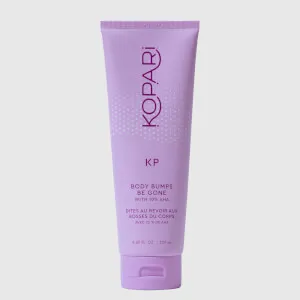
Works for
ExfoliationLactic acid, Glycolic acid + 1 moreWorks well
“The brains behind Kopari Beauty know all too well how frustrating they can be, that’s why they’ve introduced Body Bumps Be Gone: a body scrub that’s powered by alpha hydroxy acids to refine the texture of your limbs.”
This product can help exfoliate the skin. In other words, it helps break down the bonds between dead cells on the surface of the skin and speed up the skin turnover. Skin often appears softer and brighter after exfoliation, but overdoing it can result in disrupted skin barrier. The following ingredient is doing the exfoliating job in this product: glycolic acid, lactic acid.
MoisturizingLactic acid, Caprylic/capric triglyceride + 9 moreWorks
“That’s not all, volcanic sand, fine coconut shells and pumice also gently exfoliate and purify your pores while antioxidant-packed green tea extract soothes and jojoba seed oil hydrates skin.”
This product can help improve hydration of the skin with the two types of ingredients.
The first type is called “humectants”:
these ingredients help attract water.
When humectants are on the surface of the skin, they “pull in” the moisture from the outside environment, or from
within deeper layers of the skin. The following ingredients in this product do the job:
glycerin, lactic acid.
This product also contains ingredients called “occlusives”. They help reduce the speed with which our skin loses moisture to the outside environment. These ingredients also help soften the upper layer of the skin, so it feels less tight and nicer to the touch. The following ingredients in this product do the job: caprylic/capric triglyceride, cetearyl alcohol.
Anti-agingSide benefit · Lactic acid, Glycolic acid + 1 moreWorks well
This product can help reduce and prevent fine lines and wrinkles, improve skin elasticity and firmness because it contains glycolic acid.
These ingredients in the product can also be helpful, even though there is less evidence for their effectiveness: lactic acid.
Keep in mind that it typically takes at least 6 weeks to notice any results because the changes that are needed to improve fine lines and elasticity happen in the deeper layers of the skin. No topical anti-aging product can “erase” wrinkles or fully reverse signs of aging.
Evens skin toneSide benefit · Lactic acid, Glycolic acid + 2 moreWorks well
This product can help reduce hypepigmentation and even out the skin tone because it contains the following effective ingredients: glycolic acid, lactic acid
The following ingredient (ingredients) in this product might be helpful, but there is no evidence to confirm that it actually can help even out the skin tone: glycyrrhiza glabra root extract.
Keep in mind that you would need to apply any topical skincare targetted at hypigmentation consistently for a couple of months to get a result. No topical skincare product can help get rid of hyperpigmentation (including post-acne marks and age spots) instantly.
Can it cause trouble?
Irritancy15 flagged ingredientsLow risk
Comedogenic1 ingredient rated 2 or more on the 0–5 pore-clogging scale1 flagged


User reviews
Be the first — your take helps the next person decide.
Ingredients
Filter by role to see what each ingredient is doing.
Water~45–55%
Pumice~5.2–6.3%
- Irritation risk
- Low
Milled volcanic rock. Used as an abrasive for physical exfoliation
More about PumiceGlycerin~3.9–4.7%
- Irritation risk
- Low
One of the best moisturizing ingredients. Naturally present in skin. It attracts water to the upper layer of the skin working as a humectant
More about GlycerinLactic acid~3–3.7%
- Irritation risk
- Medium
An exfoliating and moisturizing alpha-hydroxy acid (AHA). Typically causes less irritation than other AHAs, for example, glycolic acid. At high concentrations (about 15%), lactic acid can help reduce lines and wrinkles. Recent studies show that lactic acid can support the "good" bacteria living on skin's surface (healthy skin microbiome)
More about Lactic acidGlycolic acid~2.3–2.9%
- Irritation risk
- High
An alpha-hydroxy acid (AHA) that helps to remove the dead skin cells on the surface of the skin reveling a more even, smoother complexation. It is also able to stimulate collagen production with long-term use. Could help to reduce pore congestion. It can be irritating to the skin. Apply sunscreen daily if using products with glycolic acid
More about Glycolic acidCaprylic/capric triglyceride~2–2.5%
- Irritation risk
- Medium
A good mix of fatty acids that forms a protective layer on the skin. Improves the shelf life of products. Derived from coconut and glycerin
More about Caprylic/capric triglycerideHydroxypropyl starch phosphate~1.7–2.1%
- Irritation risk
- Medium
Helps oil and water mix together and used to stabilize product formulations
More about Hydroxypropyl starch phosphateStearic acid~1.5–1.9%
- Irritation risk
- Low
Helps oil and water mix together and works as an emollient
More about Stearic acidDecyl glucoside~1.2–1.5%
- Irritation risk
- High
Helps oil and water mix together. Can be irritating
More about Decyl glucosideCetearyl alcohol~1.1–1.3%
- Irritation risk
- Low
- Comedogenicity
- 2/5
A non-drying alcohol. Works as an emollient. Helps water and oil mix together and creates a nice product texture
More about Cetearyl alcoholSorbitan oleate decylglucoside crosspolymer~0.75–1.15%
- Irritation risk
- Medium
Helps oil and water mix together. Used as a cleansing agent
More about Sorbitan oleate decylglucoside crosspolymerSodium lauroyl sarcosinate~1.3–1.6%
- Irritation risk
- Medium
Helps oil and water mix together and works as a cleansing agent
More about Sodium lauroyl sarcosinateSodium hydroxide~0.55–0.85%
Hydroxyethylcellulose~0.55–0.8%
- Irritation risk
- Low
Used to thicken product formulations and create gel-like textures
More about HydroxyethylcelluloseLauryl glucoside~0.55–0.85%
Phenoxyethanol~0.5–0.75%
- Irritation risk
- Low
A preservative. It helps prevent bacterial growth in cosmetic products
More about PhenoxyethanolSodium benzoate~0.25–0.5%
Glyceryl stearate~0.5–0.75%
- Irritation risk
- Low
An emollient that softens the skin and forms a protective layer on its surface. Helps water and oil mix together
More about Glyceryl stearatePotassium sorbate~0.4–0.6%
Sorbitol~0.3–0.6%
- Irritation risk
- Low
Helps attract water to the upper layer of the skin and improves the product texture
More about SorbitolSodium methyl cocoyl taurate~0.65–0.95%
- Irritation risk
- High
Helps oil and water mix together. Can be used as cleansing agent
More about Sodium methyl cocoyl taurateAvena sativa kernel extract~0.3–0.55%
- Irritation risk
- Low
An effective moisturizing and skin barrier repair ingredient. Helps calm down inflammation and has some anti-oxidant properties
More about Avena sativa kernel extractSodium stearoyl lactylate~0.25–0.5%
- Irritation risk
- Medium
Helps oil and water mix together
More about Sodium stearoyl lactylateCocos nucifera shell powder~0.3–0.55%
- Irritation risk
- High
Physical exfoliant that can cause micro tears on the skin's surface
More about Cocos nucifera shell powderSimmondsia chinensis seed oil~0.25–0.5%
- Irritation risk
- Medium
Softens the upper layer of skin and helps restore the healthy skin barrier. Has shown to help calm down inflammation in skin. It is a stable oil, meaning that it retains its properties even when exposed to air.
More about Simmondsia chinensis seed oilVolcanic sand~0.2–0.35%
- Irritation risk
- Low
Lactobacillus ferment~0.15–0.3%
- Irritation risk
- Low
A fermentation product created by bacteria Lactobacillus. The fermented product has anti-bacterial properties and might be helpful in calming down inflammation, but studies are lacking. Helps attract water to the upper layer of the skin. Can be used as a preservative
More about Lactobacillus fermentSalix nigra bark extract~0.15–0.25%
- Irritation risk
- Medium
A plant extract that might contain salicylic acid
More about Salix nigra bark extractGlycerin~0.15–0.3%
- Irritation risk
- Low
One of the best moisturizing ingredients. Naturally present in skin. It attracts water to the upper layer of the skin working as a humectant
More about GlycerinGlycyrrhiza glabra root extract~0.15–0.25%
- Irritation risk
- Medium
A plant extract that can help lighten the skin and calm down inflammation. Might be helpful in neutralizing free radicals
More about Glycyrrhiza glabra root extractCamellia sinensis leaf extract~0.1–0.15%
- Irritation risk
- Low
Can contain potent anti-oxidant compounds (abbreviated ECG, GCG, EGC, and EGCG) that might help protect the skin from free radicals. Can help calm down inflammation and has some anti-bacterial properties. Unfortunately, these antioxidants are unstable and lose their effectiveness very quickly in products. The concentration of the antioxidant compounds in the extract also tends to be low to be effective in topical formulation
More about Camellia sinensis leaf extractIngredient list view
Water, Pumice, Glycerin, Lactic acid, Glycolic acid, Caprylic/capric triglyceride, Hydroxypropyl starch phosphate, Stearic acid, Decyl glucoside, Cetearyl alcohol, Sorbitan oleate decylglucoside crosspolymer, Sodium lauroyl sarcosinate, Sodium hydroxide, Hydroxyethylcellulose, Lauryl glucoside, Phenoxyethanol, Sodium benzoate, Glyceryl stearate, Potassium sorbate, Sorbitol, Sodium methyl cocoyl taurate, Avena sativa kernel extract, Sodium stearoyl lactylate, Cocos nucifera shell powder, Simmondsia chinensis seed oil, Volcanic sand, Lactobacillus ferment, Salix nigra bark extract, Glycerin, Glycyrrhiza glabra root extract, Camellia sinensis leaf extract
Worth comparing, line by line.
Match % combines shared ingredients, the first five ingredients, shared actives and hero ingredients, irritancy (lower counts in the alternative's favour), texture and body area. Only products in the same routine step are compared.
| Kopari BeautyBody Bumps Be GoneYOUR PRODUCT | DermadoctorKP Duty Dermatologist Formulated Body Scrub | Versed SkinBuff It Out | By BEAUTY BAYBody Exfoliating Buff with 10% AHA and Sea Salt | |
|---|---|---|---|---|
| Match | — | 58% | 52% | 48% |
| Price | — | $31.40 | $14.99 | $16.03 |
| Shared key ingredients | — | 5 of 7 | 4 of 7 | 3 of 7 |
| Key difference | — | Lactobionic Acid | Arginine | Cocos Nucifera Oil |
| Irritancy | Low | Low | Low | Low |
| Drying alcohol | — | — | — | — |
| View product | Shop | Shop | Shop |

More alternatives: Be Minimalist Glycolic + Tranexamic 11% Body ExfoliatorQ+A AHA Exfoliator Body Scrub
Sources cited in this review
Every concentration estimate and effectiveness label is anchored to one of these 11 studies and safety reviews.
- 1
- 2Epidermal and dermal effects of topical lactic acidncbi.nlm.nih.gov
- 3Dual Effects of Alpha-Hydroxy Acids on the Skinpdfs.semanticscholar.org
- 4
- 5Glycolic acid peel therapy – a current reviewncbi.nlm.nih.gov
- 6
