Works for
MoisturizingCetearyl alcohol, Glycerin + 13 moreWorks
“With carefully curated botanicals, it nurtures the skin overnight for visibly firmer, smoother and more hydrated skin.”
This product can help improve hydration of the skin with the two types of ingredients.
The first type is called “humectants”:
these ingredients help attract water.
When humectants are on the surface of the skin, they “pull in” the moisture from the outside environment, or from
within deeper layers of the skin. The following ingredients in this product do the job:
anhydroxylitol, glycerin.
This product also contains ingredients called “occlusives”. They help reduce the speed with which our skin loses moisture to the outside environment. These ingredients also help soften the upper layer of the skin, so it feels less tight and nicer to the touch. The following ingredients in this product do the job: butyrospermum parkii butter, simmondsia chinensis seed oil.
Anti-oxidationSide benefit · Melatonin, Butyrospermum parkii butter + 4 moreMay help
This product contains antioxidants (melatonin) that can help neutralize free radicals in skin to lessen the damage it gets from the UV light (sun). There is some human evidence for this effect in skin, though it is smaller or less consistent than the evidence for the best antioxidants.
Can it cause trouble?
Irritancy13 strong irritants: Parfum, Anigozanthos flavidus extract + 11 more — patch-test recommendedHigh risk
Comedogenic2 ingredients rated 2 or more on the 0–5 pore-clogging scale2 flagged
Formula review
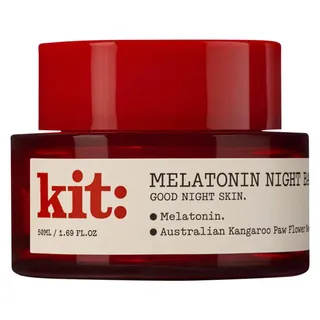
This is a modest pick if you want a balm that moisturizes, and moisturizing is the only thing it sets out to do. "Kit: - Melatonin Night Balm" makes that one claim, and the formula supports it without going further.
It moisturizes, but it covers only the basics. Moisturizing needs two kinds of ingredients working together: ones that draw water into the skin and ones that soften it and slow water loss. This balm has both. Glycerin and anhydroxylitol attract water, while butyrospermum parkii butter and sesamum indicum seed oil soften the skin and help keep that water from escaping. What it lacks are barrier helpers such as panthenol, ceramide NP or niacinamide, which support the skin's own protective layer. The balm still moisturizes without them, but those ingredients are easy to find, so leaving them out keeps it at the basic level.
Its irritant load is high, so sensitive skin is better off skipping it. The formula contains 13 ingredients that can irritate. Most are fragrance and fragrance allergens, led by parfum, eucalyptus globulus leaf oil and lavandula hybrida oil.
Two ingredients are flagged as possible pore cloggers. These are butyrospermum parkii butter, the same butter that helps hold in moisture, and cetearyl alcohol.

User reviews
Be the first — your take helps the next person decide.
Ingredients
Filter by role to see what each ingredient is doing.
Water~45–55%
Cetearyl alcohol~5.4–6.6%
- Irritation risk
- Low
- Comedogenicity
- 2/5
A non-drying alcohol. Works as an emollient. Helps water and oil mix together and creates a nice product texture
More about Cetearyl alcoholGlycerin~3.9–4.8%
- Irritation risk
- Low
One of the best moisturizing ingredients. Naturally present in skin. It attracts water to the upper layer of the skin working as a humectant
More about GlycerinSqualane~3.2–3.9%
- Irritation risk
- Low
An oil naturally present in skin. Works as an emollient to soften the skin and form a protective layer on its surface without a greasy feeling.
More about SqualaneButylene glycol~2.2–2.7%
- Irritation risk
- Low
Used to create a nice product texture and help delivery of other ingredients. Might be somewhat helpful in attracting water to the upper layer of the skin
More about Butylene glycolSimmondsia chinensis seed oil~2–2.4%
- Irritation risk
- Medium
Softens the upper layer of skin and helps restore the healthy skin barrier. Has shown to help calm down inflammation in skin. It is a stable oil, meaning that it retains its properties even when exposed to air.
More about Simmondsia chinensis seed oilSesamum indicum seed oil~1.6–1.9%
- Irritation risk
- Low
A good moisturizing plant oil. Due to the high linoleic acid content, it helps soften the upper layer of the skin, reduce water loss and support skin barrier function
More about Sesamum indicum seed oilButyrospermum parkii butter~1.4–1.7%
- Irritation risk
- Low
- Comedogenicity
- 3/5
A great moisturising ingredient that softens the skin and reduces water loss from its upper layer. It also can be helpful in protecting skin from free radicals
More about Butyrospermum parkii butterCoco-caprylate/caprate~1.1–1.3%
- Irritation risk
- Low
Helps to soften the upper layer of the skin without creating a greasy texture
More about Coco-caprylate/caprateSucrose polystearate~0.75–1.15%
- Irritation risk
- Medium
Helps oil and water mix together
More about Sucrose polystearateUndecane~0.6–0.9%
- Irritation risk
- Medium
Helps create a non-greasy finish on the skin
More about UndecaneCetyl palmitate~0.5–0.75%
- Irritation risk
- Low
An emollient that helps soften the skin and is used to improve product texture and stability
More about Cetyl palmitateParfum~0.3–0.6%
- Irritation risk
- High
An aromatic blend of unspecified and possibly irritating ingredients
More about ParfumMelatonin~0.3–0.55%
- Irritation risk
- Low
A compound that can regulate sleep cycles in humans and animals. When used in cosmetics, comes from plant sources. It can work as anti-oxidant in skin when applied topically in skincare
More about Melatonin1,2-hexanediol~0.25–0.5%
Tridecane~0.25–0.45%
Hydroxyacetophenone~0.25–0.5%
Tocopheryl acetate~0.25–0.45%
- Irritation risk
- Medium
A more stable but less bio-available form of vitamin E compared to Tocopherol. Might help moisturize and protect the skin from free radicals, but mostly used in low concentrations to stabilize other ingredients.
More about Tocopheryl acetateXylitylglucoside~0.2–0.4%
- Irritation risk
- Low
Helps attract water to the upper layer of the skin and repair the skin barrier function
More about XylitylglucosideAnhydroxylitol~0.2–0.35%
- Irritation risk
- Low
Helps attract water to the upper layer of the skin and repair the skin barrir function
More about AnhydroxylitolSodium stearoyl glutamate~0.25–0.4%
- Irritation risk
- Medium
Helps oil and water mix together
More about Sodium stearoyl glutamateCetearyl glucoside~0.2–0.35%
- Irritation risk
- Medium
Helps water and oil in the product mix well together and improves product texture
More about Cetearyl glucosideXylitol~0.15–0.25%
- Irritation risk
- Low
Helps attract water to the upper layer of the skin and repair the skin barrier function
More about XylitolXanthan gum~0.15–0.3%
- Irritation risk
- Low
Used to create a thicker product consistency
More about Xanthan gumSodium polyacrylate~0.2–0.35%
- Irritation risk
- Low
Used to create a gel-like product texture, as well as to stabilize emulsions
More about Sodium polyacrylateCassia angustifolia seed polysaccharide~0.15–0.25%
- Irritation risk
- Medium
Helps attract water to the upper layer of the skin. Is sometimes referred to as "natural" hyaluronic acid (even though hyaluronic acid is not unnatural and is present in human skin)
More about Cassia angustifolia seed polysaccharidePhenoxyethanol~0.15–0.3%
- Irritation risk
- Low
A preservative. It helps prevent bacterial growth in cosmetic products
More about PhenoxyethanolAnigozanthos flavidus extract~0.15–0.25%
- Irritation risk
- High
Claimed to have anti-oxidant properties but no evidence is available
More about Anigozanthos flavidus extractDisodium edta~0.15–0.25%
Vitis vinifera fruit extract~0.15–0.25%
- Irritation risk
- Medium
A plant extract that helps attract water to the upper layer of the skin. It might be helpful in neutralizing free radicals in skin, but is less potent than the extract from the seeds
More about Vitis vinifera fruit extractHydroxyethylcellulose~0.15–0.3%
- Irritation risk
- Low
Used to thicken product formulations and create gel-like textures
More about HydroxyethylcelluloseAmyris balsamifera bark oil~0.1–0.25%
- Irritation risk
- Low
Juniperus virginiana oil~0.15–0.25%
- Irritation risk
- Medium
Cedarwood oil. Used as a fragrance. Can be irritating
More about Juniperus virginiana oilEucalyptus globulus leaf oil~0.15–0.25%
- Irritation risk
- High
An essential oil that can be very irritating. Has some anti-bacterial properties
More about Eucalyptus globulus leaf oilLavandula hybrida oil~0.15–0.3%
- Irritation risk
- High
Plant extract that can be irritating and is a known allergen
More about Lavandula hybrida oilLavandula angustifolia oil~0.15–0.25%
- Irritation risk
- High
An essential oil. Potential allergen and can be irritating. It has some anti-bacterial properties
More about Lavandula angustifolia oilCommiphora myrrha gum oil~0.1–0.25%
- Irritation risk
- Low
Opoponax oil~0.15–0.3%
- Irritation risk
- Low
Pogostemon cablin leaf oil~0.15–0.3%
Rosmarinus officinalis leaf oil~0.15–0.3%
- Irritation risk
- High
A plant oil with high content of volatile compounds that can irritate the skin. Can be used as a fragrance. Has anti-bacterial properties and might help neutralize free radicals on the surface of the skin
More about Rosmarinus officinalis leaf oilMentha viridis leaf oil~0.15–0.25%
Vetiveria zizanoides root oil~0.1–0.2%
- Irritation risk
- Low
Linalool~0.1–0.15%
Coumarin~0.1–0.2%
Limonene~0.1–0.15%
- Irritation risk
- High
A common frangrance that can easily irritate skin, especially if exposed to air, light or heat
More about LimoneneCitral~0.05–0.1%
Geraniol~0.05%
Ingredient list view
Water, Cetearyl alcohol, Glycerin, Squalane, Butylene glycol, Simmondsia chinensis seed oil, Sesamum indicum seed oil, Butyrospermum parkii butter, Coco-caprylate/caprate, Sucrose polystearate, Undecane, Cetyl palmitate, Parfum, Melatonin, 1,2-hexanediol, Tridecane, Hydroxyacetophenone, Tocopheryl acetate, Xylitylglucoside, Anhydroxylitol, Sodium stearoyl glutamate, Cetearyl glucoside, Xylitol, Xanthan gum, Sodium polyacrylate, Cassia angustifolia seed polysaccharide, Phenoxyethanol, Anigozanthos flavidus extract, Disodium edta, Vitis vinifera fruit extract, Hydroxyethylcellulose, Amyris balsamifera bark oil, Juniperus virginiana oil, Eucalyptus globulus leaf oil, Lavandula hybrida oil, Lavandula angustifolia oil, Commiphora myrrha gum oil, Opoponax oil, Pogostemon cablin leaf oil, Rosmarinus officinalis leaf oil, Mentha viridis leaf oil, Vetiveria zizanoides root oil, Linalool, Coumarin, Limonene, Citral, Geraniol
Compare prices
Retailers ranked by price — lowest first.
Worth comparing, line by line.
Match % combines shared ingredients, the first five ingredients, shared actives and hero ingredients, irritancy (lower counts in the alternative's favour), texture and body area. Only products in the same routine step are compared.
| Kit:Melatonin Night BalmYOUR PRODUCT | hellobubbleSOFT SWERVE Barrier Restore Balm | Augustinus BaderThe Hydration Heroes with The Rich Cream | Dr. BioECO Moisture Cream | |
|---|---|---|---|---|
| Match | — | 61% | 60% | 60% |
| Price | — | $18.00 | $325.00 | $25.90 |
| Shared key ingredients | — | 5 of 10 | 5 of 10 | 5 of 10 |
| Key difference | — | Niacinamide | Niacinamide | Panthenol |
| Irritancy | High | Low | Medium | Medium |
| Drying alcohol | — | — | — | — |
| View product | Shop | Shop | Shop |


More alternatives: Real Barrier Extreme CreamEmma Hardie Moringa Luxury Body Butter
Sources cited in this review
Every concentration estimate and effectiveness label is anchored to one of these 18 studies and safety reviews.
- 1
- 2
- 3Triglyceride composition of Sesamum indicum seed oilonlinelibrary.wiley.com
- 4
- 5Safety Assessment of Alkyl Esters as Used in Cosmeticscir-safety.org
- 6[Melatonin in dermatology. Experimental and clinical aspects]researchgate.net

Affiliate links · As an Amazon Associate, WIMJ earns from qualifying purchases.