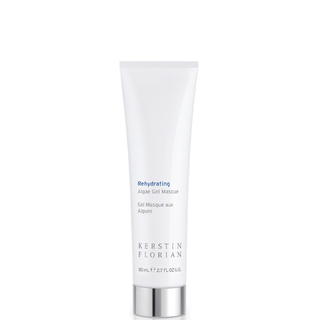
Kerstin Florian Rehydrating Algae Gel Masque
Works for
1 of 2 advertised claims delivered
Moisturizing7 ingredients credited for this claimGood support
“Rehydrating Algae Gel Masque”
This product contains good ingredients to attract water to the upper layer of the skin. These ingredients are called "humectants": glycerin, methyl gluceth-20.
When humectants are on the surface of the skin, they “pull in” the moisture from the outside environment, or from within deeper layers of the skin. If the air is dry, humectants can speed up the moisture loss from the skin. This is why it is a good idea to use another product on top of this one to help "seal in" the moisture (look for ingredients like dimethicone, squalane, oils and butters).
Evens skin tone1 ingredient credited for this claimWeak support
“Harnessing antioxidant and mineral rich Algae extracts, the gel formula works to detoxify skin and neutralise environmental aggressors, while extract of Everlasting Flower Water helps purify and tone for a more even and smooth surface.”
Effective ingredients missing or their concentration is too low
Can it cause trouble?
Irritancy7 strong irritants: Menthyl lactate, Parfum + 5 more — patch-test recommendedHigh risk
Comedogenic3 ingredients rated 2 or more on the 0–5 pore-clogging scale3 flagged
User reviews
Be the first — your take helps the next person decide.
Ingredients
Filter by role to see what each ingredient is doing.
Water~40–60%
Glycerin~4.1–6.2%
- Irritation risk
- Low
One of the best moisturizing ingredients. Naturally present in skin. It attracts water to the upper layer of the skin working as a humectant
More about GlycerinButylene glycol~3.5–5.2%
- Irritation risk
- Low
Used to create a nice product texture and help delivery of other ingredients. Might be somewhat helpful in attracting water to the upper layer of the skin
More about Butylene glycolMethyl gluceth-20~2.7–4%
- Irritation risk
- Low
Helps attract water to the upper layer of the skin and soften it
More about Methyl gluceth-20Carbomer~2–3%
- Irritation risk
- Low
Helps create a thicker or gel-like product texture. It is not a surfactant but can be used in gentle cleansing formulations
More about CarbomerHelichrysum italicum flower water~1.7–2.5%
- Irritation risk
- Low
Phenoxyethanol~0.5–1%
- Irritation risk
- Low
A preservative. It helps prevent bacterial growth in cosmetic products
More about PhenoxyethanolChondrus crispus~1.2–1.9%
- Irritation risk
- Low
- Comedogenicity
- 3/5
Red algae extract that helps attract water to the upper layer of the skin and create a nicer product consistency
More about Chondrus crispusCarrageenan~1.1–1.6%
- Irritation risk
- Medium
- Comedogenicity
- 3/5
Helps thicken the product formula and create a nice product formulation
More about CarrageenanPpg-26-buteth-26~0.85–1.25%
Ethylhexylglycerin~0.5–1.15%
Sodium hydroxide~0.4–0.95%
Peg-40 hydrogenated castor oil~0.4–0.9%
- Irritation risk
- Medium
Helps oil and water mix together
More about Peg-40 hydrogenated castor oilCaprylic/capric triglyceride~0.4–0.9%
- Irritation risk
- Medium
A good mix of fatty acids that forms a protective layer on the skin. Improves the shelf life of products. Derived from coconut and glycerin
More about Caprylic/capric triglycerideXanthan gum~0.3–0.7%
- Irritation risk
- Low
Used to create a thicker product consistency
More about Xanthan gumButeth-3~0.3–0.7%
- Irritation risk
- Low
Disodium edta~0.2–0.75%
Tocopheryl acetate~0.2–0.75%
- Irritation risk
- Medium
A more stable but less bio-available form of vitamin E compared to Tocopherol. Might help moisturize and protect the skin from free radicals, but mostly used in low concentrations to stabilize other ingredients.
More about Tocopheryl acetateSodium benzotriazolyl butylphenol sulfonate~0.15–0.65%
- Irritation risk
- Medium
Helps protect the ingredients in the formulation against UV light
More about Sodium benzotriazolyl butylphenol sulfonateMenthyl lactate~0.15–0.6%
Parfum~0.15–0.55%
- Irritation risk
- High
An aromatic blend of unspecified and possibly irritating ingredients
More about ParfumSantalum album oil~0.15–0.55%
Salicornia herbacea extract~0.1–0.45%
- Irritation risk
- Low
Benzyl alcohol~0.1–0.4%
- Irritation risk
- High
A preservative. Can be used to mask unpleasant smell. Can be irritating
More about Benzyl alcoholRetinyl palmitate~0.1–0.4%
- Irritation risk
- High
Three steps removed from the active form of vitamin A - retinoic acid. To have an effect in the skin, it first needs to be converted twice to become the retinoic acid. This means it is less potent than retinol, but could also be less irritating. Once converted to the retinoic acid in the skin, it helps against all signs of aging, improves skin cell turnover and helps fight blemishes and clogged pores. However, in many cosmetic formulations, it is used in a concentration that is too low to have the full effect
More about Retinyl palmitateChlorella vulgaris extract~0.1–0.45%
- Irritation risk
- Medium
- Comedogenicity
- 3/5
A plant extract that can help to attract water to the upper layer of the skin and might have some anti-oxidant and anti-inflammatory properties
More about Chlorella vulgaris extractPelvetia canaliculata extract~0.1–0.45%
- Irritation risk
- Low
Tributyl citrate~0.1–0.45%
Dehydroacetic acid~0.1–0.3%
Ci 42090~0.1–0.35%
Tocopherol~0.1–0.35%
- Irritation risk
- Low
Pure form of vitamin E. Can help moisturise and protect the skin from free radicals. Often used to help stabilise other ingredients or the formula itself
More about TocopherolCi 19140~0.05–0.3%
Citronellol~0.05–0.2%
Geraniol~0.05–0.15%
Linalool~0.05–0.1%
Ingredient list view
Water, Glycerin, Butylene glycol, Methyl gluceth-20, Carbomer, Helichrysum italicum flower water, Phenoxyethanol, Chondrus crispus, Carrageenan, Ppg-26-buteth-26, Ethylhexylglycerin, Sodium hydroxide, Peg-40 hydrogenated castor oil, Caprylic/capric triglyceride, Xanthan gum, Buteth-3, Disodium edta, Tocopheryl acetate, Sodium benzotriazolyl butylphenol sulfonate, Menthyl lactate, Parfum, Santalum album oil, Salicornia herbacea extract, Benzyl alcohol, Retinyl palmitate, Chlorella vulgaris extract, Pelvetia canaliculata extract, Tributyl citrate, Dehydroacetic acid, Ci 42090, Tocopherol, Ci 19140, Citronellol, Geraniol, Linalool
Compare prices
Retailers ranked by price — lowest first.
Affiliate links · prices updated regularly · As an Amazon Associate, WIMJ earns from qualifying purchases.
Sources cited in this review
Every concentration estimate and effectiveness label is anchored to one of these 9 studies and safety reviews.
- 1
- 2
- 3
- 4
- 5
- 6Vitamin E in dermatologyncbi.nlm.nih.gov

Affiliate links · As an Amazon Associate, WIMJ earns from qualifying purchases.