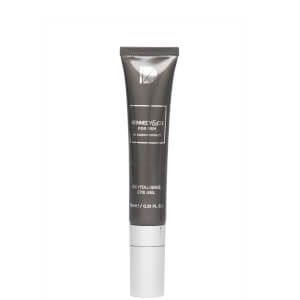
Works for
1 of 2 advertised claims delivered
Moisturizing9 ingredients credited for this claimGood support
This product can help improve hydration of the skin with the two types of ingredients.
The first type is called “humectants”:
these ingredients help attract water.
When humectants are on the surface of the skin, they “pull in” the moisture from the outside environment, or from
within deeper layers of the skin. The following ingredients in this product do the job:
glycerin, sodium hyaluronate.
This product also contains ingredients called “occlusives”. They help reduce the speed with which our skin loses moisture to the outside environment. These ingredients also help soften the upper layer of the skin, so it feels less tight and nicer to the touch. The following ingredients in this product do the job: dimethicone, isopropyl myristate.
Anti-aging1 ingredient credited for this claimWeak support
“The cooling eye gel helps to improve the look of dark circles and puffiness, promoting youthful-looking skin with a replenished radiance.”
Effective ingredients missing or their concentration is too low.
Can it cause trouble?
Irritancy3 strong irritants: Alcohol denat., Parfum + 1 more — patch-test recommendedHigh risk
Comedogenic1 ingredient rated 2 or more on the 0–5 pore-clogging scale1 flagged
User reviews
Be the first — your take helps the next person decide.
Ingredients
Filter by role to see what each ingredient is doing.
Water~40–60%
Dimethicone~5.8–8.7%
- Irritation risk
- Low
A silicone that helps to reduce water loss from the surface of the skin. Can temporarily "fill in" lines and wrinkles, absorb oil, and create a nice product finish
More about DimethiconeAlcohol denat.~4.1–6.1%
- Irritation risk
- High
Produces temporary toning effect. Can help dissolve other ingredients or preserve products
More about Alcohol denat.Glycerin~2.8–4.2%
- Irritation risk
- Low
One of the best moisturizing ingredients. Naturally present in skin. It attracts water to the upper layer of the skin working as a humectant
More about GlycerinHydrated silica~2.3–3.5%
Persea gratissima oil~1.8–2.8%
- Irritation risk
- Medium
An emollient that helps soften the skin and could be helpful in repairing its barrier function
More about Persea gratissima oilCaffeine~1.5–2.2%
- Irritation risk
- Medium
Might be helpful in neutralizing free radicals. Can have a dehydration effect that might somewhat decrease the look of puffy eyes
More about CaffeineCucumis sativus fruit extract~1.3–1.9%
- Irritation risk
- Medium
Might be somewhat helpful in reducing hyperpigmentation and neutralizing free radicals but its typical concentration in a product is too low for having an effect
More about Cucumis sativus fruit extract7-dehydrocholesterol~1–1.5%
- Irritation risk
- Medium
Pro-vitamin D. It is claimed to have anti-inflammatory effect in skin, but there is no research available confirming that this compound converts to vitamin D in skin or has any other benefits apart from softening the upper layer of the skin. This compound is different from the Vitamin D3 analogues used in medicine to treat psoriasis
More about 7-dehydrocholesterolSodium hyaluronate~0.85–1.25%
- Irritation risk
- Low
One of the best moisturizing ingredients. Attracts water into the upper layer of the skin
More about Sodium hyaluronateTocopherol~0.55–1.25%
- Irritation risk
- Low
Pure form of vitamin E. Can help moisturise and protect the skin from free radicals. Often used to help stabilise other ingredients or the formula itself
More about TocopherolPhenoxyethanol~0.45–1%
- Irritation risk
- Low
A preservative. It helps prevent bacterial growth in cosmetic products
More about PhenoxyethanolAcrylates/c10-30 alkyl acrylate crosspolymer~0.4–0.95%
- Irritation risk
- Medium
Maintains the texture of skincare products. Allows the product to spread evenly. Helps oil and water mix together
More about Acrylates/c10-30 alkyl acrylate crosspolymerButylene glycol~0.35–0.8%
- Irritation risk
- Low
Used to create a nice product texture and help delivery of other ingredients. Might be somewhat helpful in attracting water to the upper layer of the skin
More about Butylene glycolIsopropyl myristate~0.35–0.8%
- Irritation risk
- Low
- Comedogenicity
- 3/5
An emollient that helps soften the skin. Could be comedogenic
More about Isopropyl myristatePeg-40 hydrogenated castor oil~0.2–0.7%
- Irritation risk
- Medium
Helps oil and water mix together
More about Peg-40 hydrogenated castor oilPolysorbate 80~0.15–0.65%
Disodium edta~0.1–0.45%
Sodium hydroxide~0.1–0.4%
Parfum~0.1–0.3%
- Irritation risk
- High
An aromatic blend of unspecified and possibly irritating ingredients
More about ParfumCitric acid~0.05–0.25%
- Irritation risk
- Medium
Can work as an exfoliant but is typically used to adjust the product pH
More about Citric acidPotassium sorbate~0.05–0.3%
Limonene~0.05–0.15%
- Irritation risk
- High
A common frangrance that can easily irritate skin, especially if exposed to air, light or heat
More about LimoneneIngredient list view
Water, Dimethicone, Alcohol denat., Glycerin, Hydrated silica, Persea gratissima oil, Caffeine, Cucumis sativus fruit extract, 7-dehydrocholesterol, Sodium hyaluronate, Tocopherol, Phenoxyethanol, Acrylates/c10-30 alkyl acrylate crosspolymer, Butylene glycol, Isopropyl myristate, Peg-40 hydrogenated castor oil, Polysorbate 80, Disodium edta, Sodium hydroxide, Parfum, Citric acid, Potassium sorbate, Limonene
Compare prices
Retailers ranked by price — lowest first.

Affiliate links · prices updated regularly
Sources cited in this review
Every concentration estimate and effectiveness label is anchored to one of these 11 studies and safety reviews.
- 1
- 2Final Report on the Safety Assessment of Dimethicone Copolyoljournals.sagepub.com
- 3
- 4
- 5Off-Label Uses of Topical Vitamin D in Dermatology: A Systematic Reviewjournals.sagepub.com
- 6

Affiliate links · As an Amazon Associate, WIMJ earns from qualifying purchases.