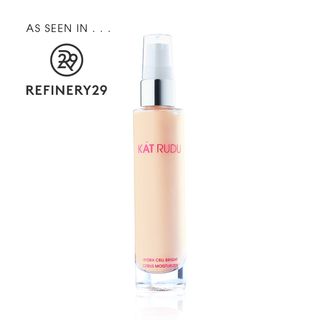
Kat Rudu Hydra Cell Bright Citrus Moisturizer
Works for
2 of 2 advertised claims delivered
MoisturizingPalmitoyl tripeptide-5, Panthenol + 17 moreStrong evidence
“Hydra Cell Bright Citrus Moisturizer”
This product can help improve hydration of the skin with the two types of ingredients.
The first type is called “humectants”:
these ingredients help attract water.
When humectants are on the surface of the skin, they “pull in” the moisture from the outside environment, or from
within deeper layers of the skin. The following ingredients in this product do the job:
glycerin, hyaluronic acid.
This product also contains ingredients called “occlusives”. They help reduce the speed with which our skin loses moisture to the outside environment. These ingredients also help soften the upper layer of the skin, so it feels less tight and nicer to the touch. The following ingredients in this product do the job: butyrospermum parkii butter, helianthus annuus seed oil.
The following ingredients in this product are especially good for supporting the skin barrier and helping with the hydration level: niacinamide, palmitoyl tripeptide-5, panthenol
Evens skin toneNiacinamide, Glycolic acid + 2 moreStrong evidence
“Over time Hydra Cell Bright Citrus Moisturizer evens tone so the skin is luminous, radiant, and incredibly supple.”
This product can help reduce hypepigmentation and even out the skin tone because it contains the following effective ingredients: glycolic acid, niacinamide
The following ingredient (ingredients) in this product might be helpful, but there is no evidence to confirm that it actually can help even out the skin tone: glycyrrhiza glabra root extract.
Keep in mind that you would need to apply any topical skincare targetted at hypigmentation consistently for a couple of months to get a result. No topical skincare product can help get rid of hyperpigmentation (including post-acne marks and age spots) instantly.
Anti-oxidationNot advertised by the brand · Astaxanthin, Haematococcus pluvialis extract + 13 moreStrong evidence
This product contains antioxidants (astaxanthin) that can help neutralize free radicals in skin. By doing so, they can lessen the damage the skin gets from the UV light (sun).
The following ingredients - camellia sinensis extract, camellia sinensis leaf extract, centella asiatica extract, haematococcus pluvialis extract also can have an antioxidant effect, but there is less evidence to confirm their effectiveness in skin.
ExfoliationNot advertised by the brand · Glycolic acid, Salix alba bark extractStrong evidence
This product can help exfoliate the skin. In other words, it helps break down the bonds between dead cells on the surface of the skin and speed up the skin turnover. Skin often appears softer and brighter after exfoliation, but overdoing it can result in disrupted skin barrier. The following ingredient is doing the exfoliating job in this product: glycolic acid.
Anti-agingNot advertised by the brand · Glycolic acid, Niacinamide + 9 moreStrong evidence
This product can help reduce and prevent fine lines and wrinkles, improve skin elasticity and firmness because it contains glycolic acid, niacinamide.
These ingredients in the product can also be helpful, even though there is less evidence for their effectiveness: astaxanthin, centella asiatica extract, palmitoyl tripeptide-5.
Keep in mind that it typically takes at least 6 weeks to notice any results because the changes that are needed to improve fine lines and elasticity happen in the deeper layers of the skin. No topical anti-aging product can “erase” wrinkles or fully reverse signs of aging.
Anti-blemishNot advertised by the brand · Niacinamide, Glycolic acid + 5 moreGood evidence
This product might be able to help reduce blemishes and clogged pores because it contains niacinamide.
The following ingredient (ingredients) in this product might be helpful, but there is no evidence to confirm that it actually works: glycolic acid
Can it cause trouble?
Irritancy6 strong irritants: Cochlearia armoracia root extract, Melissa officinalis flower/leaf/stem extract + 4 more — patch-test recommendedHigh risk
Comedogenic1 ingredient rated 2 or more on the 0–5 pore-clogging scale1 flagged

User reviews
Be the first — your take helps the next person decide.
Ingredients
Filter by role to see what each ingredient is doing.
Aloe barbadensis leaf juice~26–31%
- Irritation risk
- Medium
Traditionally used to treat sunburns, dermatitis and inflammation, but evidence for its effectiveness is lacking. The extract can contain humectants that help attract water into the skin
More about Aloe barbadensis leaf juiceAloe barbadensis extract~4.9–6%
- Irritation risk
- Medium
Traditionally used to treat sunburns, dermatitis and inflammation, but evidence for its effectiveness is lacking. The extract can contain humectants that help attract water into the skin
More about Aloe barbadensis extractWater~4.9–6%
Glycerin~3.4–4.1%
- Irritation risk
- Low
One of the best moisturizing ingredients. Naturally present in skin. It attracts water to the upper layer of the skin working as a humectant
More about GlycerinHelianthus annuus seed oil~3–3.6%
- Irritation risk
- Low
A great emollient due to its high linoleic acid content. One of the most effective plant oils in helping skin hydration and repairing skin barrier function
More about Helianthus annuus seed oilHelianthus annuus extract~2.1–2.5%
- Irritation risk
- Low
Helps soften the upper layer of the skin
More about Helianthus annuus extractNiacinamide~1.7–2.1%
- Irritation risk
- Low
Is proven to be effective in reducing blemishes, evening out skin tone and helping to improve lines and wrinkles. It helps the skin to repair sun damage, calm down inflammation and keep maintain good levels of moisture. The concentration of about 2% is effective for supporting the skin barrier and evening out the skin tone. Concentration of 4-6% is better for helping with acne and balancing the sebum production
More about NiacinamideGlobularia cordifolia callus culture extract~1.4–1.8%
- Irritation risk
- Low
An extract from plant stem cells that might help calm down inflammation in skin
More about Globularia cordifolia callus culture extractGlyceryl stearate~1.5–1.8%
- Irritation risk
- Low
An emollient that softens the skin and forms a protective layer on its surface. Helps water and oil mix together
More about Glyceryl stearateSodium ascorbyl phosphate~1.2–1.5%
- Irritation risk
- Medium
A stable derivative of vitamin C. It is oil-soluble which means it is more likely to penetrate the skin compared to the pure form of vitamin C (which is water-soluble), but it is less bio-available and is way less effective in stimulating collagen and reducing wrinkles compared to the pure form of vitamin C (L-ascorbic acid) and its other derivatives (for example, magnesium ascorbyl phosphate). At the same time, this vitamin C derivative has been shown in studies to be effective in reducing acne, blemishes and clogged pores. It is less irritating then the pure form of vitamin C
More about Sodium ascorbyl phosphateGanoderma lucidum extract~1.1–1.3%
- Irritation risk
- Medium
Helps attract water to the upper layer of the skin
More about Ganoderma lucidum extractPersea gratissima oil~1.1–1.3%
- Irritation risk
- Medium
An emollient that helps soften the skin and could be helpful in repairing its barrier function
More about Persea gratissima oilButyrospermum parkii butter~1–1.3%
- Irritation risk
- Low
- Comedogenicity
- 3/5
A great moisturising ingredient that softens the skin and reduces water loss from its upper layer. It also can be helpful in protecting skin from free radicals
More about Butyrospermum parkii butterSimmondsia chinensis seed oil~1–1.2%
- Irritation risk
- Medium
Softens the upper layer of skin and helps restore the healthy skin barrier. Has shown to help calm down inflammation in skin. It is a stable oil, meaning that it retains its properties even when exposed to air.
More about Simmondsia chinensis seed oilDaucus carota sativa seed oil~0.95–1.2%
- Irritation risk
- Low
A plant oil that might help neutralize free radicals and have an anti-bacterial effect
More about Daucus carota sativa seed oilDaucus carota sativa root extract~0.75–1.15%
- Irritation risk
- Low
Carrot extract. Might have anti-oxidant properties and be used to add orange color
More about Daucus carota sativa root extractRubus idaeus extract~0.75–1.1%
- Irritation risk
- High
Mostly used as a fragrance. Might have some anti-oxidant effect
More about Rubus idaeus extractVitis vinifera seed oil~0.75–1.15%
- Irritation risk
- Medium
A great emollient that can also have anti-oxidant properties
More about Vitis vinifera seed oilVitis vinifera seed~0.65–1%
- Irritation risk
- Low
Tocopherol~0.65–0.95%
- Irritation risk
- Low
Pure form of vitamin E. Can help moisturise and protect the skin from free radicals. Often used to help stabilise other ingredients or the formula itself
More about TocopherolPanthenol~0.6–0.9%
- Irritation risk
- Low
Helps attract water to the upper layer of the skin and can help improve skin barrier function
More about PanthenolCaesalpinia spinosa gum~0.75–1.15%
Hyaluronic acid~0.6–0.9%
- Irritation risk
- Low
One of the best moisturizing ingredients. Attracts water into the upper layer of the skin. Naturally present in skin. Typically has large molecule size unless advertised otherwise on the product label. Helps support skin's barrier function and may help to reduce inflammation
More about Hyaluronic acidGlycolic acid~0.6–0.9%
- Irritation risk
- High
An alpha-hydroxy acid (AHA) that helps to remove the dead skin cells on the surface of the skin reveling a more even, smoother complexation. It is also able to stimulate collagen production with long-term use. Could help to reduce pore congestion. It can be irritating to the skin. Apply sunscreen daily if using products with glycolic acid
More about Glycolic acidPalmitoyl tripeptide-5~0.6–0.9%
- Irritation risk
- Low
A type of peptide. Peptides are excellent moisturizers and might be able support collagen production reducing fine lines and wrinkles
More about Palmitoyl tripeptide-5Centella asiatica extract~0.65–0.95%
- Irritation risk
- Medium
A plant extract that has been shown to be able to reduce inflammation in skin, support restoration of skin barrier function, as well as support collagen production. Contains active compounds called centelloids: asiaticoside, madecasosside, asiatic acid and madecassic acid. Might be helpful in preventing stretch marks. It can be itself be irritating though.
More about Centella asiatica extractGlycyrrhiza glabra root extract~0.6–0.9%
- Irritation risk
- Medium
A plant extract that can help lighten the skin and calm down inflammation. Might be helpful in neutralizing free radicals
More about Glycyrrhiza glabra root extractCamellia sinensis leaf extract~0.6–0.9%
- Irritation risk
- Low
Can contain potent anti-oxidant compounds (abbreviated ECG, GCG, EGC, and EGCG) that might help protect the skin from free radicals. Can help calm down inflammation and has some anti-bacterial properties. Unfortunately, these antioxidants are unstable and lose their effectiveness very quickly in products. The concentration of the antioxidant compounds in the extract also tends to be low to be effective in topical formulation
More about Camellia sinensis leaf extractCamellia sinensis extract~0.6–0.85%
- Irritation risk
- Low
Tea extract. Might be helpful in neutralizing free radicals in skin
More about Camellia sinensis extractStyrax benzoin resin extract~0.7–1.05%
- Irritation risk
- Low
Styrax tonkinensis resin extract~0.55–0.85%
- Irritation risk
- Low
Astaxanthin~0.6–0.9%
- Irritation risk
- Medium
Helps neutralize free radicals in skin and might help to calm down inflammation
More about AstaxanthinHaematococcus pluvialis extract~0.6–0.85%
- Irritation risk
- Medium
Green algae extract that might contain antioxidant astaxanthin
More about Haematococcus pluvialis extractCochlearia armoracia root extract~0.6–0.9%
- Irritation risk
- High
A plant root extract that has antimicrobial properties and can mask the smell of other ingredients
More about Cochlearia armoracia root extractFoeniculum vulgare fruit extract~0.65–0.95%
- Irritation risk
- Low
Melissa officinalis flower/leaf/stem extract~0.55–0.85%
- Irritation risk
- High
Citrus limon fruit extract~0.6–0.85%
- Irritation risk
- High
Used as a fragrance. Can be irritating and cause photosensitivity
More about Citrus limon fruit extractPanax quinquefolius root extract~0.55–0.85%
- Irritation risk
- Low
Pimpinella anisum seed extract~0.5–0.75%
- Irritation risk
- Low
Salix alba bark extract~0.45–0.7%
- Irritation risk
- High
A plant extract that can help neutralize free radicals in skin. It contains a compound salicin that can theoretically be converted into salicylic acid that, in turn, helps reduce inflammation in skin, but the evidence of effectiveness in skin is lacking and the extract is usually not used in a concentration that would enable an exfoliating effect
More about Salix alba bark extractSalix alba extract~0.5–0.75%
- Irritation risk
- Low
Schisandra chinensis fruit extract~0.5–0.7%
- Irritation risk
- Medium
A berry extract that might help neutralize free radicals on the surface of the skin
More about Schisandra chinensis fruit extractCitrus sinensis peel oil expressed~0.4–0.6%
- Irritation risk
- High
Citrus aurantium dulcis seed oil~0.45–0.65%
- Irritation risk
- High
Citrus limon peel oil~0.3–0.6%
Xanthan gum~0.3–0.55%
- Irritation risk
- Low
Used to create a thicker product consistency
More about Xanthan gumDehydroacetic acid~0.3–0.55%
Sodium dehydroacetate~0.3–0.55%
Ingredient list view
Aloe barbadensis leaf juice, Aloe barbadensis extract, Water, Glycerin, Helianthus annuus seed oil, Helianthus annuus extract, Niacinamide, Globularia cordifolia callus culture extract, Glyceryl stearate, Unknown, Sodium ascorbyl phosphate, Ganoderma lucidum extract, Persea gratissima oil, Butyrospermum parkii butter, Simmondsia chinensis seed oil, Daucus carota sativa seed oil, Daucus carota sativa root extract, Rubus idaeus extract, Vitis vinifera seed oil, Vitis vinifera seed, Tocopherol, Panthenol, Caesalpinia spinosa gum, Hyaluronic acid, Glycolic acid, Palmitoyl tripeptide-5, Centella asiatica extract, Glycyrrhiza glabra root extract, Camellia sinensis leaf extract, Camellia sinensis extract, Styrax benzoin resin extract, Styrax tonkinensis resin extract, Astaxanthin, Haematococcus pluvialis extract, Cochlearia armoracia root extract, Foeniculum vulgare fruit extract, Melissa officinalis flower/leaf/stem extract, Citrus limon fruit extract, Panax quinquefolius root extract, Unknown, Pimpinella anisum seed extract, Salix alba bark extract, Salix alba extract, Schisandra chinensis fruit extract, Citrus sinensis peel oil expressed, Citrus aurantium dulcis seed oil, Citrus limon peel oil, Xanthan gum, Dehydroacetic acid, Sodium dehydroacetate
Compare prices
Retailers ranked by price — lowest first.

Affiliate links · prices updated regularly
Worth comparing, line by line.
Match % combines shared ingredients, the first five ingredients, shared actives and hero ingredients, irritancy (lower counts in the alternative's favour), texture and body area. Only products in the same routine step are compared.
| Kat RuduHydra Cell Bright Citrus MoisturizerYOUR PRODUCT | Alder New YorkLightweight Moisturizer | OlayFace Moisturizer | SUNGBOON EDITORAlaska Salmon PDRN Ultra Moisturizing Barrier Cream | |
|---|---|---|---|---|
| Match | — | 73% | 72% | 72% |
| Price | — | $34.99 | $24.29 | $19.99 |
| Shared key ingredients | — | 5 of 20 | 0 of 20 | 7 of 20 |
| Key difference | — | 3-Glyceryl Ascorbate | Avobenzone | Adenosine |
| Irritancy | High | Low | Low | Medium |
| SPF | — | — | SPF 30 | — |
| Drying alcohol | — | — | — | — |
| View product | Shop | Shop | Shop |


Product summary
Judging from the ingredient list, "Kat Rudu - Hydra Cell Bright Citrus Moisturizer" works well for improving skin hydration This moisturizer uses a good combo of humectants and emollients. These both types of ingredients are essentials for improving the skin hydration and keeping the skin barrier healthy. Humectants in this product (panthenol, glycerin, hyaluronic acid, aloe barbadensis extract and aloe barbadensis leaf juice) help to increase the water content in the upper layer of the skin. (These ingredients do so by "capturing" water molecules from the outside air or from within the deeper layers of the skin). Emollients in this formulation (helianthus annuus extract, persea gratissima oil, vitis vinifera seed oil, butyrospermum parkii butter and helianthus annuus seed oil) help to reduce the moisture loss from the skin. They also soften the skin surface and relieve the feeling of dryness and tightness.
Ingredient callouts
- We love that this moisturizer contains a good concentration of niacinamide 1.70% - 2.10%. Niacinamide is a perfect active in a moistruizer because it helps calm down inflamation in skin and support the skin barrier. More than that, it is helpful for most common skin concerns: it helps regulat oil production, help reduce acne and clogged pores, improve skin tone and prevent pigmentation marks. It also helps fight photodamage.
- We like that this moisturizer contains peptides (palmitoyl tripeptide-5 0.60% - 0.90%). There are many different kind of peptides and they are naturally present in our skin. They all are a combination of amino-acids. Some of them work as natural anti-biotics, promote wound-healing and production of collagen. The science is still not settled on how effective peptides in skincare are, but it is very likely that they have a benefit. Peptides might help restore the skin barrier and fight the signs of aging. At the very least, peptides work as humectants: they attract water to the upper layer of the skin and improve its hydration.
- This formulation also uses an effective concentration of panthenol (pro-vitamin B5) - about 0.60% - 0.90%. Panthenol helps strengthen the skin barrier, improve hydration and reduce inflammation in skin.
Irritation risk
There are quite a few common irritants in this product, including ingredients without particular skin benefits. We would not recommend it for sensitive skin. We assess the overall irritancy of this moisturizer to be high. For a detailed overview of all potential irritants: click here
You can see the detailed formula review with the breakdown of all actives in the product and the full ingredient list with estimated concentrations in the tables below.
Sources cited in this review
Every concentration estimate and effectiveness label is anchored to one of these 42 studies and safety reviews.
- 1
- 2
- 3
- 4Effect of topically applied lipids on surfactant-irritated skinonlinelibrary.wiley.com
- 5
- 6

Affiliate links · As an Amazon Associate, WIMJ earns from qualifying purchases.