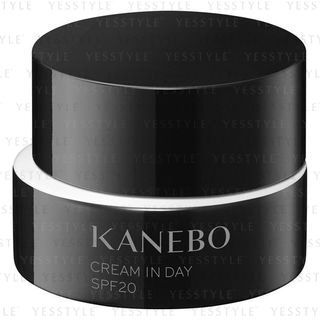
Kanebo Cream In Day SPF 20 PA+++
Works for
1 of 2 advertised claims delivered
Sun protectionSPF 20 · 6 UV filters · Broad spectrumWeak protectionSPF under 30
This product offers broad spectrum sun protection, but it is weak. We recommend to use a broad spectrum sunscreen with at least SPF 30.
Moisturizing10 ingredients credited for this claimGood support
“Cream In Day SPF 20 PA+++”
This product can help improve hydration of the skin with the two types of ingredients.
The first type is called “humectants”:
these ingredients help attract water.
When humectants are on the surface of the skin, they “pull in” the moisture from the outside environment, or from
within deeper layers of the skin. The following ingredients in this product do the job:
diglycerin, glycerin.
This product also contains ingredients called “occlusives”. They help reduce the speed with which our skin loses moisture to the outside environment. These ingredients also help soften the upper layer of the skin, so it feels less tight and nicer to the touch. The following ingredients in this product do the job: dimethicone, squalane.
Can it cause trouble?
Irritancy1 strong irritant: ParfumMedium risk
ComedogenicClean of flagged comedogenic ingredientsNone flagged
User reviews
Be the first — your take helps the next person decide.
Ingredients
Filter by role to see what each ingredient is doing.
Water~45–55%
Phytosteryl macadamiate~4.8–5.9%
- Irritation risk
- Low
Helps soften the upper layer of the skin
More about Phytosteryl macadamiateDipropylene glycol~4–4.9%
- Irritation risk
- Low
Helps to dissolve other ingredients in a formulation. Slows down the rate of product drying
More about Dipropylene glycolEthylhexyl methoxycinnamate~3.5–4.3%
- Irritation risk
- High
Octinoxate. When used in higher concentrations, works as a sunscreen protecting the skin from UVB rays. When used in lower concentration, helps to preserve the product formulation. Is shown to be harmful to coral reefs - consider avoiding bathing in coral reef areas when wearing a product with this ingredient. It can be irritating
More about Ethylhexyl methoxycinnamateSorbitol~2.3–2.8%
- Irritation risk
- Low
Helps attract water to the upper layer of the skin and improves the product texture
More about SorbitolGlycerin~2–2.4%
- Irritation risk
- Low
One of the best moisturizing ingredients. Naturally present in skin. It attracts water to the upper layer of the skin working as a humectant
More about GlycerinDiglycerin~1.6–2%
- Irritation risk
- Low
Helps attract water to the upper layer of the skin
More about DiglycerinBehenyl alcohol~1.5–1.8%
- Irritation risk
- Low
Non-drying alcohol that helps water and oil mix together. Also serves as an emollient
More about Behenyl alcoholSqualane~1.2–1.5%
- Irritation risk
- Low
An oil naturally present in skin. Works as an emollient to soften the skin and form a protective layer on its surface without a greasy feeling.
More about SqualaneButylene glycol~0.95–1.15%
- Irritation risk
- Low
Used to create a nice product texture and help delivery of other ingredients. Might be somewhat helpful in attracting water to the upper layer of the skin
More about Butylene glycolTitanium dioxide~1.1–1.3%
- Irritation risk
- Low
Works as a UV filter when used in high concentrations. It is photostable and is effective mostly against the UVB light, with some protection in the UVA range. In small concentrations, used for its ability to improve the color of cosmetic products. Is usually well tolerated by the skin
More about Titanium dioxideBis-ethylhexyloxyphenol methoxyphenyl triazine~0.8–1.2%
- Irritation risk
- Medium
Tinosorb S. One of the most effective broad spectrum sunscreen ingredients. Protects from both UVA and UVB rays. It is photostable. Unfortunately, not approved by FDA (US) yet.
More about Bis-ethylhexyloxyphenol methoxyphenyl triazineDimethicone~0.6–0.85%
- Irritation risk
- Low
A silicone that helps to reduce water loss from the surface of the skin. Can temporarily "fill in" lines and wrinkles, absorb oil, and create a nice product finish
More about DimethiconePhenylbenzimidazole sulfonic acid~0.7–1.05%
- Irritation risk
- Medium
Ensulizole. A UV filter that is effective against UVB rays. Does not protect against UVA light. It is photostable and can be used to help stabilize other sunscreen ingredients. It is water-soluble meaning that it can help create lighter sunscreen formulations
More about Phenylbenzimidazole sulfonic acidCholesterol~0.5–0.75%
- Irritation risk
- Low
An emollient that is naturally found in skin
More about CholesterolMica~0.5–0.75%
- Irritation risk
- Low
Creates an illusion of smoother and more radiant skin tone. Adds shimmer to the skin by reflecting light
More about MicaCholesterol~0.5–0.75%
- Irritation risk
- Low
An emollient that is naturally found in skin
More about CholesterolWool~0.45–0.65%
- Irritation risk
- Low
Ethylhexyl triazone~0.55–0.8%
- Irritation risk
- Medium
Uvinul T. A UV filter. Effective against UVB rays. It is photostable. Can increase water resistance properties of the sunscreen. Unfortunately, not approved by the FDA (US) yet
More about Ethylhexyl triazoneHydrogenated lecithin~0.3–0.6%
- Irritation risk
- Low
Helps to retain moisture by creating a protective barrier on the skin. Rich in fatty acids. Improves product texture and helps with the penetration of other ingredients.
More about Hydrogenated lecithinIsostearic acid~0.45–0.65%
- Irritation risk
- Low
Used to create a nice product texture
More about Isostearic acidDiethylamino hydroxybenzoyl hexyl benzoate~0.5–0.75%
- Irritation risk
- Medium
Uvinul A Plus. A new generation broad spectrum sunscreen that offers an effective protection especially in the UVA range. It is stable in formulations. Unfortunately, is not approved by the FDA (US) yet
More about Diethylamino hydroxybenzoyl hexyl benzoateCarbomer~0.25–0.5%
- Irritation risk
- Low
Helps create a thicker or gel-like product texture. It is not a surfactant but can be used in gentle cleansing formulations
More about CarbomerSilica~0.4–0.6%
Palmitic acid~0.3–0.55%
- Irritation risk
- Low
An emollient that is naturally present in skin and helps soften it
More about Palmitic acidXanthan gum~0.25–0.45%
- Irritation risk
- Low
Used to create a thicker product consistency
More about Xanthan gumParfum~0.2–0.35%
- Irritation risk
- High
An aromatic blend of unspecified and possibly irritating ingredients
More about ParfumDisodium edta~0.2–0.35%
Roe extract~0.15–0.25%
- Irritation risk
- Low
Chrysanthemum indicum extract~0.1–0.15%
- Irritation risk
- Low
Phenoxyethanol~0.1–0.15%
- Irritation risk
- Low
A preservative. It helps prevent bacterial growth in cosmetic products
More about PhenoxyethanolChlorphenesin~0.05–0.1%
Ci 14700~0.05%
Ingredient list view
Water, Phytosteryl macadamiate, Dipropylene glycol, Ethylhexyl methoxycinnamate, Sorbitol, Glycerin, Diglycerin, Behenyl alcohol, Squalane, Butylene glycol, Unknown, Titanium dioxide, Bis-ethylhexyloxyphenol methoxyphenyl triazine, Dimethicone, Phenylbenzimidazole sulfonic acid, Unknown, Cholesterol, Unknown, Mica, Cholesterol, Wool, Ethylhexyl triazone, Hydrogenated lecithin, Isostearic acid, Diethylamino hydroxybenzoyl hexyl benzoate, Carbomer, Silica, Palmitic acid, Xanthan gum, Parfum, Disodium edta, Roe extract, Chrysanthemum indicum extract, Phenoxyethanol, Chlorphenesin, Ci 14700
Compare prices
Retailers ranked by price — lowest first.

Affiliate links · prices updated regularly
Product summary
"Kanebo - Cream In Day SPF 20 PA+++" "is a broad spectrum sunscreen meaning that it protects both from UVB rays (" burning "- they cause sunburn) and UVA rays (" aging "- they don't cause sunburn but lead to premature aging and pigmentation issues). However, it does not offer enough sun protection. We recommend to use a sunscreen with at least SPF 30 daily.
It also works as a moisturizer, so you do not have to use an additional hydrating product.
Sunscreen filters
This sunscreen uses a mixture of both mineral and organic (so-called" chemical ") UV filters. The organic filters in the product are: tinosorb s, uvinul a plus, octinoxate and uvinul t. As for the mineral filters, this sunscreen uses titanium dioxide.
Irritation risk
This formulation includes some common irritants, including ingredients that do not provide a benefit for the skin. We assess the overall irritancy of this product to be medium. For a detailed overview of all potential irritants: click here
You can see the detailed formula review with the breakdown of all actives in the product and the full ingredient list with estimated concentrations in the tables below.
Price
The product retails for 94.24$ in the United States.
For a detailed price comparison: click here.
Sources cited in this review
Every concentration estimate and effectiveness label is anchored to one of these 4 studies and safety reviews.
- 1Safety Assessment of Phytosterols as Used in Cosmeticscir-safety.org
- 2
- 3
- 4Final Report on the Safety Assessment of Dimethicone Copolyoljournals.sagepub.com

Affiliate links · As an Amazon Associate, WIMJ earns from qualifying purchases.