Works for
MoisturizingUrea, Glycerin + 21 moreWorks well
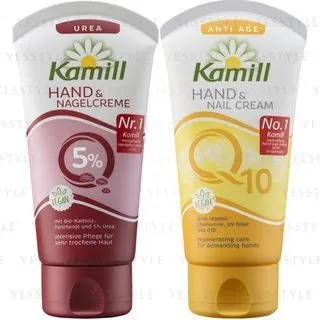
“Hand & Nail Cream , 4 Types”
This product can help improve hydration of the skin with the two types of ingredients.
The first type is called “humectants”:
these ingredients help attract water.
When humectants are on the surface of the skin, they “pull in” the moisture from the outside environment, or from
within deeper layers of the skin. The following ingredients in this product do the job:
glycerin, lactic acid.
This product also contains ingredients called “occlusives”. They help reduce the speed with which our skin loses moisture to the outside environment. These ingredients also help soften the upper layer of the skin, so it feels less tight and nicer to the touch. The following ingredients in this product do the job: dimethicone, cetyl dimethicone.
The following ingredients in this product are especially good for supporting the skin barrier and helping with the hydration level: urea
Evens skin toneLactic acidWorks well
“Thanks to the light SPF filters, this cream prevents premature aging of the skin, brightens and reduces discoloration. Urea Reduces irritation. Great for cracked skin. Prevents loss of moisture. Extreme protection of the hand. Pack Size , 75ml”
This product can help reduce hypepigmentation and even out the skin tone because it contains the following effective ingredients: lactic acid
Keep in mind that you would need to apply any topical skincare targetted at hypigmentation consistently for a couple of months to get a result. No topical skincare product can help get rid of hyperpigmentation (including post-acne marks and age spots) instantly.
Anti-agingLactic acid, Creatine + 1 moreMay help
“The coenzyme Q10 and Vitamin E cream protects the skin from free radical damage and effectively reduces wrinkles.”
This product contains creatine, lactic acid. These ingredients might be able to help reduce and prevent fine lines and wrinkles, improve skin elasticity and firmness, but there is not enough evidence that it actually works.
ExfoliationNot advertised by the brand · Lactic acid, UreaWorks well
This product can help exfoliate the skin. In other words, it helps break down the bonds between dead cells on the surface of the skin and speed up the skin turnover. Skin often appears softer and brighter after exfoliation, but overdoing it can result in disrupted skin barrier. The following ingredient is doing the exfoliating job in this product: lactic acid.
Anti-oxidationNot advertised by the brand · Ubiquinone, Creatine + 3 moreWorks well
This product contains antioxidants (ubiquinone) that can help neutralize free radicals in skin. By doing so, they can lessen the damage the skin gets from the UV light (sun).
The following ingredients - creatine also can have an antioxidant effect, but there is less evidence to confirm their effectiveness in skin.
Can it cause trouble?
Irritancy1 strong irritant: ParfumMedium risk
Comedogenic4 ingredients rated 2 or more on the 0–5 pore-clogging scale4 flagged
User reviews
Be the first — your take helps the next person decide.
Ingredients
Filter by role to see what each ingredient is doing.
Water~45–55%
Glycerin~4.5–5.5%
- Irritation risk
- Low
One of the best moisturizing ingredients. Naturally present in skin. It attracts water to the upper layer of the skin working as a humectant
More about GlycerinBisabolol~4.1–5%
- Irritation risk
- Low
An active component of chamomile plant that historically has been used to calm down irritated skin. A recent study shows that bisabolol indeed can have some anti-inflammatory effect on skin, even though conclusive data is lacking. Bisabolol has a sweet floral scent and can be added to products for its aromatic properties
More about BisabololGlucose~3–3.7%
- Irritation risk
- Low
Helps attract water to the upper layer of the skin. Could be helpful in restoring the skin barrier function
More about GlucoseLactic acid~2.3–2.8%
- Irritation risk
- Medium
An exfoliating and moisturizing alpha-hydroxy acid (AHA). Typically causes less irritation than other AHAs, for example, glycolic acid. At high concentrations (about 15%), lactic acid can help reduce lines and wrinkles. Recent studies show that lactic acid can support the "good" bacteria living on skin's surface (healthy skin microbiome)
More about Lactic acidPropylene glycol~1.9–2.3%
- Irritation risk
- High
Helps oil and water mix together and can enhance the penetration of other ingredients into the skin. It can be irritating
More about Propylene glycolCarbomer~1.6–2%
- Irritation risk
- Low
Helps create a thicker or gel-like product texture. It is not a surfactant but can be used in gentle cleansing formulations
More about CarbomerButylene glycol~1.4–1.8%
- Irritation risk
- Low
Used to create a nice product texture and help delivery of other ingredients. Might be somewhat helpful in attracting water to the upper layer of the skin
More about Butylene glycolSodium hydroxide~1.2–1.4%
Sodium benzoate~0.25–0.5%
Potassium sorbate~0.3–0.6%
Parfum~0.55–0.8%
- Irritation risk
- High
An aromatic blend of unspecified and possibly irritating ingredients
More about ParfumDecylene glycol~0.5–0.75%
- Irritation risk
- Low
Used to creat a nice product texture and support penetration of other ingredients
More about Decylene glycolStearyl alcohol~0.55–0.85%
- Irritation risk
- Low
An emollient that helps soften the skin
More about Stearyl alcoholDistarch phosphate~0.45–0.65%
- Irritation risk
- Low
Ubiquinone~0.45–0.65%
- Irritation risk
- Low
Coenzyme Q10. It helps neutralize free radicals in skin, improves skin hydration and might be helpful agains fine lines and wrinkles. It can be an allergen
More about UbiquinoneHydrogenated coco-glycerides~0.45–0.65%
- Irritation risk
- Medium
Helps oil and water mix together while creating a nice finish on the skin
More about Hydrogenated coco-glyceridesPalmitic acid~0.45–0.65%
- Irritation risk
- Low
An emollient that is naturally present in skin and helps soften it
More about Palmitic acidDisodium edta~0.3–0.55%
Polyglyceryl-3 methylglucose distearate~0.3–0.6%
- Irritation risk
- Medium
Helps water and oil mix together
More about Polyglyceryl-3 methylglucose distearateCreatine~0.25–0.5%
- Irritation risk
- Low
Can support skin's ability to neutralize free radicals and produce collagen, though further research is needed to confirm effectiveness
More about CreatineCocoglycerides~0.3–0.55%
- Irritation risk
- High
Help soften the upper layer of the skin and make it easier for oil and water mix together. Recently, a rising number of allergic reactions to cocoglycerides and other coconut-derived surfactants has been reported. As there is a significant overlap between frequent irritants and allergens, we flag this ingredient for attention of those with very sensitive, reactive skin
More about CocoglyceridesPanthenol~0.25–0.45%
- Irritation risk
- Low
Helps attract water to the upper layer of the skin and can help improve skin barrier function
More about PanthenolGlyceryl stearate citrate~0.3–0.55%
- Irritation risk
- Low
Helps oil and water mix together while softening the upper layer of the skin
More about Glyceryl stearate citrateCetearyl alcohol~0.3–0.55%
- Irritation risk
- Low
- Comedogenicity
- 2/5
A non-drying alcohol. Works as an emollient. Helps water and oil mix together and creates a nice product texture
More about Cetearyl alcoholMethyl glucose sesquistearate~0.3–0.55%
- Irritation risk
- Medium
Helps water and oil mix together
More about Methyl glucose sesquistearateAvena sativa kernel extract~0.25–0.5%
- Irritation risk
- Low
An effective moisturizing and skin barrier repair ingredient. Helps calm down inflammation and has some anti-oxidant properties
More about Avena sativa kernel extractCetyl dimethicone~0.3–0.55%
- Irritation risk
- Low
A type of silicone. Helps soften the upper layer of the skin and creates a nice, light product texture
More about Cetyl dimethiconeUrea~0.25–0.45%
- Irritation risk
- Low
Naturally present in skin (urea makes up about 7% of natural moisturizing factors in skin). Attracts water to the upper layer of the skin. Also has a positive effect on the skin barrier beyond the humectant action. Can enhance penetration of other ingredients. Is an exfoliating ingredient when used in high concentrations
More about UreaStearic acid~0.5–0.75%
- Irritation risk
- Low
Helps oil and water mix together and works as an emollient
More about Stearic acidDecyl oleate~0.25–0.5%
- Irritation risk
- Low
- Comedogenicity
- 2/5
Helps soften the upper layer of the skin
More about Decyl oleateDisodium phosphate~0.25–0.45%
- Irritation risk
- Low
Helps adjust the product pH and stabilize the formulation
More about Disodium phosphateChamomilla recutita extract~0.25–0.45%
- Irritation risk
- High
Plant extract that can have healing and anti-inflammatory properties. It is a potential allergen and can be irritating
More about Chamomilla recutita extractEthylhexylglycerin~0.25–0.45%
Ethylhexyl stearate~0.3–0.55%
- Irritation risk
- Low
Helps soften the upper layer of the skin
More about Ethylhexyl stearateHeliotropine~0.2–0.4%
- Irritation risk
- Low
Isopropyl palmitate~0.25–0.45%
- Irritation risk
- Medium
- Comedogenicity
- 3/5
Helps soften the upper layer of the skin and create a thicker product consistency
More about Isopropyl palmitateChamomilla recutita flower extract~0.25–0.4%
- Irritation risk
- High
Plant extract that can have healing and anti-inflammatory properties. It is a potential allergen and can be irritating
More about Chamomilla recutita flower extractTocopheryl acetate~0.25–0.45%
- Irritation risk
- Medium
A more stable but less bio-available form of vitamin E compared to Tocopherol. Might help moisturize and protect the skin from free radicals, but mostly used in low concentrations to stabilize other ingredients.
More about Tocopheryl acetatePhenoxyethanol~0.2–0.4%
- Irritation risk
- Low
A preservative. It helps prevent bacterial growth in cosmetic products
More about PhenoxyethanolTriacetin~0.2–0.4%
Glyceryl stearate~0.25–0.45%
- Irritation risk
- Low
An emollient that softens the skin and forms a protective layer on its surface. Helps water and oil mix together
More about Glyceryl stearateCaprylyl glycol~0.2–0.35%
- Irritation risk
- Medium
Helps preserve products and creates a nice product texture
More about Caprylyl glycolDimethicone~0.2–0.4%
- Irritation risk
- Low
A silicone that helps to reduce water loss from the surface of the skin. Can temporarily "fill in" lines and wrinkles, absorb oil, and create a nice product finish
More about DimethiconeGlyceryl stearate se~0.15–0.3%
- Irritation risk
- Low
- Comedogenicity
- 2/5
Used to stabilize the product formulations and works as an emollient
More about Glyceryl stearate seDicaprylyl ether~0.15–0.25%
- Irritation risk
- Low
Helps soften the upper layer of the skin while creating a non-greasy feel on the skin. Helps to dissolve other ingredients
More about Dicaprylyl etherPhenoxyethanol~0.15–0.25%
- Irritation risk
- Low
A preservative. It helps prevent bacterial growth in cosmetic products
More about PhenoxyethanolIngredient list view
Water, Glycerin, Bisabolol, Glucose, Lactic acid, Propylene glycol, Carbomer, Butylene glycol, Sodium hydroxide, Sodium benzoate, Potassium sorbate, Parfum, Decylene glycol, Stearyl alcohol, Distarch phosphate, Ubiquinone, Hydrogenated coco-glycerides, Palmitic acid, Disodium edta, Polyglyceryl-3 methylglucose distearate, Creatine, Cocoglycerides, Panthenol, Glyceryl stearate citrate, Cetearyl alcohol, Methyl glucose sesquistearate, Avena sativa kernel extract, Cetyl dimethicone, Urea, Stearic acid, Decyl oleate, Disodium phosphate, Chamomilla recutita extract, Ethylhexylglycerin, Ethylhexyl stearate, Heliotropine, Isopropyl palmitate, Chamomilla recutita flower extract, Tocopheryl acetate, Phenoxyethanol, Triacetin, Glyceryl stearate, Caprylyl glycol, Dimethicone, Unknown, Glyceryl stearate se, Dicaprylyl ether, Phenoxyethanol
Compare prices
Retailers ranked by price — lowest first.

Worth comparing, line by line.
Match % combines shared ingredients, the first five ingredients, shared actives and hero ingredients, irritancy (lower counts in the alternative's favour), texture and body area. Only products in the same routine step are compared.
| KamillHand & Nail Cream - 4 TypesYOUR PRODUCT | Elizabeth GrantIntensive Hand & Foot Cream | MesoesteticRadiance DNA Hand Cream | STHKINUHADAKOMACHI Hand & Heel Cream Jar Type | |
|---|---|---|---|---|
| Match | — | 48% | 48% | 47% |
| Price | $10.50 | $29.00+$18.50 | $48.81+$38.31 | $39.27+$28.77 |
| Shared key ingredients | — | 4 of 9 | 5 of 9 | 4 of 9 |
| Key difference | — | Lanolin | Retinyl Palmitate | Mineral Oil |
| Irritancy | Medium | Medium | Medium | Medium |
| Drying alcohol | — | — | — | — |
| View product | Shop | Shop | Shop |


More alternatives: GEHWOL Gerlasan Hand CreamOillan Derm+, hand cream concentrate
Product summary
Judging from the ingredient list, "Kamill - Hand & Nail Cream - 4 Types" works well for improving skin hydration As we expect from a proper moisturizer, the formula includes a combo of effective humectants and emollients. These are the two different types of ingredients that are essential for improving the skin hydration and supporting a healthy skin barrier. Urea, glycerin, lactic acid, glucose and butylene glycol in this product (humectants) attract water molecules to the upper layer of the skin (the water comes from the outside air or from the deeper layers of the skin if the air is dry). Emollients in this formulation (cetyl dimethicone, dimethicone, cetearyl alcohol, decyl oleate and caprylyl glycol) help to reduce the moisture loss from the skin. They also soften the skin surface and relieve the feeling of dryness and tightness.
Ingredient callouts
- This product contains acids (lactic acid 2.30% - 2.80%). Their concentration is low, and they will not have a strong exfoliating effect. Instead, they work to support the skin natural acid mantle and to attract water (as humectants). Lactic acid is particularly good in attracting water to the upper layer of the skin and improving the skin barrier.
Irritation risk
This moisturizer contains some common irritants, including those without a benefit for the skin. We assess the overall irritancy of this moisturizer to be medium. For a detailed overview of all potential irritants: click here
You can see the detailed formula review with the breakdown of all actives in the product and the full ingredient list with estimated concentrations in the tables below.
Price
The product retails for 10.50$ in the United States.
For a detailed price comparison: click here.
Sources cited in this review
Every concentration estimate and effectiveness label is anchored to one of these 18 studies and safety reviews.
- 1
- 2
- 3
- 4Epidermal and dermal effects of topical lactic acidncbi.nlm.nih.gov
- 5Dual Effects of Alpha-Hydroxy Acids on the Skinpdfs.semanticscholar.org
- 6Surfactants and experimental irritant contact dermatitisncbi.nlm.nih.gov

Affiliate links · As an Amazon Associate, WIMJ earns from qualifying purchases.