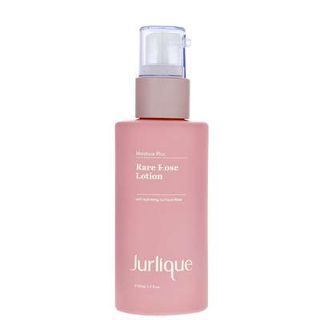
Jurlique Face Moisture Plus Rare Rose Lotion
Works for
1 of 1 advertised claim delivered
Moisturizing13 ingredients credited for this claimGood support
“Face Moisture Plus Rare Rose Lotion”
This product can help improve hydration of the skin with the two types of ingredients.
The first type is called “humectants”:
these ingredients help attract water.
When humectants are on the surface of the skin, they “pull in” the moisture from the outside environment, or from
within deeper layers of the skin. The following ingredients in this product do the job:
glycerin.
This product also contains ingredients called “occlusives”. They help reduce the speed with which our skin loses moisture to the outside environment. These ingredients also help soften the upper layer of the skin, so it feels less tight and nicer to the touch. The following ingredients in this product do the job: beeswax, caprylic/capric triglyceride.
Can it cause trouble?
Irritancy9 strong irritants: Rosa hybrid flower extract, Rosa gallica flower extract + 7 more — patch-test recommendedHigh risk
Comedogenic1 ingredient rated 2 or more on the 0–5 pore-clogging scale1 flagged
User reviews
Be the first — your take helps the next person decide.
Ingredients
Filter by role to see what each ingredient is doing.
Water~45–55%
Caprylic/capric triglyceride~6.6–8%
- Irritation risk
- Medium
A good mix of fatty acids that forms a protective layer on the skin. Improves the shelf life of products. Derived from coconut and glycerin
More about Caprylic/capric triglycerideGlycerin~4.2–5.2%
- Irritation risk
- Low
One of the best moisturizing ingredients. Naturally present in skin. It attracts water to the upper layer of the skin working as a humectant
More about GlycerinHydrogenated vegetable glycerides citrate~2.9–3.5%
Rosa canina fruit oil~2.5–3%
- Irritation risk
- Medium
A great emollient. Contains vitamin E (tocopherol) which may give it some anti-oxidant properties. Can contain volatile compounds and can be irritating
More about Rosa canina fruit oilDicaprylyl ether~2–2.5%
- Irritation risk
- Low
Helps soften the upper layer of the skin while creating a non-greasy feel on the skin. Helps to dissolve other ingredients
More about Dicaprylyl etherPersea gratissima oil~1.8–2.1%
- Irritation risk
- Medium
An emollient that helps soften the skin and could be helpful in repairing its barrier function
More about Persea gratissima oilSimmondsia chinensis seed oil~1.6–2%
- Irritation risk
- Medium
Softens the upper layer of skin and helps restore the healthy skin barrier. Has shown to help calm down inflammation in skin. It is a stable oil, meaning that it retains its properties even when exposed to air.
More about Simmondsia chinensis seed oilBeeswax~1.3–1.6%
- Irritation risk
- Low
Forms a protective barrier that holds water and keeps dry skin hydrated. Keeps an emulsion from separating into its oil and liquid components, and increases the thickness of a product. Can be an allergen
More about BeeswaxCera alba~1.2–1.4%
- Irritation risk
- Medium
Forms a protective barrier that holds water and keeps dry skin hydrated. Keeps an emulsion from separating into its oil and liquid components, and increases the thickness of a product. Can be an allergen
More about Cera albaButyrospermum parkii butter~0.75–1.15%
- Irritation risk
- Low
- Comedogenicity
- 3/5
A great moisturising ingredient that softens the skin and reduces water loss from its upper layer. It also can be helpful in protecting skin from free radicals
More about Butyrospermum parkii butterCarthamus tinctorius seed oil~0.65–0.95%
- Irritation risk
- Low
An emollient that helps soften the skin and might help calm down inflammation
More about Carthamus tinctorius seed oilCassia angustifolia seed polysaccharide~0.55–0.8%
- Irritation risk
- Medium
Helps attract water to the upper layer of the skin. Is sometimes referred to as "natural" hyaluronic acid (even though hyaluronic acid is not unnatural and is present in human skin)
More about Cassia angustifolia seed polysaccharideRosa hybrid flower extract~0.45–0.7%
- Irritation risk
- High
Rosa gallica flower extract~0.45–0.65%
- Irritation risk
- High
Althaea officinalis root extract~0.45–0.65%
- Irritation risk
- High
A plant extract that can help attract water to the upper layer of the skin and might help to reduce inflammation
More about Althaea officinalis root extractCalendula officinalis flower extract~0.4–0.6%
- Irritation risk
- High
A plant extract that has some anti-oxidant and anti-bacterial properties. Can be irritating
More about Calendula officinalis flower extractLavandula angustifolia flower extract~0.45–0.7%
- Irritation risk
- High
Essential oil that can be irritating
More about Lavandula angustifolia flower extractOpuntia ficus-indica stem extract~0.3–0.55%
- Irritation risk
- Low
Cellulose~0.3–0.6%
- Irritation risk
- Low
Can be used to help absorb oil as well as add volume and imporve texture of products.
More about CellulosePropanediol~0.3–0.55%
- Irritation risk
- Low
Acts as a solvent for other ingredients. Speeds up the absorption of other ingredients into the skin
More about PropanediolXanthan gum~0.25–0.5%
- Irritation risk
- Low
Used to create a thicker product consistency
More about Xanthan gumParfum~0.2–0.4%
- Irritation risk
- High
An aromatic blend of unspecified and possibly irritating ingredients
More about ParfumSodium stearoyl glutamate~0.3–0.55%
- Irritation risk
- Medium
Helps oil and water mix together
More about Sodium stearoyl glutamateTocopherol~0.25–0.45%
- Irritation risk
- Low
Pure form of vitamin E. Can help moisturise and protect the skin from free radicals. Often used to help stabilise other ingredients or the formula itself
More about TocopherolIron oxides~0.2–0.4%
- Irritation risk
- Low
An umbrella term for the following three colorants: CI 77491, CI 77492, CI 77499. They might be able to offer some protection against visible light, but the degree of the protection is not clear
More about Iron oxidesCi 77491~0.2–0.4%
- Irritation risk
- Low
A red colorant made of iron oxide. Typically is not irritating
More about Ci 77491Hydroxyethylcellulose~0.2–0.4%
- Irritation risk
- Low
Used to thicken product formulations and create gel-like textures
More about HydroxyethylcellulosePhenoxyethanol~0.2–0.35%
- Irritation risk
- Low
A preservative. It helps prevent bacterial growth in cosmetic products
More about PhenoxyethanolEthylhexylglycerin~0.2–0.35%
Sodium benzoate~0.15–0.25%
Citric acid~0.15–0.25%
- Irritation risk
- Medium
Can work as an exfoliant but is typically used to adjust the product pH
More about Citric acidCitronellol~0.1–0.2%
Geraniol~0.1–0.15%
Linalool~0.05–0.15%
Eugenol~0.05–0.1%
Ingredient list view
Water, Caprylic/capric triglyceride, Glycerin, Hydrogenated vegetable glycerides citrate, Rosa canina fruit oil, Dicaprylyl ether, Persea gratissima oil, Simmondsia chinensis seed oil, Beeswax, Cera alba, Butyrospermum parkii butter, Carthamus tinctorius seed oil, Cassia angustifolia seed polysaccharide, Rosa hybrid flower extract, Rosa gallica flower extract, Althaea officinalis root extract, Calendula officinalis flower extract, Lavandula angustifolia flower extract, Opuntia ficus-indica stem extract, Cellulose, Propanediol, Xanthan gum, Parfum, Sodium stearoyl glutamate, Tocopherol, Iron oxides, Ci 77491, Hydroxyethylcellulose, Phenoxyethanol, Ethylhexylglycerin, Sodium benzoate, Citric acid, Citronellol, Geraniol, Linalool, Eugenol
Compare prices
Retailers ranked by price — lowest first.
Affiliate links · prices updated regularly · As an Amazon Associate, WIMJ earns from qualifying purchases.
Sources cited in this review
Every concentration estimate and effectiveness label is anchored to one of these 14 studies and safety reviews.
- 1
- 2
- 3
- 4
- 5Contact Burn with Blister Formation in Children Treated with Sennosidesonlinelibrary.wiley.com
- 6

Affiliate links · As an Amazon Associate, WIMJ earns from qualifying purchases.