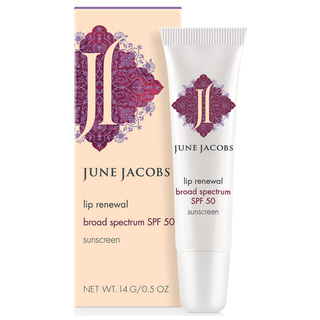
June Jacobs Spa June Jacobs Lip Renewal SPF 50
Works for
2 of 3 advertised claims delivered
Sun protectionSPF 50 · 2 UV filters · Partial spectrumWeak protection
This product does not offer good protection against UVA rays.
Anti-oxidation8 ingredients credited for this claimStrong support
This product contains antioxidants (vitis vinifera seed extract) that can help neutralize free radicals in skin. By doing so, they can lessen the damage the skin gets from the UV light (sun).
The following ingredients - punica granatum extract also can have an antioxidant effect, but there is less evidence to confirm their effectiveness in skin.
Anti-aging6 ingredients credited for this claimModerate support
“June Jacobs Patent Pending Anti-Oxidant Blend -White Tea Leaf Extract, Red Tea Leaf Extract, Green Tea Leaf Extract, Goji Berry Fruit Extract, Pomegranate Extract, and Grape Seed Extract help to neutralize free radicals, protect skin from environmental toxins and combat the visible signs of premature aging.”
This product contains vitis vinifera seed extract. This ingredient might be able to help reduce and prevent fine lines and wrinkles, improve skin elasticity and firmness, but there is not enough evidence that it actually works. The biggest anti-aging effect in this product comes from sun protection. Sun damage is the main factor causing early signs of skin aging. We, however, do not recommend using this product as a sunscreen because the protection it offers is not strong enough).
MoisturizingNot advertised by the brand · 13 ingredients credited for this claimGood support
This product can help improve hydration of the skin with the two types of ingredients.
The first type is called “humectants”:
these ingredients help attract water.
When humectants are on the surface of the skin, they “pull in” the moisture from the outside environment, or from
within deeper layers of the skin. The following ingredients in this product do the job:
glycerin, hyaluronic acid.
This product also contains ingredients called “occlusives”. They help reduce the speed with which our skin loses moisture to the outside environment. These ingredients also help soften the upper layer of the skin, so it feels less tight and nicer to the touch. The following ingredients in this product do the job: butyrospermum parkii butter, copernicia cerifera wax.
Can it cause trouble?
Irritancy4 strong irritants: Benzophenone-3, Parfum + 2 more — patch-test recommendedHigh risk
Comedogenic1 ingredient rated 2 or more on the 0–5 pore-clogging scale1 flagged
User reviews
Be the first — your take helps the next person decide.
Ingredients
Filter by role to see what each ingredient is doing.
Ethylhexyl methoxycinnamate7%
- Irritation risk
- High
Octinoxate. When used in higher concentrations, works as a sunscreen protecting the skin from UVB rays. When used in lower concentration, helps to preserve the product formulation. Is shown to be harmful to coral reefs - consider avoiding bathing in coral reef areas when wearing a product with this ingredient. It can be irritating
More about Ethylhexyl methoxycinnamateBenzophenone-34.5%
- Irritation risk
- High
Same as oxybenzone. Protects in the UVB and short UVA range. In small concentrations, used to stabilize product formulation. Can be irritating. Is shown to be harmful to coral reefs - consider avoiding bathing in coral reef areas when wearing a product with this ingredient. It can penetrate the skin and get absorbed into bloodstream faster than other popular filters available in the US. The study that produced this finding did not address any potential health effects of the absorption
More about Benzophenone-3Microcrystalline wax~22–33%
Diisostearyl malate~4.8–7.2%
- Irritation risk
- Medium
Helps to soften the upper layer of the skin
More about Diisostearyl malateGlyceryl diisostearate~3.3–5%
Simmondsia chinensis seed oil~3.9–5.8%
- Irritation risk
- Medium
Softens the upper layer of skin and helps restore the healthy skin barrier. Has shown to help calm down inflammation in skin. It is a stable oil, meaning that it retains its properties even when exposed to air.
More about Simmondsia chinensis seed oilCopernicia cerifera wax~3–4.5%
- Irritation risk
- Low
Helps to soften the upper layer of the skin and create a nice product consistency
More about Copernicia cerifera waxButyrospermum parkii butter~2.3–3.4%
- Irritation risk
- Low
- Comedogenicity
- 3/5
A great moisturising ingredient that softens the skin and reduces water loss from its upper layer. It also can be helpful in protecting skin from free radicals
More about Butyrospermum parkii butterDimethicone~1.8–2.7%
- Irritation risk
- Low
A silicone that helps to reduce water loss from the surface of the skin. Can temporarily "fill in" lines and wrinkles, absorb oil, and create a nice product finish
More about DimethiconeVitis vinifera seed oil~1.3–2%
- Irritation risk
- Medium
A great emollient that can also have anti-oxidant properties
More about Vitis vinifera seed oilParfum~0.95–1.45%
- Irritation risk
- High
An aromatic blend of unspecified and possibly irritating ingredients
More about ParfumAroma~0.8–1.25%
Glycerin~0.55–1.25%
- Irritation risk
- Low
One of the best moisturizing ingredients. Naturally present in skin. It attracts water to the upper layer of the skin working as a humectant
More about GlycerinTriisostearin~0.45–1.1%
- Irritation risk
- Low
Tocopherol~0.45–1%
- Irritation risk
- Low
Pure form of vitamin E. Can help moisturise and protect the skin from free radicals. Often used to help stabilise other ingredients or the formula itself
More about TocopherolCamellia sinensis leaf extract~0.4–0.9%
- Irritation risk
- Low
Can contain potent anti-oxidant compounds (abbreviated ECG, GCG, EGC, and EGCG) that might help protect the skin from free radicals. Can help calm down inflammation and has some anti-bacterial properties. Unfortunately, these antioxidants are unstable and lose their effectiveness very quickly in products. The concentration of the antioxidant compounds in the extract also tends to be low to be effective in topical formulation
More about Camellia sinensis leaf extractLycium barbarum fruit extract~0.35–0.75%
- Irritation risk
- Medium
A plant extract that can help neutralize free radicals in skin and attract water to its upper layer
More about Lycium barbarum fruit extractPunica granatum extract~0.2–0.75%
- Irritation risk
- Medium
A plant extract that can help neutralize free radicals in skin and even out the skin tone, but is typically used in products in a concentration that is too low to be effective
More about Punica granatum extractVitis vinifera seed extract~0.2–0.75%
- Irritation risk
- Low
A plant extract that contains resveratrol and other anti-oxidant compounds that can help neutralize free radicals, reduce inflammation in skin and even out its tone. Can be also used to stabilize the product formulation
More about Vitis vinifera seed extractAspalathus linearis leaf extract~0.15–0.6%
- Irritation risk
- Low
Plant extract that might have help to neutralize free radicals in skin, but evidence of effectiveness is skin is lacking
More about Aspalathus linearis leaf extractSqualane~0.2–0.7%
- Irritation risk
- Low
An oil naturally present in skin. Works as an emollient to soften the skin and form a protective layer on its surface without a greasy feeling.
More about SqualaneAllantoin~0.1–0.35%
- Irritation risk
- Low
Helps calm down inflammation in skin and can help reduce itching. Helps to repair the skin barrier and keep skin hydrated
More about AllantoinHyaluronic acid~0.1–0.35%
- Irritation risk
- Low
One of the best moisturizing ingredients. Attracts water into the upper layer of the skin. Naturally present in skin. Typically has large molecule size unless advertised otherwise on the product label. Helps support skin's barrier function and may help to reduce inflammation
More about Hyaluronic acidWater~0.1–0.35%
Limonene~0.05–0.25%
- Irritation risk
- High
A common frangrance that can easily irritate skin, especially if exposed to air, light or heat
More about LimoneneIngredient list view
Ethylhexyl methoxycinnamate, Benzophenone-3, Microcrystalline wax, Diisostearyl malate, Glyceryl diisostearate, Simmondsia chinensis seed oil, Copernicia cerifera wax, Butyrospermum parkii butter, Dimethicone, Vitis vinifera seed oil, Parfum, Aroma, Glycerin, Triisostearin, Tocopherol, Camellia sinensis leaf extract, Lycium barbarum fruit extract, Punica granatum extract, Vitis vinifera seed extract, Aspalathus linearis leaf extract, Squalane, Allantoin, Hyaluronic acid, Water, Limonene
Compare prices
Retailers ranked by price — lowest first.
Product summary
"June Jacobs Spa - June Jacobs Lip Renewal SPF 50" does not provide enough UVA protection. UVA rays do not cause sunburn, but still damage the skin, leading to early signs of aging and pigmentation issues.
Because it includes good moisturizing ingredients, it can also work as a hydrating day cream.
Sunscreen filters
This is a so-called "chemical" sunscreen. It means that it uses organic UV filters. They typically offer good sun protection and rarely leave a white cast, but they can be irritating for some people with sensitive skin. The UV filters in this sunscreen are: oxybenzone 4.50% (declared) and octinoxate 7.00% (declared).
Irritation risk
There are some common irritants in this product, including ingredients that do not have benefits for the skin. We assess the overall irritancy of this product to be high. For a detailed overview of all potential irritants: click here
You can see the detailed formula review with the breakdown of all actives in the product and the full ingredient list with estimated concentrations in the tables below.
Price
The product retails from 14.40$ up to 24.00$ in the United States and for 32.00CA$ in Canada.
For a detailed price comparison: click here.
Sources cited in this review
Every concentration estimate and effectiveness label is anchored to one of these 21 studies and safety reviews.
- 1
- 2
- 3On Photostability of Oxybenzonecore.ac.uk
- 4
- 5Final Report on the Safety Assessment of Dimethicone Copolyoljournals.sagepub.com
- 6

Affiliate links · As an Amazon Associate, WIMJ earns from qualifying purchases.