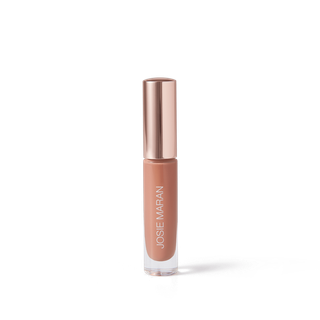
Josie Maran Cosmetics Argan Hyaluronic Lip Booster
Works for
1 of 1 advertised claim delivered
Moisturizing11 ingredients credited for this claimGood support
“Argan Hyaluronic Lip Booster”
This product can help soften the skin and reduce its moisture loss with emollients and occlusives: helianthus annuus seed oil, ricinus communis seed oil.
Keep in mind that this product does not contain effective ingredients to attract water to the upper layer of the skin. This is why an additional product with humectants like glycerin or hyaluronic acid can be helpful (apply it before this product for the best results).
Can it cause trouble?
Irritancy1 strong irritant: ParfumMedium risk
Comedogenic1 ingredient rated 2 or more on the 0–5 pore-clogging scale1 flagged
User reviews
Be the first — your take helps the next person decide.
Ingredients
Filter by role to see what each ingredient is doing.
Ricinus communis seed oil~25–38%
- Irritation risk
- Medium
A plant oil that can help soften the skin. It might be helpful in calming down inflammation, but solid research is lacking. Is often used in lip products to create the needed product consistency
More about Ricinus communis seed oilDiisostearoyl polyglyceryl-3 dimer dilinoleate~5.5–8.2%
- Irritation risk
- Low
Shorea robusta resin~4.8–7.3%
- Irritation risk
- Low
Tapioca starch~3.6–5.5%
Octyldodecanol~2.7–4.1%
- Irritation risk
- Low
An emollient that helps to soften the skin and create a pleasant product texture and stabilize the formulation
More about OctyldodecanolSilica~2.3–3.4%
Hectorite~1.7–2.5%
- Irritation risk
- Low
Argania spinosa kernel oil~1.4–2.1%
- Irritation risk
- Medium
An emollient that helps soften the upper layer of the skin. Might have some weak anti-oxidant properties
More about Argania spinosa kernel oilHydrolyzed sodium hyaluronate~1.1–1.6%
- Irritation risk
- Low
Attracts water into the upper layer of the skin
More about Hydrolyzed sodium hyaluronateSimmondsia chinensis seed oil~0.95–1.45%
- Irritation risk
- Medium
Softens the upper layer of skin and helps restore the healthy skin barrier. Has shown to help calm down inflammation in skin. It is a stable oil, meaning that it retains its properties even when exposed to air.
More about Simmondsia chinensis seed oilLimnanthes alba seed oil~0.6–1.4%
- Irritation risk
- Low
This oil's cmposition is closest to rapeseed oil. It is a very stable oil and serves as an emoillient
More about Limnanthes alba seed oilButyrospermum parkii butter~0.55–1.25%
- Irritation risk
- Low
- Comedogenicity
- 3/5
A great moisturising ingredient that softens the skin and reduces water loss from its upper layer. It also can be helpful in protecting skin from free radicals
More about Butyrospermum parkii butterHelianthus annuus seed oil~0.45–1.05%
- Irritation risk
- Low
A great emollient due to its high linoleic acid content. One of the most effective plant oils in helping skin hydration and repairing skin barrier function
More about Helianthus annuus seed oilTocopherol~0.4–0.9%
- Irritation risk
- Low
Pure form of vitamin E. Can help moisturise and protect the skin from free radicals. Often used to help stabilise other ingredients or the formula itself
More about TocopherolParfum~0.3–0.7%
- Irritation risk
- High
An aromatic blend of unspecified and possibly irritating ingredients
More about ParfumCaprylic/capric triglyceride~0.4–0.9%
- Irritation risk
- Medium
A good mix of fatty acids that forms a protective layer on the skin. Improves the shelf life of products. Derived from coconut and glycerin
More about Caprylic/capric triglycerideGlyceryl behenate~0.35–0.85%
- Irritation risk
- Medium
Used to create a thicker product consistency and help soften the upper layer of the skin
More about Glyceryl behenateUndaria pinnatifida extract~0.15–0.7%
- Irritation risk
- Low
A seaweed extract that helps attract water to the upper layer of the skin and might have an anti-oxidant effect
More about Undaria pinnatifida extractTitanium dioxide~0.3–0.7%
- Irritation risk
- Low
Works as a UV filter when used in high concentrations. It is photostable and is effective mostly against the UVB light, with some protection in the UVA range. In small concentrations, used for its ability to improve the color of cosmetic products. Is usually well tolerated by the skin
More about Titanium dioxideCi 77891~0.15–0.55%
- Irritation risk
- Low
Iron oxides~0.15–0.55%
- Irritation risk
- Low
An umbrella term for the following three colorants: CI 77491, CI 77492, CI 77499. They might be able to offer some protection against visible light, but the degree of the protection is not clear
More about Iron oxidesCi 15850~0.1–0.35%
Blue 1 lake~0.05–0.25%
Ci 42090~0.05–0.25%
Ingredient list view
Ricinus communis seed oil, Diisostearoyl polyglyceryl-3 dimer dilinoleate, Shorea robusta resin, Tapioca starch, Octyldodecanol, Silica, Hectorite, Argania spinosa kernel oil, Hydrolyzed sodium hyaluronate, Simmondsia chinensis seed oil, Limnanthes alba seed oil, Butyrospermum parkii butter, Helianthus annuus seed oil, Tocopherol, Parfum, Caprylic/capric triglyceride, Glyceryl behenate, Undaria pinnatifida extract, Titanium dioxide, Ci 77891, Iron oxides, Ci 15850, Blue 1 lake, Ci 42090
Compare prices
Retailers ranked by price — lowest first.
Sources cited in this review
Every concentration estimate and effectiveness label is anchored to one of these 10 studies and safety reviews.
- 1
- 2
- 3
- 4
- 5
- 6

Affiliate links · As an Amazon Associate, WIMJ earns from qualifying purchases.