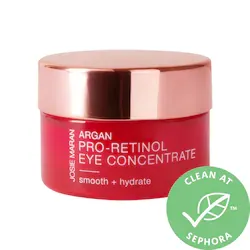
Josie Maran Argan Pro-Retinol Eye Cream
Works for
1 of 2 advertised claims delivered
MoisturizingButyrospermum parkii butter, Fructose + 21 moreGood evidence
“, Botanical Eye Hydrators Horse chestnut extract, arjun tree (an ayurvedic tradition), and encapsulated hyaluronic acid boost restorative hydration to visibly plump and smooth the delicate eye area.”
This product can help improve hydration of the skin with the two types of ingredients.
The first type is called “humectants”:
these ingredients help attract water.
When humectants are on the surface of the skin, they “pull in” the moisture from the outside environment, or from
within deeper layers of the skin. The following ingredients in this product do the job:
biosaccharide gum-1, fructose.
This product also contains ingredients called “occlusives”. They help reduce the speed with which our skin loses moisture to the outside environment. These ingredients also help soften the upper layer of the skin, so it feels less tight and nicer to the touch. The following ingredients in this product do the job: beeswax, butyrospermum parkii butter.
Anti-agingButyrospermum parkii butter, Tocopherol + 1 moreLimited evidence
“Skin Type Normal, Dry, Combination, and Oily Skincare Concerns Fine Lines/Wrinkles, Loss of Firmness/Elasticity, and Dark Circles Formulation Cream Highlighted Ingredients , Dunaliella salina (Pink Algae) Extract A pro-retinol that helps reduce the appearance of fine lines and wrinkles.”
This product does not contain ingredients that are able to reduce fine lines and wrinkles or help with skin elasticity, but it can improve the look of the skin temporarily through moisturization. Well-moisturized skin might also be able to repair the sun damage better.This ingredient - butyrospermum parkii butter - could be helpful for preventing or repairing signs of aging in theory, but there is no evidence that it actually works.
This ingredient quercetin might be able to help neutralize free radicals in skin and help it fight off some of the sun damage.
Anti-oxidationNot advertised by the brand · Quercetin, Squalene + 8 moreModerate evidence
This product contains antioxidants (quercetin, squalene) that might be able to help neutralize free radicals in skin to lessen the damage it gets from the UV light (sun). There is not enough evidence to confirm their effectiveness in skin though.
Can it cause trouble?
Irritancy1 strong irritant: Citrus aurantium dulcis oilMedium risk
Comedogenic3 ingredients rated 2 or more on the 0–5 pore-clogging scale3 flagged
User reviews
Be the first — your take helps the next person decide.
Ingredients
Filter by role to see what each ingredient is doing.
Water~45–55%
Butylene glycol~6–7.3%
- Irritation risk
- Low
Used to create a nice product texture and help delivery of other ingredients. Might be somewhat helpful in attracting water to the upper layer of the skin
More about Butylene glycolGlyceryl stearate~3.8–4.6%
- Irritation risk
- Low
An emollient that softens the skin and forms a protective layer on its surface. Helps water and oil mix together
More about Glyceryl stearateOctyldodecanol~3–3.7%
- Irritation risk
- Low
An emollient that helps to soften the skin and create a pleasant product texture and stabilize the formulation
More about OctyldodecanolHydrogenated olive oil unsaponifiables~2.3–2.8%
- Irritation risk
- Low
Help soften the upper layer of the skin
More about Hydrogenated olive oil unsaponifiablesCetyl alcohol~1.9–2.3%
- Irritation risk
- Low
A non-drying alcohol that works to soften the skin and stabilize product formulations helping oil and water mix together
More about Cetyl alcoholButyrospermum parkii butter~1.6–2%
- Irritation risk
- Low
- Comedogenicity
- 3/5
A great moisturising ingredient that softens the skin and reduces water loss from its upper layer. It also can be helpful in protecting skin from free radicals
More about Butyrospermum parkii butterSilica~1.5–1.8%
Tribehenin~1–1.3%
- Irritation risk
- Low
Used to create a thicker product consistency and soften the upper layer of the skin
More about TribeheninBeeswax~0.75–1.15%
- Irritation risk
- Low
Forms a protective barrier that holds water and keeps dry skin hydrated. Keeps an emulsion from separating into its oil and liquid components, and increases the thickness of a product. Can be an allergen
More about BeeswaxCera alba~0.7–1.05%
- Irritation risk
- Medium
Forms a protective barrier that holds water and keeps dry skin hydrated. Keeps an emulsion from separating into its oil and liquid components, and increases the thickness of a product. Can be an allergen
More about Cera albaBeeswax~0.55–0.8%
- Irritation risk
- Low
Forms a protective barrier that holds water and keeps dry skin hydrated. Keeps an emulsion from separating into its oil and liquid components, and increases the thickness of a product. Can be an allergen
More about BeeswaxBenzyl alcohol~0.3–0.6%
- Irritation risk
- High
A preservative. Can be used to mask unpleasant smell. Can be irritating
More about Benzyl alcoholArgania spinosa kernel oil~0.35–0.65%
- Irritation risk
- Medium
An emollient that helps soften the upper layer of the skin. Might have some weak anti-oxidant properties
More about Argania spinosa kernel oilC9-12 alkane~0.3–0.55%
Octyldodecyl pca~0.35–0.6%
- Irritation risk
- Low
Dunaliella salina extract~0.3–0.5%
- Irritation risk
- Low
A green micro-algae extract that might help neutralize free radicals in skin, but solid evidence is lacking. It helps to soften the upper layer of the skin
More about Dunaliella salina extractOlea europaea fruit oil~0.25–0.5%
- Irritation risk
- Medium
An emollient that helps soften the skin but is not effective for restoring its barrier function. Might be helpful to calm down inflammation
More about Olea europaea fruit oilBeta-carotene~0.2–0.4%
Aesculus hippocastanum extract~0.25–0.45%
- Irritation risk
- High
A plant extract. Benefits of topical application are not confirmed
More about Aesculus hippocastanum extractCoffea arabica seed extract~0.2–0.35%
- Irritation risk
- Low
Might be helpful in neutralizing free radicals in skin
More about Coffea arabica seed extractCaffeine~0.2–0.35%
- Irritation risk
- Medium
Might be helpful in neutralizing free radicals. Can have a dehydration effect that might somewhat decrease the look of puffy eyes
More about CaffeineTerminalia arjuna extract~0.15–0.3%
- Irritation risk
- Low
Citrus aurantium dulcis oil~0.2–0.35%
- Irritation risk
- High
Used as a fragrance. It can be irritating and cause photosensitivity
More about Citrus aurantium dulcis oilBiosaccharide gum-1~0.15–0.3%
- Irritation risk
- Low
Helps attract water to the upper layer of the skin and is claimed to provide a longer-lasting hydration because of its ability to create a water-binding film on the surface of the skin
More about Biosaccharide gum-1Sodium hyaluronate~0.2–0.35%
- Irritation risk
- Low
One of the best moisturizing ingredients. Attracts water into the upper layer of the skin
More about Sodium hyaluronateQuercetin~0.2–0.35%
- Irritation risk
- Low
Might be able to help neutralize free radicals in skin
More about QuercetinPhysalis alkekengi calyx extract~0.2–0.35%
- Irritation risk
- Low
Squalene~0.25–0.45%
- Irritation risk
- Low
- Comedogenicity
- 2/5
An oil that is naturally part of skin sebum that helps to soften its upper layer, reduce water loss and neutralize free radicals. It might be comedogenic. Avoid applying large concentrations (or pure oil) before sun exposure as oxidized squalene can clog pores and lead to skin irritation. Today squalene is mostly derived from vegetable oils or synthetized by yeast
More about SqualeneHelianthus annuus seed wax~0.2–0.4%
- Irritation risk
- Low
Helps soften the upper layer of the skin and support skin's barrier function while creating a thicker product consistency
More about Helianthus annuus seed waxFructose~0.2–0.4%
- Irritation risk
- Low
Helps attract water to the upper layer of the skin
More about FructoseCetearyl alcohol~0.25–0.5%
- Irritation risk
- Low
- Comedogenicity
- 2/5
A non-drying alcohol. Works as an emollient. Helps water and oil mix together and creates a nice product texture
More about Cetearyl alcoholSodium stearoyl lactylate~0.25–0.45%
- Irritation risk
- Medium
Helps oil and water mix together
More about Sodium stearoyl lactylateOleic acid~0.25–0.5%
- Irritation risk
- Medium
Helps soften the upper layer of the skin. At the same time, it can weaken the skin's barrier enhancing penetration of other ingredients and increasing the risk of skin dryness
More about Oleic acidSorbitan caprylate~0.25–0.45%
- Irritation risk
- Medium
Helps oil and water mix together
More about Sorbitan caprylateEthylhexylglycerin~0.25–0.4%
Glycerin~0.25–0.5%
- Irritation risk
- Low
One of the best moisturizing ingredients. Naturally present in skin. It attracts water to the upper layer of the skin working as a humectant
More about GlycerinXanthan gum~0.25–0.45%
- Irritation risk
- Low
Used to create a thicker product consistency
More about Xanthan gumSynthetic fluorphlogopite~0.25–0.45%
- Irritation risk
- Low
A mineral that is used as an optical filter (makes the skin looks nicer through light reflection) and to improve the texture of cosmetic products
More about Synthetic fluorphlogopiteSodium stearoyl glutamate~0.3–0.5%
- Irritation risk
- Medium
Helps oil and water mix together
More about Sodium stearoyl glutamateSucrose palmitate~0.25–0.5%
Sodium phytate~0.2–0.4%
Dehydroacetic acid~0.2–0.4%
Maltodextrin~0.25–0.4%
- Irritation risk
- Low
Used to stabilize the product formulation and can help absorb oil
More about MaltodextrinLecithin~0.25–0.5%
- Irritation risk
- Low
Used mostly for creating emulsions - helping oil and water mix together. Helps soften the upper layer of the skin
More about LecithinGlyceryl linoleate~0.3–0.5%
- Irritation risk
- Medium
Helps oil and water mix together
More about Glyceryl linoleateTocopheryl acetate~0.25–0.45%
- Irritation risk
- Medium
A more stable but less bio-available form of vitamin E compared to Tocopherol. Might help moisturize and protect the skin from free radicals, but mostly used in low concentrations to stabilize other ingredients.
More about Tocopheryl acetateSodium hydroxide~0.25–0.4%
Potassium sorbate~0.25–0.45%
Caprylic/capric triglyceride~0.25–0.5%
- Irritation risk
- Medium
A good mix of fatty acids that forms a protective layer on the skin. Improves the shelf life of products. Derived from coconut and glycerin
More about Caprylic/capric triglycerideCitric acid~0.2–0.4%
- Irritation risk
- Medium
Can work as an exfoliant but is typically used to adjust the product pH
More about Citric acidTin oxide~0.35–0.6%
- Irritation risk
- Low
A colorant that can add a pearl-like appearance to the formulation
More about Tin oxideTocopherol~0.2–0.4%
- Irritation risk
- Low
Pure form of vitamin E. Can help moisturise and protect the skin from free radicals. Often used to help stabilise other ingredients or the formula itself
More about TocopherolAscorbyl palmitate~0.15–0.3%
- Irritation risk
- Medium
Being a lipid soluble form of vitamin C, it is more stable and can penetrate the skin better than L-Ascorbic acid. It is effective in protecting the skin from free radicals, as well as evening the skin tone, but is less effective in stimulating collagen production compared to L-Ascorbic acid.
More about Ascorbyl palmitateTitanium dioxide~0.25–0.45%
- Irritation risk
- Low
Works as a UV filter when used in high concentrations. It is photostable and is effective mostly against the UVB light, with some protection in the UVA range. In small concentrations, used for its ability to improve the color of cosmetic products. Is usually well tolerated by the skin
More about Titanium dioxideCi 77891~0.15–0.25%
- Irritation risk
- Low
Iron oxides~0.15–0.25%
- Irritation risk
- Low
An umbrella term for the following three colorants: CI 77491, CI 77492, CI 77499. They might be able to offer some protection against visible light, but the degree of the protection is not clear
More about Iron oxidesCi 77491~0.1–0.15%
- Irritation risk
- Low
A red colorant made of iron oxide. Typically is not irritating
More about Ci 77491Ci 77499~0.1–0.15%
Ingredient list view
Water, Butylene glycol, Glyceryl stearate, Octyldodecanol, Hydrogenated olive oil unsaponifiables, Cetyl alcohol, Butyrospermum parkii butter, Silica, Tribehenin, Beeswax, Cera alba, Beeswax, Benzyl alcohol, Argania spinosa kernel oil, C9-12 alkane, Octyldodecyl pca, Dunaliella salina extract, Olea europaea fruit oil, Beta-carotene, Aesculus hippocastanum extract, Coffea arabica seed extract, Caffeine, Terminalia arjuna extract, Citrus aurantium dulcis oil, Biosaccharide gum-1, Sodium hyaluronate, Quercetin, Physalis alkekengi calyx extract, Squalene, Helianthus annuus seed wax, Fructose, Cetearyl alcohol, Sodium stearoyl lactylate, Oleic acid, Sorbitan caprylate, Ethylhexylglycerin, Glycerin, Xanthan gum, Synthetic fluorphlogopite, Sodium stearoyl glutamate, Sucrose palmitate, Sodium phytate, Dehydroacetic acid, Maltodextrin, Lecithin, Glyceryl linoleate, Tocopheryl acetate, Sodium hydroxide, Potassium sorbate, Caprylic/capric triglyceride, Citric acid, Tin oxide, Tocopherol, Ascorbyl palmitate, Titanium dioxide, Ci 77891, Iron oxides, Ci 77491, Ci 77499
Compare prices
Retailers ranked by price — lowest first.

Sources cited in this review
Every concentration estimate and effectiveness label is anchored to one of these 23 studies and safety reviews.
- 1
- 2
- 3
- 4
- 5Use of “natural” oils for moisturization: Review of olive, coconut, and sunflower seed oilonlinelibrary.wiley.com
- 6Contact dermatitis to extract of horse chestnut (esculin)pubmed.ncbi.nlm.nih.gov

Affiliate links · As an Amazon Associate, WIMJ earns from qualifying purchases.