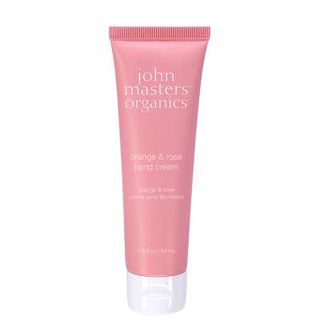
John Masters Organics Body Orange & Rose Hand Cream
Works for
1 of 1 advertised claim delivered
Moisturizing10 ingredients credited for this claimGood support
“Body Orange & Rose Hand Cream”
This product can help improve hydration of the skin with the two types of ingredients.
The first type is called “humectants”:
these ingredients help attract water.
When humectants are on the surface of the skin, they “pull in” the moisture from the outside environment, or from
within deeper layers of the skin. The following ingredients in this product do the job:
glycerin, aloe barbadensis extract.
This product also contains ingredients called “occlusives”. They help reduce the speed with which our skin loses moisture to the outside environment. These ingredients also help soften the upper layer of the skin, so it feels less tight and nicer to the touch. The following ingredients in this product do the job: helianthus annuus seed oil, cetearyl alcohol.
Can it cause trouble?
Irritancy13 strong irritants: Citrus aurantium dulcis peel oil, Rosa damascena flower oil + 11 more — patch-test recommendedHigh risk
Comedogenic1 ingredient rated 2 or more on the 0–5 pore-clogging scale1 flagged

User reviews
Be the first — your take helps the next person decide.
Ingredients
Filter by role to see what each ingredient is doing.
Aloe barbadensis leaf juice~23–34%
- Irritation risk
- Medium
Traditionally used to treat sunburns, dermatitis and inflammation, but evidence for its effectiveness is lacking. The extract can contain humectants that help attract water into the skin
More about Aloe barbadensis leaf juiceAloe barbadensis extract~4.8–7.2%
- Irritation risk
- Medium
Traditionally used to treat sunburns, dermatitis and inflammation, but evidence for its effectiveness is lacking. The extract can contain humectants that help attract water into the skin
More about Aloe barbadensis extractHelianthus annuus seed oil~4.6–6.9%
- Irritation risk
- Low
A great emollient due to its high linoleic acid content. One of the most effective plant oils in helping skin hydration and repairing skin barrier function
More about Helianthus annuus seed oilGlyceryl stearate citrate~3.7–5.6%
- Irritation risk
- Low
Helps oil and water mix together while softening the upper layer of the skin
More about Glyceryl stearate citrateCetearyl alcohol~3–4.5%
- Irritation risk
- Low
- Comedogenicity
- 2/5
A non-drying alcohol. Works as an emollient. Helps water and oil mix together and creates a nice product texture
More about Cetearyl alcoholGlyceryl caprylate~2.2–3.3%
- Irritation risk
- Low
An emollient that can also help water and oil mix together, as well as prevent bacteria growth in products
More about Glyceryl caprylateGlycerin~1.7–2.6%
- Irritation risk
- Low
One of the best moisturizing ingredients. Naturally present in skin. It attracts water to the upper layer of the skin working as a humectant
More about GlycerinWater~1.3–2%
Cetyl esters~1.3–1.9%
- Irritation risk
- Low
Helps soften upper layer of the skin and can enhance penetration of other ingredients into the upper layer of the skin
More about Cetyl estersCitrus aurantium dulcis peel oil~1–1.5%
- Irritation risk
- High
An essentil oil from orange peel. Potential allergen and can be irritating
More about Citrus aurantium dulcis peel oilRosa damascena flower oil~0.85–1.3%
- Irritation risk
- High
Used as a fragrance. Can be irritating
More about Rosa damascena flower oilRosa damascena extract~0.55–1.3%
- Irritation risk
- High
Oil of a very fragrant pink rose used as fragrance in cosmetics. Extensive research has shown it has mixed benefits. In the pro column, inhaling this flower’s scent seems to have relaxing properties and the plant’s petals contain skin-soothing and antioxidant compounds that can benefit skin. On the flipside, the numerous chemicals that create this rose’s distinctive fragrance pose a risk of causing skin aggravation.
More about Rosa damascena extractVanilla planifolia fruit extract~0.5–1.2%
- Irritation risk
- High
A plant extract used as a fragrance. Can be irritating
More about Vanilla planifolia fruit extractCananga odorata flower oil~0.45–1.1%
Cymbopogon martini oil~0.45–1.05%
- Irritation risk
- High
Aromatic plant oil used in cosmetics as a fragrance. A likely irritant
More about Cymbopogon martini oilEugenia caryophyllus bud oil~0.45–1%
Rosmarinus officinalis leaf extract~0.45–1%
- Irritation risk
- High
Can be helpful in reducing inflammation in skin, including inflamed acne. It can be irritating
More about Rosmarinus officinalis leaf extractXanthan gum~0.45–1%
- Irritation risk
- Low
Used to create a thicker product consistency
More about Xanthan gumSodium phytate~0.35–0.85%
Sodium anisate~0.35–0.85%
Lactic acid~0.35–0.8%
- Irritation risk
- Medium
An exfoliating and moisturizing alpha-hydroxy acid (AHA). Typically causes less irritation than other AHAs, for example, glycolic acid. At high concentrations (about 15%), lactic acid can help reduce lines and wrinkles. Recent studies show that lactic acid can support the "good" bacteria living on skin's surface (healthy skin microbiome)
More about Lactic acidAlcohol~0.35–0.8%
- Irritation risk
- High
Can be drying and contribute to skin irritation. Used in formulars to dissolve other ingredients, create a thinner product consistency or for its antibacterial properties
More about AlcoholLimonene~0.2–0.8%
- Irritation risk
- High
A common frangrance that can easily irritate skin, especially if exposed to air, light or heat
More about LimoneneGeraniol~0.15–0.7%
Linalool~0.15–0.65%
Ingredient list view
Aloe barbadensis leaf juice, Aloe barbadensis extract, Helianthus annuus seed oil, Glyceryl stearate citrate, Cetearyl alcohol, Glyceryl caprylate, Glycerin, Water, Cetyl esters, Citrus aurantium dulcis peel oil, Rosa damascena flower oil, Rosa damascena extract, Vanilla planifolia fruit extract, Cananga odorata flower oil, Cymbopogon martini oil, Eugenia caryophyllus bud oil, Rosmarinus officinalis leaf extract, Xanthan gum, Sodium phytate, Sodium anisate, Lactic acid, Alcohol, Limonene, Geraniol, Linalool
Compare prices
Retailers ranked by price — lowest first.

Affiliate links · prices updated regularly
Worth comparing, line by line.
Match % combines shared ingredients, the first five ingredients, shared actives and hero ingredients, irritancy (lower counts in the alternative's favour), texture and body area. Only products in the same routine step are compared.
| John Masters OrganicsBody Orange & Rose Hand CreamYOUR PRODUCT | WeledaSkin Food Body Butter | Maria ÅkerbergFace Cream Sensitive | |
|---|---|---|---|
| Match | — | 55% | 51% |
| Price | $14.81 | $12.92−$1.89 | — |
| Shared key ingredients | — | 4 of 4 | 2 of 4 |
| Key difference | — | Butyrospermum Parkii Butter | Beeswax |
| Irritancy | High | High | Medium |
| Drying alcohol | Contains drying alcohol | Contains drying alcohol | — |
| View product | Shop | Shop |

Sources cited in this review
Every concentration estimate and effectiveness label is anchored to one of these 13 studies and safety reviews.
- 1
- 2
- 3Effect of topically applied lipids on surfactant-irritated skinonlinelibrary.wiley.com
- 4
- 5
- 6

Affiliate links · As an Amazon Associate, WIMJ earns from qualifying purchases.