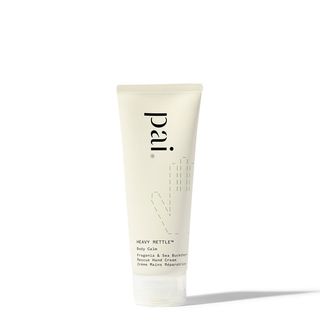
Pai Skincare Pai Heavy Mettle Fragonia & Sea Buckthorn Rescue Hand Cream
Works for
1 of 1 advertised claim delivered
Moisturizing21 ingredients credited for this claimStrong support
“Fuelled by biomimicking Ceramides and an omega-rich botanical complex to support the skin barrier and lock in moisture.Delicately fragranced with 100% natural Kind Scent™ – Pai’s proprietary skin-friendly and dermatologist-approved aroma. A moment of calm for hardworking hands.”
This product can help improve hydration of the skin with the two types of ingredients.
The first type is called “humectants”:
these ingredients help attract water.
When humectants are on the surface of the skin, they “pull in” the moisture from the outside environment, or from
within deeper layers of the skin. The following ingredients in this product do the job:
fructose, glycerin.
This product also contains ingredients called “occlusives”. They help reduce the speed with which our skin loses moisture to the outside environment. These ingredients also help soften the upper layer of the skin, so it feels less tight and nicer to the touch. The following ingredients in this product do the job: helianthus annuus seed oil, myristyl myristate.
The following ingredients in this product are especially good for supporting the skin barrier and helping with the hydration level: ceramide np, phytosphingosine
Can it cause trouble?
Irritancy2 strong irritants: Sodium anisate, ParfumMedium risk
Comedogenic2 ingredients rated 2 or more on the 0–5 pore-clogging scale2 flagged
User reviews
Be the first — your take helps the next person decide.
Ingredients
Filter by role to see what each ingredient is doing.
Water~45–55%
Glycerin~4.8–5.9%
- Irritation risk
- Low
One of the best moisturizing ingredients. Naturally present in skin. It attracts water to the upper layer of the skin working as a humectant
More about GlycerinOlea europaea fruit oil~4.1–5%
- Irritation risk
- Medium
An emollient that helps soften the skin but is not effective for restoring its barrier function. Might be helpful to calm down inflammation
More about Olea europaea fruit oilGlyceryl stearate citrate~2.8–3.4%
- Irritation risk
- Low
Helps oil and water mix together while softening the upper layer of the skin
More about Glyceryl stearate citrateHelianthus annuus seed oil~2.4–2.9%
- Irritation risk
- Low
A great emollient due to its high linoleic acid content. One of the most effective plant oils in helping skin hydration and repairing skin barrier function
More about Helianthus annuus seed oilHelianthus annuus extract~1.9–2.4%
- Irritation risk
- Low
Helps soften the upper layer of the skin
More about Helianthus annuus extractMyristyl myristate~1.7–2.1%
- Irritation risk
- Medium
- Comedogenicity
- 3/5
An emollient. Is not recommended for acne-prone skin as it can be comedogenic
More about Myristyl myristateHydrogenated coco-glycerides~1.5–1.8%
- Irritation risk
- Medium
Helps oil and water mix together while creating a nice finish on the skin
More about Hydrogenated coco-glyceridesHeptyl undecylenate~1.3–1.6%
- Irritation risk
- Medium
Helps soften the upper layer of the skin, reduce water loss from the skin surface over time and create a nice product finish
More about Heptyl undecylenateGlyceryl stearate~1–1.2%
- Irritation risk
- Low
An emollient that softens the skin and forms a protective layer on its surface. Helps water and oil mix together
More about Glyceryl stearateSimmondsia chinensis seed oil~0.75–1.15%
- Irritation risk
- Medium
Softens the upper layer of skin and helps restore the healthy skin barrier. Has shown to help calm down inflammation in skin. It is a stable oil, meaning that it retains its properties even when exposed to air.
More about Simmondsia chinensis seed oilCellulose~0.7–1.05%
- Irritation risk
- Low
Can be used to help absorb oil as well as add volume and imporve texture of products.
More about CelluloseVitis vinifera seed oil~0.55–0.85%
- Irritation risk
- Medium
A great emollient that can also have anti-oxidant properties
More about Vitis vinifera seed oilVitis vinifera~0.45–0.7%
- Irritation risk
- Low
A plant extract that contains resveratrol and other anti-oxidant compounds that can help neutralize free radicals, reduce inflammation in skin and even out its tone. Can be also used to stabilize the product formulation
More about Vitis viniferaAvena sativa kernel extract~0.45–0.7%
- Irritation risk
- Low
An effective moisturizing and skin barrier repair ingredient. Helps calm down inflammation and has some anti-oxidant properties
More about Avena sativa kernel extractButyrospermum parkii butter~0.5–0.7%
- Irritation risk
- Low
- Comedogenicity
- 3/5
A great moisturising ingredient that softens the skin and reduces water loss from its upper layer. It also can be helpful in protecting skin from free radicals
More about Butyrospermum parkii butterMoringa oleifera seed oil~0.45–0.65%
- Irritation risk
- Medium
A plant oil that helps soften the upper layer of the skin. Is unlikely to be helpful in restoring skin barrier function due to the low content of linoleic acid
More about Moringa oleifera seed oilMacadamia integrifolia seed oil~0.4–0.6%
- Irritation risk
- Low
A plant oil that helps soften the upper layer of the skin
More about Macadamia integrifolia seed oilInulin~0.3–0.55%
- Irritation risk
- Low
Helps attract water to the upper layer of the skin. Is claimed to support the growth of "good" bacteria in skin (as a "prebiotic"), but the research is lacking
More about InulinPotassium hyaluronate~0.3–0.55%
- Irritation risk
- Low
Ceramide np~0.3–0.55%
- Irritation risk
- Low
A type of lipid similar to ceramides naturally present in skin. Helps to soften the upper layer of the skin and supports the skin barrier function to keep it hydrated. Can help to prevent inflammation in skin
More about Ceramide npPhytosphingosine~0.3–0.55%
- Irritation risk
- Low
A type of lipid that is naturally present in skin. It might help in repairing skin barrier function and has anti-bacterial effect
More about PhytosphingosineXanthan gum~0.25–0.45%
- Irritation risk
- Low
Used to create a thicker product consistency
More about Xanthan gumSodium levulinate~0.25–0.4%
Glyceryl caprylate~0.3–0.5%
- Irritation risk
- Low
An emollient that can also help water and oil mix together, as well as prevent bacteria growth in products
More about Glyceryl caprylateSodium anisate~0.2–0.4%
Polyglyceryl-3 distearate~0.25–0.45%
Tocopherol~0.2–0.4%
- Irritation risk
- Low
Pure form of vitamin E. Can help moisturise and protect the skin from free radicals. Often used to help stabilise other ingredients or the formula itself
More about TocopherolHydrogenated lecithin~0.2–0.35%
- Irritation risk
- Low
Helps to retain moisture by creating a protective barrier on the skin. Rich in fatty acids. Improves product texture and helps with the penetration of other ingredients.
More about Hydrogenated lecithinLactic acid~0.15–0.3%
- Irritation risk
- Medium
An exfoliating and moisturizing alpha-hydroxy acid (AHA). Typically causes less irritation than other AHAs, for example, glycolic acid. At high concentrations (about 15%), lactic acid can help reduce lines and wrinkles. Recent studies show that lactic acid can support the "good" bacteria living on skin's surface (healthy skin microbiome)
More about Lactic acidSodium phytate~0.15–0.25%
Fructose~0.1–0.2%
- Irritation risk
- Low
Helps attract water to the upper layer of the skin
More about FructoseParfum~0.05–0.15%
- Irritation risk
- High
An aromatic blend of unspecified and possibly irritating ingredients
More about ParfumIngredient list view
Water, Glycerin, Olea europaea fruit oil, Glyceryl stearate citrate, Helianthus annuus seed oil, Helianthus annuus extract, Myristyl myristate, Hydrogenated coco-glycerides, Heptyl undecylenate, Glyceryl stearate, Simmondsia chinensis seed oil, Cellulose, Vitis vinifera seed oil, Vitis vinifera, Avena sativa kernel extract, Butyrospermum parkii butter, Moringa oleifera seed oil, Unknown, Macadamia integrifolia seed oil, Inulin, Potassium hyaluronate, Ceramide np, Phytosphingosine, Xanthan gum, Sodium levulinate, Glyceryl caprylate, Sodium anisate, Polyglyceryl-3 distearate, Tocopherol, Hydrogenated lecithin, Lactic acid, Sodium phytate, Fructose, Parfum
Compare prices
Retailers ranked by price — lowest first.
Affiliate links · prices updated regularly · As an Amazon Associate, WIMJ earns from qualifying purchases.
Product summary
Judging from the ingredient list, "Pai Skincare - Pai Heavy Mettle Fragonia & Sea Buckthorn Rescue Hand Cream" works well for improving skin hydration The formulation is based on a combination of good humectants and emollients. Both are needed to increase the skin hydration level. Fructose and glycerin in this product (humectants) attract water molecules to the upper layer of the skin (the water comes from the outside air or from the deeper layers of the skin if the air is dry). Emollients in this formulation (ceramide np, phytosphingosine, helianthus annuus extract, vitis vinifera seed oil and helianthus annuus seed oil) help to reduce the moisture loss from the skin. They also soften the skin surface and relieve the feeling of dryness and tightness.
Ingredient callouts
- As a plus, this moisturizer also contains Ceramides (phytosphingosine 0.30% - 0.55% and ceramide np 0.30% - 0.55%). Ceramides are a type of lipids that our skin produces itself. They are a building block of the skin's barrier. Ceramides used in skincare are synthetic or extracted from plants. They work well for softening the skin surface and "patch holes" in the skin's barrier.
Irritation risk
This moisturizer contains some common irritants, including those without a benefit for the skin. We assess the overall irritancy of this moisturizer to be medium. For a detailed overview of all potential irritants: click here
You can see the detailed formula review with the breakdown of all actives in the product and the full ingredient list with estimated concentrations in the tables below.
About the brand
According to Cruelty-Free Kitty "Pai Skincare" is cruelty free and so is its parent company.
Price
The product retails for 23.95£ in the United Kingdom.
For a detailed price comparison: click here.
Sources cited in this review
Every concentration estimate and effectiveness label is anchored to one of these 18 studies and safety reviews.
- 1
- 2Use of “natural” oils for moisturization: Review of olive, coconut, and sunflower seed oilonlinelibrary.wiley.com
- 3
- 4
- 5Effect of topically applied lipids on surfactant-irritated skinonlinelibrary.wiley.com
- 6

Affiliate links · As an Amazon Associate, WIMJ earns from qualifying purchases.