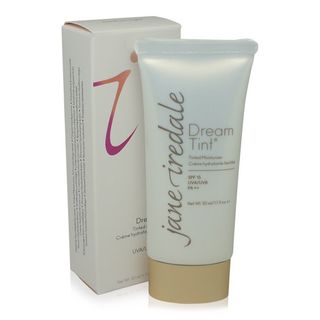
jane iredale Dream Tint SPF 15 Tinted Moisturizer Medium Light
Works for
1 of 4 advertised claims delivered
Sun protectionSPF 15 · 1 UV filter · Partial spectrumWeak protectionSPF under 30
This product does not offer good protection against UVA rays.
This product can be considered "reef safe" because it does not contain the UV filters (oxybenzone and octinoxate) that can be harmful to coral reefs when present in the water in high concentrations.
Moisturizing11 ingredients credited for this claimGood support
“Dream Tint SPF 15 Tinted Moisturizer Medium Light”
This product can help improve hydration of the skin with the two types of ingredients.
The first type is called “humectants”:
these ingredients help attract water.
When humectants are on the surface of the skin, they “pull in” the moisture from the outside environment, or from
within deeper layers of the skin. The following ingredients in this product do the job:
algae extract, glycerin.
This product also contains ingredients called “occlusives”. They help reduce the speed with which our skin loses moisture to the outside environment. These ingredients also help soften the upper layer of the skin, so it feels less tight and nicer to the touch. The following ingredients in this product do the job: dimethicone, helianthus annuus seed oil.
Evens skin tone2 ingredients credited for this claimLimited support
“It nourishes the skin, soothing and protecting with natural ingredients while evening the skin's tone”
This product contains ingredients (punica granatum extract) that could help reduce hyperpigmentation (for example, post-acne marks or age spots) in theory, but there is not enough evidence that they actually work.
The biggest effect for evening out skin tone in this product comes from sun protection. Sun damage is the main factor causing age spots, darkening of post-acne marks and other discolorations. This is why sun protection is the best strategy for maintaining an even skin tone. We, however, do not recommend using this product as a sunscreen because the protection it offers is not strong enough).
Anti-aging3 ingredients credited for this claimLimited support
“It covers up imperfections, including discolorations, large pores and fine lines and.”
This product does not contain ingredients that are able to reduce fine lines and wrinkles or help with skin elasticity, but it can improve the look of the skin temporarily through moisturization. Well-moisturized skin might also be able to repair the sun damage better.This ingredient - camellia sinensis leaf extract - could be helpful for preventing or repairing signs of aging in theory, but there is no evidence that it actually works.
This ingredient camellia sinensis leaf extract might be able to help neutralize free radicals in skin and help it fight off some of the sun damage.
The biggest anti-aging effect in this product comes from sun protection. Sun damage is the main factor causing early signs of skin aging. We, however, do not recommend using this product as a sunscreen because the protection it offers is not strong enough).
Anti-oxidationNot advertised by the brand · 3 ingredients credited for this claimModerate support
This product contains antioxidants (camellia sinensis leaf extract, punica granatum extract) that might be able to help neutralize free radicals in skin to lessen the damage it gets from the UV light (sun). There is not enough evidence to confirm their effectiveness in skin though.
Can it cause trouble?
Irritancy2 strong irritants: Citrus grandis seed extract, Lavandula angustifolia oilMedium risk
Comedogenic2 ingredients rated 2 or more on the 0–5 pore-clogging scale2 flagged
User reviews
Ingredients
Filter by role to see what each ingredient is doing.
Titanium dioxide4.5%
- Irritation risk
- Low
Works as a UV filter when used in high concentrations. It is photostable and is effective mostly against the UVB light, with some protection in the UVA range. In small concentrations, used for its ability to improve the color of cosmetic products. Is usually well tolerated by the skin
More about Titanium dioxideWater~45–55%
Algae extract~6.9–8.4%
- Irritation risk
- Low
- Comedogenicity
- 3/5
Plant extract that helps the skin to attract water and make it more smooth for touch. Also shows promise of anti-aging properties, but research is not extensive yet
More about Algae extractSambucus nigra extract~5.5–6.7%
- Irritation risk
- Low
Dimethicone~3.8–4.7%
- Irritation risk
- Low
A silicone that helps to reduce water loss from the surface of the skin. Can temporarily "fill in" lines and wrinkles, absorb oil, and create a nice product finish
More about DimethiconeJojoba esters~2.6–3.1%
- Irritation risk
- Medium
An emollient made of jojoba oil. Helps soften the skin and support its barrier function
More about Jojoba estersOctyldodecyl neopentanoate~2.1–2.6%
- Irritation risk
- Low
An emollient that helps soften the skin. Often used to stabilize other ingredients, for example, sunscreen
More about Octyldodecyl neopentanoateGlyceryl stearate~1.9–2.3%
- Irritation risk
- Low
An emollient that softens the skin and forms a protective layer on its surface. Helps water and oil mix together
More about Glyceryl stearateHelianthus annuus seed oil~1.8–2.2%
- Irritation risk
- Low
A great emollient due to its high linoleic acid content. One of the most effective plant oils in helping skin hydration and repairing skin barrier function
More about Helianthus annuus seed oilGlycerin~1.4–1.8%
- Irritation risk
- Low
One of the best moisturizing ingredients. Naturally present in skin. It attracts water to the upper layer of the skin working as a humectant
More about GlycerinRaphanus sativus root extract~1.1–1.3%
- Irritation risk
- Low
Boron nitride~1–1.2%
- Irritation risk
- Low
Helps to absord oil and evenly disperse other ingredients (for example, pigment) in product formulation
More about Boron nitrideButyrospermum parkii butter~0.8–1.15%
- Irritation risk
- Low
- Comedogenicity
- 3/5
A great moisturising ingredient that softens the skin and reduces water loss from its upper layer. It also can be helpful in protecting skin from free radicals
More about Butyrospermum parkii butterSimmondsia chinensis seed oil~0.75–1.1%
- Irritation risk
- Medium
Softens the upper layer of skin and helps restore the healthy skin barrier. Has shown to help calm down inflammation in skin. It is a stable oil, meaning that it retains its properties even when exposed to air.
More about Simmondsia chinensis seed oilCamellia sinensis leaf extract~0.65–1%
- Irritation risk
- Low
Can contain potent anti-oxidant compounds (abbreviated ECG, GCG, EGC, and EGCG) that might help protect the skin from free radicals. Can help calm down inflammation and has some anti-bacterial properties. Unfortunately, these antioxidants are unstable and lose their effectiveness very quickly in products. The concentration of the antioxidant compounds in the extract also tends to be low to be effective in topical formulation
More about Camellia sinensis leaf extractCitrus grandis seed extract~0.55–0.8%
- Irritation risk
- High
Lavandula angustifolia oil~0.55–0.85%
- Irritation risk
- High
An essential oil. Potential allergen and can be irritating. It has some anti-bacterial properties
More about Lavandula angustifolia oilPunica granatum extract~0.5–0.7%
- Irritation risk
- Medium
A plant extract that can help neutralize free radicals in skin and even out the skin tone, but is typically used in products in a concentration that is too low to be effective
More about Punica granatum extractGlyceryl polymethacrylate~0.5–0.75%
- Irritation risk
- Low
Used to create a nice product texture
More about Glyceryl polymethacrylateIron oxides~0.3–0.6%
- Irritation risk
- Low
An umbrella term for the following three colorants: CI 77491, CI 77492, CI 77499. They might be able to offer some protection against visible light, but the degree of the protection is not clear
More about Iron oxidesCi 77489~0.25–0.5%
- Irritation risk
- Low
Iron oxides~0.25–0.45%
- Irritation risk
- Low
An umbrella term for the following three colorants: CI 77491, CI 77492, CI 77499. They might be able to offer some protection against visible light, but the degree of the protection is not clear
More about Iron oxidesMica~0.25–0.45%
- Irritation risk
- Low
Creates an illusion of smoother and more radiant skin tone. Adds shimmer to the skin by reflecting light
More about MicaUltramarines~0.15–0.3%
- Irritation risk
- Low
Ci 77007~0.15–0.25%
Chromium oxide greens~0.1–0.2%
- Irritation risk
- Low
Ci 77288~0.1–0.15%
- Irritation risk
- Low
Ingredient list view
Titanium dioxide, Water, Algae extract, Sambucus nigra extract, Dimethicone, Jojoba esters, Octyldodecyl neopentanoate, Glyceryl stearate, Helianthus annuus seed oil, Glycerin, Raphanus sativus root extract, Boron nitride, Butyrospermum parkii butter, Simmondsia chinensis seed oil, Camellia sinensis leaf extract, Citrus grandis seed extract, Lavandula angustifolia oil, Punica granatum extract, Glyceryl polymethacrylate, Iron oxides, Ci 77489, Iron oxides, Mica, Ultramarines, Ci 77007, Chromium oxide greens, Ci 77288
Compare prices
Retailers ranked by price — lowest first.

Product summary
We do not recommend "jane iredale - Dream Tint SPF 15 Tinted Moisturizer Medium Light" because it does not provide good UVA protection. UVA sun rays don't burn the skin, but they still lead to photoaging and hyperpigmentation.
It also works as a moisturizer, so you do not have to use an additional hydrating product.
Sunscreen filters
This moisturizer is a mineral sunscreen. It uses titanium dioxide for sun protection. Titanium dioxide almost never irritates the skin or stings eyes, but it can leave a white cast.
Irritation risk
There are some common irritants in this product, including ingredients that do not have benefits for the skin. We assess the overall irritancy of this moisturizer to be medium. For a detailed overview of all potential irritants: click here
You can see the detailed formula review with the breakdown of all actives in the product and the full ingredient list with estimated concentrations in the tables below.
About the brand
According to Cruelty-Free Kitty "jane iredale" is cruelty free and so is its parent company.
Price
The product retails for 86.00A$ in Australia and from 25.59$ up to 36.80$ in the United States.
For a detailed price comparison: click here.
Sources cited in this review
Every concentration estimate and effectiveness label is anchored to one of these 12 studies and safety reviews.
- 1
- 2Final Report on the Safety Assessment of Dimethicone Copolyoljournals.sagepub.com
- 3
- 4
- 5
- 6Effect of topically applied lipids on surfactant-irritated skinonlinelibrary.wiley.com

Affiliate links · As an Amazon Associate, WIMJ earns from qualifying purchases.