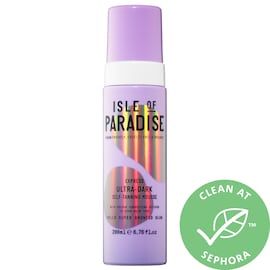
Isle of Paradise Express Ultra Dark Mousse
Works for
1 of 1 advertised claim delivered
Moisturizing7 ingredients credited for this claimStrong support
“Hydrates and smooths the look of skin. . Avocado Oil.”
This product can help improve hydration of the skin with the two types of ingredients.
The first type is called “humectants”:
these ingredients help attract water.
When humectants are on the surface of the skin, they “pull in” the moisture from the outside environment, or from
within deeper layers of the skin. The following ingredients in this product do the job:
glycerin, aloe barbadensis extract.
This product also contains ingredients called “occlusives”. They help reduce the speed with which our skin loses moisture to the outside environment. These ingredients also help soften the upper layer of the skin, so it feels less tight and nicer to the touch. The following ingredients in this product do the job: cocos nucifera oil, salvia hispanica seed oil.
The following ingredients in this product are especially good for supporting the skin barrier and helping with the hydration level: panthenol
Evens skin toneNot advertised by the brand · 3 ingredients credited for this claimStrong support
This product can help reduce hypepigmentation and even out the skin tone because it contains the following effective ingredients: hydroquinone.
Keep in mind that you would need to apply any topical skincare targetted at hypigmentation consistently for a couple of months to get a result. No topical skincare product can help get rid of hyperpigmentation (including post-acne marks and age spots) instantly.
Can it cause trouble?
Irritancy9 strong irritants: Citrus grandis peel oil, Eucalyptus globulus leaf oil + 7 more — patch-test recommendedHigh risk
Comedogenic2 ingredients rated 2 or more on the 0–5 pore-clogging scale2 flagged
User reviews
Be the first — your take helps the next person decide.
Ingredients
Filter by role to see what each ingredient is doing.
Water~45–55%
Dihydroxyacetone~4.6–5.6%
Propylene glycol~4.1–5%
- Irritation risk
- High
Helps oil and water mix together and can enhance the penetration of other ingredients into the skin. It can be irritating
More about Propylene glycolGlycerin~3–3.7%
- Irritation risk
- Low
One of the best moisturizing ingredients. Naturally present in skin. It attracts water to the upper layer of the skin working as a humectant
More about GlycerinPeg-40 hydrogenated castor oil~2.2–2.7%
- Irritation risk
- Medium
Helps oil and water mix together
More about Peg-40 hydrogenated castor oilEthoxydiglycol~1.8–2.2%
Decyl glucoside~1.7–2.1%
- Irritation risk
- High
Helps oil and water mix together. Can be irritating
More about Decyl glucosideGlycereth-26~1.4–1.7%
Erythrulose~1.1–1.4%
- Irritation risk
- Low
Methoxyphenyl t-butylphenyl propanediol~0.9–1.1%
- Irritation risk
- Low
Agastache mexicana flower/leaf/stem extract~0.65–1%
- Irritation risk
- Low
Tropaeolum majus flower/leaf/stem extract~0.55–0.8%
- Irritation risk
- Low
Panthenol~0.5–0.75%
- Irritation risk
- Low
Helps attract water to the upper layer of the skin and can help improve skin barrier function
More about PanthenolAloe barbadensis extract~0.45–0.7%
- Irritation risk
- Medium
Traditionally used to treat sunburns, dermatitis and inflammation, but evidence for its effectiveness is lacking. The extract can contain humectants that help attract water into the skin
More about Aloe barbadensis extractCitrus grandis peel oil~0.4–0.6%
- Irritation risk
- High
A plant oil with high content of volatile compounds that, especially when exposed to air, can cause allergic reactions and irritate the skin
More about Citrus grandis peel oilCocos nucifera oil~0.4–0.65%
- Irritation risk
- Low
- Comedogenicity
- 3/5
An emollient. Found to be as effective as a moisturizer for dry skin as mineral oil. Could be comedogenic
More about Cocos nucifera oilEucalyptus globulus leaf oil~0.35–0.65%
- Irritation risk
- High
An essential oil that can be very irritating. Has some anti-bacterial properties
More about Eucalyptus globulus leaf oilMentha piperita oil~0.3–0.6%
Persea gratissima oil~0.4–0.6%
- Irritation risk
- Medium
An emollient that helps soften the skin and could be helpful in repairing its barrier function
More about Persea gratissima oilSalvia hispanica seed oil~0.3–0.6%
- Irritation risk
- Low
Chia seed oil. Helps to soften the upper layer of the skin and might be helpful in repairing skin barrier
More about Salvia hispanica seed oilSalvia officinalis oil~0.25–0.5%
- Irritation risk
- High
Ascorbic acid~0.25–0.5%
- Irritation risk
- High
The most well-researched antioxidant that works in skin. Helps neutralize free radicals supporting collagen production, helping to even out the skin tone and preventing early signs of aging
More about Ascorbic acidEthylhexylglycerin~0.25–0.5%
Propanediol~0.3–0.5%
- Irritation risk
- Low
Acts as a solvent for other ingredients. Speeds up the absorption of other ingredients into the skin
More about PropanediolSodium metabisulfite~0.1–0.2%
Parfum~0.25–0.45%
- Irritation risk
- High
An aromatic blend of unspecified and possibly irritating ingredients
More about ParfumPhenoxyethanol~0.25–0.5%
- Irritation risk
- Low
A preservative. It helps prevent bacterial growth in cosmetic products
More about PhenoxyethanolBenzoic acid~0.3–0.5%
Dehydroacetic acid~0.25–0.45%
Triethylene glycol~0.25–0.45%
- Irritation risk
- Low
Ci 19140~0.25–0.5%
Ci 15985~0.25–0.5%
Ci 17200~0.25–0.5%
Ci 15985~0.25–0.5%
Ci 19140~0.25–0.5%
Ci 42090~0.25–0.5%
Ci 14700~0.25–0.5%
Rosa damascena callus~0.25–0.5%
- Irritation risk
- High
Formaldehyde~0.2–0.4%
- Irritation risk
- Low
Paraffinum liquidum~0.25–0.45%
- Irritation risk
- Low
Mineral oil. One of the most effective and well studied occlusive and emollient moisturizing ingredients. Helps reduce moisture loss in skin and repair skin barrier function
More about Paraffinum liquidumRetinyl palmitate~0.2–0.35%
- Irritation risk
- High
Three steps removed from the active form of vitamin A - retinoic acid. To have an effect in the skin, it first needs to be converted twice to become the retinoic acid. This means it is less potent than retinol, but could also be less irritating. Once converted to the retinoic acid in the skin, it helps against all signs of aging, improves skin cell turnover and helps fight blemishes and clogged pores. However, in many cosmetic formulations, it is used in a concentration that is too low to have the full effect
More about Retinyl palmitateBenzophenone-3~0.35–0.65%
- Irritation risk
- High
Same as oxybenzone. Protects in the UVB and short UVA range. In small concentrations, used to stabilize product formulation. Can be irritating. Is shown to be harmful to coral reefs - consider avoiding bathing in coral reef areas when wearing a product with this ingredient. It can penetrate the skin and get absorbed into bloodstream faster than other popular filters available in the US. The study that produced this finding did not address any potential health effects of the absorption
More about Benzophenone-3Coal tar~0.2–0.35%
- Irritation risk
- Low
- Comedogenicity
- 3/5
Hydroquinone~0.15–0.3%
- Irritation risk
- High
A potent anti-pigmentation active. It can have serious side-effects though and ideally is used under supervision of a doctor. It should not be used over a long period of time (over a year).
More about HydroquinoneParfum~0.15–0.25%
- Irritation risk
- High
An aromatic blend of unspecified and possibly irritating ingredients
More about ParfumTriclocarban1%
- Irritation risk
- Low
Triclosan~0.1–0.25%
- Irritation risk
- Low
Ingredient list view
Water, Dihydroxyacetone, Propylene glycol, Glycerin, Peg-40 hydrogenated castor oil, Ethoxydiglycol, Decyl glucoside, Glycereth-26, Erythrulose, Methoxyphenyl t-butylphenyl propanediol, Agastache mexicana flower/leaf/stem extract, Tropaeolum majus flower/leaf/stem extract, Panthenol, Unknown, Aloe barbadensis extract, Citrus grandis peel oil, Cocos nucifera oil, Eucalyptus globulus leaf oil, Mentha piperita oil, Persea gratissima oil, Salvia hispanica seed oil, Salvia officinalis oil, Ascorbic acid, Ethylhexylglycerin, Propanediol, Sodium metabisulfite, Parfum, Phenoxyethanol, Benzoic acid, Dehydroacetic acid, Triethylene glycol, Ci 19140, Unknown, Ci 15985, Unknown, Ci 17200, Ci 15985, Unknown, Ci 19140, Unknown, Ci 42090, Ci 14700, Rosa damascena callus, Formaldehyde, Paraffinum liquidum, Retinyl palmitate, Benzophenone-3, Coal tar, Hydroquinone, Parfum, Triclocarban, Triclosan
Compare prices
Retailers ranked by price — lowest first.

Product summary
Based on the ingredients included, "Isle of Paradise - Express Ultra Dark Mousse" works well for moisturizing the skin. To work well, any moisturizer needs to include a combination of water-binding and emollient ingredients. Isle of Paradise - Express Ultra Dark Mousse ticks this box. Humectants in this product (panthenol, glycerin and aloe barbadensis extract) help to increase the water content in the upper layer of the skin. (These ingredients do so by "capturing" water molecules from the outside air or from within the deeper layers of the skin). Salvia hispanica seed oil and cocos nucifera oil in this product help decrease the water evoporation from the skin, so that it stays hydrated for longer. These ingredients also soften the skin and take away the feeling of tightness and dryness.
Ingredient callouts
- This product also contains vitamin C (Ascorbic Acid). It can be an effective active for anti-aging and evening out the skin tone, but in this moisturizer it is used for stabilizing other ingredients in the formulation. In this concentration (0.25% - 0.50%) it cannot have a noticeable benefit for the skin.
- This moisturizer includes a form of retinoids (vitamin A) - retinyl palmitate 0.20% - 0.35%, but this type of vitamin A is not very effective. It could in theory help with fine lines and wrinkles, but the effect is most likely minimal.
Irritation risk
There are quite a few common irritants in this product, including ingredients without particular skin benefits. We would not recommend it for sensitive skin. We assess the overall irritancy of this moisturizer to be high. For a detailed overview of all potential irritants: click here
You can see the detailed formula review with the breakdown of all actives in the product and the full ingredient list with estimated concentrations in the tables below.
Price
The product retails from 32.00$ up to 42.00$ in the United States and for 27.99£ in the United Kingdom.
For a detailed price comparison: click here.
Sources cited in this review
Every concentration estimate and effectiveness label is anchored to one of these 16 studies and safety reviews.
- 1Surfactants and experimental irritant contact dermatitisncbi.nlm.nih.gov
- 2Propylene Glycolpubmed.ncbi.nlm.nih.gov
- 3Skin-sensitizing and irritant properties of propylene glycolonlinelibrary.wiley.com
- 4
- 5
- 6

Affiliate links · As an Amazon Associate, WIMJ earns from qualifying purchases.