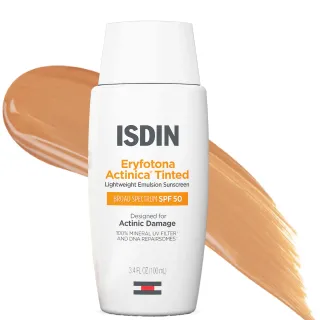
ISDIN Eryfotona Actinica Tinted Mineral Broad-Spectrum Face Sunscreen SPF 50
Works for
0 of 1 advertised claim delivered
Sun protectionSPF 50 · 2 UV filters · Partial spectrumWeak protection
This product does not offer good protection against UVA rays.
This product can be considered "reef safe" because it does not contain the UV filters (oxybenzone and octinoxate) that can be harmful to coral reefs when present in the water in high concentrations.
MoisturizingNot advertised by the brand · Panthenol, Polyglyceryl-2 dipolyhydroxystearate + 11 moreStrong evidence
This product can help improve hydration of the skin with the two types of ingredients.
The first type is called “humectants”:
these ingredients help attract water.
When humectants are on the surface of the skin, they “pull in” the moisture from the outside environment, or from
within deeper layers of the skin. The following ingredients in this product do the job:
panthenol, caprylyl glycol.
This product also contains ingredients called “occlusives”. They help reduce the speed with which our skin loses moisture to the outside environment. These ingredients also help soften the upper layer of the skin, so it feels less tight and nicer to the touch. The following ingredients in this product do the job: caprylic/capric triglyceride, dimethicone.
The following ingredients in this product are especially good for supporting the skin barrier and helping with the hydration level: panthenol
Can it cause trouble?
Irritancy1 strong irritant: ParfumMedium risk
Comedogenic1 ingredient rated 2 or more on the 0–5 pore-clogging scale1 flagged

User reviews
Be the first — your take helps the next person decide.
Ingredients
Filter by role to see what each ingredient is doing.
Titanium dioxide16.1%
- Irritation risk
- Low
Works as a UV filter when used in high concentrations. It is photostable and is effective mostly against the UVB light, with some protection in the UVA range. In small concentrations, used for its ability to improve the color of cosmetic products. Is usually well tolerated by the skin
More about Titanium dioxideWater~45–55%
Propylene glycol dicaprylate/dicaprate~5.7–6.9%
- Irritation risk
- Low
Dimethicone~5.9–7.2%
- Irritation risk
- Low
A silicone that helps to reduce water loss from the surface of the skin. Can temporarily "fill in" lines and wrinkles, absorb oil, and create a nice product finish
More about DimethiconeC15-19 alkane~3.6–4.4%
- Irritation risk
- Low
Helps soften the upper layer of the skin and create a nice product texture
More about C15-19 alkaneDicaprylyl carbonate~2.6–3.1%
- Irritation risk
- Low
Helps products spread more easily and works as an emollient to soften skin
More about Dicaprylyl carbonateSilica~2.1–2.6%
Dibutyl adipate~1.8–2.2%
- Irritation risk
- Low
Helps soften the upper layer of the skin and create a nice product consistency
More about Dibutyl adipateAlcohol denat.~1.5–1.8%
- Irritation risk
- High
Produces temporary toning effect. Can help dissolve other ingredients or preserve products
More about Alcohol denat.Peg-30 dipolyhydroxystearate~1.3–1.5%
- Irritation risk
- Medium
Helps oil and water mix together
More about Peg-30 dipolyhydroxystearatePolyglyceryl-2 dipolyhydroxystearate~1–1.2%
- Irritation risk
- Low
Helps to soften the upper layer of the skin
More about Polyglyceryl-2 dipolyhydroxystearateIron oxides~0.75–1.1%
- Irritation risk
- Low
An umbrella term for the following three colorants: CI 77491, CI 77492, CI 77499. They might be able to offer some protection against visible light, but the degree of the protection is not clear
More about Iron oxidesCaprylic/capric triglyceride~0.7–1.05%
- Irritation risk
- Medium
A good mix of fatty acids that forms a protective layer on the skin. Improves the shelf life of products. Derived from coconut and glycerin
More about Caprylic/capric triglycerideButyloctyl salicylate~0.5–0.75%
- Irritation risk
- Medium
A synthetic ester of salicylic acid that is used to help disperse pigments and boost effectiveness of sunscreen ingredients. It is able to absorb UV light (working as an organic, or chemical filter), but is not approved as a sunscreen ingredient on its own
More about Butyloctyl salicylateMagnesium sulfate~0.55–0.8%
Vp/eicosene copolymer~0.45–0.7%
- Irritation risk
- Medium
Used to improve the product adherence to the skin, for example, to pro-long the protective effect of sunscreens. Can be irritating to very sensitive skin
More about Vp/eicosene copolymer1,2-hexanediol~0.45–0.65%
Caprylyl glycol~0.5–0.75%
- Irritation risk
- Medium
Helps preserve products and creates a nice product texture
More about Caprylyl glycolPanthenol~0.4–0.6%
- Irritation risk
- Low
Helps attract water to the upper layer of the skin and can help improve skin barrier function
More about PanthenolParfum~0.3–0.55%
- Irritation risk
- High
An aromatic blend of unspecified and possibly irritating ingredients
More about ParfumDisteardimonium hectorite~0.3–0.55%
- Irritation risk
- Low
A type of clay that is used to thicken the product consistency
More about Disteardimonium hectoriteTocopheryl acetate~0.25–0.45%
- Irritation risk
- Medium
A more stable but less bio-available form of vitamin E compared to Tocopherol. Might help moisturize and protect the skin from free radicals, but mostly used in low concentrations to stabilize other ingredients.
More about Tocopheryl acetateDimethicone/vinyl dimethicone crosspolymer~0.25–0.4%
- Irritation risk
- Low
Used to stabilize product formulations and create a nice product texture
More about Dimethicone/vinyl dimethicone crosspolymerPropylene carbonate~0.25–0.45%
- Irritation risk
- Low
Is used to dissolve other ingredients and create nice product texture
More about Propylene carbonatePeg-10 dimethicone~0.3–0.55%
- Irritation risk
- Low
A silicone that works to soften the upper layer of the skin and reduce its water loss
More about Peg-10 dimethiconeTriethoxycaprylylsilane~0.15–0.3%
- Irritation risk
- Low
A type of silicone that helps oil and water mix well together. Helps to disperse other ingredients, e.g. pigments, evenly in a formulation
More about TriethoxycaprylylsilaneLecithin~0.25–0.45%
- Irritation risk
- Low
Used mostly for creating emulsions - helping oil and water mix together. Helps soften the upper layer of the skin
More about LecithinPlankton extract~0.15–0.25%
- Irritation risk
- Medium
- Comedogenicity
- 3/5
Can help attract water to the upper layer of the skin
More about Plankton extractHydroxyacetophenone~0.1–0.2%
Phenethyl alcohol~0.1–0.15%
Tocopherol~0.05–0.1%
- Irritation risk
- Low
Pure form of vitamin E. Can help moisturise and protect the skin from free radicals. Often used to help stabilise other ingredients or the formula itself
More about TocopherolIngredient list view
Titanium dioxide, Water, Propylene glycol dicaprylate/dicaprate, Dimethicone, C15-19 alkane, Dicaprylyl carbonate, Silica, Dibutyl adipate, Alcohol denat., Peg-30 dipolyhydroxystearate, Polyglyceryl-2 dipolyhydroxystearate, Iron oxides, Caprylic/capric triglyceride, Butyloctyl salicylate, Magnesium sulfate, Vp/eicosene copolymer, 1,2-hexanediol, Caprylyl glycol, Panthenol, Parfum, Disteardimonium hectorite, Tocopheryl acetate, Dimethicone/vinyl dimethicone crosspolymer, Propylene carbonate, Peg-10 dimethicone, Triethoxycaprylylsilane, Lecithin, Plankton extract, Hydroxyacetophenone, Phenethyl alcohol, Tocopherol
Compare prices
Retailers ranked by price — lowest first.

Worth comparing, line by line.
Match % combines shared ingredients, the first five ingredients, shared actives and hero ingredients, irritancy (lower counts in the alternative's favour), texture and body area. Only products in the same routine step are compared.
| ISDINEryfotona Actinica Tinted Mineral Broad-Spectrum Face Sunscreen SPF 50YOUR PRODUCT | FOTOPROTECTORMineral Baby Pediatrics SPF 50 | Rodan + FieldsREVERSE Brightening Defense Fluid Lotion SPF 50 | Face Reality SkincareBrilliant Defense SPF 50 | |
|---|---|---|---|---|
| Match | — | 65% | 58% | 58% |
| Price | $46.00 | $43.34−$2.66 | — | $42.00−$4.00 |
| Shared key ingredients | — | 4 of 7 | 4 of 7 | 4 of 7 |
| Key difference | — | Sodium Hyaluronate | Niacinamide | Aminopropyl Ascorbyl Phosphate |
| Irritancy | Medium | Low | Low | Low |
| SPF | SPF 50 | SPF 50 | SPF 50 | SPF 50 |
| Drying alcohol | Contains drying alcohol | Contains drying alcohol | — | — |
| View product | Shop | Shop | Shop |
Sources cited in this review
Every concentration estimate and effectiveness label is anchored to one of these 11 studies and safety reviews.
- 1
- 2Final Report on the Safety Assessment of Dimethicone Copolyoljournals.sagepub.com
- 3
- 4Safety Assessment of Magnesium Sulfate as Used in Cosmeticsncbi.nlm.nih.gov
- 5
- 6

Affiliate links · As an Amazon Associate, WIMJ earns from qualifying purchases.