Works for
2 of 2 advertised claims delivered
Moisturizing18 ingredients credited for this claimStrong evidence
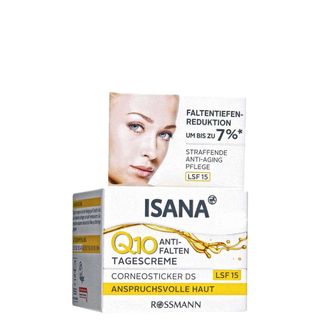
“Q10 Anti-Wrinkle Day Cream”
This product can help improve hydration of the skin with the two types of ingredients.
The first type is called “humectants”:
these ingredients help attract water.
When humectants are on the surface of the skin, they “pull in” the moisture from the outside environment, or from
within deeper layers of the skin. The following ingredients in this product do the job:
arginine, glycerin.
This product also contains ingredients called “occlusives”. They help reduce the speed with which our skin loses moisture to the outside environment. These ingredients also help soften the upper layer of the skin, so it feels less tight and nicer to the touch. The following ingredients in this product do the job: arginine, helianthus annuus seed oil.
The following ingredients in this product are especially good for supporting the skin barrier and helping with the hydration level: panthenol
Anti-aging3 ingredients credited for this claimModerate evidence
“Q10 Anti-Wrinkle Day Cream”
This product contains ubiquinone. This ingredient help neutralize free radicals in skin. By doing so, they might be able to prevent early signs of aging (like fine lines and wrinkles), at least to some extent. These ingredients will not be able to "reverse" signs of aging.
Anti-oxidationNot advertised by the brand · 4 ingredients credited for this claimStrong evidence
This product contains antioxidants (ubiquinone) that can help neutralize free radicals in skin. By doing so, they can lessen the damage the skin gets from the UV light (sun).
Can it cause trouble?
Irritancy5 strong irritants: Parfum, Benzyl salicylate + 3 more — patch-test recommendedHigh risk
Comedogenic3 ingredients rated 2 or more on the 0–5 pore-clogging scale3 flagged
User reviews
Be the first — your take helps the next person decide.
Ingredients
Filter by role to see what each ingredient is doing.
Water~45–55%
Coco-caprylate~5.7–6.9%
- Irritation risk
- Medium
An emollient that softens skin and creates a nice product texture
More about Coco-caprylatePhenylbenzimidazole sulfonic acid~4.4–5.4%
- Irritation risk
- Medium
Ensulizole. A UV filter that is effective against UVB rays. Does not protect against UVA light. It is photostable and can be used to help stabilize other sunscreen ingredients. It is water-soluble meaning that it can help create lighter sunscreen formulations
More about Phenylbenzimidazole sulfonic acidArginine~3.2–3.9%
- Irritation risk
- Low
An amino acid that is naturally present in skin and helps keep it hydrated. When used together with AHAs, it can reduce their irritating effect on the skin
More about ArginineCetearyl alcohol~2.4–2.9%
- Irritation risk
- Low
- Comedogenicity
- 2/5
A non-drying alcohol. Works as an emollient. Helps water and oil mix together and creates a nice product texture
More about Cetearyl alcoholGlycerin~2–2.5%
- Irritation risk
- Low
One of the best moisturizing ingredients. Naturally present in skin. It attracts water to the upper layer of the skin working as a humectant
More about GlycerinC12-15 alkyl benzoate~1.7–2%
- Irritation risk
- Low
Enhances the product texture and makes it more spreadable. Helps reduce water loss from the outer layer of skin. Extands the shelf life by preventing bacteria growth
More about C12-15 alkyl benzoateCocoglycerides~1.5–1.8%
- Irritation risk
- High
Help soften the upper layer of the skin and make it easier for oil and water mix together. Recently, a rising number of allergic reactions to cocoglycerides and other coconut-derived surfactants has been reported. As there is a significant overlap between frequent irritants and allergens, we flag this ingredient for attention of those with very sensitive, reactive skin
More about CocoglyceridesBis-ethylhexyloxyphenol methoxyphenyl triazine~1.6–2%
- Irritation risk
- Medium
Tinosorb S. One of the most effective broad spectrum sunscreen ingredients. Protects from both UVA and UVB rays. It is photostable. Unfortunately, not approved by FDA (US) yet.
More about Bis-ethylhexyloxyphenol methoxyphenyl triazineEthylhexyl triazone~1.4–1.8%
- Irritation risk
- Medium
Uvinul T. A UV filter. Effective against UVB rays. It is photostable. Can increase water resistance properties of the sunscreen. Unfortunately, not approved by the FDA (US) yet
More about Ethylhexyl triazoneGlycine soja oil~0.7–1.05%
- Irritation risk
- Medium
- Comedogenicity
- 2/5
A good emollient that helps soften the skin and helps repair its barrier function. It can clog pores if used in high concentrations.
More about Glycine soja oilHydrogenated vegetable glycerides~0.6–0.9%
- Irritation risk
- Low
Help soften the upper layer of the skin
More about Hydrogenated vegetable glyceridesMacadamia integrifolia seed oil~0.55–0.8%
- Irritation risk
- Low
A plant oil that helps soften the upper layer of the skin
More about Macadamia integrifolia seed oilTocopheryl acetate~0.5–0.7%
- Irritation risk
- Medium
A more stable but less bio-available form of vitamin E compared to Tocopherol. Might help moisturize and protect the skin from free radicals, but mostly used in low concentrations to stabilize other ingredients.
More about Tocopheryl acetatePanthenol~0.45–0.65%
- Irritation risk
- Low
Helps attract water to the upper layer of the skin and can help improve skin barrier function
More about PanthenolUbiquinone~0.45–0.65%
- Irritation risk
- Low
Coenzyme Q10. It helps neutralize free radicals in skin, improves skin hydration and might be helpful agains fine lines and wrinkles. It can be an allergen
More about UbiquinoneTocopherol~0.45–0.65%
- Irritation risk
- Low
Pure form of vitamin E. Can help moisturise and protect the skin from free radicals. Often used to help stabilise other ingredients or the formula itself
More about TocopherolHelianthus annuus seed oil~0.4–0.65%
- Irritation risk
- Low
A great emollient due to its high linoleic acid content. One of the most effective plant oils in helping skin hydration and repairing skin barrier function
More about Helianthus annuus seed oilSqualane~0.4–0.65%
- Irritation risk
- Low
An oil naturally present in skin. Works as an emollient to soften the skin and form a protective layer on its surface without a greasy feeling.
More about SqualaneChlorella vulgaris extract~0.3–0.55%
- Irritation risk
- Medium
- Comedogenicity
- 3/5
A plant extract that can help to attract water to the upper layer of the skin and might have some anti-oxidant and anti-inflammatory properties
More about Chlorella vulgaris extractMaris sal~0.25–0.5%
- Irritation risk
- Medium
Used to thicken the product formulation and might help to add minerals to the surface of the skin. It is used in scrubs as a physical exfoliant. Can increase sensitivity to other ingredients if left on the skin or used in high concentration
More about Maris salOlive oil decyl esters~0.25–0.5%
- Irritation risk
- Low
Potassium cetyl phosphate~0.25–0.5%
- Irritation risk
- Medium
Helps oil and water mix together
More about Potassium cetyl phosphatePhenoxyethanol~0.25–0.45%
- Irritation risk
- Low
A preservative. It helps prevent bacterial growth in cosmetic products
More about PhenoxyethanolBentonite~0.25–0.45%
Hydrogenated palm glycerides~0.3–0.55%
- Irritation risk
- Low
An emollient that softens the skin
More about Hydrogenated palm glyceridesParfum~0.2–0.35%
- Irritation risk
- High
An aromatic blend of unspecified and possibly irritating ingredients
More about ParfumCarbomer~0.25–0.4%
- Irritation risk
- Low
Helps create a thicker or gel-like product texture. It is not a surfactant but can be used in gentle cleansing formulations
More about CarbomerXanthan gum~0.25–0.4%
- Irritation risk
- Low
Used to create a thicker product consistency
More about Xanthan gumBenzyl salicylate~0.2–0.35%
Ethylhexylglycerin~0.2–0.35%
Citric acid~0.2–0.35%
- Irritation risk
- Medium
Can work as an exfoliant but is typically used to adjust the product pH
More about Citric acidDisodium edta~0.2–0.35%
Hydrated silica~0.3–0.55%
Alpha-isomethyl ionone~0.15–0.25%
- Irritation risk
- High
A fragrance. Potential allergen and can be irritating
More about Alpha-isomethyl iononeLinalool~0.1–0.2%
Lactic acid~0.1–0.2%
- Irritation risk
- Medium
An exfoliating and moisturizing alpha-hydroxy acid (AHA). Typically causes less irritation than other AHAs, for example, glycolic acid. At high concentrations (about 15%), lactic acid can help reduce lines and wrinkles. Recent studies show that lactic acid can support the "good" bacteria living on skin's surface (healthy skin microbiome)
More about Lactic acidPantolactone~0.1–0.15%
- Irritation risk
- Low
Helps attract water to the upper layer of the skin
More about PantolactoneCitronellol~0.05–0.1%
Ingredient list view
Water, Coco-caprylate, Phenylbenzimidazole sulfonic acid, Arginine, Cetearyl alcohol, Glycerin, C12-15 alkyl benzoate, Cocoglycerides, Bis-ethylhexyloxyphenol methoxyphenyl triazine, Ethylhexyl triazone, Glycine soja oil, Hydrogenated vegetable glycerides, Macadamia integrifolia seed oil, Tocopheryl acetate, Panthenol, Ubiquinone, Tocopherol, Helianthus annuus seed oil, Squalane, Chlorella vulgaris extract, Maris sal, Olive oil decyl esters, Potassium cetyl phosphate, Phenoxyethanol, Bentonite, Hydrogenated palm glycerides, Parfum, Carbomer, Xanthan gum, Benzyl salicylate, Ethylhexylglycerin, Citric acid, Disodium edta, Hydrated silica, Alpha-isomethyl ionone, Linalool, Lactic acid, Pantolactone, Citronellol
Compare prices
Retailers ranked by price — lowest first.

Worth comparing, line by line.
Match % combines shared ingredients, the first five ingredients, shared actives and hero ingredients, irritancy (lower counts in the alternative's favour), texture and body area. Only products in the same routine step are compared.
| ISANAQ10 Anti-Wrinkle Day CreamYOUR PRODUCT | BABORSkinovage Complex C Cream | HickapBedtime Magic Repairing Night Cream | MedicubeDeep Vita C Capsule Cream | |
|---|---|---|---|---|
| Match | — | 60% | 58% | 58% |
| Price | $4.89 | $59.99+$55.10 | — | $22.50+$17.61 |
| Shared key ingredients | — | 6 of 13 | 7 of 13 | 7 of 13 |
| Key difference | — | Retinyl Palmitate | Hydroxypinacolone Retinoate | Niacinamide |
| Irritancy | High | Medium | Medium | Medium |
| Drying alcohol | — | — | — | — |
| View product | Shop | Shop | Shop |


Product summary
"ISANA - Q10 Anti-Wrinkle Day Cream" has a good moisturizing formula. The formulation is based on a combination of good humectants and emollients. Both are needed to increase the skin hydration level. Panthenol, arginine, glycerin and pantolactone in this product (humectants) attract water molecules to the upper layer of the skin (the water comes from the outside air or from the deeper layers of the skin if the air is dry). Glycine soja oil, arginine, helianthus annuus seed oil, squalane and c12-15 alkyl benzoate in this product help decrease the water evoporation from the skin, so that it stays hydrated for longer. These ingredients also soften the skin and take away the feeling of tightness and dryness.
This product contains ingredients that could be beneficial, but their concentrations are too low in this formulation: lactic acid and vitamin eIrritation risk
This moisturizer contains a bunch of common irritants, including ingredients that do not provide any known benefit for the skin. It might not be the best choice if your skin is sensitive. We assess the overall irritancy of this moisturizer to be high. For a detailed overview of all potential irritants: click here
You can see the detailed formula review with the breakdown of all actives in the product and the full ingredient list with estimated concentrations in the tables below.
Price
The product retails from 4.89$ up to 34.85$ in the United States.
For a detailed price comparison: click here.
Sources cited in this review
Every concentration estimate and effectiveness label is anchored to one of these 13 studies and safety reviews.
- 1
- 2
- 3Skin moisturizing effects of panthenol-based formulationspdfs.semanticscholar.org
- 4
- 5Vitamin E in dermatologyncbi.nlm.nih.gov
- 6Vitamin E and Skin Healthlpi.oregonstate.edu

Affiliate links · As an Amazon Associate, WIMJ earns from qualifying purchases.