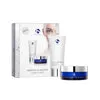
Works for
MoisturizingJojoba esters, Glycerin + 6 moreWorks
“Step 2. with a refreshing mint gel formula, the Hydra-Intensive Cooling Masque refreshes and reinvigorates your skin with deep hydration.”
This product can help improve hydration of the skin with the two types of ingredients.
The first type is called “humectants”:
these ingredients help attract water.
When humectants are on the surface of the skin, they “pull in” the moisture from the outside environment, or from
within deeper layers of the skin. The following ingredients in this product do the job:
glycerin, butylene glycol.
This product also contains ingredients called “occlusives”. They help reduce the speed with which our skin loses moisture to the outside environment. These ingredients also help soften the upper layer of the skin, so it feels less tight and nicer to the touch. The following ingredients in this product do the job: jojoba esters.
ExfoliationSalicylic acid ~0.15–0.6%, below the ~0.5% it needsUnder-dosed
“Polishes deeply Helps increase skin cell turnover Renews complexion How to use.”
This product does not contain effective exfoliating ingredients. It might be able to deliver physical exfoliation, that is scrub off some of the dead cells on the surface of the skin. We do not recommend physical exfoliation, because it is not uniform (some bits of skin can get exfoliated too much while others not at all). It can also traumatize the skin and aggrevate acne and other skin conditions.
Can it cause trouble?
Irritancy2 strong irritants: Retinyl palmitate, ParfumMedium risk
ComedogenicClean of flagged comedogenic ingredientsNone flagged

User reviews
Be the first — your take helps the next person decide.
Ingredients
Filter by role to see what each ingredient is doing.
Water~40–60%
Microcrystalline cellulose~5–7.5%
Jojoba esters~3.8–5.7%
- Irritation risk
- Medium
An emollient made of jojoba oil. Helps soften the skin and support its barrier function
More about Jojoba estersGlycerin~2.7–4.1%
- Irritation risk
- Low
One of the best moisturizing ingredients. Naturally present in skin. It attracts water to the upper layer of the skin working as a humectant
More about GlycerinDisodium laureth sulfosuccinate~2.3–3.4%
Cocamidopropyl betaine~2.3–3.4%
- Irritation risk
- High
Helps water and oil mix together. Used as a cleansing ingredient. Could be an allergen
More about Cocamidopropyl betainePropylene glycol~1.5–2.2%
- Irritation risk
- High
Helps oil and water mix together and can enhance the penetration of other ingredients into the skin. It can be irritating
More about Propylene glycolPeg-30 glyceryl cocoate~1.3–2%
Saccharum officinarum extract~1.1–1.6%
- Irritation risk
- Low
Sugar extract that helps attract water to the upper layer of the skin
More about Saccharum officinarum extractDecane~0.9–1.3%
- Irritation risk
- Low
Centella asiatica extract~0.45–1.1%
- Irritation risk
- Medium
A plant extract that has been shown to be able to reduce inflammation in skin, support restoration of skin barrier function, as well as support collagen production. Contains active compounds called centelloids: asiaticoside, madecasosside, asiatic acid and madecassic acid. Might be helpful in preventing stretch marks. It can be itself be irritating though.
More about Centella asiatica extractChamomilla recutita flower extract~0.45–1.05%
- Irritation risk
- High
Plant extract that can have healing and anti-inflammatory properties. It is a potential allergen and can be irritating
More about Chamomilla recutita flower extractCamellia sinensis leaf extract~0.45–1%
- Irritation risk
- Low
Can contain potent anti-oxidant compounds (abbreviated ECG, GCG, EGC, and EGCG) that might help protect the skin from free radicals. Can help calm down inflammation and has some anti-bacterial properties. Unfortunately, these antioxidants are unstable and lose their effectiveness very quickly in products. The concentration of the antioxidant compounds in the extract also tends to be low to be effective in topical formulation
More about Camellia sinensis leaf extractTocopheryl acetate~0.4–0.95%
- Irritation risk
- Medium
A more stable but less bio-available form of vitamin E compared to Tocopherol. Might help moisturize and protect the skin from free radicals, but mostly used in low concentrations to stabilize other ingredients.
More about Tocopheryl acetateHydroxyethylcellulose~0.35–0.85%
- Irritation risk
- Low
Used to thicken product formulations and create gel-like textures
More about HydroxyethylcellulosePhenoxyethanol~0.35–0.8%
- Irritation risk
- Low
A preservative. It helps prevent bacterial growth in cosmetic products
More about PhenoxyethanolXanthan gum~0.2–0.75%
- Irritation risk
- Low
Used to create a thicker product consistency
More about Xanthan gumSalicylic acid~0.15–0.6%
- Irritation risk
- High
Used for skin exfoliation. It has an anti-inflammatory and anti-bacterial effect, helps to unclog pores, prevent blemishes and speed up healing of the existing ones. Sometimes referred to as a BHA (beta-hydroxy acid)
More about Salicylic acidAminomethyl propanol~0.15–0.55%
Butylene glycol~0.1–0.45%
- Irritation risk
- Low
Used to create a nice product texture and help delivery of other ingredients. Might be somewhat helpful in attracting water to the upper layer of the skin
More about Butylene glycolRetinyl palmitate~0.1–0.35%
- Irritation risk
- High
Three steps removed from the active form of vitamin A - retinoic acid. To have an effect in the skin, it first needs to be converted twice to become the retinoic acid. This means it is less potent than retinol, but could also be less irritating. Once converted to the retinoic acid in the skin, it helps against all signs of aging, improves skin cell turnover and helps fight blemishes and clogged pores. However, in many cosmetic formulations, it is used in a concentration that is too low to have the full effect
More about Retinyl palmitateAscorbyl palmitate~0.1–0.35%
- Irritation risk
- Medium
Being a lipid soluble form of vitamin C, it is more stable and can penetrate the skin better than L-Ascorbic acid. It is effective in protecting the skin from free radicals, as well as evening the skin tone, but is less effective in stimulating collagen production compared to L-Ascorbic acid.
More about Ascorbyl palmitateCitric acid~0.05–0.3%
- Irritation risk
- Medium
Can work as an exfoliant but is typically used to adjust the product pH
More about Citric acidParfum~0.05–0.2%
- Irritation risk
- High
An aromatic blend of unspecified and possibly irritating ingredients
More about ParfumPhospholipids~0.05–0.25%
- Irritation risk
- Low
Emollients that are naturaly present in skin. In addition, they help water and oil mix together in the product
More about PhospholipidsDisodium edta~0.05–0.1%
Ingredient list view
Water, Microcrystalline cellulose, Jojoba esters, Glycerin, Disodium laureth sulfosuccinate, Cocamidopropyl betaine, Propylene glycol, Peg-30 glyceryl cocoate, Saccharum officinarum extract, Unknown, Decane, Centella asiatica extract, Chamomilla recutita flower extract, Camellia sinensis leaf extract, Tocopheryl acetate, Hydroxyethylcellulose, Phenoxyethanol, Xanthan gum, Salicylic acid, Aminomethyl propanol, Butylene glycol, Retinyl palmitate, Ascorbyl palmitate, Citric acid, Parfum, Phospholipids, Disodium edta
Compare prices
Retailers ranked by price — lowest first.
Affiliate links · As an Amazon Associate, WIMJ earns from qualifying purchases.
Worth comparing, line by line.
Match % combines shared ingredients, the first five ingredients, shared actives and hero ingredients, irritancy (lower counts in the alternative's favour), texture and body area. Only products in the same routine step are compared.
| iS ClinicalSmooth & SootheYOUR PRODUCT | Deviant SkincareGentle Resurfacing Liquid | colibri skincare2% BHA Peeling | Skin FunctionalRetexturising Honey | |
|---|---|---|---|---|
| Match | — | 84% | 83% | 81% |
| Price | $164.00 | $52.00−$112.00 | — | — |
| Shared key ingredients | — | 3 of 7 | 3 of 7 | 2 of 7 |
| Key difference | — | Glycolic Acid | Epigallocatechin Gallate | Niacinamide |
| Irritancy | Medium | Low | Low | Low |
| Drying alcohol | — | — | — | — |
| View product | Shop | Shop | Shop |


More alternatives: Revolution BHA 2%AcneFree Dermatology Inspired Care Blackhead Removing Scrub With Charcoal
Product summary
"iS Clinical - Smooth & Soothe" could be helpful for: Moisturizing, but its actives are not the most effective or are not well-studied.
Ingredient callouts
- this product includes a form of Retinoids (vitamin A) - retinyl palmitate 0.10% - 0.35%, but this type of vitamin A is not very effective. It could in theory help with fine lines and wrinkles, but the effect is most likely minimal.
- Humectants (glycerin 2.70% - 4.10%). These ingredients help attract water to the upper layer of the skin and improve the skin hydration.
Price
The product retails for 359.86CA$ in Canada, for 145.00$ in the United States and from 113.25£ up to 120.00£ in the United Kingdom.
For a detailed price comparison: click here.
Sources cited in this review
Every concentration estimate and effectiveness label is anchored to one of these 15 studies and safety reviews.
- 1
- 2Surfactants and experimental irritant contact dermatitisncbi.nlm.nih.gov
- 3Propylene Glycolpubmed.ncbi.nlm.nih.gov
- 4Skin-sensitizing and irritant properties of propylene glycolonlinelibrary.wiley.com
- 5
- 6Centella asiatica in cosmetologyncbi.nlm.nih.gov

Affiliate links · As an Amazon Associate, WIMJ earns from qualifying purchases.