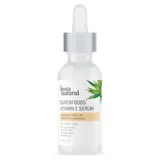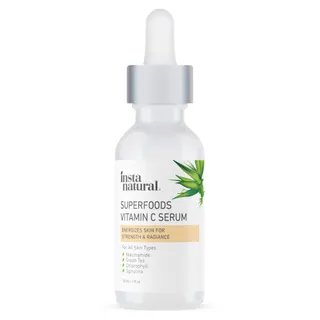
InstaNatural Superfoods Vitamin C Serum

InstaNatural Superfoods Vitamin C Serum

Efficacy100/100IrritancyHigh

Works for

Moisturizing
Niacinamide, Caprylic/capric triglyceride + 12 more
Works well
What the product description says
“Improves and strengthens the skin’s protective barrier”
Source: Insta natural

This product can help improve hydration of the skin with the two types of ingredients.

The first type is called “humectants”:
these ingredients help attract water. When humectants are on the surface of the skin, they “pull in” the moisture from the outside environment, or from within deeper layers of the skin. The following ingredients in this product do the job: glycerin, sodium hyaluronate.

This product also contains ingredients called “occlusives”. They help reduce the speed with which our skin loses moisture to the outside environment. These ingredients also help soften the upper layer of the skin, so it feels less tight and nicer to the touch. The following ingredients in this product do the job: caprylic/capric triglyceride, squalane.

The following ingredients in this product are especially good for supporting the skin barrier and helping with the hydration level: niacinamide

NiacinamideHeroEffect: HighIs proven to be effective in reducing blemishes, evening out skin tone and helping to improve lines and wrinkles. It helps the skin to repair sun damage, calm down inflammation and keep maintain good levels of moisture. The concentration of about 2% is effective for supporting the skin barrier and evening out the skin tone. Concentration of 4-6% is better for helping with acne and balancing the sebum production~0.9–1.1%
Caprylic/capric triglycerideKey active· Emollient, OcclusiveEffect: HighA good mix of fatty acids that forms a protective layer on the skin. Improves the shelf life of products. Derived from coconut and glycerin~4.1–5%
SqualaneKey active· Emollient, OcclusiveEffect: HighAn oil naturally present in skin. Works as an emollient to soften the skin and form a protective layer on its surface without a greasy feeling.~3.1–3.8%
GlycerinKey active· HumectantEffect: HighOne of the best moisturizing ingredients. Naturally present in skin. It attracts water to the upper layer of the skin working as a humectant~2.4–2.9%
Limnanthes alba seed oilKey active· EmollientEffect: HighThis oil's cmposition is closest to rapeseed oil. It is a very stable oil and serves as an emoillient~1.2–1.4%
Sodium hyaluronateKey active· HumectantEffect: HighOne of the best moisturizing ingredients. Attracts water into the upper layer of the skin~0.55–0.85%
Brassica oleracea italica seed oilKey active· EmollientEffect: MediumA plant seed oil that consists mainly of erucic acid and used to help soften the upper layer of the skin. This fatty acid can enhance penetration of other ingredients into the skin but it is not a good moisturizer on its own~0.5–0.75%
Centella asiatica extractKey activeEffect: HighA plant extract that has been shown to be able to reduce inflammation in skin, support restoration of skin barrier function, as well as support collagen production. Contains active compounds called centelloids: asiaticoside, madecasosside, asiatic acid and madecassic acid. Might be helpful in preventing stretch marks. It can be itself be irritating though.~0.45–0.65%
Glucosyl hesperidinKey active· HumectantEffect: MediumMight be able to neutralize free radicals in skin. Also works as a humectant~0.35–0.65%
Camellia sinensis leaf extractEffect: LowCan contain potent anti-oxidant compounds (abbreviated ECG, GCG, EGC, and EGCG) that might help protect the skin from free radicals. Can help calm down inflammation and has some anti-bacterial properties. Unfortunately, these antioxidants are unstable and lose their effectiveness very quickly in products. The concentration of the antioxidant compounds in the extract also tends to be low to be effective in topical formulation~0.35–0.6%
Aloe barbadensis leaf juiceEffect: Low, below effective doseTraditionally used to treat sunburns, dermatitis and inflammation, but evidence for its effectiveness is lacking. The extract can contain humectants that help attract water into the skin~0.65–1%
Brassica oleracea acephala leaf extractEffect: Low, below effective doseMight be helpful in neutralizing free radicals in skin but solid research is lacking. Helps attract water to the upper layer of the skin~0.5–0.75%
LecithinEffect: Low, below effective doseUsed mostly for creating emulsions - helping oil and water mix together. Helps soften the upper layer of the skin~0.35–0.6%
TocopherolEffect: Low, below effective dosePure form of vitamin E. Can help moisturise and protect the skin from free radicals. Often used to help stabilise other ingredients or the formula itself~0.25–0.5%
Anti-aging
Niacinamide, Centella asiatica extract + 5 more
Works well
What the product description says
“Softens the look of lines and wrinkles”
Source: Insta natural

This product can help reduce and prevent fine lines and wrinkles, improve skin elasticity and firmness because it contains niacinamide.

These ingredients in the product can also be helpful, even though there is less evidence for their effectiveness: centella asiatica extract.

Keep in mind that it typically takes at least 6 weeks to notice any results because the changes that are needed to improve fine lines and elasticity happen in the deeper layers of the skin. No topical anti-aging product can “erase” wrinkles or fully reverse signs of aging.

NiacinamideKey activeEffect: HighIs proven to be effective in reducing blemishes, evening out skin tone and helping to improve lines and wrinkles. It helps the skin to repair sun damage, calm down inflammation and keep maintain good levels of moisture. The concentration of about 2% is effective for supporting the skin barrier and evening out the skin tone. Concentration of 4-6% is better for helping with acne and balancing the sebum production~0.9–1.1%
Centella asiatica extractKey activeEffect: MediumA plant extract that has been shown to be able to reduce inflammation in skin, support restoration of skin barrier function, as well as support collagen production. Contains active compounds called centelloids: asiaticoside, madecasosside, asiatic acid and madecassic acid. Might be helpful in preventing stretch marks. It can be itself be irritating though.~0.45–0.65%
Limnanthes alba seed oilEffect: LowThis oil's cmposition is closest to rapeseed oil. It is a very stable oil and serves as an emoillient~1.2–1.4%
Camellia sinensis leaf extractEffect: LowCan contain potent anti-oxidant compounds (abbreviated ECG, GCG, EGC, and EGCG) that might help protect the skin from free radicals. Can help calm down inflammation and has some anti-bacterial properties. Unfortunately, these antioxidants are unstable and lose their effectiveness very quickly in products. The concentration of the antioxidant compounds in the extract also tends to be low to be effective in topical formulation~0.35–0.6%
Sodium ascorbyl phosphateEffect: Low, below effective doseA stable derivative of vitamin C. It is oil-soluble which means it is more likely to penetrate the skin compared to the pure form of vitamin C (which is water-soluble), but it is less bio-available and is way less effective in stimulating collagen and reducing wrinkles compared to the pure form of vitamin C (L-ascorbic acid) and its other derivatives (for example, magnesium ascorbyl phosphate). At the same time, this vitamin C derivative has been shown in studies to be effective in reducing acne, blemishes and clogged pores. It is less irritating then the pure form of vitamin C~1.3–1.6%
Aloe barbadensis leaf juiceEffect: Low, below effective doseTraditionally used to treat sunburns, dermatitis and inflammation, but evidence for its effectiveness is lacking. The extract can contain humectants that help attract water into the skin~0.65–1%
TocopherolEffect: Low, below effective dosePure form of vitamin E. Can help moisturise and protect the skin from free radicals. Often used to help stabilise other ingredients or the formula itself~0.25–0.5%
Evens skin tone
Niacinamide, Camellia sinensis leaf extract
Works well
What the product description says
“Brightens and reduces the look of discoloration”
Source: Insta natural

This product can help reduce hypepigmentation and even out the skin tone because it contains the following effective ingredients: niacinamide

Keep in mind that you would need to apply any topical skincare targetted at hypigmentation consistently for a couple of months to get a result. No topical skincare product can help get rid of hyperpigmentation (including post-acne marks and age spots) instantly.

NiacinamideKey activeEffect: HighIs proven to be effective in reducing blemishes, evening out skin tone and helping to improve lines and wrinkles. It helps the skin to repair sun damage, calm down inflammation and keep maintain good levels of moisture. The concentration of about 2% is effective for supporting the skin barrier and evening out the skin tone. Concentration of 4-6% is better for helping with acne and balancing the sebum production~0.9–1.1%
Camellia sinensis leaf extractEffect: LowCan contain potent anti-oxidant compounds (abbreviated ECG, GCG, EGC, and EGCG) that might help protect the skin from free radicals. Can help calm down inflammation and has some anti-bacterial properties. Unfortunately, these antioxidants are unstable and lose their effectiveness very quickly in products. The concentration of the antioxidant compounds in the extract also tends to be low to be effective in topical formulation~0.35–0.6%
Anti-blemish
Side benefit · Niacinamide, Centella asiatica extract + 4 more
Works well

This product can help reduce breakouts and clogged pores because it contains the following ingredient: niacinamide. This ingredient is used for treating acne and can have a noticeable effect.

NiacinamideHeroEffect: HighIs proven to be effective in reducing blemishes, evening out skin tone and helping to improve lines and wrinkles. It helps the skin to repair sun damage, calm down inflammation and keep maintain good levels of moisture. The concentration of about 2% is effective for supporting the skin barrier and evening out the skin tone. Concentration of 4-6% is better for helping with acne and balancing the sebum production~0.9–1.1%
Centella asiatica extractEffect: LowA plant extract that has been shown to be able to reduce inflammation in skin, support restoration of skin barrier function, as well as support collagen production. Contains active compounds called centelloids: asiaticoside, madecasosside, asiatic acid and madecassic acid. Might be helpful in preventing stretch marks. It can be itself be irritating though.~0.45–0.65%
Camellia sinensis leaf extractEffect: LowCan contain potent anti-oxidant compounds (abbreviated ECG, GCG, EGC, and EGCG) that might help protect the skin from free radicals. Can help calm down inflammation and has some anti-bacterial properties. Unfortunately, these antioxidants are unstable and lose their effectiveness very quickly in products. The concentration of the antioxidant compounds in the extract also tends to be low to be effective in topical formulation~0.35–0.6%
Aloe barbadensis leaf juiceEffect: Low, below effective doseTraditionally used to treat sunburns, dermatitis and inflammation, but evidence for its effectiveness is lacking. The extract can contain humectants that help attract water into the skin~0.65–1%
Sodium ascorbyl phosphateUnder-dosedA stable derivative of vitamin C. It is oil-soluble which means it is more likely to penetrate the skin compared to the pure form of vitamin C (which is water-soluble), but it is less bio-available and is way less effective in stimulating collagen and reducing wrinkles compared to the pure form of vitamin C (L-ascorbic acid) and its other derivatives (for example, magnesium ascorbyl phosphate). At the same time, this vitamin C derivative has been shown in studies to be effective in reducing acne, blemishes and clogged pores. It is less irritating then the pure form of vitamin C~1.3–1.6%
Rosmarinus officinalis leaf extractUnder-dosedCan be helpful in reducing inflammation in skin, including inflamed acne. It can be irritating~0.3–0.6%
Anti-oxidation
Side benefit · Centella asiatica extract, Camellia sinensis leaf extract + 6 more
May help

This product contains antioxidants (camellia sinensis leaf extract, centella asiatica extract) that can help neutralize free radicals in skin to lessen the damage it gets from the UV light (sun). There is some human evidence for this effect in skin, though it is smaller or less consistent than the evidence for the best antioxidants.

Centella asiatica extractKey activeEffect: MediumA plant extract that has been shown to be able to reduce inflammation in skin, support restoration of skin barrier function, as well as support collagen production. Contains active compounds called centelloids: asiaticoside, madecasosside, asiatic acid and madecassic acid. Might be helpful in preventing stretch marks. It can be itself be irritating though.~0.45–0.65%
Camellia sinensis leaf extractKey activeEffect: MediumCan contain potent anti-oxidant compounds (abbreviated ECG, GCG, EGC, and EGCG) that might help protect the skin from free radicals. Can help calm down inflammation and has some anti-bacterial properties. Unfortunately, these antioxidants are unstable and lose their effectiveness very quickly in products. The concentration of the antioxidant compounds in the extract also tends to be low to be effective in topical formulation~0.35–0.6%
Limnanthes alba seed oilEffect: LowThis oil's cmposition is closest to rapeseed oil. It is a very stable oil and serves as an emoillient~1.2–1.4%
Spinacia oleracea leaf extractEffect: LowA plant extract that might have some anti-oxidant properties~0.45–0.65%
Glucosyl hesperidinEffect: LowMight be able to neutralize free radicals in skin. Also works as a humectant~0.35–0.65%
Rosmarinus officinalis leaf extractEffect: Low, below effective doseCan be helpful in reducing inflammation in skin, including inflamed acne. It can be irritating~0.3–0.6%
Sodium ascorbyl phosphateUnder-dosedA stable derivative of vitamin C. It is oil-soluble which means it is more likely to penetrate the skin compared to the pure form of vitamin C (which is water-soluble), but it is less bio-available and is way less effective in stimulating collagen and reducing wrinkles compared to the pure form of vitamin C (L-ascorbic acid) and its other derivatives (for example, magnesium ascorbyl phosphate). At the same time, this vitamin C derivative has been shown in studies to be effective in reducing acne, blemishes and clogged pores. It is less irritating then the pure form of vitamin C~1.3–1.6%
TocopherolUnder-dosedPure form of vitamin E. Can help moisturise and protect the skin from free radicals. Often used to help stabilise other ingredients or the formula itself~0.25–0.5%

Can it cause trouble?

Irritancy
9 strong irritants: Rosmarinus officinalis leaf extract, Hibiscus rosa-sinensis flower extract + 7 more — patch-test recommended
High risk
We flagged 27 ingredients with irritancy potential. Severity depends on your sensitivity threshold; the table lists the worst offenders first.
IngredientFunctionIrritationEst. amount
Rosmarinus officinalis leaf extractCan be helpful in reducing inflammation in skin, including inflamed acne. It can be irritatingHigh~0.3–0.6%est.
Chamomilla recutita flower extractPlant extract that can have healing and anti-inflammatory properties. It is a potential allergen and can be irritatingHigh~0.3–0.55%est.
Citrus aurantium dulcis peel extractUsed as a fragranceHigh~0.25–0.5%est.
Mentha piperita leaf extractUsed as a fragrance and can be irritatingHigh~0.3–0.55%est.
Lavandula angustifolia flower/leaf/stem extractUsed as a fragranceHigh~0.3–0.55%est.
Citrus grandis fruit extract—High~0.25–0.45%est.
Citrus limon peel extractA very irritating fragrant ingredientHigh~0.25–0.5%est.
Mentha viridis extractUsed as a fragrance and can be irritatingHigh~0.3–0.6%est.
Vanilla planifolia fruit extractA plant extract used as a fragrance. Can be irritatingHigh~0.3–0.5%est.
PullulanCreates a thin drying film on the skin resulting in a short-term tightening effectHigh~0.3–0.55%est.
Phenethyl alcoholA fragrance. Can be irritatingHigh~0.1–0.15%est.
Caprylic/capric triglycerideA good mix of fatty acids that forms a protective layer on the skin. Improves the shelf life of products. Derived from coconut and glycerinMedium~4.1–5%est.
Glyceryl oleate citrateHelps oil and water mix togetherMedium~1.9–2.3%est.
Avena sativa bran extract—Medium~1.8–2.2%est.
Sodium ascorbyl phosphateA stable derivative of vitamin C. It is oil-soluble which means it is more likely to penetrate the skin compared to the pure form of vitamin C (which is water-soluble), but it is less bio-available and is way less effective in stimulating collagen and reducing wrinkles compared to the pure form of vitamin C (L-ascorbic acid) and its other derivatives (for example, magnesium ascorbyl phosphate). At the same time, this vitamin C derivative has been shown in studies to be effective in reducing acne, blemishes and clogged pores. It is less irritating then the pure form of vitamin CMedium~1.3–1.6%est.
Aloe barbadensis leaf juiceTraditionally used to treat sunburns, dermatitis and inflammation, but evidence for its effectiveness is lacking. The extract can contain humectants that help attract water into the skinMedium~0.65–1%est.
Brassica oleracea acephala leaf extractMight be helpful in neutralizing free radicals in skin but solid research is lacking. Helps attract water to the upper layer of the skinMedium~0.5–0.75%est.
Brassica oleracea italica seed oilA plant seed oil that consists mainly of erucic acid and used to help soften the upper layer of the skin. This fatty acid can enhance penetration of other ingredients into the skin but it is not a good moisturizer on its ownMedium~0.5–0.75%est.
Spinacia oleracea leaf extractA plant extract that might have some anti-oxidant propertiesMedium~0.45–0.65%est.
Centella asiatica extractA plant extract that has been shown to be able to reduce inflammation in skin, support restoration of skin barrier function, as well as support collagen production. Contains active compounds called centelloids: asiaticoside, madecasosside, asiatic acid and madecassic acid. Might be helpful in preventing stretch marks. It can be itself be irritating though.Medium~0.45–0.65%est.
Sodium levulinateA preservativeMedium~0.25–0.5%est.
Sodium citrateHelps to control the skin's pH level. Maintains the skin's natural film of amino-lactic acids and oils. Helps to preserve productsMedium~0.25–0.5%est.
Citric acidCan work as an exfoliant but is typically used to adjust the product pHMedium~0.2–0.35%est.
Potassium sorbateA preservativeMedium~0.15–0.25%est.
Leuconostoc/radish root ferment filtrateA preservative that comes from radishes fermented by a bacteria. New research suggests that the preservation properties in the ingredient come from an ammonium salt that is not present naturally in radish root but used in its cultivation. Is problematic because the exact amount of the preservative agents is difficult to determineMedium~0.1–0.2%est.
HydroxyacetophenoneUsed to increase effectiveness of preservativesMedium~0.1–0.2%est.
Comedogenic
1 ingredient rated 2 or more on the 0–5 pore-clogging scale
1 flagged
These ingredients have a comedogenic rating of 2 or more on a 0–5 scale; the table shows each one's rating. In leave-on products they can clog pores in acne-prone skin.
IngredientFunctionRatingEst. amount
Spirulina maxima extract—3/5~0.45–0.7%est.
Did this help you decide?

User reviews

Would you recommend?
No community reviews yet.

Be the first — your take helps the next person decide.

Ingredients

Filter by role to see what each ingredient is doing.

Water~45–55%
Formula
Irritation risk
Low

Plain old water

More about Water
Propanediol~4.1–5.1%
Formula
Irritation risk
Low

Acts as a solvent for other ingredients. Speeds up the absorption of other ingredients into the skin

More about Propanediol
Caprylic/capric triglyceride~4.1–5%
Key activeIrritant · medium
Irritation risk
Medium
Works for
Moisturizing

A good mix of fatty acids that forms a protective layer on the skin. Improves the shelf life of products. Derived from coconut and glycerin

More about Caprylic/capric triglyceride
Squalane~3.1–3.8%
Key active
Irritation risk
Low
Works for
Moisturizing

An oil naturally present in skin. Works as an emollient to soften the skin and form a protective layer on its surface without a greasy feeling.

More about Squalane
Glycerin~2.4–2.9%
Key active
Irritation risk
Low
Works for
Moisturizing

One of the best moisturizing ingredients. Naturally present in skin. It attracts water to the upper layer of the skin working as a humectant

More about Glycerin
Glyceryl oleate citrate~1.9–2.3%
Irritant · medium
Irritation risk
Medium
Works for
Cleansing

Helps oil and water mix together

More about Glyceryl oleate citrate
Avena sativa bran extract~1.8–2.2%
Irritant · medium
Sodium ascorbyl phosphate~1.3–1.6%
Under-dosedIrritant · medium
Irritation risk
Medium
Works for
Anti-blemishAnti-oxidationAnti-aging

A stable derivative of vitamin C. It is oil-soluble which means it is more likely to penetrate the skin compared to the pure form of vitamin C (which is water-soluble), but it is less bio-available and is way less effective in stimulating collagen and reducing wrinkles compared to the pure form of vitamin C (L-ascorbic acid) and its other derivatives (for example, magnesium ascorbyl phosphate). At the same time, this vitamin C derivative has been shown in studies to be effective in reducing acne, blemishes and clogged pores. It is less irritating then the pure form of vitamin C

More about Sodium ascorbyl phosphate
Limnanthes alba seed oil~1.2–1.4%
Key active
Irritation risk
Low
Works for
MoisturizingAnti-oxidationAnti-aging

This oil's cmposition is closest to rapeseed oil. It is a very stable oil and serves as an emoillient

More about Limnanthes alba seed oil
Niacinamide~0.9–1.1%
Hero · Moisturizing, Anti-blemish
Irritation risk
Low
Works for
Anti-agingEvens skin toneMoisturizingAnti-blemishReduces irritationAnti-inflammatoryReduces rednessAntibacterial

Is proven to be effective in reducing blemishes, evening out skin tone and helping to improve lines and wrinkles. It helps the skin to repair sun damage, calm down inflammation and keep maintain good levels of moisture. The concentration of about 2% is effective for supporting the skin barrier and evening out the skin tone. Concentration of 4-6% is better for helping with acne and balancing the sebum production

More about Niacinamide
Aloe barbadensis leaf juice~0.65–1%
Irritant · medium
Irritation risk
Medium
Works for
MoisturizingAntibacterialReduces irritationReduces rednessAnti-inflammatoryAnti-blemishAnti-aging

Traditionally used to treat sunburns, dermatitis and inflammation, but evidence for its effectiveness is lacking. The extract can contain humectants that help attract water into the skin

More about Aloe barbadensis leaf juice
Sodium hyaluronate~0.55–0.85%
Key active
Irritation risk
Low
Works for
Moisturizing

One of the best moisturizing ingredients. Attracts water into the upper layer of the skin

More about Sodium hyaluronate
Chlorophyllin-copper complex~0.5–0.8%
Formula
Brassica oleracea acephala leaf extract~0.5–0.75%
Irritant · medium
Irritation risk
Medium
Works for
Moisturizing

Might be helpful in neutralizing free radicals in skin but solid research is lacking. Helps attract water to the upper layer of the skin

More about Brassica oleracea acephala leaf extract
Brassica oleracea italica seed oil~0.5–0.75%
Key activeIrritant · medium
Irritation risk
Medium
Works for
Moisturizing

A plant seed oil that consists mainly of erucic acid and used to help soften the upper layer of the skin. This fatty acid can enhance penetration of other ingredients into the skin but it is not a good moisturizer on its own

More about Brassica oleracea italica seed oil
Spirulina maxima extract~0.45–0.7%
Comedogenic 3/5
Irritation risk
Low
Comedogenicity
3/5
More about Spirulina maxima extract
Spinacia oleracea leaf extract~0.45–0.65%
Irritant · medium
Irritation risk
Medium
Works for
Anti-oxidation

A plant extract that might have some anti-oxidant properties

More about Spinacia oleracea leaf extract
Glucosyl hesperidin~0.35–0.65%
Key active
Irritation risk
Low
Works for
MoisturizingAnti-oxidation

Might be able to neutralize free radicals in skin. Also works as a humectant

More about Glucosyl hesperidin
Rosmarinus officinalis leaf extract~0.3–0.6%
Under-dosedIrritant · high
Irritation risk
High
Works for
Anti-blemishAntibacterialAnti-oxidation

Can be helpful in reducing inflammation in skin, including inflamed acne. It can be irritating

More about Rosmarinus officinalis leaf extract
Centella asiatica extract~0.45–0.65%
Key activeIrritant · medium
Irritation risk
Medium
Works for
MoisturizingAnti-inflammatoryReduces rednessReduces irritationAnti-oxidationAnti-agingAnti-blemish

A plant extract that has been shown to be able to reduce inflammation in skin, support restoration of skin barrier function, as well as support collagen production. Contains active compounds called centelloids: asiaticoside, madecasosside, asiatic acid and madecassic acid. Might be helpful in preventing stretch marks. It can be itself be irritating though.

More about Centella asiatica extract
Hibiscus rosa-sinensis flower extract~0.3–0.55%
Irritant · high
Camellia sinensis leaf extract~0.35–0.6%
Key active
Irritation risk
Low
Works for
Anti-oxidationAntibacterialAnti-agingAnti-blemishEvens skin toneMoisturizing

Can contain potent anti-oxidant compounds (abbreviated ECG, GCG, EGC, and EGCG) that might help protect the skin from free radicals. Can help calm down inflammation and has some anti-bacterial properties. Unfortunately, these antioxidants are unstable and lose their effectiveness very quickly in products. The concentration of the antioxidant compounds in the extract also tends to be low to be effective in topical formulation

More about Camellia sinensis leaf extract
Chamomilla recutita flower extract~0.3–0.55%
Irritant · high
Irritation risk
High
Works for
Anti-inflammatory

Plant extract that can have healing and anti-inflammatory properties. It is a potential allergen and can be irritating

More about Chamomilla recutita flower extract
Citrus aurantium dulcis peel extract~0.25–0.5%
Irritant · high
Irritation risk
High

Used as a fragrance

More about Citrus aurantium dulcis peel extract
Mentha piperita leaf extract~0.3–0.55%
Irritant · high
Irritation risk
High

Used as a fragrance and can be irritating

More about Mentha piperita leaf extract
Lavandula angustifolia flower/leaf/stem extract~0.3–0.55%
Irritant · high
Citrus grandis fruit extract~0.25–0.45%
Irritant · high
Citrus limon peel extract~0.25–0.5%
Irritant · high
Irritation risk
High

A very irritating fragrant ingredient

More about Citrus limon peel extract
Mentha viridis extract~0.3–0.6%
Irritant · high
Irritation risk
High

Used as a fragrance and can be irritating

More about Mentha viridis extract
Vanilla planifolia fruit extract~0.3–0.5%
Irritant · high
Irritation risk
High

A plant extract used as a fragrance. Can be irritating

More about Vanilla planifolia fruit extract
Pullulan~0.3–0.55%
Irritant · high
Irritation risk
High
Works for
Mattifying

Creates a thin drying film on the skin resulting in a short-term tightening effect

More about Pullulan
Lecithin~0.35–0.6%
Formula
Irritation risk
Low
Works for
CleansingMoisturizing

Used mostly for creating emulsions - helping oil and water mix together. Helps soften the upper layer of the skin

More about Lecithin
Sodium phytate~0.3–0.55%
Formula
Irritation risk
Low

Used to stabilize product formulations

More about Sodium phytate
Sodium levulinate~0.25–0.5%
Irritant · medium
Irritation risk
Medium

A preservative

More about Sodium levulinate
Sodium citrate~0.25–0.5%
Irritant · medium
Irritation risk
Medium

Helps to control the skin's pH level. Maintains the skin's natural film of amino-lactic acids and oils. Helps to preserve products

More about Sodium citrate
Tocopherol~0.25–0.5%
Under-dosed
Irritation risk
Low
Works for
Anti-oxidationAnti-agingAnti-inflammatoryMoisturizing

Pure form of vitamin E. Can help moisturise and protect the skin from free radicals. Often used to help stabilise other ingredients or the formula itself

More about Tocopherol
Sclerotium gum~0.25–0.45%
Formula
Irritation risk
Low

Used to create gel-like formulas and stabilize emulsions

More about Sclerotium gum
Xanthan gum~0.25–0.45%
Formula
Irritation risk
Low
Works for
Cleansing

Used to create a thicker product consistency

More about Xanthan gum
Citric acid~0.2–0.35%
Irritant · medium
Irritation risk
Medium

Can work as an exfoliant but is typically used to adjust the product pH

More about Citric acid
Sodium hydroxide~0.2–0.35%
Formula
Irritation risk
Low

Used to adjust the product's pH

More about Sodium hydroxide
Potassium sorbate~0.15–0.25%
Irritant · medium
Irritation risk
Medium

A preservative

More about Potassium sorbate
Leuconostoc/radish root ferment filtrate~0.1–0.2%
Irritant · medium
Irritation risk
Medium

A preservative that comes from radishes fermented by a bacteria. New research suggests that the preservation properties in the ingredient come from an ammonium salt that is not present naturally in radish root but used in its cultivation. Is problematic because the exact amount of the preservative agents is difficult to determine

More about Leuconostoc/radish root ferment filtrate
Silica~0.25–0.45%
Formula
Irritation risk
Low

Used to absorb oil and can temporarily mattify skin

More about Silica
Hydroxyacetophenone~0.1–0.2%
Irritant · medium
Irritation risk
Medium

Used to increase effectiveness of preservatives

More about Hydroxyacetophenone
Phenethyl alcohol~0.1–0.15%
Irritant · high
Irritation risk
High

A fragrance. Can be irritating

More about Phenethyl alcohol
Pentylene
Not recognized
Ingredient list view

Water, Propanediol, Caprylic/capric triglyceride, Squalane, Glycerin, Glyceryl oleate citrate, Avena sativa bran extract, Sodium ascorbyl phosphate, Limnanthes alba seed oil, Niacinamide, Aloe barbadensis leaf juice, Sodium hyaluronate, Chlorophyllin-copper complex, Brassica oleracea acephala leaf extract, Brassica oleracea italica seed oil, Spirulina maxima extract, Spinacia oleracea leaf extract, Glucosyl hesperidin, Rosmarinus officinalis leaf extract, Centella asiatica extract, Hibiscus rosa-sinensis flower extract, Camellia sinensis leaf extract, Chamomilla recutita flower extract, Citrus aurantium dulcis peel extract, Mentha piperita leaf extract, Lavandula angustifolia flower/leaf/stem extract, Citrus grandis fruit extract, Citrus limon peel extract, Mentha viridis extract, Vanilla planifolia fruit extract, Pullulan, Lecithin, Sodium phytate, Sodium levulinate, Sodium citrate, Tocopherol, Sclerotium gum, Xanthan gum, Citric acid, Sodium hydroxide, Potassium sorbate, Leuconostoc/radish root ferment filtrate, Silica, Hydroxyacetophenone, Phenethyl alcohol, Unknown

Compare prices

Retailers ranked by price — lowest first.

No pricing data available yet for this product.

Worth comparing, line by line.

Match % combines shared ingredients, the first five ingredients, shared actives and hero ingredients, irritancy (lower counts in the alternative's favour), texture and body area. Only products in the same routine step are compared.

Side-by-side comparison of this product against its closest alternatives
InstaNaturalSuperfoods Vitamin C SerumYOUR PRODUCTLive No B.S.Vitamin C + E SerumSwisseBeauty vitamin c 10% brightening booster serumMEDI-PEELCINDELLA AMPOULE
Match—91%88%86%
Price——$10.17—
Shared key ingredients—5 of 125 of 127 of 12
Key difference—Ferulic AcidSunflower Seed OilAdenosine
Irritancy High Medium Low High
Drying alcohol————
View product Shop Shop Shop

More alternatives: HydroPeptide Firma-BrightNEOGEN X SUR.MEDIC Real Vita C Serum

Cheaper alternatives? Browse formulas in the same category.
We compare ingredient profiles across our catalog — pick the closest match for your budget.
Open dupe finder

Product summary

"InstaNatural - Superfoods Vitamin C Serum" could be helpful for: Moisturizing, but its actives are not the most effective or are not well-studied.

Ingredient callouts

  • Humectants (sodium hyaluronate 0.55% - 0.85% and glycerin 2.40% - 2.90%). These ingredients help attract water to the upper layer of the skin and improve the skin hydration.

About the brand

According to Cruelty-Free Kitty "InstaNatural" is cruelty free and so is its parent company.

Sources cited in this review

Every concentration estimate and effectiveness label is anchored to one of these 26 studies and safety reviews.

  1. 1
  2. 2
  3. 3
  4. 4
  5. 5
  6. 6
InstaNatural Superfoods Vitamin C Serum
InstaNaturalSuperfoods Vitamin C Serum

Affiliate links · As an Amazon Associate, WIMJ earns from qualifying purchases.

As an Amazon Associate, WIMJ earns from qualifying purchases.