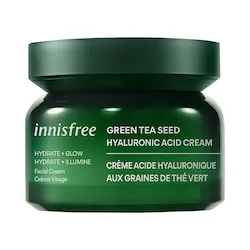
innisfree Green Tea Hyaluronic Acid Hydrating Moisturizer
Works for
MoisturizingPanthenol, Madecassoside + 27 moreWorks well
“Green Tea Hyaluronic Acid Hydrating Moisturizer”
This product can help improve hydration of the skin with the two types of ingredients.
The first type is called “humectants”:
these ingredients help attract water.
When humectants are on the surface of the skin, they “pull in” the moisture from the outside environment, or from
within deeper layers of the skin. The following ingredients in this product do the job:
camellia sinensis seed oil, glycerin.
This product also contains ingredients called “occlusives”. They help reduce the speed with which our skin loses moisture to the outside environment. These ingredients also help soften the upper layer of the skin, so it feels less tight and nicer to the touch. The following ingredients in this product do the job: squalane, camellia sinensis seed oil.
The following ingredients in this product are especially good for supporting the skin barrier and helping with the hydration level: ceramide np, madecassoside, panthenol, phytosphingosine
Anti-oxidationNot advertised by the brand · Madecassoside, Camellia sinensis seed oil + 2 moreWorks well
This product contains antioxidants (madecassoside) that can help neutralize free radicals in skin. By doing so, they can lessen the damage the skin gets from the UV light (sun).
Anti-agingNot advertised by the brand · Madecassoside, Camellia sinensis seed oil + 4 moreMay help
This product contains madecassoside. This ingredient might be able to help reduce and prevent fine lines and wrinkles, improve skin elasticity and firmness, but there is not enough evidence that it actually works.
Can it cause trouble?
Irritancy3 strong irritants: Parfum, Linalool + 1 more — patch-test recommendedHigh risk
Comedogenic2 ingredients rated 2 or more on the 0–5 pore-clogging scale2 flagged


User reviews
Be the first — your take helps the next person decide.
Ingredients
Filter by role to see what each ingredient is doing.
Water~45–55%
Propanediol~4.8–5.8%
- Irritation risk
- Low
Acts as a solvent for other ingredients. Speeds up the absorption of other ingredients into the skin
More about PropanediolGlycerin~3.9–4.7%
- Irritation risk
- Low
One of the best moisturizing ingredients. Naturally present in skin. It attracts water to the upper layer of the skin working as a humectant
More about GlycerinMethyl trimethicone~3.1–3.7%
- Irritation risk
- Low
A type of silicone that helps create a silky product finish and dissolve other ingredients
More about Methyl trimethiconeStearyl dimethicone~2.4–2.9%
- Irritation risk
- Low
Helps soften the upper layer of the skin
More about Stearyl dimethiconeButylene glycol dicaprylate/dicaprate~2–2.4%
- Irritation risk
- Low
Helps soften the upper layer of the skin
More about Butylene glycol dicaprylate/dicapratePentaerythrityl tetraethylhexanoate~1.7–2%
- Irritation risk
- Low
Used to create a nice product consistency while softening the upper layer of the skin
More about Pentaerythrityl tetraethylhexanoateCamellia sinensis seed oil~1.4–1.8%
- Irritation risk
- Low
A plant oil that helps to soften the upper layer of the skin and can help restore the skin barrier. Might have some anti-oxidant effect
More about Camellia sinensis seed oil1,2-hexanediol~0.7–1.05%
Glyceryl polymethacrylate~1–1.2%
- Irritation risk
- Low
Used to create a nice product texture
More about Glyceryl polymethacrylatePolymethylsilsesquioxane~0.75–1.15%
- Irritation risk
- Low
A silicone that improves product texture and helps dissolve other ingredients. Can form a non-greasy film on the skin to prevent moisture loss
More about PolymethylsilsesquioxaneTrehalose~0.6–0.9%
- Irritation risk
- Low
A sugar that attracts water to the upper layer of the skin
More about TrehaloseOctadecene~0.55–0.8%
- Irritation risk
- Low
Squalane~0.55–0.85%
- Irritation risk
- Low
An oil naturally present in skin. Works as an emollient to soften the skin and form a protective layer on its surface without a greasy feeling.
More about SqualaneHydroxyethyl acrylate/sodium acryloyldimethyl taurate copolymer~0.5–0.7%
- Irritation risk
- Medium
A gelling agent that thickens the product consistency and leaves the skin with a velvety finish
More about Hydroxyethyl acrylate/sodium acryloyldimethyl taurate copolymerPolyglyceryl-3 methylglucose distearate~0.5–0.75%
- Irritation risk
- Medium
Helps water and oil mix together
More about Polyglyceryl-3 methylglucose distearateCarbomer~0.45–0.7%
- Irritation risk
- Low
Helps create a thicker or gel-like product texture. It is not a surfactant but can be used in gentle cleansing formulations
More about CarbomerHydrogenated lecithin~0.45–0.7%
- Irritation risk
- Low
Helps to retain moisture by creating a protective barrier on the skin. Rich in fatty acids. Improves product texture and helps with the penetration of other ingredients.
More about Hydrogenated lecithinCholesterol~0.45–0.7%
- Irritation risk
- Low
An emollient that is naturally found in skin
More about CholesterolGlyceryl stearate~0.45–0.65%
- Irritation risk
- Low
An emollient that softens the skin and forms a protective layer on its surface. Helps water and oil mix together
More about Glyceryl stearateTromethamine~0.3–0.6%
Lactobacillus ferment lysate~0.3–0.55%
- Irritation risk
- Low
A "broth" with parts of dead cells of lactobacteria. Might be helpful supporting diverse microbiome in skin, but evidence is lacking
More about Lactobacillus ferment lysateParfum~0.25–0.5%
- Irritation risk
- High
An aromatic blend of unspecified and possibly irritating ingredients
More about ParfumHyaluronic acid~0.3–0.55%
- Irritation risk
- Low
One of the best moisturizing ingredients. Attracts water into the upper layer of the skin. Naturally present in skin. Typically has large molecule size unless advertised otherwise on the product label. Helps support skin's barrier function and may help to reduce inflammation
More about Hyaluronic acidPanthenol~0.3–0.55%
- Irritation risk
- Low
Helps attract water to the upper layer of the skin and can help improve skin barrier function
More about PanthenolAllantoin~0.25–0.5%
- Irritation risk
- Low
Helps calm down inflammation in skin and can help reduce itching. Helps to repair the skin barrier and keep skin hydrated
More about AllantoinCetearyl alcohol~0.35–0.65%
- Irritation risk
- Low
- Comedogenicity
- 2/5
A non-drying alcohol. Works as an emollient. Helps water and oil mix together and creates a nice product texture
More about Cetearyl alcoholXanthan gum~0.3–0.55%
- Irritation risk
- Low
Used to create a thicker product consistency
More about Xanthan gumGlyceryl caprylate~0.35–0.65%
- Irritation risk
- Low
An emollient that can also help water and oil mix together, as well as prevent bacteria growth in products
More about Glyceryl caprylateSodium stearoyl glutamate~0.35–0.65%
- Irritation risk
- Medium
Helps oil and water mix together
More about Sodium stearoyl glutamateButylene glycol~0.3–0.55%
- Irritation risk
- Low
Used to create a nice product texture and help delivery of other ingredients. Might be somewhat helpful in attracting water to the upper layer of the skin
More about Butylene glycolDisodium edta~0.3–0.55%
Ethylhexylglycerin~0.3–0.55%
Sorbitan isostearate~0.3–0.55%
- Irritation risk
- Low
Helps oil and water mix together
More about Sorbitan isostearateCamellia sinensis leaf extract~0.3–0.55%
- Irritation risk
- Low
Can contain potent anti-oxidant compounds (abbreviated ECG, GCG, EGC, and EGCG) that might help protect the skin from free radicals. Can help calm down inflammation and has some anti-bacterial properties. Unfortunately, these antioxidants are unstable and lose their effectiveness very quickly in products. The concentration of the antioxidant compounds in the extract also tends to be low to be effective in topical formulation
More about Camellia sinensis leaf extractLinalool~0.25–0.5%
Sodium hyaluronate~0.25–0.5%
- Irritation risk
- Low
One of the best moisturizing ingredients. Attracts water into the upper layer of the skin
More about Sodium hyaluronateLimonene~0.25–0.45%
- Irritation risk
- High
A common frangrance that can easily irritate skin, especially if exposed to air, light or heat
More about LimoneneMadecassoside~0.25–0.5%
- Irritation risk
- Medium
An antioxidant that is typically derived from plant Centella Asiatica. It can help neutralize free radicals in skin and support skin barrier function. It could, however, itself be irritating. It is often unstable in formulations
More about MadecassosideLactic acid~0.25–0.45%
- Irritation risk
- Medium
An exfoliating and moisturizing alpha-hydroxy acid (AHA). Typically causes less irritation than other AHAs, for example, glycolic acid. At high concentrations (about 15%), lactic acid can help reduce lines and wrinkles. Recent studies show that lactic acid can support the "good" bacteria living on skin's surface (healthy skin microbiome)
More about Lactic acidDextrin~0.25–0.45%
- Irritation risk
- Low
A sugar that is used to stabilize the product formulation. Can help attract water to the upper layer of the skin
More about DextrinTheobroma cacao extract~0.2–0.4%
- Irritation risk
- Low
- Comedogenicity
- 3/5
Camellia sinensis seed extract~0.15–0.3%
- Irritation risk
- Low
Hydrolyzed hyaluronic acid~0.15–0.3%
- Irritation risk
- Low
One of the best moisturizing ingredients. Attracts water into the upper layer of the skin. A version of it is naturally present in skin
More about Hydrolyzed hyaluronic acidCeramide np~0.2–0.35%
- Irritation risk
- Low
A type of lipid similar to ceramides naturally present in skin. Helps to soften the upper layer of the skin and supports the skin barrier function to keep it hydrated. Can help to prevent inflammation in skin
More about Ceramide npTocopherol~0.15–0.3%
- Irritation risk
- Low
Pure form of vitamin E. Can help moisturise and protect the skin from free radicals. Often used to help stabilise other ingredients or the formula itself
More about TocopherolSodium hyaluronate crosspolymer~0.15–0.25%
- Irritation risk
- Medium
Attracts water into the upper layer of the skin
More about Sodium hyaluronate crosspolymerPhytosphingosine~0.15–0.25%
- Irritation risk
- Low
A type of lipid that is naturally present in skin. It might help in repairing skin barrier function and has anti-bacterial effect
More about PhytosphingosineSodium acetylated hyaluronate~0.05–0.15%
- Irritation risk
- Low
A type of hyaluronic acid that works as an excellent moisturizer by attracting water into the upper layer of the skin. Is typically feels less sticky on the skin compared to the usual hyaluronic acid
More about Sodium acetylated hyaluronateIngredient list view
Water, Propanediol, Glycerin, Methyl trimethicone, Stearyl dimethicone, Butylene glycol dicaprylate/dicaprate, Pentaerythrityl tetraethylhexanoate, Camellia sinensis seed oil, 1,2-hexanediol, Glyceryl polymethacrylate, Polymethylsilsesquioxane, Trehalose, Octadecene, Squalane, Hydroxyethyl acrylate/sodium acryloyldimethyl taurate copolymer, Polyglyceryl-3 methylglucose distearate, Carbomer, Hydrogenated lecithin, Cholesterol, Glyceryl stearate, Tromethamine, Lactobacillus ferment lysate, Parfum, Hyaluronic acid, Panthenol, Allantoin, Cetearyl alcohol, Xanthan gum, Glyceryl caprylate, Sodium stearoyl glutamate, Butylene glycol, Disodium edta, Ethylhexylglycerin, Sorbitan isostearate, Camellia sinensis leaf extract, Linalool, Sodium hyaluronate, Limonene, Madecassoside, Lactic acid, Dextrin, Theobroma cacao extract, Camellia sinensis seed extract, Hydrolyzed hyaluronic acid, Ceramide np, Tocopherol, Sodium hyaluronate crosspolymer, Phytosphingosine, Sodium acetylated hyaluronate
Compare prices
Retailers ranked by price — lowest first.
Affiliate links · As an Amazon Associate, WIMJ earns from qualifying purchases.
Worth comparing, line by line.
Match % combines shared ingredients, the first five ingredients, shared actives and hero ingredients, irritancy (lower counts in the alternative's favour), texture and body area. Only products in the same routine step are compared.
| innisfreeGreen Tea Hyaluronic Acid Hydrating MoisturizerYOUR PRODUCT | YUMUCica Exosome Blemish Relief Cream | AbibGlutathiosome Creme Vita Tube 75ml | mixsoonMaster Repair Cream Deep Soothing | |
|---|---|---|---|---|
| Match | — | 52% | 52% | 51% |
| Price | — | $24.00 | $14.01 | $42.00 |
| Shared key ingredients | — | 11 of 19 | 12 of 19 | 9 of 19 |
| Key difference | — | Niacinamide | Niacinamide | Dimethicone |
| Irritancy | High | Medium | Medium | Medium |
| Drying alcohol | — | — | — | — |
| View product | Shop | Shop | Shop |


More alternatives: Dr Sam's Flawless Moisturiser IntenseVT Cosmetics VT PDRN Cream 100
Product summary
Based on the ingredient list, "innisfree - Green Tea Hyaluronic Acid Hydrating Moisturizer" can work well for skin moisturization. As we expect from a proper moisturizer, the formula includes a combo of effective humectants and emollients. These are the two different types of ingredients that are essential for improving the skin hydration and supporting a healthy skin barrier. Humectants in this product (panthenol, camellia sinensis seed oil, glycerin, hyaluronic acid and hydrolyzed hyaluronic acid) help to increase the water content in the upper layer of the skin. (These ingredients do so by "capturing" water molecules from the outside air or from within the deeper layers of the skin). Emollients in this formulation (ceramide np, phytosphingosine, camellia sinensis seed oil, cholesterol and stearyl dimethicone) help to reduce the moisture loss from the skin. They also soften the skin surface and relieve the feeling of dryness and tightness.
Ingredient callouts
- As a plus, this moisturizer also contains Ceramides (phytosphingosine 0.15% - 0.25% and ceramide np 0.20% - 0.35%). Ceramides are a type of lipids that our skin produces itself. They are a building block of the skin's barrier. Ceramides used in skincare are synthetic or extracted from plants. They work well for softening the skin surface and "patch holes" in the skin's barrier.
- Actives derived from an extract of the Centella Asiatica plant (also known as Gotu Kola) - madecassoside 0.25% - 0.50% The Centella Asiatica Actives help strengthen and restore the skin barrier, decrease inflammation in skin and neutralize free radicals. They also can help to reduce scarring. The good news is that these actives work even in low concentrations.
Irritation risk
This moisturizer contains some common irritants, including those without a benefit for the skin. We assess the overall irritancy of this moisturizer to be high. For a detailed overview of all potential irritants: click here
You can see the detailed formula review with the breakdown of all actives in the product and the full ingredient list with estimated concentrations in the tables below.
Price
The product retails for 130.00A$ in Australia, for 29.00$ in the United States and for 39.00CA$ in Canada.
For a detailed price comparison: click here.
Sources cited in this review
Every concentration estimate and effectiveness label is anchored to one of these 26 studies and safety reviews.
- 1
- 2Safety Assessment of Pentaerythrityl Tetraesters as Used in Cosmeticsjournals.sagepub.com
- 3
- 4
- 5Safety Assessment of Tromethamine as Used in Cosmeticscir-safety.org
- 6Efficacy of a New Topical Nano-hyaluronic Acid in Humansncbi.nlm.nih.gov

Affiliate links · As an Amazon Associate, WIMJ earns from qualifying purchases.