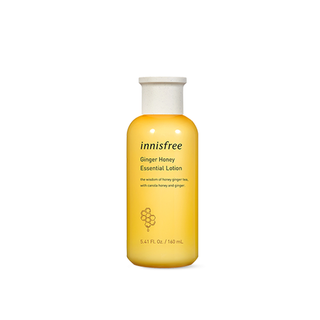
innisfree Ginger Honey Essential Lotion
Works for
1 of 1 advertised claim delivered
MoisturizingGlycerin, Butyrospermum parkii butter + 14 moreGood evidence
“Ginger Honey Essential Lotion”
This product can help improve hydration of the skin with the two types of ingredients.
The first type is called “humectants”:
these ingredients help attract water.
When humectants are on the surface of the skin, they “pull in” the moisture from the outside environment, or from
within deeper layers of the skin. The following ingredients in this product do the job:
glycerin, honey extract.
This product also contains ingredients called “occlusives”. They help reduce the speed with which our skin loses moisture to the outside environment. These ingredients also help soften the upper layer of the skin, so it feels less tight and nicer to the touch. The following ingredients in this product do the job: butyrospermum parkii butter, dimethicone.
Can it cause trouble?
Irritancy5 strong irritants: Zingiber officinale root extract, Parfum + 3 more — patch-test recommendedHigh risk
Comedogenic5 ingredients rated 2 or more on the 0–5 pore-clogging scale5 flagged
User reviews
Be the first — your take helps the next person decide.
Ingredients
Filter by role to see what each ingredient is doing.
Honey extract~25–31%
- Irritation risk
- Medium
Helps attract water to the upper layer of the skin
More about Honey extractZingiber officinale root extract~11–14%
- Irritation risk
- High
A plant extract that can contain an irritating essential oil. Might have some anti-oxidant effect, but evidence is lacking
More about Zingiber officinale root extractWater~6.1–7.5%
Glycerin~4.5–5.5%
- Irritation risk
- Low
One of the best moisturizing ingredients. Naturally present in skin. It attracts water to the upper layer of the skin working as a humectant
More about GlycerinPropanediol~3.8–4.6%
- Irritation risk
- Low
Acts as a solvent for other ingredients. Speeds up the absorption of other ingredients into the skin
More about PropanediolHydrogenated poly(c6-14 olefin)~3.1–3.8%
- Irritation risk
- Low
Helps soften the upper layer of the skin and create a nice product texture
More about Hydrogenated poly(c6-14 olefin)Butylene glycol~2.4–3%
- Irritation risk
- Low
Used to create a nice product texture and help delivery of other ingredients. Might be somewhat helpful in attracting water to the upper layer of the skin
More about Butylene glycolPentaerythrityl tetraethylhexanoate~2–2.5%
- Irritation risk
- Low
Used to create a nice product consistency while softening the upper layer of the skin
More about Pentaerythrityl tetraethylhexanoateDimethicone~1.7–2.1%
- Irritation risk
- Low
A silicone that helps to reduce water loss from the surface of the skin. Can temporarily "fill in" lines and wrinkles, absorb oil, and create a nice product finish
More about DimethiconeHoney extract~1.2–1.4%
- Irritation risk
- Medium
Helps attract water to the upper layer of the skin
More about Honey extractButyrospermum parkii butter~1.1–1.3%
- Irritation risk
- Low
- Comedogenicity
- 3/5
A great moisturising ingredient that softens the skin and reduces water loss from its upper layer. It also can be helpful in protecting skin from free radicals
More about Butyrospermum parkii butterPolyglyceryl-3 methylglucose distearate~0.95–1.15%
- Irritation risk
- Medium
Helps water and oil mix together
More about Polyglyceryl-3 methylglucose distearateGlyceryl stearate~0.95–1.15%
- Irritation risk
- Low
An emollient that softens the skin and forms a protective layer on its surface. Helps water and oil mix together
More about Glyceryl stearateCetearyl alcohol~1–1.2%
- Irritation risk
- Low
- Comedogenicity
- 2/5
A non-drying alcohol. Works as an emollient. Helps water and oil mix together and creates a nice product texture
More about Cetearyl alcoholGlyceryl stearate citrate~0.8–1.15%
- Irritation risk
- Low
Helps oil and water mix together while softening the upper layer of the skin
More about Glyceryl stearate citrateHydrogenated vegetable oil~0.75–1.15%
- Irritation risk
- Low
- Comedogenicity
- 2/5
An oil from a mixture of different vegetables. Helps soften the upper layer of the skin
More about Hydrogenated vegetable oilPhenoxyethanol~0.5–1%
- Irritation risk
- Low
A preservative. It helps prevent bacterial growth in cosmetic products
More about PhenoxyethanolSodium polyacrylate~0.75–1.15%
- Irritation risk
- Low
Used to create a gel-like product texture, as well as to stabilize emulsions
More about Sodium polyacrylateDimethicone/vinyl dimethicone crosspolymer~0.6–0.85%
- Irritation risk
- Low
Used to stabilize product formulations and create a nice product texture
More about Dimethicone/vinyl dimethicone crosspolymerStearic acid~0.7–1.05%
- Irritation risk
- Low
Helps oil and water mix together and works as an emollient
More about Stearic acidPalmitic acid~0.65–0.95%
- Irritation risk
- Low
An emollient that is naturally present in skin and helps soften it
More about Palmitic acidParfum~0.5–0.7%
- Irritation risk
- High
An aromatic blend of unspecified and possibly irritating ingredients
More about ParfumHydrogenated polydecene~0.45–0.65%
- Irritation risk
- Low
Helps to soften the upper layer of the skin and create a nice product texture
More about Hydrogenated polydeceneLimnanthes alba seed oil~0.5–0.7%
- Irritation risk
- Low
This oil's cmposition is closest to rapeseed oil. It is a very stable oil and serves as an emoillient
More about Limnanthes alba seed oilXanthan gum~0.45–0.65%
- Irritation risk
- Low
Used to create a thicker product consistency
More about Xanthan gumCarbomer~0.35–0.65%
- Irritation risk
- Low
Helps create a thicker or gel-like product texture. It is not a surfactant but can be used in gentle cleansing formulations
More about CarbomerDisodium edta~0.45–0.65%
Ethylhexylglycerin~0.45–0.65%
Tromethamine~0.4–0.65%
Zingiber officinale root extract~0.3–0.5%
- Irritation risk
- High
A plant extract that can contain an irritating essential oil. Might have some anti-oxidant effect, but evidence is lacking
More about Zingiber officinale root extractPpg-5-laureth-5~0.5–0.75%
Linalool~0.2–0.4%
Limonene~0.15–0.3%
- Irritation risk
- High
A common frangrance that can easily irritate skin, especially if exposed to air, light or heat
More about LimoneneBrassica napus seed oil~0.25–0.45%
- Irritation risk
- Low
Myristic acid~0.2–0.35%
- Irritation risk
- Medium
- Comedogenicity
- 3/5
Helps oil and water mix together. Could be comedogenic
More about Myristic acidGeraniol~0.05–0.1%
Lauric acid~0.15–0.3%
- Irritation risk
- Medium
- Comedogenicity
- 3/5
Helps water and oil mix together. Has anti-bacterial properties that might be helpful in preventing blemishes
More about Lauric acidTocopherol~0.1–0.15%
- Irritation risk
- Low
Pure form of vitamin E. Can help moisturise and protect the skin from free radicals. Often used to help stabilise other ingredients or the formula itself
More about TocopherolIngredient list view
Unknown, Honey extract, Zingiber officinale root extract, Water, Glycerin, Propanediol, Hydrogenated poly(c6-14 olefin), Butylene glycol, Pentaerythrityl tetraethylhexanoate, Dimethicone, Honey extract, Butyrospermum parkii butter, Polyglyceryl-3 methylglucose distearate, Glyceryl stearate, Cetearyl alcohol, Glyceryl stearate citrate, Hydrogenated vegetable oil, Phenoxyethanol, Sodium polyacrylate, Dimethicone/vinyl dimethicone crosspolymer, Stearic acid, Palmitic acid, Parfum, Hydrogenated polydecene, Limnanthes alba seed oil, Xanthan gum, Carbomer, Disodium edta, Ethylhexylglycerin, Tromethamine, Zingiber officinale root extract, Ppg-5-laureth-5, Linalool, Limonene, Brassica napus seed oil, Myristic acid, Geraniol, Lauric acid, Tocopherol
Compare prices
Retailers ranked by price — lowest first.
Sources cited in this review
Every concentration estimate and effectiveness label is anchored to one of these 11 studies and safety reviews.
- 1
- 2
- 3Safety Assessment of Pentaerythrityl Tetraesters as Used in Cosmeticsjournals.sagepub.com
- 4
- 5Final Report on the Safety Assessment of Dimethicone Copolyoljournals.sagepub.com
- 6Safety Assessment of Polyene Group as Used in Cosmeticscir-safety.org

Affiliate links · As an Amazon Associate, WIMJ earns from qualifying purchases.