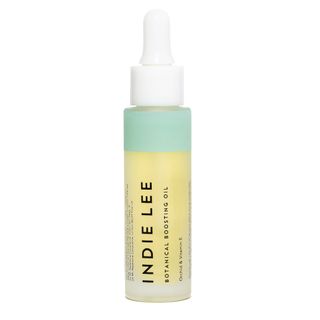
Works for
1 of 2 advertised claims delivered
Moisturizing17 ingredients credited for this claimGood support
“Orchid extract pairs with Avocado, Rosehip and Squalane oils to lock in moisture with a lightning-fast dry down.”
This product can help soften the skin and reduce its moisture loss with emollients and occlusives: caprylic/capric triglyceride, simmondsia chinensis seed oil.
Keep in mind that this product does not contain effective ingredients to attract water to the upper layer of the skin. This is why an additional product with humectants like glycerin or hyaluronic acid can be helpful (apply it before this product for the best results).
Evens skin toneNo ingredient credited for this claimNo support
“Vitamin E evens skin tone and protects from environmental stressors while Malic Acid brightens and smooths for velvety skin.”
Effective ingredients missing or their concentration is too low
Anti-oxidationNot advertised by the brand · 6 ingredients credited for this claimModerate support
This product contains antioxidants (vaccinium macrocarpon seed oil) that might be able to help neutralize free radicals in skin to lessen the damage it gets from the UV light (sun). There is not enough evidence to confirm their effectiveness in skin though.
Can it cause trouble?
Irritancy8 strong irritants: Balanites roxburghii seed oil, Pelargonium graveolens flower oil + 6 more — patch-test recommendedHigh risk
Comedogenic2 ingredients rated 2 or more on the 0–5 pore-clogging scale2 flagged
User reviews
Be the first — your take helps the next person decide.
Ingredients
Filter by role to see what each ingredient is doing.
Squalane~25–37%
- Irritation risk
- Low
An oil naturally present in skin. Works as an emollient to soften the skin and form a protective layer on its surface without a greasy feeling.
More about SqualaneCoconut alkanes~6.7–10.1%
- Irritation risk
- Medium
- Comedogenicity
- 2/5
An emollient that helps soften the skin
More about Coconut alkanesEthylhexyl palmitate~4.7–7%
- Irritation risk
- Low
- Comedogenicity
- 3/5
An emollient that helps soften the skin and create a nice product texture
More about Ethylhexyl palmitateSimmondsia chinensis seed oil~3.6–5.3%
- Irritation risk
- Medium
Softens the upper layer of skin and helps restore the healthy skin barrier. Has shown to help calm down inflammation in skin. It is a stable oil, meaning that it retains its properties even when exposed to air.
More about Simmondsia chinensis seed oilJojoba esters~2.4–3.6%
- Irritation risk
- Medium
An emollient made of jojoba oil. Helps soften the skin and support its barrier function
More about Jojoba estersEthyl macadamiate~1.9–2.9%
Caprylic/capric triglyceride~1.8–2.7%
- Irritation risk
- Medium
A good mix of fatty acids that forms a protective layer on the skin. Improves the shelf life of products. Derived from coconut and glycerin
More about Caprylic/capric triglycerideCoco-caprylate/caprate~1.4–2.1%
- Irritation risk
- Low
Helps to soften the upper layer of the skin without creating a greasy texture
More about Coco-caprylate/caprateTocopherol~1–1.5%
- Irritation risk
- Low
Pure form of vitamin E. Can help moisturise and protect the skin from free radicals. Often used to help stabilise other ingredients or the formula itself
More about TocopherolLinum usitatissimum seed oil~0.8–1.25%
Persea gratissima oil~0.6–1.35%
- Irritation risk
- Medium
An emollient that helps soften the skin and could be helpful in repairing its barrier function
More about Persea gratissima oilPrunus armeniaca kernel oil~0.5–1.15%
- Irritation risk
- Medium
An emollient that helps soften the skin
More about Prunus armeniaca kernel oilRibes nigrum seed oil~0.45–1.05%
- Irritation risk
- Medium
An emollient. Can be helpful for restoring skin barrier function.
More about Ribes nigrum seed oilRosa canina fruit oil~0.4–0.95%
- Irritation risk
- Medium
A great emollient. Contains vitamin E (tocopherol) which may give it some anti-oxidant properties. Can contain volatile compounds and can be irritating
More about Rosa canina fruit oilSalvia hispanica seed oil~0.4–0.9%
- Irritation risk
- Low
Chia seed oil. Helps to soften the upper layer of the skin and might be helpful in repairing skin barrier
More about Salvia hispanica seed oilVaccinium macrocarpon seed oil~0.4–0.9%
- Irritation risk
- Medium
A plant oil that can help neutralize free radicals, soften the upper layer of the skin, and support skin's barrier function
More about Vaccinium macrocarpon seed oilBalanites roxburghii seed oil~0.3–0.75%
- Irritation risk
- High
An emollient. Could be irritating
More about Balanites roxburghii seed oilMalic acid~0.2–0.75%
Curcuma longa root extract~0.15–0.55%
- Irritation risk
- High
A plant extract that can contain an active compound curcumin, that may have some anti-inflammatory properties when applied to the skin, but solid research is lacking and the typical concentration used in skincare products is too low. Can be an irritant
More about Curcuma longa root extractPelargonium graveolens flower oil~0.15–0.6%
- Irritation risk
- High
An essential oil. Can be irritating. Can become an allergen with oxidation
More about Pelargonium graveolens flower oilCitrus aurantium bergamia peel oil~0.15–0.55%
- Irritation risk
- High
Cymbidium grandiflorum flower extract~0.15–0.6%
- Irritation risk
- Low
Brassica oleracea italica seed oil~0.15–0.7%
- Irritation risk
- Medium
A plant seed oil that consists mainly of erucic acid and used to help soften the upper layer of the skin. This fatty acid can enhance penetration of other ingredients into the skin but it is not a good moisturizer on its own
More about Brassica oleracea italica seed oilCitral~0.1–0.35%
Citronellol~0.1–0.35%
Geraniol~0.05–0.3%
Linalool~0.05–0.25%
Limonene~0.05–0.2%
- Irritation risk
- High
A common frangrance that can easily irritate skin, especially if exposed to air, light or heat
More about LimoneneIngredient list view
Squalane, Coconut alkanes, Ethylhexyl palmitate, Simmondsia chinensis seed oil, Jojoba esters, Ethyl macadamiate, Caprylic/capric triglyceride, Coco-caprylate/caprate, Tocopherol, Linum usitatissimum seed oil, Persea gratissima oil, Prunus armeniaca kernel oil, Ribes nigrum seed oil, Rosa canina fruit oil, Salvia hispanica seed oil, Vaccinium macrocarpon seed oil, Balanites roxburghii seed oil, Malic acid, Curcuma longa root extract, Pelargonium graveolens flower oil, Citrus aurantium bergamia peel oil, Cymbidium grandiflorum flower extract, Brassica oleracea italica seed oil, Citral, Citronellol, Geraniol, Linalool, Limonene
Compare prices
Retailers ranked by price — lowest first.


Sources cited in this review
Every concentration estimate and effectiveness label is anchored to one of these 9 studies and safety reviews.
- 1Safety Assessment of Alkyl Esters as Used in Cosmeticscir-safety.org
- 2Vitamin E in dermatologyncbi.nlm.nih.gov
- 3Vitamin E and Skin Healthlpi.oregonstate.edu
- 4Wound‐healing Properties of the Oils of Vitis vinifera and Vaccinium macrocarpononlinelibrary.wiley.com
- 5
- 6

Affiliate links · As an Amazon Associate, WIMJ earns from qualifying purchases.