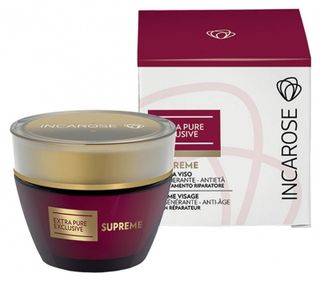
Incarose Extra Pure Exclusive Supremer Anti-Age Regenerating Face Cream
Works for
2 of 2 advertised claims delivered
Moisturizing21 ingredients credited for this claimStrong support
“Extra Pure Exclusive Supremer Anti-Age Regenerating Face Cream”
This product can help improve hydration of the skin with the two types of ingredients.
The first type is called “humectants”:
these ingredients help attract water.
When humectants are on the surface of the skin, they “pull in” the moisture from the outside environment, or from
within deeper layers of the skin. The following ingredients in this product do the job:
carnosine, sodium hyaluronate.
This product also contains ingredients called “occlusives”. They help reduce the speed with which our skin loses moisture to the outside environment. These ingredients also help soften the upper layer of the skin, so it feels less tight and nicer to the touch. The following ingredients in this product do the job: dimethicone, helianthus annuus seed oil.
The following ingredients in this product are especially good for supporting the skin barrier and helping with the hydration level: ceramide ap, ceramide eop, ceramide np, phytosphingosine
Anti-aging5 ingredients credited for this claimModerate support
“Extra Pure Exclusive Supremer Anti-Age Regenerating Face Cream”
This product contains carnosine. This ingredient might be able to help reduce and prevent fine lines and wrinkles, improve skin elasticity and firmness, but there is not enough evidence that it actually works.
Anti-oxidationNot advertised by the brand · 5 ingredients credited for this claimStrong support
This product contains antioxidants (carnosine) that can help neutralize free radicals in skin. By doing so, they can lessen the damage the skin gets from the UV light (sun).
Anti-blemishNot advertised by the brand · 2 ingredients credited for this claimGood support
This product might be able to help reduce blemishes and clogged pores because it contains ethyl linoleate.
Can it cause trouble?
Irritancy1 strong irritant: ParfumMedium risk
Comedogenic1 ingredient rated 2 or more on the 0–5 pore-clogging scale1 flagged


User reviews
Be the first — your take helps the next person decide.
Ingredients
Filter by role to see what each ingredient is doing.
Water~45–55%
Cetearyl isononanoate~4.3–5.2%
- Irritation risk
- Low
An emollient that softens the skin and helps prevent moisture loss.
More about Cetearyl isononanoateButyrospermum parkii oil~4.4–5.4%
- Irritation risk
- Low
- Comedogenicity
- 3/5
Hydroxyethyl acrylate/sodium acryloyldimethyl taurate copolymer~3.2–3.9%
- Irritation risk
- Medium
A gelling agent that thickens the product consistency and leaves the skin with a velvety finish
More about Hydroxyethyl acrylate/sodium acryloyldimethyl taurate copolymerEthylhexyl stearate~2.4–3%
- Irritation risk
- Low
Helps soften the upper layer of the skin
More about Ethylhexyl stearateDimethicone~2.1–2.6%
- Irritation risk
- Low
A silicone that helps to reduce water loss from the surface of the skin. Can temporarily "fill in" lines and wrinkles, absorb oil, and create a nice product finish
More about DimethiconeIsohexadecane~1.8–2.2%
- Irritation risk
- Low
Improves the texture of the product and helps soften the skin. Helps oil and water mix together and can be used as a cleansing agent
More about IsohexadecanePhenoxyethanol~0.5–1%
- Irritation risk
- Low
A preservative. It helps prevent bacterial growth in cosmetic products
More about PhenoxyethanolCarnosine~1.2–1.4%
- Irritation risk
- Low
A type of peptide. It attracts water to the upper layer of the skin. It can help neutralize free radicals in skin combatting the sun damage
More about CarnosineArgania spinosa kernel oil~1–1.2%
- Irritation risk
- Medium
An emollient that helps soften the upper layer of the skin. Might have some weak anti-oxidant properties
More about Argania spinosa kernel oilParfum~0.65–1%
- Irritation risk
- High
An aromatic blend of unspecified and possibly irritating ingredients
More about ParfumAmmonium acryloyldimethyltaurate/vp copolymer~0.6–0.85%
- Irritation risk
- Low
Increases thickness of a product. Texture enhancer for oil-in-water emulsions
More about Ammonium acryloyldimethyltaurate/vp copolymerSodium hyaluronate~0.5–0.75%
- Irritation risk
- Low
One of the best moisturizing ingredients. Attracts water into the upper layer of the skin
More about Sodium hyaluronateHelianthus annuus seed oil~0.5–0.75%
- Irritation risk
- Low
A great emollient due to its high linoleic acid content. One of the most effective plant oils in helping skin hydration and repairing skin barrier function
More about Helianthus annuus seed oilSodium dehydroacetate~0.3–0.6%
Macadamia ternifolia seed oil~0.45–0.7%
- Irritation risk
- Medium
Plant oil from nuts that helps soften the upper layer of the skin. Contains a high concentration of oleic acid that can weaken skin's barrier function and increase water-loss while enhancing penetration of other ingredients
More about Macadamia ternifolia seed oilSodium lauroyl lactylate~0.45–0.65%
- Irritation risk
- Medium
Helps water and oil mix together
More about Sodium lauroyl lactylateBenzoic acid~0.25–0.5%
Lecithin~0.4–0.6%
- Irritation risk
- Low
Used mostly for creating emulsions - helping oil and water mix together. Helps soften the upper layer of the skin
More about LecithinGlyceryl linoleate~0.35–0.65%
- Irritation risk
- Medium
Helps oil and water mix together
More about Glyceryl linoleateEthyl linoleate~0.3–0.55%
- Irritation risk
- Medium
Helps reduce acne and blemishes. Helps to soften the upper layer of the skin and reduce inflammation. Might be helpful in reducing hyperpigmentation and evening out the skin tone, but evidence of effectiveness in skin are lacking
More about Ethyl linoleateDehydroacetic acid~0.25–0.5%
Glyceryl oleate~0.3–0.5%
- Irritation risk
- High
Helps oil and water mix together. Can be irritating
More about Glyceryl oleateEthyl oleate~0.25–0.5%
- Irritation risk
- Medium
Ethyl oleate is a long-chain fatty acid ethyl ester resulting from the formal condensation of the carboxy group of oleic acid with the hydroxy group of ethanol. It derives from an oleic acid. In skincare, it is used to soften the upper layer of the skin, improve the product texture and smell
More about Ethyl oleateEthyl linoleate~0.25–0.5%
- Irritation risk
- Medium
Helps reduce acne and blemishes. Helps to soften the upper layer of the skin and reduce inflammation. Might be helpful in reducing hyperpigmentation and evening out the skin tone, but evidence of effectiveness in skin are lacking
More about Ethyl linoleateEthyl linolenate~0.3–0.55%
- Irritation risk
- Low
Lactic acid~0.25–0.45%
- Irritation risk
- Medium
An exfoliating and moisturizing alpha-hydroxy acid (AHA). Typically causes less irritation than other AHAs, for example, glycolic acid. At high concentrations (about 15%), lactic acid can help reduce lines and wrinkles. Recent studies show that lactic acid can support the "good" bacteria living on skin's surface (healthy skin microbiome)
More about Lactic acidLupinus albus seed extract~0.25–0.45%
- Irritation risk
- Medium
A plant extract that helps soften the upper layer of the skin
More about Lupinus albus seed extractTocopherol~0.25–0.45%
- Irritation risk
- Low
Pure form of vitamin E. Can help moisturise and protect the skin from free radicals. Often used to help stabilise other ingredients or the formula itself
More about TocopherolCeramide np~0.3–0.5%
- Irritation risk
- Low
A type of lipid similar to ceramides naturally present in skin. Helps to soften the upper layer of the skin and supports the skin barrier function to keep it hydrated. Can help to prevent inflammation in skin
More about Ceramide npAscorbyl palmitate~0.25–0.4%
- Irritation risk
- Medium
Being a lipid soluble form of vitamin C, it is more stable and can penetrate the skin better than L-Ascorbic acid. It is effective in protecting the skin from free radicals, as well as evening the skin tone, but is less effective in stimulating collagen production compared to L-Ascorbic acid.
More about Ascorbyl palmitateEthylhexylglycerin~0.2–0.4%
Polyaminopropyl biguanide~0.15–0.3%
- Irritation risk
- High
A preservative. There seem to be an increasing number of cases of allergic reactions to it
More about Polyaminopropyl biguanideVitis vinifera fruit meristem cell culture~0.2–0.4%
- Irritation risk
- Low
Phytosphingosine~0.25–0.45%
- Irritation risk
- Low
A type of lipid that is naturally present in skin. It might help in repairing skin barrier function and has anti-bacterial effect
More about PhytosphingosineCeramide ap~0.15–0.3%
- Irritation risk
- Low
A type of lipid similar to ceramides naturally present in skin. Helps to soften the upper layer of the skin and supports the skin barrier function to keep it hydrated. Can help to prevent inflammation in skin
More about Ceramide apCholesterol~0.2–0.35%
- Irritation risk
- Low
An emollient that is naturally found in skin
More about CholesterolXanthan gum~0.15–0.25%
- Irritation risk
- Low
Used to create a thicker product consistency
More about Xanthan gumGlyceryl linolenate~0.15–0.3%
- Irritation risk
- Low
Helps soften the upper layer of the skin
More about Glyceryl linolenateCitric acid~0.05–0.1%
- Irritation risk
- Medium
Can work as an exfoliant but is typically used to adjust the product pH
More about Citric acidCeramide eop~0.15–0.25%
- Irritation risk
- Low
A type of lipid similar to ceramides naturally present in skin. Helps to soften the upper layer of the skin and supports the skin barrier function to keep it hydrated. Can help to prevent inflammation in skin
More about Ceramide eopIngredient list view
Water, Cetearyl isononanoate, Butyrospermum parkii oil, Hydroxyethyl acrylate/sodium acryloyldimethyl taurate copolymer, Ethylhexyl stearate, Dimethicone, Isohexadecane, Phenoxyethanol, Carnosine, Argania spinosa kernel oil, Parfum, Ammonium acryloyldimethyltaurate/vp copolymer, Sodium hyaluronate, Helianthus annuus seed oil, Sodium dehydroacetate, Macadamia ternifolia seed oil, Sodium lauroyl lactylate, Benzoic acid, Lecithin, Glyceryl linoleate, Ethyl linoleate, Dehydroacetic acid, Glyceryl oleate, Ethyl oleate, Ethyl linoleate, Ethyl linolenate, Lactic acid, Lupinus albus seed extract, Tocopherol, Ceramide np, Ascorbyl palmitate, Ethylhexylglycerin, Polyaminopropyl biguanide, Vitis vinifera fruit meristem cell culture, Phytosphingosine, Ceramide ap, Cholesterol, Xanthan gum, Glyceryl linolenate, Citric acid, Ceramide eop
Compare prices
Retailers ranked by price — lowest first.
Affiliate links · prices updated regularly · As an Amazon Associate, WIMJ earns from qualifying purchases.
Worth comparing, line by line.
Match % combines shared ingredients, the first five ingredients, shared actives and hero ingredients, irritancy (lower counts in the alternative's favour), texture and body area. Only products in the same routine step are compared.
| IncaroseExtra Pure Exclusive Supremer Anti-Age Regenerating Face CreamYOUR PRODUCT | RilastilAcnestil Attiva Cream | DR. JETSKE ULTEERepair Cream | CeraVeMoisturizing Cream | |
|---|---|---|---|---|
| Match | — | 55% | 54% | 54% |
| Price | $34.01 | $24.44−$9.57 | — | $4.00−$30.01 |
| Shared key ingredients | — | 9 of 14 | 7 of 14 | 7 of 14 |
| Key difference | — | Niacinamide | Ceramide Ns | Petrolatum |
| Irritancy | Medium | Low | Low | Low |
| Drying alcohol | — | — | — | — |
| View product | Shop | Shop | Shop |


Product summary
Judging from the ingredient list, "Incarose - Extra Pure Exclusive Supremer Anti-Age Regenerating Face Cream" works well for improving skin hydration To work well, any moisturizer needs to include a combination of water-binding and emollient ingredients. Incarose - Extra Pure Exclusive Supremer Anti-Age Regenerating Face Cream ticks this box. Carnosine and sodium hyaluronate in this product (humectants) attract water molecules to the upper layer of the skin (the water comes from the outside air or from the deeper layers of the skin if the air is dry). Ceramide eop, ceramide np, phytosphingosine, argania spinosa kernel oil and butyrospermum parkii oil in this product help decrease the water evoporation from the skin, so that it stays hydrated for longer. These ingredients also soften the skin and take away the feeling of tightness and dryness.
Ingredient callouts
- Another benefit is that this moisturizer contain ceramides (ceramide eop 0.15% - 0.25%, ceramide ap 0.15% - 0.30%, phytosphingosine 0.25% - 0.45% and ceramide np 0.30% - 0.50%). Ceramides are an important part of our natural skin barrier. The Ceramides used in skincare are synthetic or come from plants. They help soften the skin and can help "fill the gaps" in the skin barrier, keeping the skin hydrated and resilient for longer.
Irritation risk
This moisturizer contains some common irritants, including those without a benefit for the skin. We assess the overall irritancy of this moisturizer to be medium. For a detailed overview of all potential irritants: click here
You can see the detailed formula review with the breakdown of all actives in the product and the full ingredient list with estimated concentrations in the tables below.
Price
The product retails for 97.85$ in the United States and from 25.48£ up to 32.10£ in the United Kingdom.
For a detailed price comparison: click here.
Sources cited in this review
Every concentration estimate and effectiveness label is anchored to one of these 23 studies and safety reviews.
- 1
- 2Final Report on the Safety Assessment of Dimethicone Copolyoljournals.sagepub.com
- 3
- 4
- 5Hyaluronic acid: A key molecule in skin agingncbi.nlm.nih.gov
- 6

Affiliate links · As an Amazon Associate, WIMJ earns from qualifying purchases.