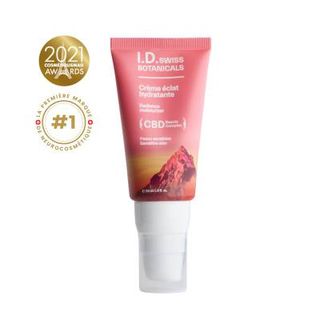
I.D. Swiss Botanicals Radiance Moisturizer Rich in Vitamin C Vitamin E
Works for
1 of 2 advertised claims delivered
Moisturizing16 ingredients credited for this claimGood evidence
“Radiance Moisturizer Rich in Vitamin C Vitamin E”
This product can help improve hydration of the skin with the two types of ingredients.
The first type is called “humectants”:
these ingredients help attract water.
When humectants are on the surface of the skin, they “pull in” the moisture from the outside environment, or from
within deeper layers of the skin. The following ingredients in this product do the job:
arginine, glycerin.
This product also contains ingredients called “occlusives”. They help reduce the speed with which our skin loses moisture to the outside environment. These ingredients also help soften the upper layer of the skin, so it feels less tight and nicer to the touch. The following ingredients in this product do the job: arginine, butyrospermum parkii butter.
Anti-aging4 ingredients credited for this claimLimited evidence
“The daily use will have a relaxing effect and contribute to lowering 28% of wrinkles.”
This product does not contain ingredients that are able to reduce fine lines and wrinkles or help with skin elasticity, but it can improve the look of the skin temporarily through moisturization. Well-moisturized skin might also be able to repair the sun damage better.This ingredient - butyrospermum parkii butter - could be helpful for preventing or repairing signs of aging in theory, but there is no evidence that it actually works.
Can it cause trouble?
Irritancy4 strong irritants: Parfum, Alcohol + 2 more — patch-test recommendedHigh risk
Comedogenic2 ingredients rated 2 or more on the 0–5 pore-clogging scale2 flagged
User reviews
Be the first — your take helps the next person decide.
Ingredients
Filter by role to see what each ingredient is doing.
Water~40–60%
Glycerin~4.1–6.1%
- Irritation risk
- Low
One of the best moisturizing ingredients. Naturally present in skin. It attracts water to the upper layer of the skin working as a humectant
More about GlycerinButyrospermum parkii butter~3.7–5.6%
- Irritation risk
- Low
- Comedogenicity
- 3/5
A great moisturising ingredient that softens the skin and reduces water loss from its upper layer. It also can be helpful in protecting skin from free radicals
More about Butyrospermum parkii butterC15-19 alkane~2.7–4.1%
- Irritation risk
- Low
Helps soften the upper layer of the skin and create a nice product texture
More about C15-19 alkanePropanediol~2.1–3.1%
- Irritation risk
- Low
Acts as a solvent for other ingredients. Speeds up the absorption of other ingredients into the skin
More about PropanediolPentylene glycol~1.7–2.6%
- Irritation risk
- Medium
Used to preserve products, dissolve other ingredients and create a nice product texture
More about Pentylene glycolGlyceryl stearate~1.5–2.2%
- Irritation risk
- Low
An emollient that softens the skin and forms a protective layer on its surface. Helps water and oil mix together
More about Glyceryl stearateSodium stearoyl glutamate~1.3–2%
- Irritation risk
- Medium
Helps oil and water mix together
More about Sodium stearoyl glutamateXanthan gum~1.1–1.6%
- Irritation risk
- Low
Used to create a thicker product consistency
More about Xanthan gumGlyceryl stearate citrate~0.9–1.35%
- Irritation risk
- Low
Helps oil and water mix together while softening the upper layer of the skin
More about Glyceryl stearate citrateGlyceryl caprylate~0.55–1.3%
- Irritation risk
- Low
An emollient that can also help water and oil mix together, as well as prevent bacteria growth in products
More about Glyceryl caprylateLysolecithin~0.45–1.05%
- Irritation risk
- Low
Lecithin derivative. It helps oil and water mix together and can enhance penetration of other ingredients. It helps soften the upper layer of the skin
More about LysolecithinSclerotium gum~0.4–0.9%
- Irritation risk
- Low
Used to create gel-like formulas and stabilize emulsions
More about Sclerotium gumParfum~0.35–0.8%
- Irritation risk
- High
An aromatic blend of unspecified and possibly irritating ingredients
More about ParfumTocopherol~0.35–0.8%
- Irritation risk
- Low
Pure form of vitamin E. Can help moisturise and protect the skin from free radicals. Often used to help stabilise other ingredients or the formula itself
More about TocopherolPullulan~0.35–0.8%
- Irritation risk
- High
Creates a thin drying film on the skin resulting in a short-term tightening effect
More about PullulanMaltooligosyl glucoside~0.3–0.75%
- Irritation risk
- Low
Helps water and oil mix together and can help attract water to the upper layer of the skin
More about Maltooligosyl glucosideAscorbyl glucoside~0.2–0.75%
- Irritation risk
- Medium
A vitamin C derivative that is more stable but less potent than pure form of vitamin C. Has a potential to boost collagen production, nutralise free radicals and reduce hyperpigmentation, but the required concentration is likely to be much higher than for the pure form of vitamin C, limiting the ingredient's effectiveness in products
More about Ascorbyl glucosideEthylhexylglycerin~0.2–0.7%
Glycine soja oil~0.15–0.65%
- Irritation risk
- Medium
- Comedogenicity
- 2/5
A good emollient that helps soften the skin and helps repair its barrier function. It can clog pores if used in high concentrations.
More about Glycine soja oilLactic acid~0.15–0.6%
- Irritation risk
- Medium
An exfoliating and moisturizing alpha-hydroxy acid (AHA). Typically causes less irritation than other AHAs, for example, glycolic acid. At high concentrations (about 15%), lactic acid can help reduce lines and wrinkles. Recent studies show that lactic acid can support the "good" bacteria living on skin's surface (healthy skin microbiome)
More about Lactic acidHydrogenated starch hydrolysate~0.15–0.55%
- Irritation risk
- Low
Helps to attract water to the upper layer of the skin. Can add sweet taste to lip products
More about Hydrogenated starch hydrolysateAlcohol~0.15–0.5%
- Irritation risk
- High
Can be drying and contribute to skin irritation. Used in formulars to dissolve other ingredients, create a thinner product consistency or for its antibacterial properties
More about AlcoholArginine~0.1–0.45%
- Irritation risk
- Low
An amino acid that is naturally present in skin and helps keep it hydrated. When used together with AHAs, it can reduce their irritating effect on the skin
More about ArginineSodium phytate~0.1–0.45%
Cannabis sativa seed oil~0.15–0.5%
- Irritation risk
- Medium
A plant oil that due to its high linoleic acid content can help strengthen skin's barrier function and soften its upper layer
More about Cannabis sativa seed oilTerminalia ferdinandiana fruit extract~0.1–0.35%
- Irritation risk
- Medium
A plant extract that might have some anti-oxidant effect in skin, but evidence is lacking
More about Terminalia ferdinandiana fruit extractSilica~0.15–0.6%
Lecithin~0.1–0.35%
- Irritation risk
- Low
Used mostly for creating emulsions - helping oil and water mix together. Helps soften the upper layer of the skin
More about LecithinLinalool~0.05–0.2%
Cannabis sativa leaf extract~0.05–0.25%
- Irritation risk
- Low
Pinus cembra wood extract~0.05–0.15%
- Irritation risk
- High
A fragrant extract. Can be irritating
More about Pinus cembra wood extractIngredient list view
Water, Glycerin, Butyrospermum parkii butter, C15-19 alkane, Propanediol, Pentylene glycol, Glyceryl stearate, Sodium stearoyl glutamate, Xanthan gum, Glyceryl stearate citrate, Glyceryl caprylate, Lysolecithin, Sclerotium gum, Parfum, Tocopherol, Pullulan, Maltooligosyl glucoside, Ascorbyl glucoside, Ethylhexylglycerin, Glycine soja oil, Lactic acid, Hydrogenated starch hydrolysate, Alcohol, Arginine, Sodium phytate, Cannabis sativa seed oil, Terminalia ferdinandiana fruit extract, Silica, Lecithin, Linalool, Cannabis sativa leaf extract, Pinus cembra wood extract
Compare prices
Retailers ranked by price — lowest first.
Sources cited in this review
Every concentration estimate and effectiveness label is anchored to one of these 11 studies and safety reviews.
- 1
- 2Vitamin E in dermatologyncbi.nlm.nih.gov
- 3Vitamin E and Skin Healthlpi.oregonstate.edu
- 4The Roles of Vitamin C in Skin Healthncbi.nlm.nih.gov
- 5
- 6Epidermal and dermal effects of topical lactic acidncbi.nlm.nih.gov

Affiliate links · As an Amazon Associate, WIMJ earns from qualifying purchases.