Works for
2 of 2 advertised claims delivered
Anti-aging2 ingredients credited for this claimModerate support
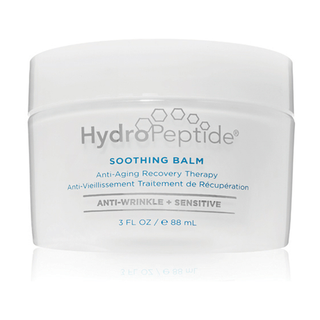
“Soften and hydrate your skin with the HydroPeptide Soothing Balm , an anti-ageing recovery treatment that works to nourish dry and dehydrated skin.”
This product contains superoxide dismutase. This ingredient help neutralize free radicals in skin. By doing so, they might be able to prevent early signs of aging (like fine lines and wrinkles), at least to some extent. These ingredients will not be able to "reverse" signs of aging.
Moisturizing14 ingredients credited for this claimGood support
“Dry, wanting skin feels replenishes and regenerated.”
This product can help soften the skin and reduce its moisture loss with emollients and occlusives: beeswax, cera alba.
Keep in mind that this product does not contain effective ingredients to attract water to the upper layer of the skin. This is why an additional product with humectants like glycerin or hyaluronic acid can be helpful (apply it before this product for the best results).
Anti-oxidationNot advertised by the brand · 7 ingredients credited for this claimStrong support
This product contains antioxidants (superoxide dismutase) that can help neutralize free radicals in skin. By doing so, they can lessen the damage the skin gets from the UV light (sun).
Can it cause trouble?
Irritancy10 strong irritants: Arnica montana flower extract, Vanilla planifolia fruit extract + 8 more — patch-test recommendedHigh risk
Comedogenic3 ingredients rated 2 or more on the 0–5 pore-clogging scale3 flagged
User reviews
Be the first — your take helps the next person decide.
Ingredients
Filter by role to see what each ingredient is doing.
Cocos nucifera oil~22–33%
- Irritation risk
- Low
- Comedogenicity
- 3/5
An emollient. Found to be as effective as a moisturizer for dry skin as mineral oil. Could be comedogenic
More about Cocos nucifera oilPersea gratissima oil~4.2–6.3%
- Irritation risk
- Medium
An emollient that helps soften the skin and could be helpful in repairing its barrier function
More about Persea gratissima oilGlycine soja oil~4.4–6.6%
- Irritation risk
- Medium
- Comedogenicity
- 2/5
A good emollient that helps soften the skin and helps repair its barrier function. It can clog pores if used in high concentrations.
More about Glycine soja oilOlea europaea fruit oil~3.6–5.4%
- Irritation risk
- Medium
An emollient that helps soften the skin but is not effective for restoring its barrier function. Might be helpful to calm down inflammation
More about Olea europaea fruit oilCera alba~3.1–4.7%
- Irritation risk
- Medium
Forms a protective barrier that holds water and keeps dry skin hydrated. Keeps an emulsion from separating into its oil and liquid components, and increases the thickness of a product. Can be an allergen
More about Cera albaBeeswax~2.3–3.4%
- Irritation risk
- Low
Forms a protective barrier that holds water and keeps dry skin hydrated. Keeps an emulsion from separating into its oil and liquid components, and increases the thickness of a product. Can be an allergen
More about BeeswaxStearyl behenate~1.7–2.5%
- Irritation risk
- Low
Helps soften the upper layer of the skin
More about Stearyl behenateArnica montana flower extract~1.3–1.9%
- Irritation risk
- High
A plant extract that can be irritating. It can have some anti-bacterial properties, but there are no evidence of a beneficial effect for skin
More about Arnica montana flower extractTocopherol~1–1.5%
- Irritation risk
- Low
Pure form of vitamin E. Can help moisturise and protect the skin from free radicals. Often used to help stabilise other ingredients or the formula itself
More about TocopherolBisabolol~0.85–1.25%
- Irritation risk
- Low
An active component of chamomile plant that historically has been used to calm down irritated skin. A recent study shows that bisabolol indeed can have some anti-inflammatory effect on skin, even though conclusive data is lacking. Bisabolol has a sweet floral scent and can be added to products for its aromatic properties
More about BisabololCaprylic/capric triglyceride~0.85–1.25%
- Irritation risk
- Medium
A good mix of fatty acids that forms a protective layer on the skin. Improves the shelf life of products. Derived from coconut and glycerin
More about Caprylic/capric triglycerideTocopheryl acetate~0.5–1.15%
- Irritation risk
- Medium
A more stable but less bio-available form of vitamin E compared to Tocopherol. Might help moisturize and protect the skin from free radicals, but mostly used in low concentrations to stabilize other ingredients.
More about Tocopheryl acetateTocopherol~0.45–1.05%
- Irritation risk
- Low
Pure form of vitamin E. Can help moisturise and protect the skin from free radicals. Often used to help stabilise other ingredients or the formula itself
More about TocopherolVanilla planifolia fruit extract~0.4–0.95%
- Irritation risk
- High
A plant extract used as a fragrance. Can be irritating
More about Vanilla planifolia fruit extractJasminum officinale flower/leaf extract~0.35–0.8%
Cucumis sativus fruit extract~0.4–0.9%
- Irritation risk
- Medium
Might be somewhat helpful in reducing hyperpigmentation and neutralizing free radicals but its typical concentration in a product is too low for having an effect
More about Cucumis sativus fruit extractGlycine soja protein~0.45–1%
- Irritation risk
- Low
A plant extract that helps to attract water to the upper layer of the skin and soften it. It might be helpful in neutralizing free radicals. It might be somewhat helpful for evening out the skin tone. It might be able to support elastin production but solid research is lacking
More about Glycine soja proteinHydrolyzed rice bran protein~0.35–0.85%
- Irritation risk
- Low
Superoxide dismutase~0.35–0.75%
- Irritation risk
- Low
An antioxidant enzyme that is naturally present in skin. It can help support skin barrier function and reduce inflammation in skin. It is used in topical medications for inflammatory skin conditions including atopic dermatitis (eczema) and psoriasis. There are three types of natural Superoxide Dismutase in human skin. The compound used in topical treatments and cosmetics are mimics of typically one of these natural variants
More about Superoxide dismutaseOryza sativa bran extract~0.3–0.7%
Rosmarinus officinalis leaf extract~0.15–0.7%
- Irritation risk
- High
Can be helpful in reducing inflammation in skin, including inflamed acne. It can be irritating
More about Rosmarinus officinalis leaf extractHelianthus annuus extract~0.35–0.8%
- Irritation risk
- Low
Helps soften the upper layer of the skin
More about Helianthus annuus extractCitrus limon peel extract~0.15–0.55%
Citrus aurantium dulcis fruit extract~0.15–0.6%
- Irritation risk
- High
A plant extract that is used as a fragrance. Can be irritating and lead to photosensitivity
More about Citrus aurantium dulcis fruit extractGlyceryl stearate~0.2–0.75%
- Irritation risk
- Low
An emollient that softens the skin and forms a protective layer on its surface. Helps water and oil mix together
More about Glyceryl stearateHydrogenated soybean oil~0.15–0.7%
- Irritation risk
- Low
- Comedogenicity
- 2/5
Limonene~0.1–0.4%
- Irritation risk
- High
A common frangrance that can easily irritate skin, especially if exposed to air, light or heat
More about LimoneneLinalool~0.1–0.35%
Citral~0.1–0.3%
Amyl cinnamal~0.05–0.25%
- Irritation risk
- High
Ingredient list view
Unknown, Cocos nucifera oil, Persea gratissima oil, Glycine soja oil, Olea europaea fruit oil, Cera alba, Beeswax, Stearyl behenate, Arnica montana flower extract, Tocopherol, Bisabolol, Caprylic/capric triglyceride, Tocopheryl acetate, Tocopherol, Vanilla planifolia fruit extract, Jasminum officinale flower/leaf extract, Cucumis sativus fruit extract, Glycine soja protein, Hydrolyzed rice bran protein, Superoxide dismutase, Oryza sativa bran extract, Rosmarinus officinalis leaf extract, Helianthus annuus extract, Citrus limon peel extract, Citrus aurantium dulcis fruit extract, Glyceryl stearate, Hydrogenated soybean oil, Limonene, Linalool, Citral, Amyl cinnamal
Compare prices
Retailers ranked by price — lowest first.

Sources cited in this review
Every concentration estimate and effectiveness label is anchored to one of these 23 studies and safety reviews.
- 1Use of “natural” oils for moisturization: Review of olive, coconut, and sunflower seed oilonlinelibrary.wiley.com
- 2
- 3Effects of Topical Arnica Gel on Post-Laser Treatment Bruisesonlinelibrary.wiley.com
- 4
- 5
- 6

Affiliate links · As an Amazon Associate, WIMJ earns from qualifying purchases.