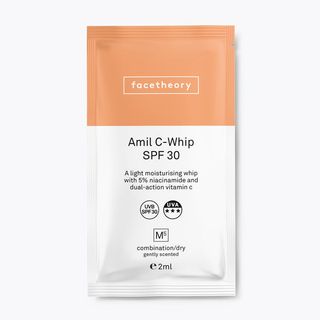
Facetheory Amil-C Whip M5 SPF 30 with 5% Niacinamide and Dual Action Vitamin C
Works for
4 of 4 advertised claims delivered
Sun protectionSPF 30 · 2 UV filtersBroad spectrum
This product offers a good level of protection against both UVB and UVA rays.
This sunscreen uses organic (so-called "chemical") sunscreen filters. Organic, or "chemical" filters usually provide reliable sun protection and rarely leave a white cast. Sunscreens with organic filters can sting eyes.
This product can be considered "reef safe" because it does not contain the UV filters (oxybenzone and octinoxate) that can be harmful to coral reefs when present in the water in high concentrations.
Evens skin tone3 ingredients credited for this claimStrong support
“5% niacinamide and dual-action vitamin C (sodium ascorbyl phosphate and ethyl ascorbic acid) help to balance skin tone, reduce redness and minimise pore size.”
This product offers broad spectrum sun protection. It means that it can prevent hyperpigmentation and help keep the skin tone even (sun damage is the main factor causing age spots, darkening of post-acne marks and other discolorations).
Anti-blemish2 ingredients credited for this claimStrong support
“Sodium ascorbyl phosphate fights acne-causing bacteria, helping to prevent breakouts and sore, irritated skin.”
This product can help reduce breakouts and clogged pores because it contains the following ingredient: niacinamide. This ingredient is used for treating acne and can have a noticeable effect.
Moisturizing9 ingredients credited for this claimStrong support
“Amil-C Whip M5 SPF 30+ is our whipped mousse moisturiser that refines and brightens your skin while protecting it against UV damage.”
This product contains good ingredients to attract water to the upper layer of the skin. These ingredients are called "humectants": glycerin.
When humectants are on the surface of the skin, they “pull in” the moisture from the outside environment, or from within deeper layers of the skin. If the air is dry, humectants can speed up the moisture loss from the skin. This is why it is a good idea to use another product on top of this one to help "seal in" the moisture (look for ingredients like dimethicone, squalane, oils and butters).
The following ingredients in this product are especially good for supporting the skin barrier and helping with the hydration level: niacinamide
Anti-agingNot advertised by the brand · 5 ingredients credited for this claimStrong support
This product can help reduce and prevent fine lines and wrinkles, improve skin elasticity and firmness because it contains niacinamide.
Keep in mind that it typically takes at least 6 weeks to notice any results because the changes that are needed to improve fine lines and elasticity happen in the deeper layers of the skin. No topical anti-aging product can “erase” wrinkles or fully reverse signs of aging.
This product can also help prevent early signs of skin aging because it offers a good level of broad spectrum sun protection. Sun damage is the main cause of premature skin aging, and protecting your skin from the sun is the best anti-aging strategy.
Anti-oxidationNot advertised by the brand · 4 ingredients credited for this claimModerate support
This product contains antioxidants (3-o-ethyl ascorbic acid) that might be able to help neutralize free radicals in skin to lessen the damage it gets from the UV light (sun). There is not enough evidence to confirm their effectiveness in skin though.
Can it cause trouble?
Irritancy3 strong irritants: Sodium anisate, Citrus grandis peel oil + 1 more — patch-test recommendedHigh risk
ComedogenicClean of flagged comedogenic ingredientsNone flagged

User reviews
Ingredients
Filter by role to see what each ingredient is doing.
Water~40–60%
Bis-ethylhexyloxyphenol methoxyphenyl triazine~5.3–8%
- Irritation risk
- Medium
Tinosorb S. One of the most effective broad spectrum sunscreen ingredients. Protects from both UVA and UVB rays. It is photostable. Unfortunately, not approved by FDA (US) yet.
More about Bis-ethylhexyloxyphenol methoxyphenyl triazineNiacinamide~3.7–5.5%
- Irritation risk
- Low
Is proven to be effective in reducing blemishes, evening out skin tone and helping to improve lines and wrinkles. It helps the skin to repair sun damage, calm down inflammation and keep maintain good levels of moisture. The concentration of about 2% is effective for supporting the skin barrier and evening out the skin tone. Concentration of 4-6% is better for helping with acne and balancing the sebum production
More about NiacinamideCoco-caprylate~2.9–4.3%
- Irritation risk
- Medium
An emollient that softens skin and creates a nice product texture
More about Coco-caprylateButyloctyl salicylate~2.1–3.1%
- Irritation risk
- Medium
A synthetic ester of salicylic acid that is used to help disperse pigments and boost effectiveness of sunscreen ingredients. It is able to absorb UV light (working as an organic, or chemical filter), but is not approved as a sunscreen ingredient on its own
More about Butyloctyl salicylateGlyceryl stearate~1.7–2.6%
- Irritation risk
- Low
An emollient that softens the skin and forms a protective layer on its surface. Helps water and oil mix together
More about Glyceryl stearatePolyglyceryl-6 stearate~1.5–2.2%
- Irritation risk
- Low
Helps soften the upper layer of the skin
More about Polyglyceryl-6 stearateMicrocrystalline cellulose~1.3–2%
Sodium ascorbyl phosphate~1–1.5%
- Irritation risk
- Medium
A stable derivative of vitamin C. It is oil-soluble which means it is more likely to penetrate the skin compared to the pure form of vitamin C (which is water-soluble), but it is less bio-available and is way less effective in stimulating collagen and reducing wrinkles compared to the pure form of vitamin C (L-ascorbic acid) and its other derivatives (for example, magnesium ascorbyl phosphate). At the same time, this vitamin C derivative has been shown in studies to be effective in reducing acne, blemishes and clogged pores. It is less irritating then the pure form of vitamin C
More about Sodium ascorbyl phosphateLactic acid~0.8–1.2%
- Irritation risk
- Medium
An exfoliating and moisturizing alpha-hydroxy acid (AHA). Typically causes less irritation than other AHAs, for example, glycolic acid. At high concentrations (about 15%), lactic acid can help reduce lines and wrinkles. Recent studies show that lactic acid can support the "good" bacteria living on skin's surface (healthy skin microbiome)
More about Lactic acidCetyl alcohol~0.55–1.3%
- Irritation risk
- Low
A non-drying alcohol that works to soften the skin and stabilize product formulations helping oil and water mix together
More about Cetyl alcoholTocopherol~0.4–0.95%
- Irritation risk
- Low
Pure form of vitamin E. Can help moisturise and protect the skin from free radicals. Often used to help stabilise other ingredients or the formula itself
More about TocopherolGlycerin~0.4–0.9%
- Irritation risk
- Low
One of the best moisturizing ingredients. Naturally present in skin. It attracts water to the upper layer of the skin working as a humectant
More about GlycerinSodium anisate~0.35–0.8%
Sodium levulinate~0.3–0.7%
Glyceryl caprylate~0.3–0.7%
- Irritation risk
- Low
An emollient that can also help water and oil mix together, as well as prevent bacteria growth in products
More about Glyceryl caprylate3-o-ethyl ascorbic acid~0.15–0.6%
- Irritation risk
- High
A vitamin C derivative that is more stable but less potent than pure form of vitamin C. Can help neutralize free radicals and help reduce hyperpigmentation, but the required concentration is likely to be much higher than for the pure form of vitamin C, limiting the ingredient's effectiveness in products
More about 3-o-ethyl ascorbic acidPolyglyceryl-6 behenate~0.15–0.55%
Rosa canina fruit extract~0.1–0.5%
- Irritation risk
- Medium
A plant extract that might have some anti-oxidant properties, but evidence is lacking
More about Rosa canina fruit extractGellan gum~0.1–0.45%
Sodium phytate~0.1–0.35%
Xanthan gum~0.1–0.35%
- Irritation risk
- Low
Used to create a thicker product consistency
More about Xanthan gumCitrus grandis peel oil~0.05–0.15%
- Irritation risk
- High
A plant oil with high content of volatile compounds that, especially when exposed to air, can cause allergic reactions and irritate the skin
More about Citrus grandis peel oilLimonene0.475%
- Irritation risk
- High
A common frangrance that can easily irritate skin, especially if exposed to air, light or heat
More about LimoneneIngredient list view
Water, Bis-ethylhexyloxyphenol methoxyphenyl triazine, Niacinamide, Coco-caprylate, Butyloctyl salicylate, Glyceryl stearate, Polyglyceryl-6 stearate, Microcrystalline cellulose, Sodium ascorbyl phosphate, Lactic acid, Cetyl alcohol, Tocopherol, Glycerin, Sodium anisate, Sodium levulinate, Glyceryl caprylate, 3-o-ethyl ascorbic acid, Polyglyceryl-6 behenate, Rosa canina fruit extract, Gellan gum, Sodium phytate, Xanthan gum, Citrus grandis peel oil, Limonene
Compare prices
Retailers ranked by price — lowest first.

Worth comparing, line by line.
Match % combines shared ingredients, the first five ingredients, shared actives and hero ingredients, irritancy (lower counts in the alternative's favour), texture and body area. Only products in the same routine step are compared.
| FacetheoryAmil-C Whip M5 SPF 30 with 5% Niacinamide and Dual Action Vitamin CYOUR PRODUCT | OlayTotal Effects Whip Face Moisturizer with Sunscreen SPF 40 | SuntegrityClearspf - Sheer Moisturizing Daily Sunscreen Spf 30 | Thank You FarmerSun Project Soothing Sun Lotion SPF 30 Broad Spectrum | |
|---|---|---|---|---|
| Match | — | 72% | 72% | 70% |
| Price | $2.63 | $16.99+$14.36 | — | $24.00+$21.37 |
| Shared key ingredients | — | 4 of 8 | 3 of 8 | 3 of 8 |
| Key difference | — | Panthenol | Panthenol | Adenosine |
| Irritancy | High | Medium | Low | Low |
| SPF | SPF 30 | SPF 40 | SPF 30 | SPF 30 |
| Drying alcohol | — | — | — | — |
| View product | Shop | Shop | Shop |


Product summary
We believe that "Facetheory - Amil-C Whip M5 SPF 30 with 5% Niacinamide and Dual Action Vitamin C" can provide reliable sun protection based on the ingredients listed. It can protect from both UVA and UVB rays. This is great news because not all sunscreens with SPF ratings give UVA protection. (UVA rays do not cause sunburn, but still damage our skin and lead to early aging).
It contains good moisturizing ingredients and can double as a hydrating day cream. This product prevents early signs of aging by protecting against sun damage (all broad spectrum sunscreens do that).
Sunscreen filters
This sunscreen uses so-called "chemical", or organic UV filters (organic simply means that their molecules contain atoms of carbon). These filters typically give good sun protection and rarely leave a white cast, but they can be irritating for sensitive skin. The UV filters in this sunscreen are: tinosorb s 4.60% - 6.80% and butyloctyl salicylate 2.00% - 3.00%.
Irritation risk
This moisturizer contains some common irritants, including those without a benefit for the skin. We assess the overall irritancy of this moisturizer to be high. For a detailed overview of all potential irritants: click here
You can see the detailed formula review with the breakdown of all actives in the product and the full ingredient list with estimated concentrations in the tables below.
What our users say
Based on 4 reviews 100% recommend this product- When it comes to comedogenicity, two out of three reviewers didn't notice clogged pores after using this sunscreen, but the third reviewer found that it clogged pores.
- As for the white cast, all of the reviewers (4) say that it does not leave a white cast.
- When it comes to using this sunscreen under makeup, two out of two reviewers report that the product does not pill under makeup.
- As for using this sunscreen in the eye area, two out of three reviewers said that it doesn't sting eyes, but one user experienced the issue.
About the brand
According to Cruelty-Free Kitty "Facetheory" is cruelty free and so is its parent company.
Price
The product retails from 1.99£ up to 18.49£ in the United Kingdom.
For a detailed price comparison: click here.
Sources cited in this review
Every concentration estimate and effectiveness label is anchored to one of these 16 studies and safety reviews.
- 1
- 2
- 3
- 4
- 5Sodium ascorbyl phosphate in topical microemulsionssciencedirect.com
- 6

Affiliate links · As an Amazon Associate, WIMJ earns from qualifying purchases.