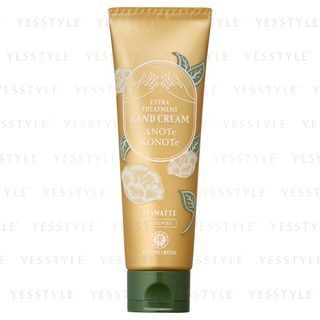
House of Rose Extra Treatment Hand Cream
Works for
1 of 1 advertised claim delivered
MoisturizingHydrolyzed hyaluronic acid, Polyglutamic acid + 15 moreGood evidence
“The dense medicated hand cream melts into your hands, preventing rough hands and keeping your hands moisturized.”
This product can help improve hydration of the skin with the two types of ingredients.
The first type is called “humectants”:
these ingredients help attract water.
When humectants are on the surface of the skin, they “pull in” the moisture from the outside environment, or from
within deeper layers of the skin. The following ingredients in this product do the job:
allantoin, dipotassium glycyrrhizate.
This product also contains ingredients called “occlusives”. They help reduce the speed with which our skin loses moisture to the outside environment. These ingredients also help soften the upper layer of the skin, so it feels less tight and nicer to the touch. The following ingredients in this product do the job: butyrospermum parkii butter, dimethicone.
Anti-oxidationNot advertised by the brand · Camellia sinensis leaf extract, Butyrospermum parkii butterModerate evidence
This product contains antioxidants (camellia sinensis leaf extract) that might be able to help neutralize free radicals in skin to lessen the damage it gets from the UV light (sun). There is not enough evidence to confirm their effectiveness in skin though.
Can it cause trouble?
Irritancy5 flagged ingredientsLow risk
Comedogenic3 ingredients rated 2 or more on the 0–5 pore-clogging scale3 flagged
User reviews
Be the first — your take helps the next person decide.
Ingredients
Filter by role to see what each ingredient is doing.
Allantoin~23–34%
- Irritation risk
- Low
Helps calm down inflammation in skin and can help reduce itching. Helps to repair the skin barrier and keep skin hydrated
More about AllantoinDipotassium glycyrrhizate~4.5–6.8%
- Irritation risk
- Low
A salt derived from licorice. Works as an emollient to soften the upper layer of the skin and can help calm down inflammation. Might be helpful for skin lightening
More about Dipotassium glycyrrhizateSqualane~4.6–7%
- Irritation risk
- Low
An oil naturally present in skin. Works as an emollient to soften the skin and form a protective layer on its surface without a greasy feeling.
More about SqualaneHydrogenated rapeseed alcohol~3.9–5.8%
Cetyl palmitate~3–4.5%
- Irritation risk
- Low
An emollient that helps soften the skin and is used to improve product texture and stability
More about Cetyl palmitateSodium riboflavin phosphate~2–3.1%
- Irritation risk
- Low
Behenyl alcohol~1.8–2.7%
- Irritation risk
- Low
Non-drying alcohol that helps water and oil mix together. Also serves as an emollient
More about Behenyl alcoholButyrospermum parkii butter~1.5–2.3%
- Irritation risk
- Low
- Comedogenicity
- 3/5
A great moisturising ingredient that softens the skin and reduces water loss from its upper layer. It also can be helpful in protecting skin from free radicals
More about Butyrospermum parkii butterPaeonia albiflora root extract~1.2–1.8%
- Irritation risk
- Low
Camellia sinensis leaf extract~1–1.5%
- Irritation risk
- Low
Can contain potent anti-oxidant compounds (abbreviated ECG, GCG, EGC, and EGCG) that might help protect the skin from free radicals. Can help calm down inflammation and has some anti-bacterial properties. Unfortunately, these antioxidants are unstable and lose their effectiveness very quickly in products. The concentration of the antioxidant compounds in the extract also tends to be low to be effective in topical formulation
More about Camellia sinensis leaf extractHydrolyzed royal jelly protein~0.85–1.25%
- Irritation risk
- High
Hydrolyzed hyaluronic acid~0.55–1.25%
- Irritation risk
- Low
One of the best moisturizing ingredients. Attracts water into the upper layer of the skin. A version of it is naturally present in skin
More about Hydrolyzed hyaluronic acidSodium hyaluronate~0.5–1.15%
- Irritation risk
- Low
One of the best moisturizing ingredients. Attracts water into the upper layer of the skin
More about Sodium hyaluronatePolyglutamic acid~0.5–1.1%
- Irritation risk
- Low
Helps attract water to the upper layer of the skin.
More about Polyglutamic acidAlgin~0.45–1.05%
- Irritation risk
- Low
- Comedogenicity
- 3/5
Used to thicken product formulation. Can help attract water to the upper layer of the skin
More about AlginCitric acid~0.45–1.05%
- Irritation risk
- Medium
Can work as an exfoliant but is typically used to adjust the product pH
More about Citric acidSodium citrate~0.45–1%
- Irritation risk
- Medium
Helps to control the skin's pH level. Maintains the skin's natural film of amino-lactic acids and oils. Helps to preserve products
More about Sodium citrateGlycerin~0.45–1.05%
- Irritation risk
- Low
One of the best moisturizing ingredients. Naturally present in skin. It attracts water to the upper layer of the skin working as a humectant
More about GlycerinWater~0.35–0.85%
Stearic acid~0.45–1.1%
- Irritation risk
- Low
Helps oil and water mix together and works as an emollient
More about Stearic acidButylene glycol~0.35–0.75%
- Irritation risk
- Low
Used to create a nice product texture and help delivery of other ingredients. Might be somewhat helpful in attracting water to the upper layer of the skin
More about Butylene glycolSilica~0.4–0.95%
Dimethicone~0.35–0.85%
- Irritation risk
- Low
A silicone that helps to reduce water loss from the surface of the skin. Can temporarily "fill in" lines and wrinkles, absorb oil, and create a nice product finish
More about DimethiconeXanthan gum~0.2–0.8%
- Irritation risk
- Low
Used to create a thicker product consistency
More about Xanthan gumPentylene glycol~0.35–0.8%
- Irritation risk
- Medium
Used to preserve products, dissolve other ingredients and create a nice product texture
More about Pentylene glycolGlyceryl stearate se~0.15–0.65%
- Irritation risk
- Low
- Comedogenicity
- 2/5
Used to stabilize the product formulations and works as an emollient
More about Glyceryl stearate sePropanediol~0.15–0.65%
- Irritation risk
- Low
Acts as a solvent for other ingredients. Speeds up the absorption of other ingredients into the skin
More about PropanediolPolylysine10%
- Irritation risk
- Low
Glycerin~0.15–0.6%
- Irritation risk
- Low
One of the best moisturizing ingredients. Naturally present in skin. It attracts water to the upper layer of the skin working as a humectant
More about GlycerinPhenoxyethanol~0.15–0.55%
- Irritation risk
- Low
A preservative. It helps prevent bacterial growth in cosmetic products
More about PhenoxyethanolIngredient list view
Allantoin, Dipotassium glycyrrhizate, Squalane, Hydrogenated rapeseed alcohol, Cetyl palmitate, Sodium riboflavin phosphate, Behenyl alcohol, Butyrospermum parkii butter, Unknown, Unknown, Paeonia albiflora root extract, Camellia sinensis leaf extract, Hydrolyzed royal jelly protein, Hydrolyzed hyaluronic acid, Sodium hyaluronate, Polyglutamic acid, Algin, Citric acid, Sodium citrate, Glycerin, Water, Stearic acid, Butylene glycol, Silica, Dimethicone, Xanthan gum, Unknown, Unknown, Unknown, Pentylene glycol, Glyceryl stearate se, Propanediol, Polylysine, Glycerin, Phenoxyethanol
Compare prices
Retailers ranked by price — lowest first.

Affiliate links · prices updated regularly
Sources cited in this review
Every concentration estimate and effectiveness label is anchored to one of these 12 studies and safety reviews.
- 1
- 2
- 3
- 4Efficacy of a New Topical Nano-hyaluronic Acid in Humansncbi.nlm.nih.gov
- 5Physiochemical properties and application of hyaluronic acid: a systematic reviewonlinelibrary.wiley.com
- 6Hyaluronic acid: A key molecule in skin agingncbi.nlm.nih.gov

Affiliate links · As an Amazon Associate, WIMJ earns from qualifying purchases.