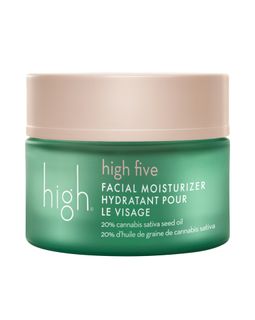
High Beauty High Five Facial Moisturizer
Works for
1 of 1 advertised claim delivered
Moisturizing33 ingredients credited for this claimGood support
“High Five Facial Moisturizer”
This product can help improve hydration of the skin with the two types of ingredients.
The first type is called “humectants”:
these ingredients help attract water.
When humectants are on the surface of the skin, they “pull in” the moisture from the outside environment, or from
within deeper layers of the skin. The following ingredients in this product do the job:
anhydroxylitol, glycerin.
This product also contains ingredients called “occlusives”. They help reduce the speed with which our skin loses moisture to the outside environment. These ingredients also help soften the upper layer of the skin, so it feels less tight and nicer to the touch. The following ingredients in this product do the job: cocos nucifera oil, helianthus annuus seed oil.
Anti-oxidationNot advertised by the brand · 17 ingredients credited for this claimStrong support
This product contains antioxidants (ubiquinone, vitis vinifera seed extract) that can help neutralize free radicals in skin. By doing so, they can lessen the damage the skin gets from the UV light (sun).
The following ingredients - punica granatum extract, vaccinium macrocarpon seed oil also can have an antioxidant effect, but there is less evidence to confirm their effectiveness in skin.
Anti-agingNot advertised by the brand · 8 ingredients credited for this claimModerate support
This product contains vitis vinifera seed extract. This ingredient might be able to help reduce and prevent fine lines and wrinkles, improve skin elasticity and firmness, but there is not enough evidence that it actually works.
Can it cause trouble?
Irritancy3 strong irritants: Citrus aurantium amara leaf/twig extract, Mentha citrata leaf extract + 1 more — patch-test recommendedHigh risk
Comedogenic4 ingredients rated 2 or more on the 0–5 pore-clogging scale4 flagged

User reviews
Be the first — your take helps the next person decide.
Ingredients
Filter by role to see what each ingredient is doing.
Aloe barbadensis leaf juice~23–34%
- Irritation risk
- Medium
Traditionally used to treat sunburns, dermatitis and inflammation, but evidence for its effectiveness is lacking. The extract can contain humectants that help attract water into the skin
More about Aloe barbadensis leaf juiceCannabis sativa seed oil~3.9–5.9%
- Irritation risk
- Medium
A plant oil that due to its high linoleic acid content can help strengthen skin's barrier function and soften its upper layer
More about Cannabis sativa seed oilHelianthus annuus seed oil~4.6–6.8%
- Irritation risk
- Low
A great emollient due to its high linoleic acid content. One of the most effective plant oils in helping skin hydration and repairing skin barrier function
More about Helianthus annuus seed oilCetearyl alcohol~3.1–4.7%
- Irritation risk
- Low
- Comedogenicity
- 2/5
A non-drying alcohol. Works as an emollient. Helps water and oil mix together and creates a nice product texture
More about Cetearyl alcoholPropanediol~2.6–3.9%
- Irritation risk
- Low
Acts as a solvent for other ingredients. Speeds up the absorption of other ingredients into the skin
More about PropanediolCetearyl glucoside~1.8–2.8%
- Irritation risk
- Medium
Helps water and oil in the product mix well together and improves product texture
More about Cetearyl glucosideVitis vinifera seed oil~1.5–2.2%
- Irritation risk
- Medium
A great emollient that can also have anti-oxidant properties
More about Vitis vinifera seed oilGlycerin~1.2–1.7%
- Irritation risk
- Low
One of the best moisturizing ingredients. Naturally present in skin. It attracts water to the upper layer of the skin working as a humectant
More about GlycerinXylitylglucoside~0.95–1.4%
- Irritation risk
- Low
Helps attract water to the upper layer of the skin and repair the skin barrier function
More about XylitylglucosideAnhydroxylitol~0.6–1.35%
- Irritation risk
- Low
Helps attract water to the upper layer of the skin and repair the skin barrir function
More about AnhydroxylitolXylitol~0.5–1.1%
- Irritation risk
- Low
Helps attract water to the upper layer of the skin and repair the skin barrier function
More about XylitolSorbitan stearate~0.4–0.95%
Jojoba esters~0.4–1%
- Irritation risk
- Medium
An emollient made of jojoba oil. Helps soften the skin and support its barrier function
More about Jojoba estersPhenylpropanol~0.35–0.75%
- Irritation risk
- High
Helps mask the smell of other ingredients and helps preserve the product formulation
More about PhenylpropanolTocopherol~0.4–0.9%
- Irritation risk
- Low
Pure form of vitamin E. Can help moisturise and protect the skin from free radicals. Often used to help stabilise other ingredients or the formula itself
More about TocopherolButyrospermum parkii butter extract~0.4–0.9%
- Irritation risk
- Low
- Comedogenicity
- 3/5
A great moisturising ingredient that softens the skin and reduces water loss from its upper layer. It also can be helpful in protecting skin from free radicals
More about Butyrospermum parkii butter extractGlycine soja oil~0.35–0.75%
- Irritation risk
- Medium
- Comedogenicity
- 2/5
A good emollient that helps soften the skin and helps repair its barrier function. It can clog pores if used in high concentrations.
More about Glycine soja oilXanthan gum~0.2–0.75%
- Irritation risk
- Low
Used to create a thicker product consistency
More about Xanthan gumCaprylyl glycol~0.2–0.8%
- Irritation risk
- Medium
Helps preserve products and creates a nice product texture
More about Caprylyl glycolVaccinium macrocarpon seed oil~0.2–0.75%
- Irritation risk
- Medium
A plant oil that can help neutralize free radicals, soften the upper layer of the skin, and support skin's barrier function
More about Vaccinium macrocarpon seed oilSaccharum officinarum extract~0.15–0.55%
- Irritation risk
- Low
Sugar extract that helps attract water to the upper layer of the skin
More about Saccharum officinarum extractSimmondsia chinensis seed oil~0.2–0.75%
- Irritation risk
- Medium
Softens the upper layer of skin and helps restore the healthy skin barrier. Has shown to help calm down inflammation in skin. It is a stable oil, meaning that it retains its properties even when exposed to air.
More about Simmondsia chinensis seed oilSilybum marianum extract~0.2–0.7%
- Irritation risk
- High
Might be able to help neutralize free radical, calm down inflammation in skin, and even skin tone
More about Silybum marianum extractRosa canina seed oil~0.1–0.5%
- Irritation risk
- Medium
A plant oil that helps soften the upper layer of the skin. It might have anti-oxidant properties. Might help reduce inflammation in skin and help against blemishes
More about Rosa canina seed oilCocos nucifera oil~0.15–0.6%
- Irritation risk
- Low
- Comedogenicity
- 3/5
An emollient. Found to be as effective as a moisturizer for dry skin as mineral oil. Could be comedogenic
More about Cocos nucifera oilBehenyl alcohol~0.2–0.7%
- Irritation risk
- Low
Non-drying alcohol that helps water and oil mix together. Also serves as an emollient
More about Behenyl alcoholArgania spinosa kernel oil~0.15–0.65%
- Irritation risk
- Medium
An emollient that helps soften the upper layer of the skin. Might have some weak anti-oxidant properties
More about Argania spinosa kernel oilAcacia decurrens flower wax~0.15–0.6%
Acacia catechu gum~0.2–0.7%
- Irritation risk
- Low
Lonicera caprifolium flower extract~0.1–0.45%
- Irritation risk
- High
A plant extract that might help neutralize free radicals in skin. Can contain volalite oils and be irritating
More about Lonicera caprifolium flower extractHelianthus annuus seed wax~0.15–0.65%
- Irritation risk
- Low
Helps soften the upper layer of the skin and support skin's barrier function while creating a thicker product consistency
More about Helianthus annuus seed waxLonicera japonica flower extract~0.15–0.5%
- Irritation risk
- High
A plant extract that might help neutralize free radicals in skin. Can contain volalite oils and be irritating
More about Lonicera japonica flower extractLactic acid~0.15–0.5%
- Irritation risk
- Medium
An exfoliating and moisturizing alpha-hydroxy acid (AHA). Typically causes less irritation than other AHAs, for example, glycolic acid. At high concentrations (about 15%), lactic acid can help reduce lines and wrinkles. Recent studies show that lactic acid can support the "good" bacteria living on skin's surface (healthy skin microbiome)
More about Lactic acidBorago officinalis seed oil~0.15–0.65%
- Irritation risk
- Low
A plant oil that is effective in reducing irritation in skin, restore the barrier function and support its hydration
More about Borago officinalis seed oilSodium phytate~0.15–0.5%
Oenothera biennis oil~0.15–0.7%
- Irritation risk
- Medium
Helps soften the upper layer of the skin and can support skin barrier function
More about Oenothera biennis oilPolyglycerin-3~0.15–0.55%
- Irritation risk
- Low
Helps to attract water to the upper layer of the skin
More about Polyglycerin-3Linum usitatissimum seed oil~0.1–0.45%
Troxerutin~0.15–0.5%
- Irritation risk
- Low
Magnesium aspartate~0.15–0.5%
- Irritation risk
- Low
Might be helpful in restoring skin barrier function and calm down inflammation in skin
More about Magnesium aspartateZinc gluconate~0.15–0.5%
- Irritation risk
- Medium
Typically used to stabilize the product formulations. It is a salt of a polyhydroxy acid (PHA) and in larger concentrations, can help shed the dead cells from the skin surface revealing smoother skin. It can help attract water to the upper layer of the skin. Might to be helpful against acne and clogged pores. Could be helpful in neutralizing free radicals, but solid research is missing. Due to the zinc content, might help calm down inflammation in skin
More about Zinc gluconateBrassica oleracea italica seed extract~0.15–0.5%
- Irritation risk
- Low
Tetrahexyldecyl ascorbate~0.15–0.65%
- Irritation risk
- Medium
Being a lipid soluble form of vitamin C, it is more stable than ascorbic acid, but still degrades quickly and needs to be stabilized in a formulation with another ingredient. It is claimed to penetrate skin better than pure vitamin C and have the the similar benefits, but solid studies of its effectiveness are lacking. Is likely to require a higher concentration in a product than pure vitamin C to be effective. It might be able to help reduce pore clogging.
More about Tetrahexyldecyl ascorbateCopper gluconate~0.15–0.65%
- Irritation risk
- Medium
Typically used to stabilize the product formulations. It is a salt of polyhydroxy acid (PHA) and in larger concentrations, can help shed the dead cells from the skin surface revealing smoother skin. It can help attract water to the upper layer of the skin. Might to be helpful against acne and clogged pores. Could be helpful in neutralizing free radicals, but solid research is missing
More about Copper gluconateCitrus aurantium amara leaf/twig extract~0.15–0.65%
- Irritation risk
- High
Vitis vinifera seed extract~0.15–0.65%
- Irritation risk
- Low
A plant extract that contains resveratrol and other anti-oxidant compounds that can help neutralize free radicals, reduce inflammation in skin and even out its tone. Can be also used to stabilize the product formulation
More about Vitis vinifera seed extractVaccinium macrocarpon fruit extract~0.15–0.6%
- Irritation risk
- High
A berry extract. Might have some anti-oxidant properties
More about Vaccinium macrocarpon fruit extractPunica granatum extract~0.15–0.6%
- Irritation risk
- Medium
A plant extract that can help neutralize free radicals in skin and even out the skin tone, but is typically used in products in a concentration that is too low to be effective
More about Punica granatum extractNigella sativa seed oil~0.2–0.75%
- Irritation risk
- Medium
Helps soften the upper layer of the skin and support the skin's barrier due to the high content of linoleic acid
More about Nigella sativa seed oilUbiquinone~0.15–0.55%
- Irritation risk
- Low
Coenzyme Q10. It helps neutralize free radicals in skin, improves skin hydration and might be helpful agains fine lines and wrinkles. It can be an allergen
More about UbiquinoneMentha citrata leaf extract~0.1–0.4%
- Irritation risk
- High
Sodium hyaluronate~0.1–0.45%
- Irritation risk
- Low
One of the best moisturizing ingredients. Attracts water into the upper layer of the skin
More about Sodium hyaluronateMelissa officinalis leaf extract~0.1–0.5%
- Irritation risk
- High
A plant extract that is added for its fragrance. Can be irritating
More about Melissa officinalis leaf extractIngredient list view
Aloe barbadensis leaf juice, Cannabis sativa seed oil, Helianthus annuus seed oil, Cetearyl alcohol, Propanediol, Cetearyl glucoside, Vitis vinifera seed oil, Glycerin, Xylitylglucoside, Anhydroxylitol, Xylitol, Sorbitan stearate, Jojoba esters, Phenylpropanol, Tocopherol, Butyrospermum parkii butter extract, Glycine soja oil, Xanthan gum, Caprylyl glycol, Vaccinium macrocarpon seed oil, Saccharum officinarum extract, Simmondsia chinensis seed oil, Silybum marianum extract, Rosa canina seed oil, Cocos nucifera oil, Behenyl alcohol, Argania spinosa kernel oil, Acacia decurrens flower wax, Acacia catechu gum, Lonicera caprifolium flower extract, Helianthus annuus seed wax, Lonicera japonica flower extract, Lactic acid, Borago officinalis seed oil, Sodium phytate, Oenothera biennis oil, Unknown, Polyglycerin-3, Linum usitatissimum seed oil, Troxerutin, Magnesium aspartate, Zinc gluconate, Brassica oleracea italica seed extract, Tetrahexyldecyl ascorbate, Copper gluconate, Citrus aurantium amara leaf/twig extract, Vitis vinifera seed extract, Vaccinium macrocarpon fruit extract, Punica granatum extract, Nigella sativa seed oil, Ubiquinone, Mentha citrata leaf extract, Sodium hyaluronate, Melissa officinalis leaf extract
Compare prices
Retailers ranked by price — lowest first.

Worth comparing, line by line.
Match % combines shared ingredients, the first five ingredients, shared actives and hero ingredients, irritancy (lower counts in the alternative's favour), texture and body area. Only products in the same routine step are compared.
| High BeautyHigh Five Facial MoisturizerYOUR PRODUCT | CanBE Naturallyi can be radiant DAILY MOISTURIZER | CoolaSunless Tan Anti-Aging Daily Moisturizer | MISTRAM_PM Moisturiser | |
|---|---|---|---|---|
| Match | — | 55% | 54% | 51% |
| Price | $43.63 | $28.50−$15.13 | $48.00+$4.37 | $24.50−$19.13 |
| Shared key ingredients | — | 17 of 29 | 5 of 29 | 5 of 29 |
| Key difference | — | Panthenol | Gluconolactone | Retinyl Palmitate |
| Irritancy | High | High | Medium | Medium |
| Drying alcohol | — | — | — | — |
| View product | Shop | Shop | Shop |


Sources cited in this review
Every concentration estimate and effectiveness label is anchored to one of these 39 studies and safety reviews.
- 1
- 2Hemp (Cannabis sativa L.) as a Resource for Green Cosmeticstandfonline.com
- 3
- 4
- 5Effect of topically applied lipids on surfactant-irritated skinonlinelibrary.wiley.com
- 6

Affiliate links · As an Amazon Associate, WIMJ earns from qualifying purchases.