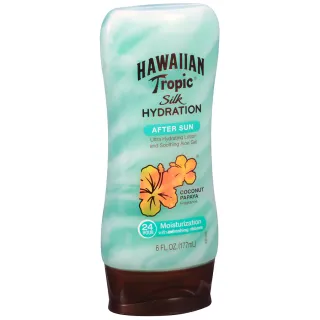
Hawaiian Tropic Silk Hydration After Sun Ultra Hydrating Lotion & Soothing Aloe Gel Coconut Papaya
Works for
1 of 1 advertised claim delivered
MoisturizingPanthenol, Mangifera indica seed butter + 10 moreStrong evidence
“Silk Hydration After Sun Ultra Hydrating Lotion & Soothing Aloe Gel Coconut Papaya”
This product can help improve hydration of the skin with the two types of ingredients.
The first type is called “humectants”:
these ingredients help attract water.
When humectants are on the surface of the skin, they “pull in” the moisture from the outside environment, or from
within deeper layers of the skin. The following ingredients in this product do the job:
glycerin, glyceryl acrylate/acrylic acid copolymer.
This product also contains ingredients called “occlusives”. They help reduce the speed with which our skin loses moisture to the outside environment. These ingredients also help soften the upper layer of the skin, so it feels less tight and nicer to the touch. The following ingredients in this product do the job: dimethicone, theobroma cacao seed butter.
The following ingredients in this product are especially good for supporting the skin barrier and helping with the hydration level: panthenol
Can it cause trouble?
Irritancy4 strong irritants: Citrus aurantium sinensis fiber, Benzophenone-4 + 2 more — patch-test recommendedHigh risk
Comedogenic3 ingredients rated 2 or more on the 0–5 pore-clogging scale3 flagged
User reviews
Be the first — your take helps the next person decide.
Ingredients
Filter by role to see what each ingredient is doing.
Water~45–55%
Glycerin~5.5–6.7%
- Irritation risk
- Low
One of the best moisturizing ingredients. Naturally present in skin. It attracts water to the upper layer of the skin working as a humectant
More about GlycerinPolysorbate 20~4.1–5%
Ethylhexyl palmitate~3.4–4.1%
- Irritation risk
- Low
- Comedogenicity
- 3/5
An emollient that helps soften the skin and create a nice product texture
More about Ethylhexyl palmitateTriethanolamine~2.4–2.9%
- Irritation risk
- Medium
Used to adjust pH of the product and can help improve the product's smell
More about TriethanolamineAcrylates/c10-30 alkyl acrylate crosspolymer~2–2.5%
- Irritation risk
- Medium
Maintains the texture of skincare products. Allows the product to spread evenly. Helps oil and water mix together
More about Acrylates/c10-30 alkyl acrylate crosspolymerDimethicone~1.8–2.2%
- Irritation risk
- Low
A silicone that helps to reduce water loss from the surface of the skin. Can temporarily "fill in" lines and wrinkles, absorb oil, and create a nice product finish
More about DimethiconePolymethylsilsesquioxane~1.6–1.9%
- Irritation risk
- Low
A silicone that improves product texture and helps dissolve other ingredients. Can form a non-greasy film on the skin to prevent moisture loss
More about PolymethylsilsesquioxaneCitrus aurantium sinensis fiber~1.3–1.6%
- Irritation risk
- High
Ethylcellulose~1.1–1.3%
- Irritation risk
- Low
Benzophenone-4~1.2–1.5%
- Irritation risk
- High
Sulisobenzone. A UV filter. Is typically used to improve the product stability under exposure to UV light. It is effective against both UVA and UVB rays. It can be used is larger concentrations as a sun protection ingredient for the skin, but can be irritating
More about Benzophenone-4Ethylhexylglycerin~0.6–0.95%
Disodium edta~0.55–0.85%
Glyceryl acrylate/acrylic acid copolymer~0.5–0.75%
- Irritation risk
- Medium
Helps attract water to the upper layer of the skin and provide a longer-lasting hydration. Can create a thicker product consistency
More about Glyceryl acrylate/acrylic acid copolymerPropylene glycol~0.45–0.7%
- Irritation risk
- High
Helps oil and water mix together and can enhance the penetration of other ingredients into the skin. It can be irritating
More about Propylene glycolPvm/ma copolymer~0.5–0.75%
- Irritation risk
- Low
Sodium ascorbyl phosphate~0.45–0.7%
- Irritation risk
- Medium
A stable derivative of vitamin C. It is oil-soluble which means it is more likely to penetrate the skin compared to the pure form of vitamin C (which is water-soluble), but it is less bio-available and is way less effective in stimulating collagen and reducing wrinkles compared to the pure form of vitamin C (L-ascorbic acid) and its other derivatives (for example, magnesium ascorbyl phosphate). At the same time, this vitamin C derivative has been shown in studies to be effective in reducing acne, blemishes and clogged pores. It is less irritating then the pure form of vitamin C
More about Sodium ascorbyl phosphateTocopheryl acetate~0.45–0.65%
- Irritation risk
- Medium
A more stable but less bio-available form of vitamin E compared to Tocopherol. Might help moisturize and protect the skin from free radicals, but mostly used in low concentrations to stabilize other ingredients.
More about Tocopheryl acetateButyrospermum parkii butter~0.45–0.7%
- Irritation risk
- Low
- Comedogenicity
- 3/5
A great moisturising ingredient that softens the skin and reduces water loss from its upper layer. It also can be helpful in protecting skin from free radicals
More about Butyrospermum parkii butterMangifera indica seed butter~0.35–0.6%
- Irritation risk
- Low
Helps to soften the upper layer of the skin and might have some anti-oxidant effect
More about Mangifera indica seed butterPanthenol~0.35–0.65%
- Irritation risk
- Low
Helps attract water to the upper layer of the skin and can help improve skin barrier function
More about PanthenolTheobroma cacao seed butter~0.35–0.65%
- Irritation risk
- Low
- Comedogenicity
- 3/5
Helps soften the upper layer of the skin and can be helpful in restoring the skin barrier function. Might have some anti-oxidant effect
More about Theobroma cacao seed butterAloe barbadensis leaf juice~0.3–0.55%
- Irritation risk
- Medium
Traditionally used to treat sunburns, dermatitis and inflammation, but evidence for its effectiveness is lacking. The extract can contain humectants that help attract water into the skin
More about Aloe barbadensis leaf juiceCarica papaya fruit extract~0.3–0.55%
- Irritation risk
- High
Colocasia antiquorum root extract~0.3–0.55%
- Irritation risk
- Low
Mangifera indica fruit extract~0.25–0.5%
- Irritation risk
- Medium
A fruit extract that might help attract water to the upper layer of the skin. There is no evidence of other benefits in skin
More about Mangifera indica fruit extractPassiflora incarnata fruit extract~0.25–0.5%
- Irritation risk
- Low
Plumeria acutifolia flower extract~0.25–0.5%
- Irritation risk
- Low
Psidium guajava fruit extract~0.2–0.4%
- Irritation risk
- High
A fruit extract that might have some anti-oxidant effect
More about Psidium guajava fruit extractPhenoxyethanol~0.2–0.35%
- Irritation risk
- Low
A preservative. It helps prevent bacterial growth in cosmetic products
More about PhenoxyethanolBenzyl alcohol~0.15–0.3%
- Irritation risk
- High
A preservative. Can be used to mask unpleasant smell. Can be irritating
More about Benzyl alcoholParfum~0.15–0.25%
- Irritation risk
- High
An aromatic blend of unspecified and possibly irritating ingredients
More about ParfumCi 42090~0.1–0.2%
Ci 19140~0.1–0.2%
Ingredient list view
Water, Glycerin, Polysorbate 20, Ethylhexyl palmitate, Triethanolamine, Acrylates/c10-30 alkyl acrylate crosspolymer, Dimethicone, Polymethylsilsesquioxane, Citrus aurantium sinensis fiber, Ethylcellulose, Benzophenone-4, Ethylhexylglycerin, Disodium edta, Glyceryl acrylate/acrylic acid copolymer, Propylene glycol, Pvm/ma copolymer, Sodium ascorbyl phosphate, Tocopheryl acetate, Butyrospermum parkii butter, Mangifera indica seed butter, Panthenol, Theobroma cacao seed butter, Aloe barbadensis leaf juice, Carica papaya fruit extract, Colocasia antiquorum root extract, Mangifera indica fruit extract, Passiflora incarnata fruit extract, Plumeria acutifolia flower extract, Psidium guajava fruit extract, Phenoxyethanol, Benzyl alcohol, Parfum, Ci 42090, Ci 19140
Compare prices
Retailers ranked by price — lowest first.

Affiliate links · prices updated regularly
Product summary
Judging from the ingredient list, "Hawaiian Tropic - Silk Hydration After Sun Ultra Hydrating Lotion & Soothing Aloe Gel Coconut Papaya" works well for improving skin hydration To work well, any moisturizer needs to include a combination of water-binding and emollient ingredients. Hawaiian Tropic - Silk Hydration After Sun Ultra Hydrating Lotion & Soothing Aloe Gel Coconut Papaya ticks this box. Humectants in this product (panthenol, glycerin and glyceryl acrylate/acrylic acid copolymer) help to increase the water content in the upper layer of the skin. (These ingredients do so by "capturing" water molecules from the outside air or from within the deeper layers of the skin). Emollients in this formulation (theobroma cacao seed butter, dimethicone and ethylhexyl palmitate) help to reduce the moisture loss from the skin. They also soften the skin surface and relieve the feeling of dryness and tightness.
This product contains ingredients that could be beneficial, but their concentrations are too low in this formulation: butyrospermum parkii butter and sodium ascorbyl phosphateIrritation risk
There are quite a few common irritants in this product, including ingredients without particular skin benefits. We would not recommend it for sensitive skin. We assess the overall irritancy of this moisturizer to be high. For a detailed overview of all potential irritants: click here
You can see the detailed formula review with the breakdown of all actives in the product and the full ingredient list with estimated concentrations in the tables below.
Price
The product retails for 8.99$ in the United States.
For a detailed price comparison: click here.
Sources cited in this review
Every concentration estimate and effectiveness label is anchored to one of these 22 studies and safety reviews.
- 1
- 2
- 3Final Report on the Safety Assessment of Dimethicone Copolyoljournals.sagepub.com
- 4Benzophenone 4: An emerging allergen in cosmetics and toiletries?pubmed.ncbi.nlm.nih.gov
- 5Surfactants and experimental irritant contact dermatitisncbi.nlm.nih.gov
- 6Propylene Glycolpubmed.ncbi.nlm.nih.gov

Affiliate links · As an Amazon Associate, WIMJ earns from qualifying purchases.