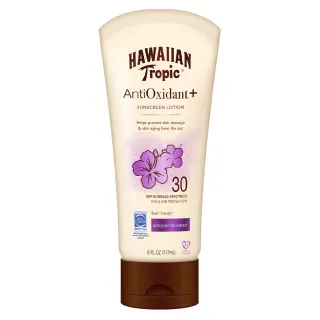
Hawaiian Tropic Antioxidant Plus Sunscreen Lotion SPF 30 With Green tea extract

Hawaiian Tropic Antioxidant Plus Sunscreen Lotion SPF 30 With Green tea extract

SPF 30Efficacy95/100IrritancyMedium·3 UV filters
Edit

Works for

2 of 2 advertised claims delivered

Sun protection
SPF 30 · 3 UV filters
Broad spectrum
SPF 30Broad spectrumChemical filtersWater-resistantNo white cast

This product offers a good level of protection against both UVB and UVA rays.

This sunscreen uses organic (so-called "chemical") sunscreen filters. Organic, or "chemical" filters usually provide reliable sun protection and rarely leave a white cast. Sunscreens with organic filters can sting eyes.

This product can be considered "reef safe" because it does not contain the UV filters (oxybenzone and octinoxate) that can be harmful to coral reefs when present in the water in high concentrations.

UV spectrum
UVB290–320 nmUVA II320–340 nmUVA I340–400 nm
Octocrylene
Homosalate
Avobenzone
FilterCoverageWhat it doesEst. amount
OctocryleneUVB Photo-stable A weak sunscreen that protects against the sun rays that cause sunburn (UVB) and is somewhat effective against the UVA rays. It is quite stable and can help stabilize other, more vulnerable, sunscreen ingredients like Avobenzone. It is an organic, or so called "chemical" sunscreen~22–33%
HomosalateUVB Photo-stable A weak sunscreen that offers some protection against the sun rays that cause sunburn (UVB), but does not offer meaningful protection against protect against the most aging sun rays (UVA). It loses its effectiveness quickly when exposed to sunlight. It is an organic, or so called "chemical" sunscreen. When used in low concentrations, helps to stabilize the product formulation7%
AvobenzoneButyl MethoxydibenzoylmethaneUVA1Avobenzone. An organic, or so-called "chemical" UV filter. Protects against both UVA and UVB rays. Needs to be combined with other filters in a formulation to be stable.2.2%
~ marks concentrations estimated from label position and typical use levels
Reef-safe
No oxybenzone or octinoxate — the two filters banned in Hawaii, Florida Keys and Aruba.
Anti-aging
3 ingredients credited for this claim
Strong support
What the product description says
“Spending time in the sun increases your risk of skin cancer and early skin aging.”
Source: Walgreens

This product can help prevent early signs of skin aging because it offers a good level of broad spectrum sun protection. Sun damage is the main cause of premature skin aging, and protecting your skin from the sun is the best anti-aging strategy.

Sodium ascorbyl phosphateEffect: LowA stable derivative of vitamin C. It is oil-soluble which means it is more likely to penetrate the skin compared to the pure form of vitamin C (which is water-soluble), but it is less bio-available and is way less effective in stimulating collagen and reducing wrinkles compared to the pure form of vitamin C (L-ascorbic acid) and its other derivatives (for example, magnesium ascorbyl phosphate). At the same time, this vitamin C derivative has been shown in studies to be effective in reducing acne, blemishes and clogged pores. It is less irritating then the pure form of vitamin C~0.05–0.25%
Camellia sinensis leaf extractEffect: Low, below effective doseCan contain potent anti-oxidant compounds (abbreviated ECG, GCG, EGC, and EGCG) that might help protect the skin from free radicals. Can help calm down inflammation and has some anti-bacterial properties. Unfortunately, these antioxidants are unstable and lose their effectiveness very quickly in products. The concentration of the antioxidant compounds in the extract also tends to be low to be effective in topical formulation~0.15–0.65%
Aloe barbadensis leaf juiceEffect: Low, below effective doseTraditionally used to treat sunburns, dermatitis and inflammation, but evidence for its effectiveness is lacking. The extract can contain humectants that help attract water into the skin~0.05–0.2%
Evens skin tone
Not advertised by the brand · 1 ingredient credited for this claim
Strong support

This product offers broad spectrum sun protection. It means that it can prevent hyperpigmentation and help keep the skin tone even (sun damage is the main factor causing age spots, darkening of post-acne marks and other discolorations).

Camellia sinensis leaf extractEffect: Low, below effective doseCan contain potent anti-oxidant compounds (abbreviated ECG, GCG, EGC, and EGCG) that might help protect the skin from free radicals. Can help calm down inflammation and has some anti-bacterial properties. Unfortunately, these antioxidants are unstable and lose their effectiveness very quickly in products. The concentration of the antioxidant compounds in the extract also tends to be low to be effective in topical formulation~0.15–0.65%
Anti-oxidation
Not advertised by the brand · 5 ingredients credited for this claim
Moderate support

This product contains antioxidants (sodium ascorbyl phosphate) that might be able to help neutralize free radicals in skin to lessen the damage it gets from the UV light (sun). There is not enough evidence to confirm their effectiveness in skin though.

Sodium ascorbyl phosphateKey activeEffect: MediumA stable derivative of vitamin C. It is oil-soluble which means it is more likely to penetrate the skin compared to the pure form of vitamin C (which is water-soluble), but it is less bio-available and is way less effective in stimulating collagen and reducing wrinkles compared to the pure form of vitamin C (L-ascorbic acid) and its other derivatives (for example, magnesium ascorbyl phosphate). At the same time, this vitamin C derivative has been shown in studies to be effective in reducing acne, blemishes and clogged pores. It is less irritating then the pure form of vitamin C~0.05–0.25%
Mangifera indica seed butterEffect: LowHelps to soften the upper layer of the skin and might have some anti-oxidant effect~0.15–0.5%
Psidium guajava fruit extractEffect: LowA fruit extract that might have some anti-oxidant effect~0.15–0.55%
Camellia sinensis leaf extractUnder-dosedEffect: MediumCan contain potent anti-oxidant compounds (abbreviated ECG, GCG, EGC, and EGCG) that might help protect the skin from free radicals. Can help calm down inflammation and has some anti-bacterial properties. Unfortunately, these antioxidants are unstable and lose their effectiveness very quickly in products. The concentration of the antioxidant compounds in the extract also tends to be low to be effective in topical formulation~0.15–0.65%
Tocopheryl acetateEffect: Low, below effective doseA more stable but less bio-available form of vitamin E compared to Tocopherol. Might help moisturize and protect the skin from free radicals, but mostly used in low concentrations to stabilize other ingredients.~0.15–0.55%
Moisturizing
Not advertised by the brand · 8 ingredients credited for this claim
Good support

This product contains good ingredients to attract water to the upper layer of the skin. These ingredients are called "humectants": glycerin.

When humectants are on the surface of the skin, they “pull in” the moisture from the outside environment, or from within deeper layers of the skin. If the air is dry, humectants can speed up the moisture loss from the skin. This is why it is a good idea to use another product on top of this one to help "seal in" the moisture (look for ingredients like dimethicone, squalane, oils and butters).

Mangifera indica seed butterKey activeEffect: HighHelps to soften the upper layer of the skin and might have some anti-oxidant effect~0.15–0.5%
GlycerinKey active· HumectantEffect: HighOne of the best moisturizing ingredients. Naturally present in skin. It attracts water to the upper layer of the skin working as a humectant~2.5–3.7%
Cetearyl alcoholKey active· EmollientEffect: MediumA non-drying alcohol. Works as an emollient. Helps water and oil mix together and creates a nice product texture~3–4.5%
Diisopropyl adipateKey active· EmollientEffect: MediumHelps soften the upper layer of the skin~4.2–6.4%
Mangifera indica fruit extractEffect: LowA fruit extract that might help attract water to the upper layer of the skin. There is no evidence of other benefits in skin~0.1–0.45%
PanthenolUnder-dosedEffect: HighHelps attract water to the upper layer of the skin and can help improve skin barrier function~0.05–0.2%
Aloe barbadensis leaf juiceEffect: Low, below effective doseTraditionally used to treat sunburns, dermatitis and inflammation, but evidence for its effectiveness is lacking. The extract can contain humectants that help attract water into the skin~0.05–0.2%
Camellia sinensis leaf extractEffect: Low, below effective doseCan contain potent anti-oxidant compounds (abbreviated ECG, GCG, EGC, and EGCG) that might help protect the skin from free radicals. Can help calm down inflammation and has some anti-bacterial properties. Unfortunately, these antioxidants are unstable and lose their effectiveness very quickly in products. The concentration of the antioxidant compounds in the extract also tends to be low to be effective in topical formulation~0.15–0.65%

Can it cause trouble?

Irritancy
2 strong irritants: Parfum, Carica papaya fruit extract
Medium risk
We flagged 16 ingredients with irritancy potential. Severity depends on your sensitivity threshold; the table lists the worst offenders first.
IngredientFunctionIrritationEst. amount
Benzyl alcoholA preservative. Can be used to mask unpleasant smell. Can be irritatingHigh~0.3–0.7%est.
Propylene glycolHelps oil and water mix together and can enhance the penetration of other ingredients into the skin. It can be irritatingHigh~0.8–1.2%est.
Coco-glucosideUsed as a cleansing agent (surfactant) in cleansers. Helps water and oil mix together in lotions. Can be irritatingHigh~0.4–0.9%est.
ParfumAn aromatic blend of unspecified and possibly irritating ingredientsHigh~0.15–0.65%est.
Psidium guajava fruit extractA fruit extract that might have some anti-oxidant effectHigh~0.15–0.55%est.
Carica papaya fruit extract—High~0.15–0.5%est.
Butyl methoxydibenzoylmethaneAvobenzone. An organic, or so-called "chemical" UV filter. Protects against both UVA and UVB rays. Needs to be combined with other filters in a formulation to be stable.Medium2.2%
HomosalateA weak sunscreen that offers some protection against the sun rays that cause sunburn (UVB), but does not offer meaningful protection against protect against the most aging sun rays (UVA). It loses its effectiveness quickly when exposed to sunlight. It is an organic, or so called "chemical" sunscreen. When used in low concentrations, helps to stabilize the product formulationMedium7%
OctocryleneA weak sunscreen that protects against the sun rays that cause sunburn (UVB) and is somewhat effective against the UVA rays. It is quite stable and can help stabilize other, more vulnerable, sunscreen ingredients like Avobenzone. It is an organic, or so called "chemical" sunscreenMedium~22–33%est.
Acrylates/c10-30 alkyl acrylate crosspolymerMaintains the texture of skincare products. Allows the product to spread evenly. Helps oil and water mix togetherMedium~0.55–1.25%est.
ChlorphenesinA preservativeMedium~0.16–0.32%est.
Disodium edtaStabilizes the product formulationMedium~0.15–0.6%est.
Tocopheryl acetateA more stable but less bio-available form of vitamin E compared to Tocopherol. Might help moisturize and protect the skin from free radicals, but mostly used in low concentrations to stabilize other ingredients.Medium~0.15–0.55%est.
Mangifera indica fruit extractA fruit extract that might help attract water to the upper layer of the skin. There is no evidence of other benefits in skinMedium~0.1–0.45%est.
Aloe barbadensis leaf juiceTraditionally used to treat sunburns, dermatitis and inflammation, but evidence for its effectiveness is lacking. The extract can contain humectants that help attract water into the skinMedium~0.05–0.2%est.
Sodium ascorbyl phosphateA stable derivative of vitamin C. It is oil-soluble which means it is more likely to penetrate the skin compared to the pure form of vitamin C (which is water-soluble), but it is less bio-available and is way less effective in stimulating collagen and reducing wrinkles compared to the pure form of vitamin C (L-ascorbic acid) and its other derivatives (for example, magnesium ascorbyl phosphate). At the same time, this vitamin C derivative has been shown in studies to be effective in reducing acne, blemishes and clogged pores. It is less irritating then the pure form of vitamin CMedium~0.05–0.25%est.
Comedogenic
1 ingredient rated 2 or more on the 0–5 pore-clogging scale
1 flagged
These ingredients have a comedogenic rating of 2 or more on a 0–5 scale; the table shows each one's rating. In leave-on products they can clog pores in acne-prone skin.
IngredientFunctionRatingEst. amount
Cetearyl alcoholA non-drying alcohol. Works as an emollient. Helps water and oil mix together and creates a nice product texture2/5~3–4.5%est.
Edit

User reviews

Would you recommend?
No community reviews yet.

Be the first — your take helps the next person decide.

Write a review · ~30s

Ingredients

Filter by role to see what each ingredient is doing.

Butyl methoxydibenzoylmethane2.2%
UV filterKey activeIrritant · medium
Irritation risk
Medium
Works for
Sun protection

Avobenzone. An organic, or so-called "chemical" UV filter. Protects against both UVA and UVB rays. Needs to be combined with other filters in a formulation to be stable.

More about Butyl methoxydibenzoylmethane
Homosalate7%
UV filterKey activeIrritant · medium
Irritation risk
Medium
Works for
Sun protection

A weak sunscreen that offers some protection against the sun rays that cause sunburn (UVB), but does not offer meaningful protection against protect against the most aging sun rays (UVA). It loses its effectiveness quickly when exposed to sunlight. It is an organic, or so called "chemical" sunscreen. When used in low concentrations, helps to stabilize the product formulation

More about Homosalate
Octocrylene~22–33%
UV filterKey activeIrritant · medium
Irritation risk
Medium
Works for
Sun protection

A weak sunscreen that protects against the sun rays that cause sunburn (UVB) and is somewhat effective against the UVA rays. It is quite stable and can help stabilize other, more vulnerable, sunscreen ingredients like Avobenzone. It is an organic, or so called "chemical" sunscreen

More about Octocrylene
Water~9.3–13.9%
Formula
Irritation risk
Low

Plain old water

More about Water
Diisopropyl adipate~4.2–6.4%
Key active
Irritation risk
Low
Works for
Moisturizing

Helps soften the upper layer of the skin

More about Diisopropyl adipate
Cetearyl alcohol~3–4.5%
Key activeComedogenic 2/5
Irritation risk
Low
Comedogenicity
2/5
Works for
CleansingMoisturizing

A non-drying alcohol. Works as an emollient. Helps water and oil mix together and creates a nice product texture

More about Cetearyl alcohol
Glycerin~2.5–3.7%
Key active
Irritation risk
Low
Works for
Moisturizing

One of the best moisturizing ingredients. Naturally present in skin. It attracts water to the upper layer of the skin working as a humectant

More about Glycerin
Phenoxyethanol~0.5–1%
Formula
Irritation risk
Low

A preservative. It helps prevent bacterial growth in cosmetic products

More about Phenoxyethanol
Benzyl alcohol~0.3–0.7%
Irritant · high
Irritation risk
High

A preservative. Can be used to mask unpleasant smell. Can be irritating

More about Benzyl alcohol
Acrylates/c12-22 alkyl methacrylate copolymer~1.1–1.7%
Formula
Propylene glycol~0.8–1.2%
Irritant · high
Irritation risk
High
Works for
Moisturizing

Helps oil and water mix together and can enhance the penetration of other ingredients into the skin. It can be irritating

More about Propylene glycol
Acrylates/c10-30 alkyl acrylate crosspolymer~0.55–1.25%
Irritant · medium
Irritation risk
Medium

Maintains the texture of skincare products. Allows the product to spread evenly. Helps oil and water mix together

More about Acrylates/c10-30 alkyl acrylate crosspolymer
Dicetyl phosphate~0.45–1.05%
Formula
Irritation risk
Low
Works for
Cleansing
More about Dicetyl phosphate
Ceteth-10 phosphate~0.4–1%
Formula
Irritation risk
Low
Works for
Cleansing
More about Ceteth-10 phosphate
Coco-glucoside~0.4–0.9%
Irritant · high
Irritation risk
High
Works for
Cleansing

Used as a cleansing agent (surfactant) in cleansers. Helps water and oil mix together in lotions. Can be irritating

More about Coco-glucoside
Chlorphenesin~0.16–0.32%
Irritant · medium
Irritation risk
Medium

A preservative

More about Chlorphenesin
Parfum~0.15–0.65%
Irritant · high
Irritation risk
High

An aromatic blend of unspecified and possibly irritating ingredients

More about Parfum
Xanthan gum~0.2–0.7%
Formula
Irritation risk
Low
Works for
Cleansing

Used to create a thicker product consistency

More about Xanthan gum
Sodium hydroxide~0.15–0.65%
Formula
Irritation risk
Low

Used to adjust the product's pH

More about Sodium hydroxide
Camellia sinensis leaf extract~0.15–0.65%
Under-dosed
Irritation risk
Low
Works for
Anti-oxidationAntibacterialAnti-agingMoisturizingEvens skin toneAnti-blemish

Can contain potent anti-oxidant compounds (abbreviated ECG, GCG, EGC, and EGCG) that might help protect the skin from free radicals. Can help calm down inflammation and has some anti-bacterial properties. Unfortunately, these antioxidants are unstable and lose their effectiveness very quickly in products. The concentration of the antioxidant compounds in the extract also tends to be low to be effective in topical formulation

More about Camellia sinensis leaf extract
Disodium edta~0.15–0.6%
Irritant · medium
Irritation risk
Medium

Stabilizes the product formulation

More about Disodium edta
Tocopheryl acetate~0.15–0.55%
Irritant · medium
Irritation risk
Medium
Works for
Anti-oxidation

A more stable but less bio-available form of vitamin E compared to Tocopherol. Might help moisturize and protect the skin from free radicals, but mostly used in low concentrations to stabilize other ingredients.

More about Tocopheryl acetate
Mangifera indica seed butter~0.15–0.5%
Key active
Irritation risk
Low
Works for
MoisturizingAnti-oxidation

Helps to soften the upper layer of the skin and might have some anti-oxidant effect

More about Mangifera indica seed butter
Psidium guajava fruit extract~0.15–0.55%
Irritant · high
Irritation risk
High
Works for
Anti-oxidation

A fruit extract that might have some anti-oxidant effect

More about Psidium guajava fruit extract
Carica papaya fruit extract~0.15–0.5%
Irritant · high
Mangifera indica fruit extract~0.1–0.45%
Irritant · medium
Irritation risk
Medium
Works for
Moisturizing

A fruit extract that might help attract water to the upper layer of the skin. There is no evidence of other benefits in skin

More about Mangifera indica fruit extract
Passiflora incarnata fruit extract~0.1–0.35%
Formula
Plumeria acutifolia flower extract~0.1–0.4%
Formula
Panthenol~0.05–0.2%
Under-dosed
Irritation risk
Low
Works for
Reduces rednessMoisturizingReduces irritation

Helps attract water to the upper layer of the skin and can help improve skin barrier function

More about Panthenol
Aloe barbadensis leaf juice~0.05–0.2%
Irritant · medium
Irritation risk
Medium
Works for
MoisturizingAntibacterialAnti-inflammatoryReduces rednessReduces irritationAnti-blemishAnti-aging

Traditionally used to treat sunburns, dermatitis and inflammation, but evidence for its effectiveness is lacking. The extract can contain humectants that help attract water into the skin

More about Aloe barbadensis leaf juice
Sodium ascorbyl phosphate~0.05–0.25%
Key activeIrritant · medium
Irritation risk
Medium
Works for
Anti-blemishAnti-oxidationAnti-aging

A stable derivative of vitamin C. It is oil-soluble which means it is more likely to penetrate the skin compared to the pure form of vitamin C (which is water-soluble), but it is less bio-available and is way less effective in stimulating collagen and reducing wrinkles compared to the pure form of vitamin C (L-ascorbic acid) and its other derivatives (for example, magnesium ascorbyl phosphate). At the same time, this vitamin C derivative has been shown in studies to be effective in reducing acne, blemishes and clogged pores. It is less irritating then the pure form of vitamin C

More about Sodium ascorbyl phosphate
Ingredient list view

Butyl methoxydibenzoylmethane, Homosalate, Octocrylene, Water, Diisopropyl adipate, Cetearyl alcohol, Glycerin, Phenoxyethanol, Benzyl alcohol, Acrylates/c12-22 alkyl methacrylate copolymer, Propylene glycol, Acrylates/c10-30 alkyl acrylate crosspolymer, Dicetyl phosphate, Ceteth-10 phosphate, Coco-glucoside, Chlorphenesin, Parfum, Xanthan gum, Sodium hydroxide, Camellia sinensis leaf extract, Disodium edta, Tocopheryl acetate, Mangifera indica seed butter, Psidium guajava fruit extract, Carica papaya fruit extract, Mangifera indica fruit extract, Passiflora incarnata fruit extract, Plumeria acutifolia flower extract, Panthenol, Aloe barbadensis leaf juice, Sodium ascorbyl phosphate

Compare prices

Retailers ranked by price — lowest first.

Walgreens
$13.99
Buy
Amazon US
Price unavailable
Check

Affiliate links · prices updated regularly · As an Amazon Associate, WIMJ earns from qualifying purchases.

Worth comparing, line by line.

Match % combines shared ingredients, the first five ingredients, shared actives and hero ingredients, irritancy (lower counts in the alternative's favour), texture and body area. Only products in the same routine step are compared.

Side-by-side comparison of this product against its closest alternatives
Hawaiian TropicAntioxidant Plus Sunscreen Lotion SPF 30 With Green tea extractYOUR PRODUCTBanana BoatKids Advanced Protection Tottle SPF 50SoltanOnce Face SPF50+Hello SundayThe One That's A Serum Face Sunscreen SPF 45
Match—65%59%58%
Price$12.49$8.58−$3.91$13.22+$0.73$26.44+$13.95
Shared key ingredients—5 of 74 of 74 of 7
Key difference—Butyloctyl SalicylateButyrospermum Parkii ButterGluconolactone
Irritancy Medium Low Medium Low
SPFSPF 30SPF 50SPF 50SPF 45
Drying alcohol————
View product Shop Shop Shop
Cheaper alternatives? See how this stacks up against similar formulas.
We compare ingredient profiles across our catalog — pick the closest match for your budget.
Open dupe finder

Product summary

Based on the ingredients included, we believe that "Hawaiian Tropic - Antioxidant Plus Sunscreen Lotion SPF 30 With Green tea extract" can offer reliable sun protection. It can protect from both UVA and UVB rays. This is great news because not all sunscreens with SPF ratings give UVA protection. (UVA rays do not cause sunburn, but still damage our skin and lead to early aging).

Because it includes good moisturizing ingredients, it can also work as a hydrating day cream. Like all broad-spectrum sunscreens, this product helps prevent early signs of aging.

Sunscreen filters

This is a so-called "chemical" sunscreen. It means that it uses organic UV filters. They typically offer good sun protection and rarely leave a white cast, but they can be irritating for some people with sensitive skin. The UV filters in this sunscreen are: avobenzone 2.20% (declared), homosalate 7.00% (declared) and octocrylene 22.00% - 33.00%.

Irritation risk

This sunscreen contains a bunch of common irritants, including ingredients that do not provide any known benefit for the skin. It might not be the best choice if your skin is sensitive. We assess the overall irritancy of it to be medium. For a detailed overview of all potential irritants: click here

You can see the detailed formula review with the breakdown of all actives in the product and the full ingredient list with estimated concentrations in the tables below.

Price

The product retails from 7.68$ up to 13.99$ in the United States.

For a detailed price comparison: click here.

Sources cited in this review

Every concentration estimate and effectiveness label is anchored to one of these 20 studies and safety reviews.

  1. 1
  2. 2
  3. 3
  4. 4
    Propylene Glycolpubmed.ncbi.nlm.nih.gov
  5. 5
  6. 6
Hawaiian Tropic Antioxidant Plus Sunscreen Lotion SPF 30 With Green tea extract
Hawaiian TropicAntioxidant Plus Sunscreen Lotion SPF 30 With Green tea extract

Affiliate links · As an Amazon Associate, WIMJ earns from qualifying purchases.

As an Amazon Associate, WIMJ earns from qualifying purchases.