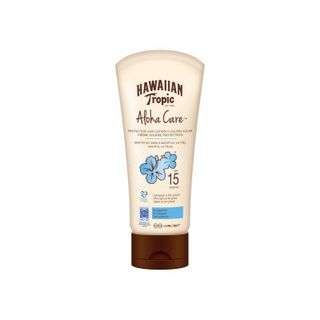
Hawaiian Tropic Aloha Care Protective Lotion SPF15
Works for
0 of 1 advertised claim delivered
Sun protectionSPF 15 · 4 UV filters · Broad spectrumWeak protectionSPF under 30
This product offers broad spectrum sun protection, but it is weak. We recommend to use a broad spectrum sunscreen with at least SPF 30.
This product can be considered "reef safe" because it does not contain the UV filters (oxybenzone and octinoxate) that can be harmful to coral reefs when present in the water in high concentrations.
MoisturizingNot advertised by the brand · 6 ingredients credited for this claimGood support
This product contains good ingredients to attract water to the upper layer of the skin. These ingredients are called "humectants": glycerin, caprylyl glycol.
When humectants are on the surface of the skin, they “pull in” the moisture from the outside environment, or from within deeper layers of the skin. If the air is dry, humectants can speed up the moisture loss from the skin. This is why it is a good idea to use another product on top of this one to help "seal in" the moisture (look for ingredients like dimethicone, squalane, oils and butters).
Can it cause trouble?
Irritancy4 strong irritants: Parfum, Carica papaya fruit extract + 2 more — patch-test recommendedHigh risk
Comedogenic1 ingredient rated 2 or more on the 0–5 pore-clogging scale1 flagged
User reviews
Be the first — your take helps the next person decide.
Ingredients
Filter by role to see what each ingredient is doing.
Water~45–55%
Diisopropyl adipate~6.7–8.2%
- Irritation risk
- Low
Helps soften the upper layer of the skin
More about Diisopropyl adipateEthylhexyl salicylate~4.7–5.8%
- Irritation risk
- Low
Octisalate. A UV filter. It offers some protection against the sun rays that cause sunburn (UVB), but does not protect against the most aging sun rays (UVA). It loses its effectiveness quickly when exposed to sunlight. It is an organic, or so called "chemical" sunscreen
More about Ethylhexyl salicylateOctocrylene~3.7–4.5%
- Irritation risk
- Medium
A weak sunscreen that protects against the sun rays that cause sunburn (UVB) and is somewhat effective against the UVA rays. It is quite stable and can help stabilize other, more vulnerable, sunscreen ingredients like Avobenzone. It is an organic, or so called "chemical" sunscreen
More about OctocryleneHomosalate~3.3–4%
- Irritation risk
- Medium
A weak sunscreen that offers some protection against the sun rays that cause sunburn (UVB), but does not offer meaningful protection against protect against the most aging sun rays (UVA). It loses its effectiveness quickly when exposed to sunlight. It is an organic, or so called "chemical" sunscreen. When used in low concentrations, helps to stabilize the product formulation
More about HomosalateSilica~2.2–2.6%
Butyl methoxydibenzoylmethane~2.1–2.6%
- Irritation risk
- Medium
Avobenzone. An organic, or so-called "chemical" UV filter. Protects against both UVA and UVB rays. Needs to be combined with other filters in a formulation to be stable.
More about Butyl methoxydibenzoylmethaneCetearyl alcohol~1.5–1.8%
- Irritation risk
- Low
- Comedogenicity
- 2/5
A non-drying alcohol. Works as an emollient. Helps water and oil mix together and creates a nice product texture
More about Cetearyl alcoholGlycerin~1.2–1.5%
- Irritation risk
- Low
One of the best moisturizing ingredients. Naturally present in skin. It attracts water to the upper layer of the skin working as a humectant
More about GlycerinPhenoxyethanol~0.5–1%
- Irritation risk
- Low
A preservative. It helps prevent bacterial growth in cosmetic products
More about PhenoxyethanolTapioca starch~0.7–1%
Vp/eicosene copolymer~0.6–0.9%
- Irritation risk
- Medium
Used to improve the product adherence to the skin, for example, to pro-long the protective effect of sunscreens. Can be irritating to very sensitive skin
More about Vp/eicosene copolymerCaprylyl glycol~0.55–0.8%
- Irritation risk
- Medium
Helps preserve products and creates a nice product texture
More about Caprylyl glycolAcrylates/c12-22 alkyl methacrylate copolymer~0.5–0.75%
- Irritation risk
- Low
Acrylates/c10-30 alkyl acrylate crosspolymer~0.45–0.7%
- Irritation risk
- Medium
Maintains the texture of skincare products. Allows the product to spread evenly. Helps oil and water mix together
More about Acrylates/c10-30 alkyl acrylate crosspolymerDicetyl phosphate~0.45–0.65%
Ceteth-10 phosphate~0.5–0.75%
Coco-glucoside~0.45–0.7%
- Irritation risk
- High
Used as a cleansing agent (surfactant) in cleansers. Helps water and oil mix together in lotions. Can be irritating
More about Coco-glucosideParfum~0.3–0.55%
- Irritation risk
- High
An aromatic blend of unspecified and possibly irritating ingredients
More about ParfumChlorphenesin~0.16–0.32%
Xanthan gum~0.3–0.5%
- Irritation risk
- Low
Used to create a thicker product consistency
More about Xanthan gumSodium hydroxide~0.25–0.45%
Disodium edta~0.2–0.4%
Sea salt~0.2–0.4%
- Irritation risk
- Medium
Used to thicken the product formulation and might help to add minerals to the surface of the skin. It is used in scrubs as a physical exfoliant. Can increase sensitivity to other ingredients if left on the skin or used in high concentration
More about Sea saltPolymethylsilsesquioxane~0.25–0.45%
- Irritation risk
- Low
A silicone that improves product texture and helps dissolve other ingredients. Can form a non-greasy film on the skin to prevent moisture loss
More about PolymethylsilsesquioxanePsidium guajava fruit extract~0.2–0.4%
- Irritation risk
- High
A fruit extract that might have some anti-oxidant effect
More about Psidium guajava fruit extractPlumeria acutifolia flower extract~0.2–0.35%
- Irritation risk
- Low
Passiflora incarnata fruit extract~0.15–0.3%
- Irritation risk
- Low
Mangifera indica fruit extract~0.15–0.25%
- Irritation risk
- Medium
A fruit extract that might help attract water to the upper layer of the skin. There is no evidence of other benefits in skin
More about Mangifera indica fruit extractCarica papaya fruit extract~0.1–0.2%
- Irritation risk
- High
Hexyl cinnamal~0.1–0.15%
Linalool~0.05–0.1%
Ingredient list view
Water, Diisopropyl adipate, Ethylhexyl salicylate, Octocrylene, Homosalate, Silica, Butyl methoxydibenzoylmethane, Cetearyl alcohol, Glycerin, Phenoxyethanol, Tapioca starch, Vp/eicosene copolymer, Caprylyl glycol, Acrylates/c12-22 alkyl methacrylate copolymer, Acrylates/c10-30 alkyl acrylate crosspolymer, Dicetyl phosphate, Ceteth-10 phosphate, Coco-glucoside, Parfum, Chlorphenesin, Xanthan gum, Sodium hydroxide, Disodium edta, Sea salt, Polymethylsilsesquioxane, Psidium guajava fruit extract, Plumeria acutifolia flower extract, Passiflora incarnata fruit extract, Mangifera indica fruit extract, Carica papaya fruit extract, Hexyl cinnamal, Linalool
Compare prices
Retailers ranked by price — lowest first.
Affiliate links · prices updated regularly · As an Amazon Associate, WIMJ earns from qualifying purchases.
Product summary
"Hawaiian Tropic - Aloha Care Protective Lotion SPF15" "is a broad spectrum sunscreen meaning that it protects both from UVB rays (" burning "- they cause sunburn) and UVA rays (" aging "- they don't cause sunburn but lead to premature aging and pigmentation issues). However, this moisturizer does not offer enough sun protection. We recommend to use a sunscreen with at least SPF 30 daily.
This moisturizer should also be hydrating enough to use without an additional moisturizer during the day.
Sunscreen filters
This sunscreen uses so-called" chemical ", or organic UV filters (organic simply means that their molecules contain atoms of carbon). These filters typically give good sun protection and rarely leave a white cast, but they can be irritating for sensitive skin. The UV filters in this sunscreen are: avobenzone 2.10% - 2.60%, octisalate 4.70% - 5.80%, homosalate 3.30% - 4.00% and octocrylene 3.70% - 4.50%.
Irritation risk
This moisturizer contains a bunch of common irritants, including ingredients that do not provide any known benefit for the skin. It might not be the best choice if your skin is sensitive. We assess the overall irritancy of this moisturizer to be high. For a detailed overview of all potential irritants: click here
You can see the detailed formula review with the breakdown of all actives in the product and the full ingredient list with estimated concentrations in the tables below.
Price
The product retails from 8.89£ up to 14.99£ in the United Kingdom.
For a detailed price comparison: click here.
Sources cited in this review
Every concentration estimate and effectiveness label is anchored to one of these 6 studies and safety reviews.
- 1
- 2
- 3
- 4
- 5Allergen of the Year—Alkyl Glucosidepracticeupdate.com
- 6

Affiliate links · As an Amazon Associate, WIMJ earns from qualifying purchases.