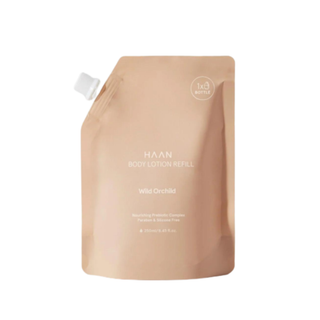
Works for
1 of 1 advertised claim delivered
Moisturizing7 ingredients credited for this claimGood support
“Deeply nourish your body with this lotion that will leave your skin healthier, smoother and softer.”
This product can help improve hydration of the skin with the two types of ingredients.
The first type is called “humectants”:
these ingredients help attract water.
When humectants are on the surface of the skin, they “pull in” the moisture from the outside environment, or from
within deeper layers of the skin. The following ingredients in this product do the job:
fructose, glycerin.
This product also contains ingredients called “occlusives”. They help reduce the speed with which our skin loses moisture to the outside environment. These ingredients also help soften the upper layer of the skin, so it feels less tight and nicer to the touch. The following ingredients in this product do the job: butyrospermum parkii butter, caprylic/capric triglyceride.
Can it cause trouble?
Irritancy8 strong irritants: Parfum, Hexyl cinnamal + 6 more — patch-test recommendedHigh risk
Comedogenic1 ingredient rated 2 or more on the 0–5 pore-clogging scale1 flagged
User reviews
Be the first — your take helps the next person decide.
Ingredients
Filter by role to see what each ingredient is doing.
Water~40–60%
Caprylic/capric triglyceride~5.6–8.4%
- Irritation risk
- Medium
A good mix of fatty acids that forms a protective layer on the skin. Improves the shelf life of products. Derived from coconut and glycerin
More about Caprylic/capric triglycerideButyrospermum parkii butter~4.1–6.1%
- Irritation risk
- Low
- Comedogenicity
- 3/5
A great moisturising ingredient that softens the skin and reduces water loss from its upper layer. It also can be helpful in protecting skin from free radicals
More about Butyrospermum parkii butterGlycerin~2.8–4.2%
- Irritation risk
- Low
One of the best moisturizing ingredients. Naturally present in skin. It attracts water to the upper layer of the skin working as a humectant
More about GlycerinPolyglyceryl-3 dicitrate/stearate~2.1–3.2%
Cetyl alcohol~1.8–2.7%
- Irritation risk
- Low
A non-drying alcohol that works to soften the skin and stabilize product formulations helping oil and water mix together
More about Cetyl alcoholPhenylpropanol~1.5–2.2%
- Irritation risk
- High
Helps mask the smell of other ingredients and helps preserve the product formulation
More about PhenylpropanolMethylsilanol mannuronate~1.2–1.9%
- Irritation risk
- Low
Inulin~1–1.6%
- Irritation risk
- Low
Helps attract water to the upper layer of the skin. Is claimed to support the growth of "good" bacteria in skin (as a "prebiotic"), but the research is lacking
More about InulinXanthan gum~0.85–1.25%
- Irritation risk
- Low
Used to create a thicker product consistency
More about Xanthan gumParfum~0.5–1.15%
- Irritation risk
- High
An aromatic blend of unspecified and possibly irritating ingredients
More about Parfum1,2-hexanediol~0.4–0.95%
Sodium acrylates copolymer~0.4–0.9%
- Irritation risk
- Medium
Used to create a thicker product consistency
More about Sodium acrylates copolymerLecithin~0.4–0.9%
- Irritation risk
- Low
Used mostly for creating emulsions - helping oil and water mix together. Helps soften the upper layer of the skin
More about LecithinFructose~0.3–0.75%
- Irritation risk
- Low
Helps attract water to the upper layer of the skin
More about FructoseSodium phytate~0.15–0.7%
Hexyl cinnamal~0.15–0.55%
Benzyl salicylate~0.1–0.45%
Linalool~0.1–0.4%
Limonene~0.1–0.35%
- Irritation risk
- High
A common frangrance that can easily irritate skin, especially if exposed to air, light or heat
More about LimoneneCoumarin~0.05–0.3%
Phenoxyethanol~0.1–0.3%
- Irritation risk
- Low
A preservative. It helps prevent bacterial growth in cosmetic products
More about PhenoxyethanolGeraniol~0.05–0.2%
Sorbic acid~0.05–0.25%
Alcohol~0.05–0.15%
- Irritation risk
- High
Can be drying and contribute to skin irritation. Used in formulars to dissolve other ingredients, create a thinner product consistency or for its antibacterial properties
More about AlcoholIngredient list view
Water, Caprylic/capric triglyceride, Butyrospermum parkii butter, Glycerin, Polyglyceryl-3 dicitrate/stearate, Cetyl alcohol, Phenylpropanol, Methylsilanol mannuronate, Inulin, Xanthan gum, Parfum, 1,2-hexanediol, Sodium acrylates copolymer, Lecithin, Fructose, Sodium phytate, Hexyl cinnamal, Benzyl salicylate, Linalool, Limonene, Coumarin, Phenoxyethanol, Geraniol, Sorbic acid, Alcohol
Compare prices
Retailers ranked by price — lowest first.
Affiliate links · prices updated regularly · As an Amazon Associate, WIMJ earns from qualifying purchases.
Sources cited in this review
Every concentration estimate and effectiveness label is anchored to one of these 5 studies and safety reviews.
- 1
- 2
- 3
- 4
- 5

Affiliate links · As an Amazon Associate, WIMJ earns from qualifying purchases.