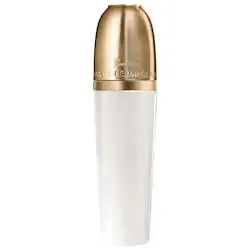
GUERLAIN The Radiance Concentrate Youth Replenisher - Brightening
Works for
3 of 3 advertised claims delivered
Moisturizing20 ingredients credited for this claimStrong support
“Dark Spots, Fine Lines and Wrinkles, and Dryness Formulation.”
This product can help improve hydration of the skin with the two types of ingredients.
The first type is called “humectants”:
these ingredients help attract water.
When humectants are on the surface of the skin, they “pull in” the moisture from the outside environment, or from
within deeper layers of the skin. The following ingredients in this product do the job:
glycerin, polyglycerin-3.
This product also contains ingredients called “occlusives”. They help reduce the speed with which our skin loses moisture to the outside environment. These ingredients also help soften the upper layer of the skin, so it feels less tight and nicer to the touch. The following ingredients in this product do the job: caprylic/capric triglyceride, dimethicone.
The following ingredients in this product are especially good for supporting the skin barrier and helping with the hydration level: hexapeptide-2
Anti-aging4 ingredients credited for this claimStrong support
“Dark Spots, Fine Lines and Wrinkles, and Dryness Formulation.”
This product can help reduce and prevent fine lines and wrinkles, improve skin elasticity and firmness because it contains adenosine.
These ingredients in the product can also be helpful, even though there is less evidence for their effectiveness: hexapeptide-2.
Keep in mind that it typically takes at least 6 weeks to notice any results because the changes that are needed to improve fine lines and elasticity happen in the deeper layers of the skin. No topical anti-aging product can “erase” wrinkles or fully reverse signs of aging.
Evens skin tone2 ingredients credited for this claimModerate support
“Dark Spots, Fine Lines and Wrinkles, and Dryness Formulation.”
The following ingredient (ingredients) in this product might be helpful, but there is no evidence to confirm that it actually works: stearyl glycyrrhetinate.
Can it cause trouble?
Irritancy8 strong irritants: Alcohol, Parfum + 6 more — patch-test recommendedHigh risk
ComedogenicClean of flagged comedogenic ingredientsNone flagged
User reviews
Be the first — your take helps the next person decide.
Ingredients
Filter by role to see what each ingredient is doing.
Water~45–55%
Glycerin~5–6.2%
- Irritation risk
- Low
One of the best moisturizing ingredients. Naturally present in skin. It attracts water to the upper layer of the skin working as a humectant
More about GlycerinDimethicone~3.9–4.7%
- Irritation risk
- Low
A silicone that helps to reduce water loss from the surface of the skin. Can temporarily "fill in" lines and wrinkles, absorb oil, and create a nice product finish
More about DimethiconeAlcohol~2.9–3.6%
- Irritation risk
- High
Can be drying and contribute to skin irritation. Used in formulars to dissolve other ingredients, create a thinner product consistency or for its antibacterial properties
More about AlcoholCaprylic/capric triglyceride~2.3–2.8%
- Irritation risk
- Medium
A good mix of fatty acids that forms a protective layer on the skin. Improves the shelf life of products. Derived from coconut and glycerin
More about Caprylic/capric triglycerideButylene glycol~1.7–2.1%
- Irritation risk
- Low
Used to create a nice product texture and help delivery of other ingredients. Might be somewhat helpful in attracting water to the upper layer of the skin
More about Butylene glycolPolyglycerin-3~1.5–1.8%
- Irritation risk
- Low
Helps to attract water to the upper layer of the skin
More about Polyglycerin-3Squalane~1.4–1.7%
- Irritation risk
- Low
An oil naturally present in skin. Works as an emollient to soften the skin and form a protective layer on its surface without a greasy feeling.
More about SqualaneSilica~1.3–1.5%
C14-22 alcohols~0.7–1.05%
- Irritation risk
- Low
A non-drying alcohol that helps stabilize product formulations
More about C14-22 alcoholsGastrodia elata root extract~0.5–0.75%
- Irritation risk
- Low
Phalaenopsis amabilis extract~0.45–0.65%
- Irritation risk
- Low
Dendrobium nobile extract~0.35–0.65%
- Irritation risk
- Medium
A plant extract has antimicrobal properties and might help reduce inflammation
More about Dendrobium nobile extractLactic acid~0.3–0.6%
- Irritation risk
- Medium
An exfoliating and moisturizing alpha-hydroxy acid (AHA). Typically causes less irritation than other AHAs, for example, glycolic acid. At high concentrations (about 15%), lactic acid can help reduce lines and wrinkles. Recent studies show that lactic acid can support the "good" bacteria living on skin's surface (healthy skin microbiome)
More about Lactic acidSteareth-21~0.45–0.65%
Synthetic fluorphlogopite~0.3–0.55%
- Irritation risk
- Low
A mineral that is used as an optical filter (makes the skin looks nicer through light reflection) and to improve the texture of cosmetic products
More about Synthetic fluorphlogopitePhenoxyethanol~0.3–0.55%
- Irritation risk
- Low
A preservative. It helps prevent bacterial growth in cosmetic products
More about PhenoxyethanolDecyloxazolidinone~0.25–0.5%
Parfum~0.2–0.4%
- Irritation risk
- High
An aromatic blend of unspecified and possibly irritating ingredients
More about ParfumPolymethylsilsesquioxane~0.2–0.4%
- Irritation risk
- Low
A silicone that improves product texture and helps dissolve other ingredients. Can form a non-greasy film on the skin to prevent moisture loss
More about PolymethylsilsesquioxaneCoco-glucoside~0.25–0.45%
- Irritation risk
- High
Used as a cleansing agent (surfactant) in cleansers. Helps water and oil mix together in lotions. Can be irritating
More about Coco-glucosideSodium citrate~0.15–0.3%
- Irritation risk
- Medium
Helps to control the skin's pH level. Maintains the skin's natural film of amino-lactic acids and oils. Helps to preserve products
More about Sodium citrateSodium hydroxide~0.15–0.25%
C12-20 alkyl glucoside~0.15–0.3%
- Irritation risk
- Medium
Helps water and oil mix together
More about C12-20 alkyl glucosideCoconut alcohol~0.2–0.35%
Pentylene glycol~0.2–0.35%
- Irritation risk
- Medium
Used to preserve products, dissolve other ingredients and create a nice product texture
More about Pentylene glycolSodium stearoyl glutamate~0.2–0.35%
- Irritation risk
- Medium
Helps oil and water mix together
More about Sodium stearoyl glutamateCi 77891~0.15–0.25%
- Irritation risk
- Low
Titanium dioxide~0.2–0.4%
- Irritation risk
- Low
Works as a UV filter when used in high concentrations. It is photostable and is effective mostly against the UVB light, with some protection in the UVA range. In small concentrations, used for its ability to improve the color of cosmetic products. Is usually well tolerated by the skin
More about Titanium dioxideBehenyl alcohol~0.2–0.35%
- Irritation risk
- Low
Non-drying alcohol that helps water and oil mix together. Also serves as an emollient
More about Behenyl alcoholBatyl alcohol~0.15–0.3%
- Irritation risk
- Low
Non-drying alcohol. Used to stabilize other ingredients and is an emollient
More about Batyl alcoholTocopheryl acetate~0.15–0.3%
- Irritation risk
- Medium
A more stable but less bio-available form of vitamin E compared to Tocopherol. Might help moisturize and protect the skin from free radicals, but mostly used in low concentrations to stabilize other ingredients.
More about Tocopheryl acetateXanthan gum~0.15–0.3%
- Irritation risk
- Low
Used to create a thicker product consistency
More about Xanthan gumAcrylates/c10-30 alkyl acrylate crosspolymer~0.15–0.3%
- Irritation risk
- Medium
Maintains the texture of skincare products. Allows the product to spread evenly. Helps oil and water mix together
More about Acrylates/c10-30 alkyl acrylate crosspolymerCetyl palmitate~0.15–0.3%
- Irritation risk
- Low
An emollient that helps soften the skin and is used to improve product texture and stability
More about Cetyl palmitateMenthoxypropanediol~0.15–0.25%
Sodium hyaluronate~0.15–0.25%
- Irritation risk
- Low
One of the best moisturizing ingredients. Attracts water into the upper layer of the skin
More about Sodium hyaluronateLecithin~0.2–0.35%
- Irritation risk
- Low
Used mostly for creating emulsions - helping oil and water mix together. Helps soften the upper layer of the skin
More about LecithinStearyl glycyrrhetinate~0.15–0.25%
- Irritation risk
- Medium
A fatty acid derived from licorice. Works as an emollient and can help calm down inflammation
More about Stearyl glycyrrhetinatePolysorbate 80~0.15–0.3%
Sorbitan stearate~0.15–0.3%
Citric acid~0.15–0.25%
- Irritation risk
- Medium
Can work as an exfoliant but is typically used to adjust the product pH
More about Citric acidMalva sylvestris extract~0.15–0.25%
- Irritation risk
- High
Adenosine~0.15–0.25%
- Irritation risk
- Low
Might help improve cell turnover and reduce inflammation in skin. One study shows that the ingredients might be able to help reduce dynamic wrinkles (for example, in the corners of the eyes or on the forehead)
More about AdenosineLinalool~0.1–0.25%
Helianthus annuus seed extract~0.15–0.25%
- Irritation risk
- Low
Alpha-isomethyl ionone~0.1–0.2%
- Irritation risk
- High
A fragrance. Potential allergen and can be irritating
More about Alpha-isomethyl iononeGeraniol~0.1–0.25%
Sodium metabisulfite~0.1–0.2%
Sodium benzoate~0.15–0.25%
Tin oxide~0.25–0.4%
- Irritation risk
- Low
A colorant that can add a pearl-like appearance to the formulation
More about Tin oxidePotassium sorbate~0.15–0.25%
Tropaeolum majus extract~0.1–0.2%
- Irritation risk
- Medium
Citronellol~0.1–0.15%
Hydrogenated lecithin~0.15–0.25%
- Irritation risk
- Low
Helps to retain moisture by creating a protective barrier on the skin. Rich in fatty acids. Improves product texture and helps with the penetration of other ingredients.
More about Hydrogenated lecithinLimonene~0.1–0.15%
- Irritation risk
- High
A common frangrance that can easily irritate skin, especially if exposed to air, light or heat
More about LimoneneEthylhexylglycerin~0.1–0.15%
Diamond powder~0.15–0.3%
- Irritation risk
- Low
Does not have known skin benefits. Might help create an optical illusion of smoother skin
More about Diamond powderTocopherol~0.1–0.2%
- Irritation risk
- Low
Pure form of vitamin E. Can help moisturise and protect the skin from free radicals. Often used to help stabilise other ingredients or the formula itself
More about TocopherolGlucose~0.1–0.2%
- Irritation risk
- Low
Helps attract water to the upper layer of the skin. Could be helpful in restoring the skin barrier function
More about GlucoseBht~0.1–0.2%
Palmitoyl tetrapeptide-10~0.05–0.15%
- Irritation risk
- Low
Hexapeptide-2~0.05–0.1%
- Irritation risk
- Low
A type of peptide. Peptides are excellent moisturizers and might be able support collagen production reducing fine lines and wrinkles
More about Hexapeptide-2Ingredient list view
Water, Glycerin, Dimethicone, Alcohol, Caprylic/capric triglyceride, Butylene glycol, Polyglycerin-3, Squalane, Silica, C14-22 alcohols, Gastrodia elata root extract, Phalaenopsis amabilis extract, Dendrobium nobile extract, Lactic acid, Steareth-21, Synthetic fluorphlogopite, Phenoxyethanol, Decyloxazolidinone, Parfum, Polymethylsilsesquioxane, Coco-glucoside, Sodium citrate, Sodium hydroxide, C12-20 alkyl glucoside, Coconut alcohol, Pentylene glycol, Sodium stearoyl glutamate, Ci 77891, Titanium dioxide, Behenyl alcohol, Batyl alcohol, Tocopheryl acetate, Xanthan gum, Acrylates/c10-30 alkyl acrylate crosspolymer, Cetyl palmitate, Menthoxypropanediol, Sodium hyaluronate, Lecithin, Stearyl glycyrrhetinate, Polysorbate 80, Sorbitan stearate, Citric acid, Malva sylvestris extract, Adenosine, Linalool, Helianthus annuus seed extract, Alpha-isomethyl ionone, Geraniol, Sodium metabisulfite, Sodium benzoate, Tin oxide, Potassium sorbate, Tropaeolum majus extract, Citronellol, Hydrogenated lecithin, Limonene, Ethylhexylglycerin, Diamond powder, Tocopherol, Glucose, Bht, Palmitoyl tetrapeptide-10, Hexapeptide-2
Compare prices
Retailers ranked by price — lowest first.
Affiliate links · prices updated regularly
Product summary
Based on the ingredients included, "GUERLAIN - The Radiance Concentrate Youth Replenisher - Brightening" works well for moisturizing the skin. As we expect from a proper moisturizer, the formula includes a combo of effective humectants and emollients. These are the two different types of ingredients that are essential for improving the skin hydration and supporting a healthy skin barrier. Glycerin, polyglycerin-3, sodium hyaluronate, glucose and butylene glycol in this product (humectants) attract water molecules to the upper layer of the skin (the water comes from the outside air or from the deeper layers of the skin if the air is dry). Emollients in this formulation (caprylic/capric triglyceride, dimethicone, squalane, cetyl palmitate and batyl alcohol) help to reduce the moisture loss from the skin. They also soften the skin surface and relieve the feeling of dryness and tightness.
Ingredient callouts
- This moistruizer also contains peptides (hexapeptide-2 0.05% - 0.10%). Peptides is a very big group of ingredients. They all consist of a different combination of amino-acids. Our skin produces peptides naturally. Some of them work as natural anti-biotics, promote wound-healing and production of collagen. The scientists are still studying how effective the topical application of peptides is, but it is very likely that peptides in skincare are helpful. They might be able to support skin barrier restoration and even have an anti-aging benefit. At the very least, they certainly help attract water to the skin and support the hydration in this way.
- Adenosine 0.15% - 0.25% in this product adds an anti-aging property to it. Adenosine is a chemical present inside our skin cells. A clinical trial confirmed that topical application of adenosine in a low concentration reduce dynamic wrinkles (these are the wrinkles that appear with age in a places where we our mimic is the most active, for example, in the corners of the eyes or on the forehead).
Irritation risk
This moisturizer contains a bunch of common irritants, including ingredients that do not provide any known benefit for the skin. It might not be the best choice if your skin is sensitive. We assess the overall irritancy of this moisturizer to be high. For a detailed overview of all potential irritants: click here
You can see the detailed formula review with the breakdown of all actives in the product and the full ingredient list with estimated concentrations in the tables below.
Price
The product retails for 640.00CA$ in Canada.
For a detailed price comparison: click here.
Sources cited in this review
Every concentration estimate and effectiveness label is anchored to one of these 19 studies and safety reviews.
- 1
- 2
- 3Final Report on the Safety Assessment of Dimethicone Copolyoljournals.sagepub.com
- 4
- 5Epidermal and dermal effects of topical lactic acidncbi.nlm.nih.gov
- 6Dual Effects of Alpha-Hydroxy Acids on the Skinpdfs.semanticscholar.org

Affiliate links · As an Amazon Associate, WIMJ earns from qualifying purchases.