Works for
1 of 2 advertised claims delivered
MoisturizingPolyglycerin-3, Sucrose + 15 moreGood evidence
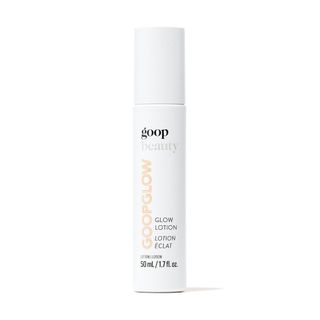
“Why We Love It: Goop Glow Lotion is a fast-absorbing facial moisturizer that works to hydrate and freshen skin for up to 72 hours.”
This product can help improve hydration of the skin with the two types of ingredients.
The first type is called “humectants”:
these ingredients help attract water.
When humectants are on the surface of the skin, they “pull in” the moisture from the outside environment, or from
within deeper layers of the skin. The following ingredients in this product do the job:
glycerin, mannitol.
This product also contains ingredients called “occlusives”. They help reduce the speed with which our skin loses moisture to the outside environment. These ingredients also help soften the upper layer of the skin, so it feels less tight and nicer to the touch. The following ingredients in this product do the job: squalane, helianthus annuus extract.
Evens skin tonePotassium azeloyl diglycinate, Tetrahexyldecyl ascorbateWeak evidence
“This daily face lotion is formulated with spirulina enzyme, vitamin C and kakadu plum to help brighten skin and protect skin against natural aggressors.”
Effective ingredients missing or their concentration is too low
Can it cause trouble?
Irritancy10 strong irritants: Rosmarinus officinalis leaf extract, Citrus aurantifolia oil + 8 more — patch-test recommendedHigh risk
Comedogenic2 ingredients rated 2 or more on the 0–5 pore-clogging scale2 flagged

User reviews
Be the first — your take helps the next person decide.
Ingredients
Filter by role to see what each ingredient is doing.
Water~45–55%
Squalane~5.5–6.7%
- Irritation risk
- Low
An oil naturally present in skin. Works as an emollient to soften the skin and form a protective layer on its surface without a greasy feeling.
More about SqualaneDicaprylyl ether~4.7–5.8%
- Irritation risk
- Low
Helps soften the upper layer of the skin while creating a non-greasy feel on the skin. Helps to dissolve other ingredients
More about Dicaprylyl etherPropanediol~3.1–3.8%
- Irritation risk
- Low
Acts as a solvent for other ingredients. Speeds up the absorption of other ingredients into the skin
More about PropanediolOctyldodecyl myristate~2.5–3%
- Irritation risk
- Low
Helps soften the upper layer of the skin
More about Octyldodecyl myristateGlycerin~2.1–2.6%
- Irritation risk
- Low
One of the best moisturizing ingredients. Naturally present in skin. It attracts water to the upper layer of the skin working as a humectant
More about GlycerinStearyl heptanoate~1.7–2.1%
Mica~1.6–1.9%
- Irritation risk
- Low
Creates an illusion of smoother and more radiant skin tone. Adds shimmer to the skin by reflecting light
More about MicaStearyl alcohol~1.3–1.6%
- Irritation risk
- Low
An emollient that helps soften the skin
More about Stearyl alcoholPolyglyceryl-6 distearate~1–1.3%
- Irritation risk
- Medium
Helps oil and water mix together while softening the upper layer of the skin
More about Polyglyceryl-6 distearateJojoba esters~0.8–1.2%
- Irritation risk
- Medium
An emollient made of jojoba oil. Helps soften the skin and support its barrier function
More about Jojoba estersStearyl caprylate~0.7–1%
- Irritation risk
- Low
Potassium cetyl phosphate~0.65–0.95%
- Irritation risk
- Medium
Helps oil and water mix together
More about Potassium cetyl phosphateTetrahexyldecyl ascorbate~0.55–0.85%
- Irritation risk
- Medium
Being a lipid soluble form of vitamin C, it is more stable than ascorbic acid, but still degrades quickly and needs to be stabilized in a formulation with another ingredient. It is claimed to penetrate skin better than pure vitamin C and have the the similar benefits, but solid studies of its effectiveness are lacking. Is likely to require a higher concentration in a product than pure vitamin C to be effective. It might be able to help reduce pore clogging.
More about Tetrahexyldecyl ascorbateSpirulina maxima extract~0.55–0.8%
- Irritation risk
- Low
- Comedogenicity
- 3/5
Terminalia ferdinandiana fruit extract~0.55–0.8%
- Irritation risk
- Medium
A plant extract that might have some anti-oxidant effect in skin, but evidence is lacking
More about Terminalia ferdinandiana fruit extractAnadenanthera colubrina bark extract~0.5–0.75%
- Irritation risk
- Low
Ergothioneine~0.5–0.75%
- Irritation risk
- Low
Can help neutralize free radicals in skin. Preliminary studies show that it can be more effective than coenzyme Q10 but studies on effective concentration for topical applications are lacking
More about ErgothioneinePotassium azeloyl diglycinate~0.45–0.7%
- Irritation risk
- Low
A derivative of azelaic acid. It is obtained by reacting the chloride of azelaic acid with two molecules of glycine (an amino acid) and potassium hydroxide. It is less studied than azelaic acid, but the available research suggests that it also can be effective in reducing skin redness, hyperpigmentation and blemishes. There are claims that it is more bio-available and more effective than azelaic acid, but no comparison study is available. Potassium azeloyl diglycinate is better soluble in water compared with azelaic acid. Because of this property, products with potassium azeloyl digclycinate can have a nicer texture
More about Potassium azeloyl diglycinateOryza sativa bran extract~0.45–0.65%
Rosmarinus officinalis leaf extract~0.35–0.65%
- Irritation risk
- High
Can be helpful in reducing inflammation in skin, including inflamed acne. It can be irritating
More about Rosmarinus officinalis leaf extractHelianthus annuus extract~0.45–0.65%
- Irritation risk
- Low
Helps soften the upper layer of the skin
More about Helianthus annuus extractHelianthus annuus seed wax~0.4–0.65%
- Irritation risk
- Low
Helps soften the upper layer of the skin and support skin's barrier function while creating a thicker product consistency
More about Helianthus annuus seed waxAcacia decurrens flower wax~0.35–0.65%
Citrus aurantifolia oil~0.4–0.6%
- Irritation risk
- High
Citrus nobilis oil~0.35–0.65%
- Irritation risk
- High
Citrus aurantium dulcis peel oil~0.35–0.6%
- Irritation risk
- High
An essentil oil from orange peel. Potential allergen and can be irritating
More about Citrus aurantium dulcis peel oilLavandula hybrida oil~0.4–0.6%
- Irritation risk
- High
Plant extract that can be irritating and is a known allergen
More about Lavandula hybrida oilVetiveria zizanoides root oil~0.3–0.6%
- Irritation risk
- Low
Citrus limon peel oil~0.3–0.6%
Mannitol~0.35–0.6%
- Irritation risk
- Low
Helps to attract water to the upper layer of the skin
More about MannitolLecithin~0.45–0.65%
- Irritation risk
- Low
Used mostly for creating emulsions - helping oil and water mix together. Helps soften the upper layer of the skin
More about LecithinSucrose~0.3–0.6%
- Irritation risk
- Low
Can help attract water to the upper layer of the skin. In crystal form, it can work as a gentle exfoliant, gentler than the salt scrub. Helps stabilize the emulsion
More about SucrosePolyglyceryl-3 beeswax~0.4–0.65%
- Irritation risk
- Medium
Helps water and oil mix together. Could be an allergen (beeswax)
More about Polyglyceryl-3 beeswaxCetyl alcohol~0.45–0.65%
- Irritation risk
- Low
A non-drying alcohol that works to soften the skin and stabilize product formulations helping oil and water mix together
More about Cetyl alcoholPolyglycerin-3~0.4–0.6%
- Irritation risk
- Low
Helps to attract water to the upper layer of the skin
More about Polyglycerin-3Potassium chloride~0.4–0.6%
- Irritation risk
- Low
Tocopherol~0.35–0.65%
- Irritation risk
- Low
Pure form of vitamin E. Can help moisturise and protect the skin from free radicals. Often used to help stabilise other ingredients or the formula itself
More about TocopherolXanthan gum~0.35–0.65%
- Irritation risk
- Low
Used to create a thicker product consistency
More about Xanthan gumMicrocrystalline cellulose~0.4–0.6%
Cellulose gum~0.35–0.6%
- Irritation risk
- Low
Used to create thicker product consistency and stabilize emulsions
More about Cellulose gumCaprylyl glycol~0.35–0.65%
- Irritation risk
- Medium
Helps preserve products and creates a nice product texture
More about Caprylyl glycolEthylhexylglycerin~0.3–0.6%
Caprylhydroxamic acid~0.3–0.55%
Benzyl alcohol~0.25–0.45%
- Irritation risk
- High
A preservative. Can be used to mask unpleasant smell. Can be irritating
More about Benzyl alcoholPotassium sorbate~0.25–0.45%
Phenoxyethanol~0.2–0.4%
- Irritation risk
- Low
A preservative. It helps prevent bacterial growth in cosmetic products
More about PhenoxyethanolChlorphenesin~0.15–0.25%
Citric acid~0.15–0.3%
- Irritation risk
- Medium
Can work as an exfoliant but is typically used to adjust the product pH
More about Citric acidCitral~0.15–0.3%
Citronellol~0.15–0.25%
Limonene~0.1–0.15%
- Irritation risk
- High
A common frangrance that can easily irritate skin, especially if exposed to air, light or heat
More about LimoneneLinalool~0.1–0.15%
Ingredient list view
Water, Squalane, Dicaprylyl ether, Propanediol, Octyldodecyl myristate, Glycerin, Stearyl heptanoate, Mica, Stearyl alcohol, Polyglyceryl-6 distearate, Jojoba esters, Stearyl caprylate, Potassium cetyl phosphate, Tetrahexyldecyl ascorbate, Spirulina maxima extract, Terminalia ferdinandiana fruit extract, Anadenanthera colubrina bark extract, Ergothioneine, Potassium azeloyl diglycinate, Oryza sativa bran extract, Rosmarinus officinalis leaf extract, Helianthus annuus extract, Helianthus annuus seed wax, Acacia decurrens flower wax, Citrus aurantifolia oil, Citrus nobilis oil, Citrus aurantium dulcis peel oil, Lavandula hybrida oil, Vetiveria zizanoides root oil, Citrus limon peel oil, Mannitol, Lecithin, Sucrose, Polyglyceryl-3 beeswax, Cetyl alcohol, Polyglycerin-3, Potassium chloride, Tocopherol, Xanthan gum, Microcrystalline cellulose, Cellulose gum, Caprylyl glycol, Ethylhexylglycerin, Caprylhydroxamic acid, Benzyl alcohol, Potassium sorbate, Phenoxyethanol, Chlorphenesin, Citric acid, Citral, Citronellol, Limonene, Linalool
Compare prices
Retailers ranked by price — lowest first.
Affiliate links · prices updated regularly · As an Amazon Associate, WIMJ earns from qualifying purchases.
Worth comparing, line by line.
Match % combines shared ingredients, the first five ingredients, shared actives and hero ingredients, irritancy (lower counts in the alternative's favour), texture and body area. Only products in the same routine step are compared.
| goopGlow LotionYOUR PRODUCT | SkinTraLet Your Skin Drink Up - hydrating face cream | Temple skincareTMPL Hydrating Face Moisturiser | Skincare by Dr VTrio Blemish AM Gel Moisturiser | |
|---|---|---|---|---|
| Match | — | 68% | 66% | 66% |
| Price | — | — | — | $50.73 |
| Shared key ingredients | — | 2 of 13 | 2 of 13 | 2 of 13 |
| Key difference | — | Niacinamide | Niacinamide | Niacinamide |
| Irritancy | High | Low | Low | Medium |
| Drying alcohol | — | — | — | — |
| View product | Shop | Shop | Shop |


Sources cited in this review
Every concentration estimate and effectiveness label is anchored to one of these 18 studies and safety reviews.
- 1
- 2
- 3
- 4
- 5A comparison of the relative antioxidant potency of L‐ergothioneine and idebenoneonlinelibrary.wiley.com
- 6

Affiliate links · As an Amazon Associate, WIMJ earns from qualifying purchases.